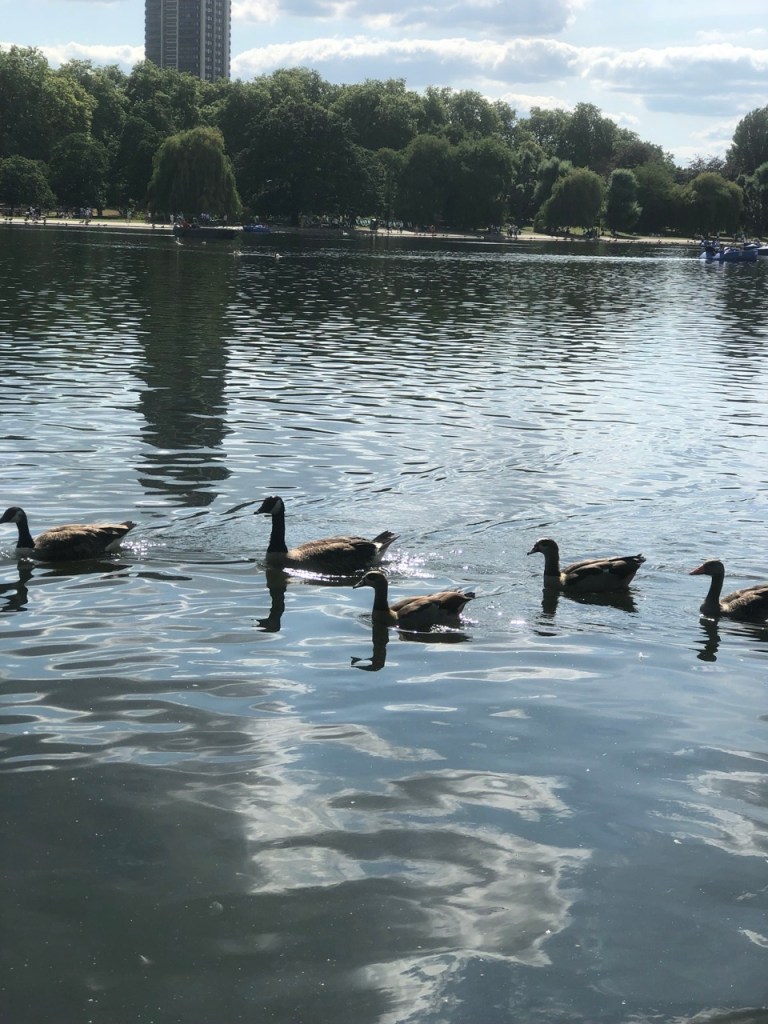
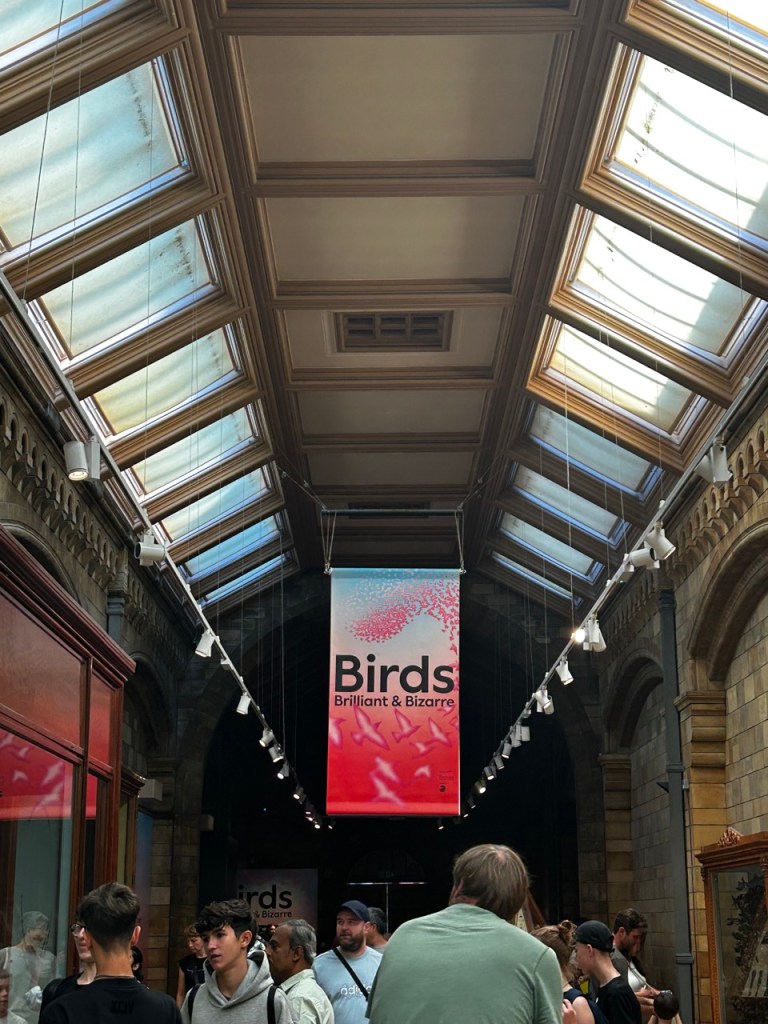
Hyde Park is a patch of green among the greys of city life, a wonderful space in the heart of the English capital. The Serpentine Lake, so named for its snake form, slithers through its heart, populated by birds and pleasure boats alike. A popular spot with the inhabitants of London, the lightly wooded grass is coated in family picnic blankets and different attires, creating a patchwork quilt of colour and pattern. We were at Hyde Park for an afternoon visit, before the next morning’s outing to the Natural History Museum, for Birds: Brilliant and Bizarre. If you want to read about that special exhibition, head over here. For now, enjoy the birds we found there.
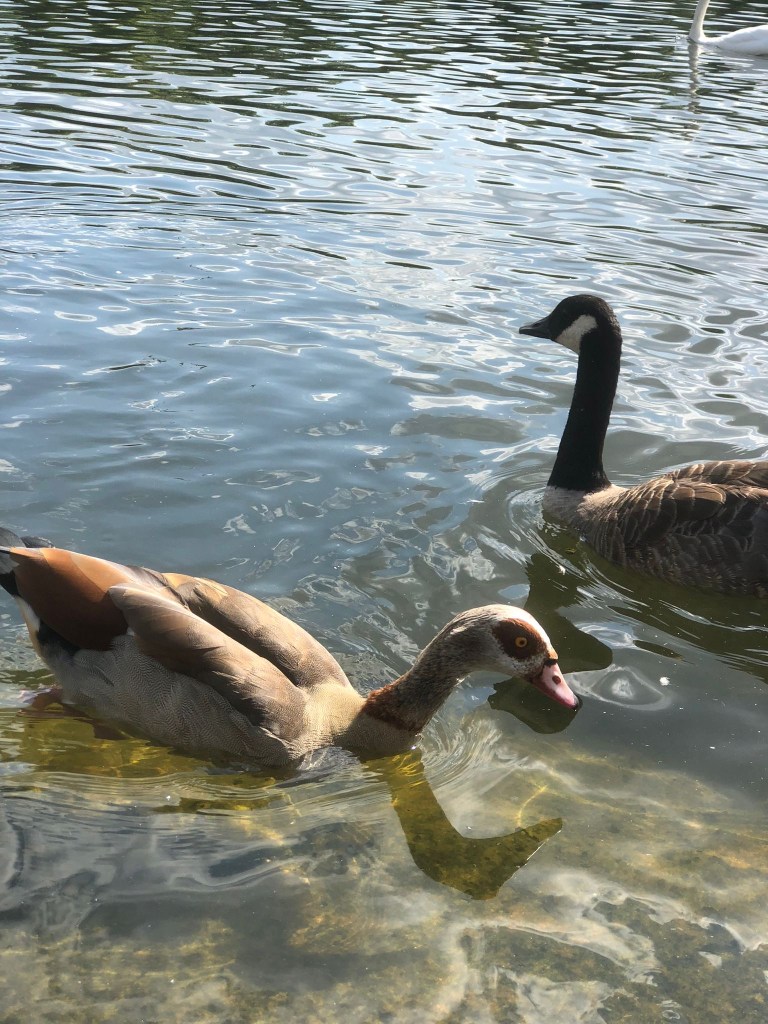
Egyptian Goose (front) and Canada Goose (behind)
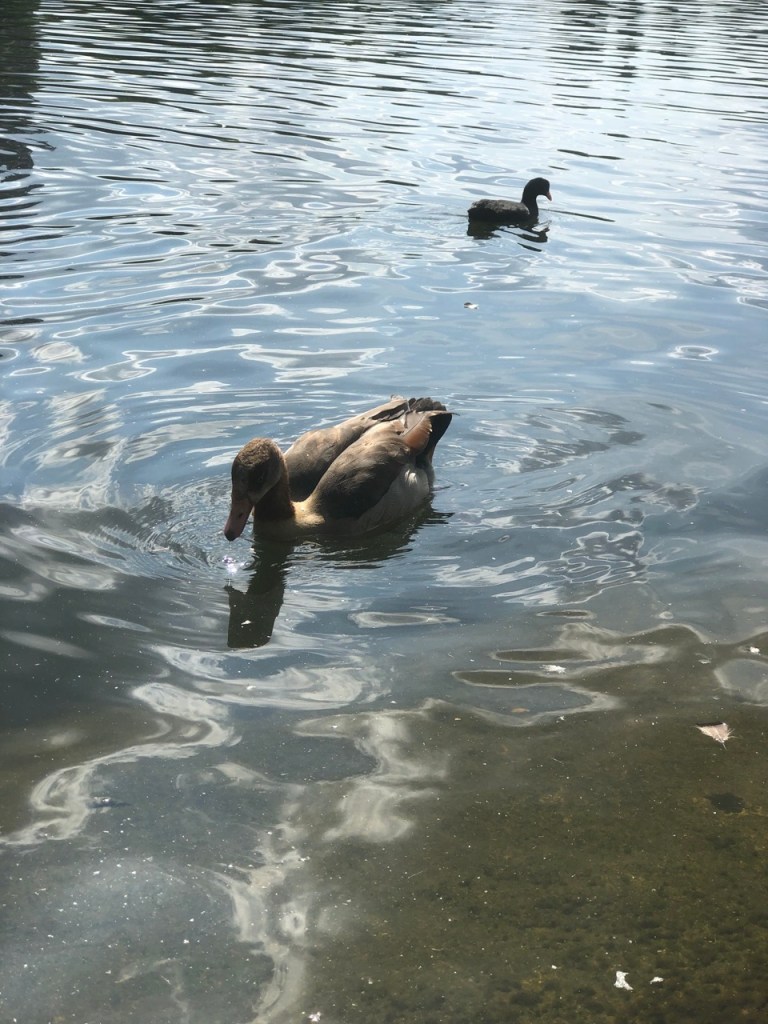
The Egyptian Goose was the first lifer I’ve had in a while, and there were several interspersed with the other geese, Canadas and Greylags. Except, there’s a catch; they’re not actually Geese. They’re really members of the Shelduck sub-family, Tadorninae, but they don’t want you to know that. Their native land is Africa, in the Nile Valley and from south of the Sahara onwards, but they were introduced to Britain and Europe to be kept in zoological collections, and to confuse the crowds at urban lakes like the Serpentine. They did, of course, escape and start to breed in the wild. They’re now at their most common in the south-east of England, but their populations extend across the south of the country.
Egyptian Goose
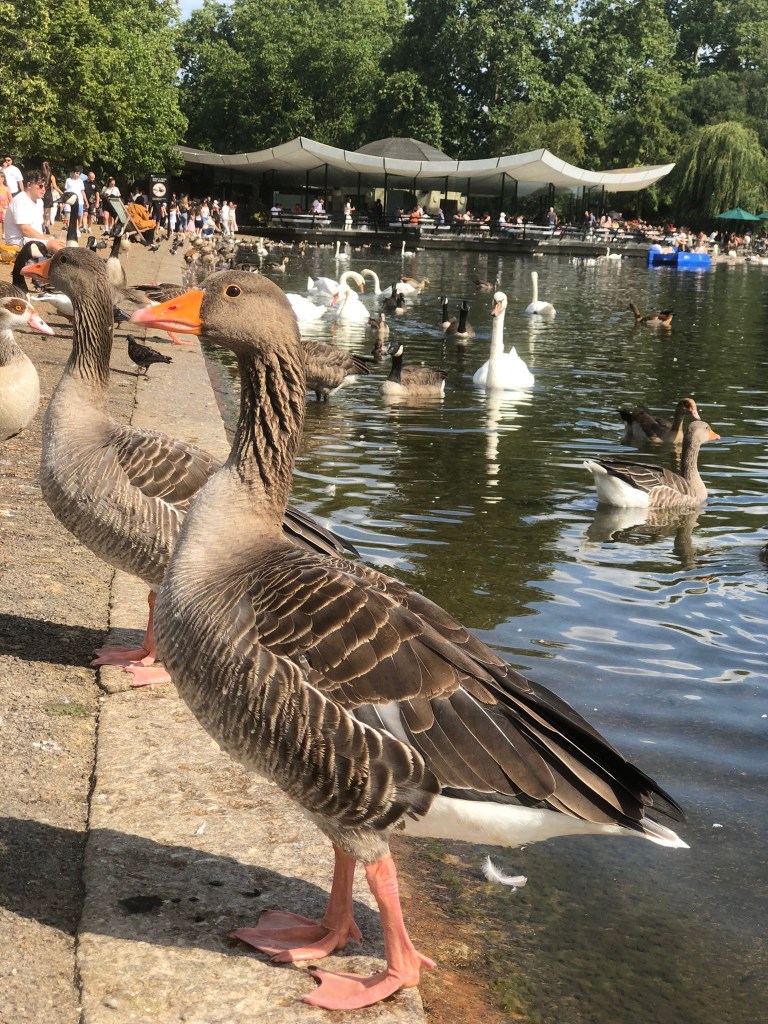
Alongside the Egyptian Geese (or should it be Egyptian Shelducks?) swam scores of Greylag Geese, a common sight across much of the UK. They are like your typical imagined goose, one of the basics of wildfowl watching in Britain, and the ancestor of many domesticated geese. But much of their population is introduced and released, and the small wild population in the south has been greatly supplemented by the arrival of these identical birds that are so different in practise. Its essentially impossible to tell the difference, and to see truly wild Greylags I highly recommend the wintering flocks in Scotland. They are some of the few in Britain to still hold a truly wild essence.
Greylag Goose.
A common cooperator with the Greylags, the resident Canada Geese numbers almost reached the heights of the above species – the key word there is ALMOST. Unlike the Greylags, these birds have never been native to the UK, or the rest of Europe for that matter. They are originally North American, but are now widespread here after being introduced, as well as to several other nations including France, Sweden, Denmark, New Zealand, Japan and Argentina. Did you know groups of geese have several different collective nouns? When on the ground they are known as a gaggle, in flight a skein or a wedge, and when flying close together they are often known as a plump!
The Canadas are on the left.
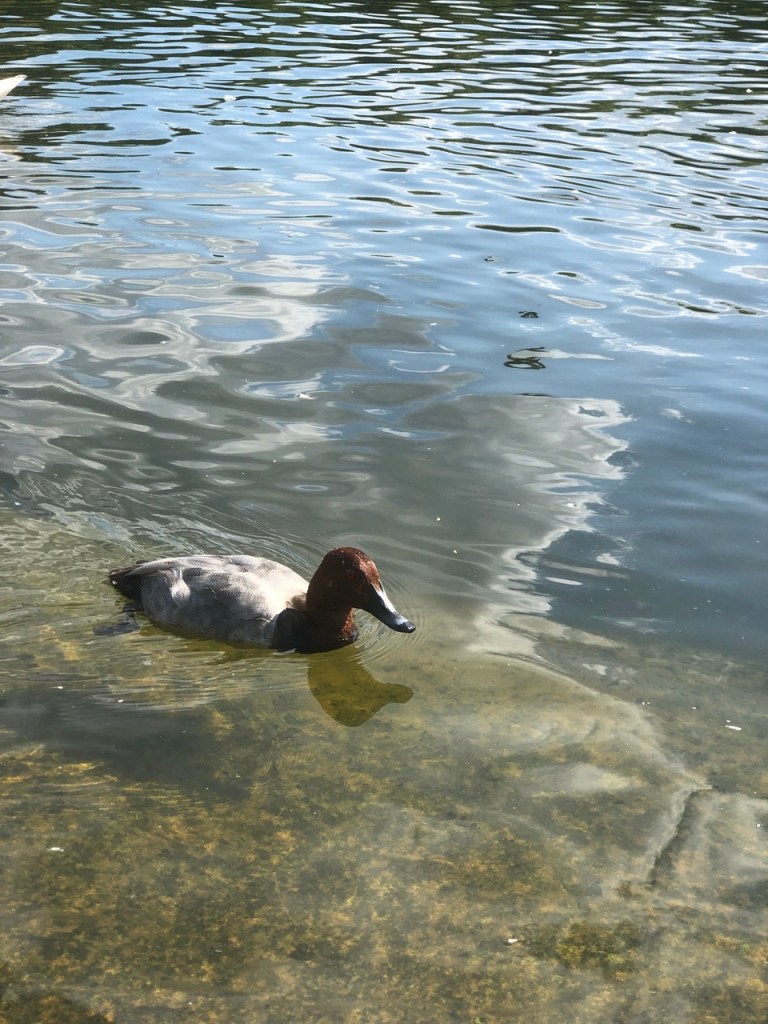
Moving on from our three geese, although it should really be two, we come to a bird I honestly didn’t expect to find here. The Common Pochard is an elegant gangster, with its rusty red hood pulled up over its face. It swims among the geese flock undetected, and when the time is right it strikes! No, I’m just kidding, it doesn’t strike anything, except waterweed and invertebrates. The Pochard is a diving duck, and is a scarce breeding bird in the UK, with around 700 pairs thought to nest here. The Common Pochard is listed as Vulnerable by the IUCN, the stage before endangered. Our breeding population is important, and we must work to protect it.
A Common Pochard
Its cousin by name, the Red Crested Pochard was introduced to the UK, and has now become an established breeding bird, thriving in urban lakes and parks. The Cotswold Water Park is this plump duck’s main stronghold, and counts reach their highest in winter, when an average of 600 birds are here. One of these birds was sat before us, nestled on the still water beneath the low hanging boughs of a willow on an island in the centre of the Serpentine. In the right light, this bird’s apparently huge head seems to glow. When you catch one at sunset, its quite a special sight.
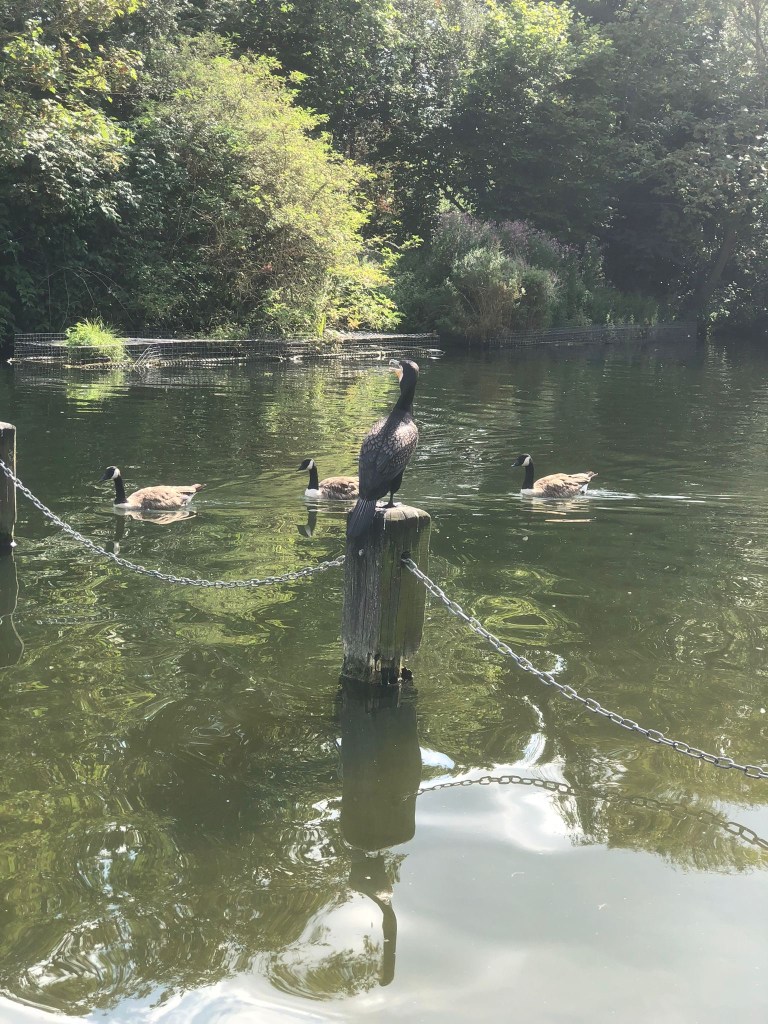
Just metres from us flew in a Great Cormorant, landing on a partly submerged post within touching distance from the bank where we stood. Cormorants are fairly common on our shores, and more are starting to move inland from the coast. They are one of the avian world’s best fishers, streamlined and rapid underwater, as well as being able to gulp down huge fish. But their one evolutionary flaw is that their glossy feathers are not even waterproof, forcing the bird after every dive to sit out of the water and allow its outstretched wings to dry in the sun! This bird’s plumage was glorious, beautifully scaled and shiny. It had either gone through moult already, or was yet to undertake the transformation that all birds face. At this time of year, they’ll often lay low and grow completely new feathers, a gruelling process.
Cormorant
The Cormorant dived, and left us face to face with a Grey Heron, dagger like bill and snake-like neck poised. It stood stock-still, eyeing us up without moving a muscle. It quickly lost interest in us though, and went back to its search for sustenance. Like the Cormorant, its fish, but it will take frogs, eels and chicks of surrounding birds. Grey Herons are the largest member of the heron family, and their special technique for fish-munching is tossing their terrified prey into the air, and catching them head-first, sliding into darkness. This prevents the fish’s tail or scales catching in its throat.
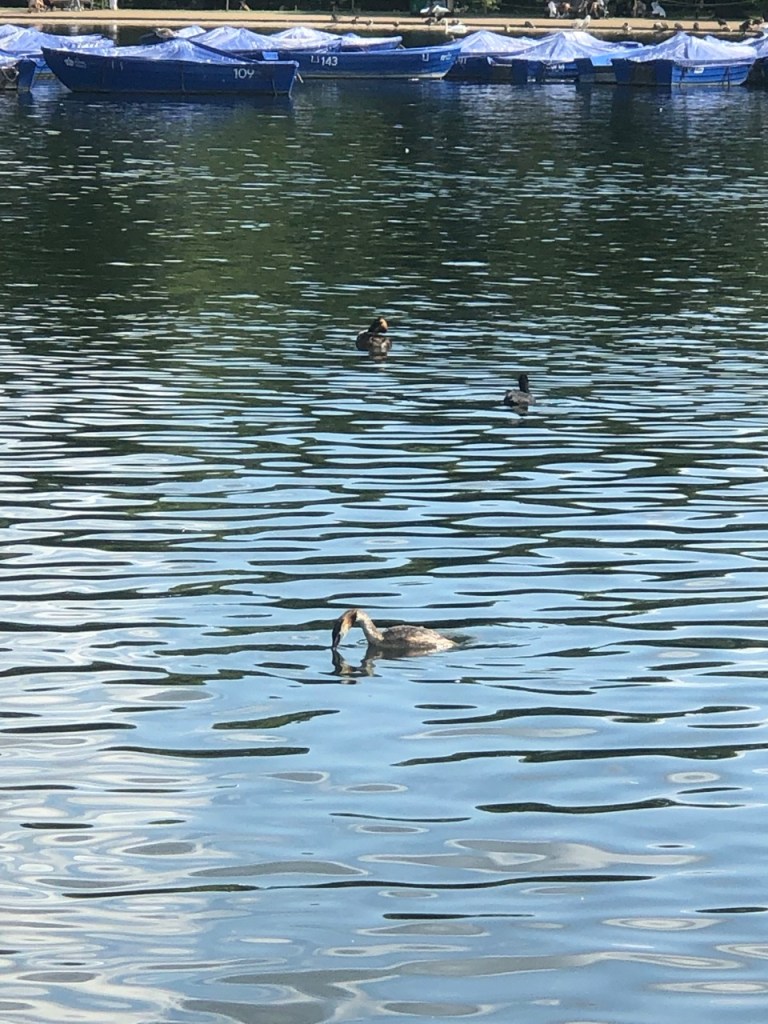
By the way, you might want to remember a part of the Heron’s diet, namely bird chicks. Because guess what? A pair of beautifully plumaged Great Crested Grebes sat on a nest nearby, encouraging several tiny striped babies into the water! I bet you’re scared for their live now! But it was incredibly late in the season to have such young offspring, and it really took me by surprise. Maybe their first brood had failed, and they’d had to start over? Anyway, these birds were once hunted for their fabulous crests, and were one of the most affected victims of the plumage trade. The formation of the RSPB changed that all, and their protests forced the government to pass the Importation of Plumage Prohibition Act, back in 1921. To read more about that, you can either check out my Birds: Brilliant and Bizarre blog here or head up to the Natural History Museum to see the exhibit for yourself! I promise you won’t be disappointed!
And drumroll please for our final pair of birds… two red billed rails called Moorhens, clearly interested in each other. It may have been courtship, or it may have been a display of dominance, but both upended their rear ends, their bodies following suits while keeping their head, neck and breast flat across the top of the water. The noises that followed were similar their common bubbling call, but seemed more like a vibration, a whirr. It was really cool to watch! And did you know that a Moorhen’s seemingly nervous flirting of its tail are actually a nervous tic?
Hyde Park is more of a birding site than meets the eye, and brilliant nature sites are actually dotted all over London. From Hampstead Heath to RSPB Rainham Marshes, the capital is full of birdlife. This buzzing, historical city is home to a lot more biodiversity than an outsider looking in may think, and from Short Eared Owls to Water Voles, its a home for so many of our native species.
This weekend’s journey to London had began with a birdy purpose. That purpose was to visit the Natural History Museum’s new exhibit – ‘Birds: Brilliant and Bizarre’. The Museum has partnered with the RSPB to create an unforgettable experience, its main aim to showcase how amazing our natural world is. Both adjectives mentioned in the title are flawlessly fulfilled, with both organisations working hard to produce a masterpiece that demonstrates how we can help our feathered friends, because at the moment we are on track to lose these natural wonders. It is an exhibit that is immersive, inclusive and with something for everyone. I was also really excited to see some of Elle Kaye’s taxidermy work, as I’d met her at Birdfair and some of her pieces were on display here. Welcome to Birds: Brilliant and Bizarre.
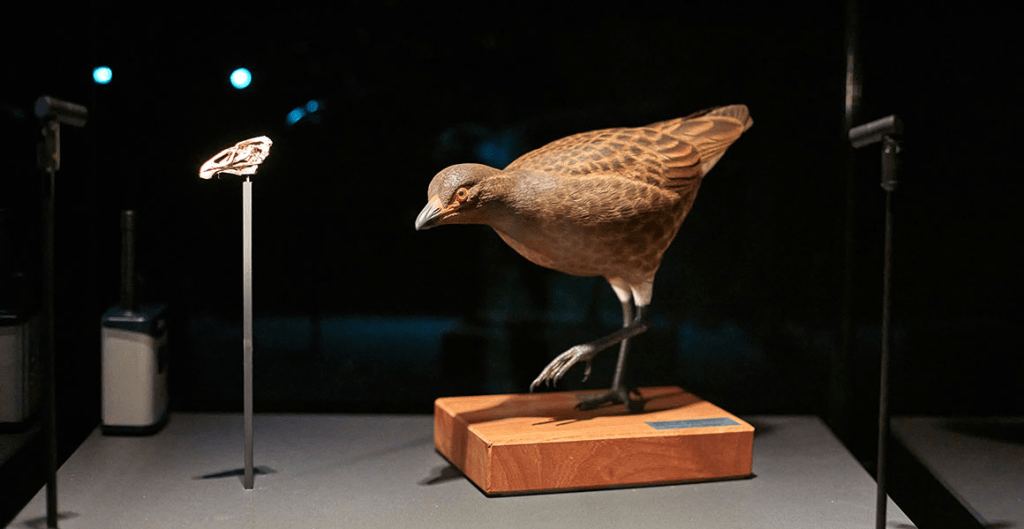
As we walked into the first few rooms, the theme was immediately apparent. The dawn of the birds, via dinosaurs, evolution and a reptile we call Archaeopteryx, led to the 11,000 species we know today. This is brilliantly illustrated by the creature nicknamed ‘Wonderchicken’, a fossil dated to 67 million years ago, that is currently the oldest known modern bird. It and a small gang of specialists survived the great extinction episode of 66 million years ago, simply due to the fact that they could adapt to their new surroundings faster than their dinosaur counterparts. Wonderchicken formed the foundation of modern bird species today, and why they are so successful across the globe.
Through evolution came what possibly characterises a bird to most people, apart from flight of course. Their ability to create such an array of songs, calls and alarms. Songs are usually reserved for courtship, and play special parts in a bird’s life. As we wound our way through the exhibit, we came across many of these romantic songsters. Most birds have approximately 175 different muscles, the largest of which is the pectorals, which controls the wings. But a bird’s syrinx is located at the bottom of their trachea, instead of the vocal folds of mammals. The syrinx is the vocal organ of birds, and their sound resonates from deep inside their body, creating the powerful yet beautiful sounds that emanate from a bird’s beak. Did you know that some birds even sing to their eggs? Superb Fairywren mothers teach the embryos inside their eggs a one-note vocal ‘password’, which they have to incorporate into their begging calls to get fed. Thus far, these birds have learnt to combat brood parasites like Cuckoos, for if an egg is laid in the nest late and doesn’t get to learn the password, the chick won’t get fed. Incredible!
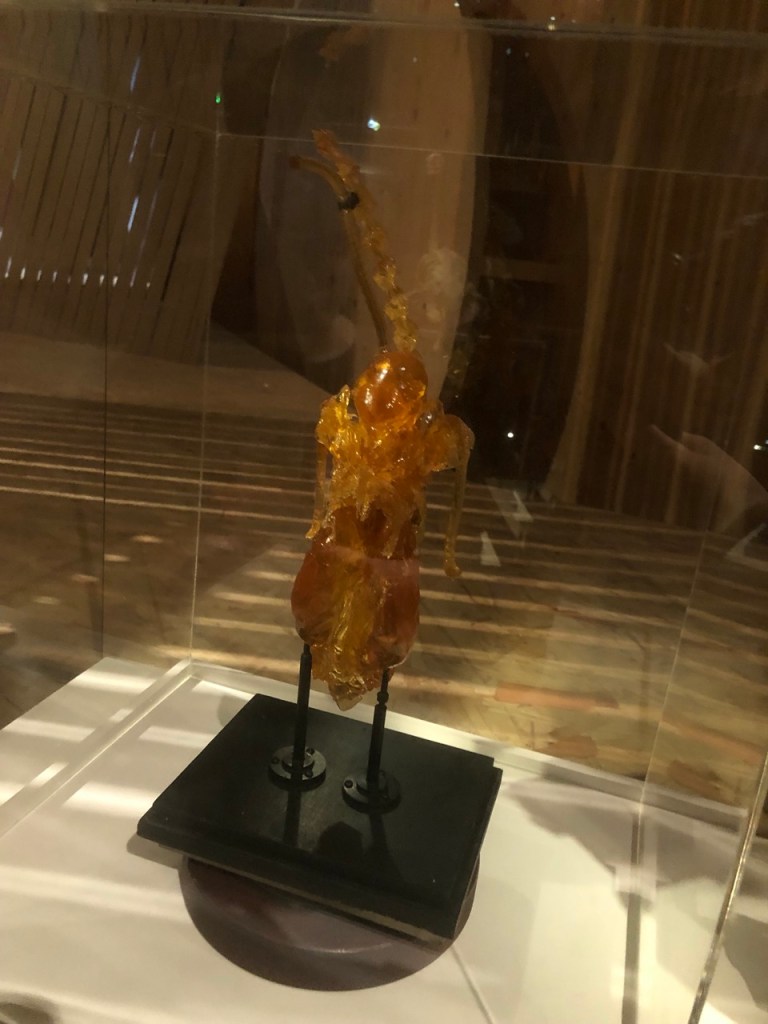
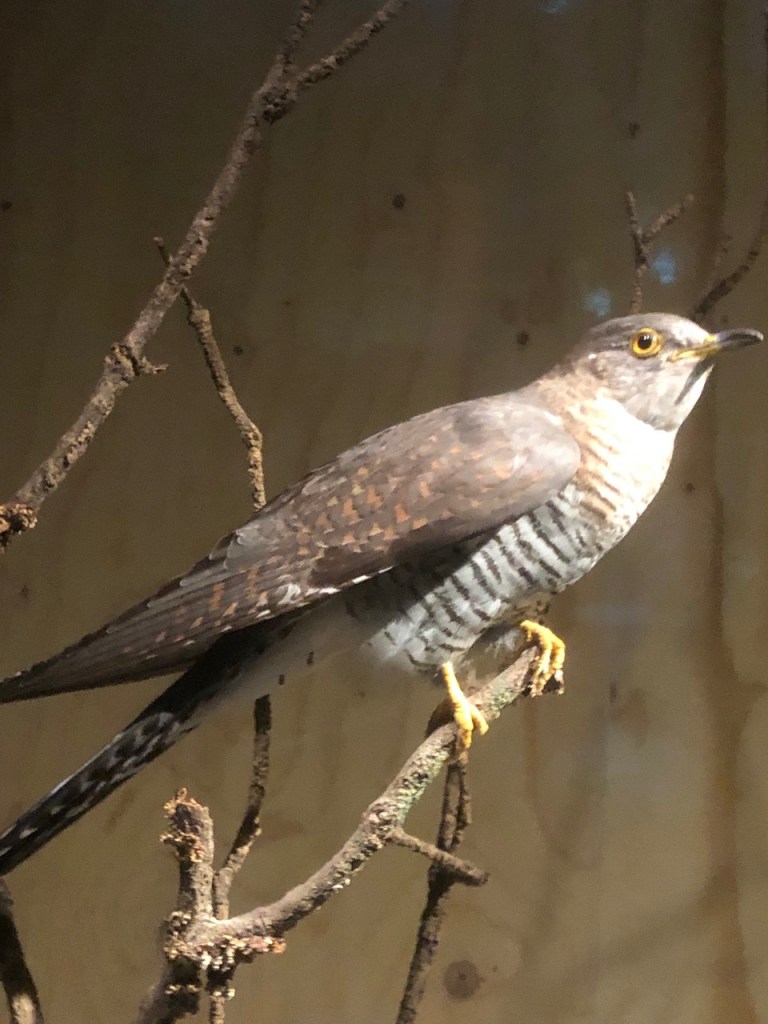
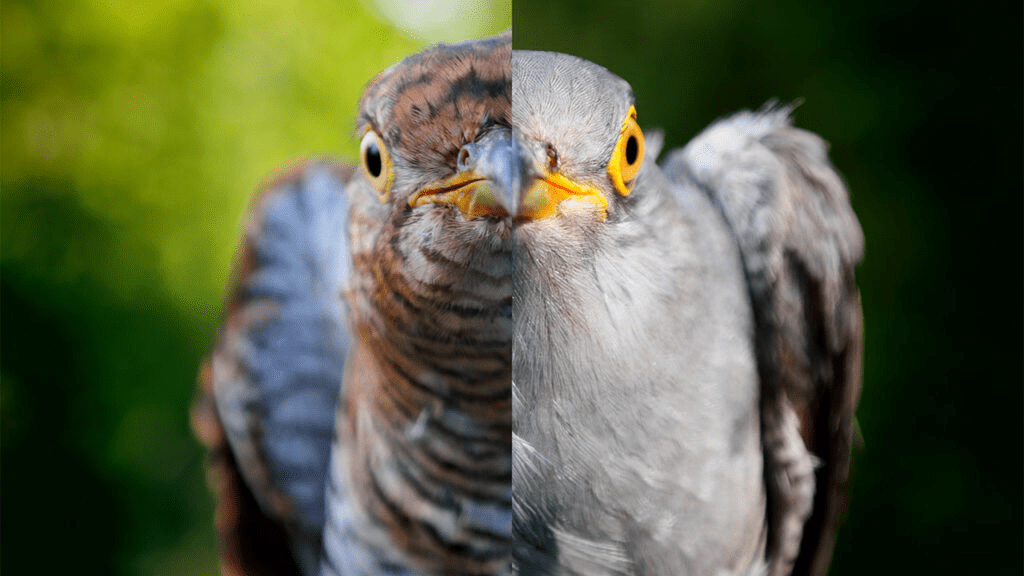
Resin cast of a Mallard’s breathing sacs.Common Cuckoo
And so we move onto one of those subjects that is lesser known. Learning time people! Today’s subject is mimicry in birds. The Superb Lyrebird is one of the world’s largest songbirds, and would make a great secret agent for its disguise skills. It can mimic almost anything it is exposed to. A car alarm, a crying baby, a creaking door. You name it, it could quite easily come out of this bird’s syrinx. One of the interactive features of this part of the exhibit was a rather tricky quiz. You would be given ten sounds, and you had to identify whether the sound was made by a Lyrebird or the actual source (I have to admit, I did get 10/10).
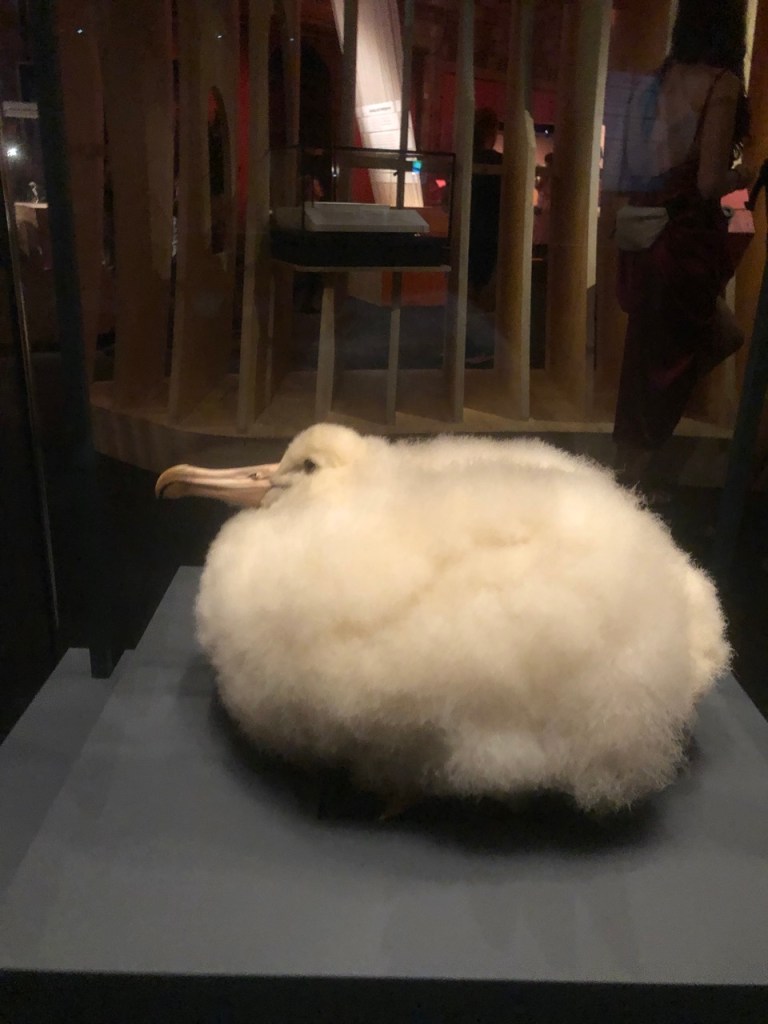
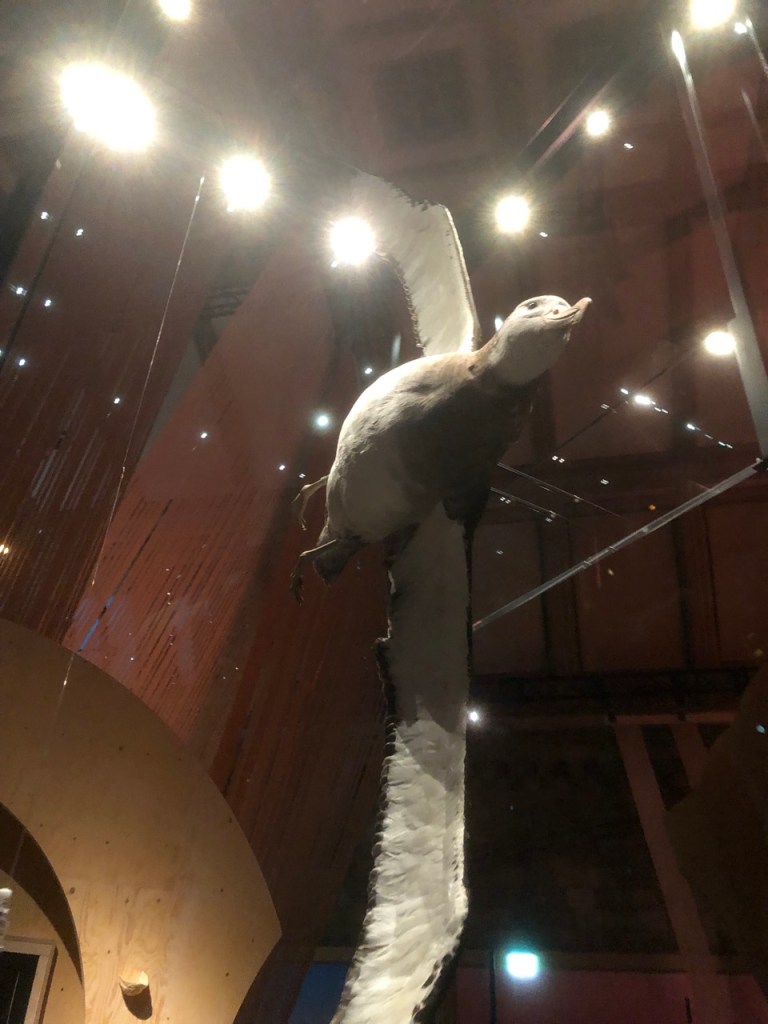
Continuing the romantics side of things, we now move onto breeding. In the centre of the room sits an albatross chick, huge and fluffy and genuinely cute. Above it flies its mother, with a wingspan certainly taller than me! Albatrosses generally have a wingspan of 8-11 ft, and considering I stand just above 5ft, they really are huge compared to my height! A bitter story in the next case shows just how deadly our actions can be. The Guam Flycatcher was, unsurprisingly, an endemic species living on Guam. Here’s the catch; it had very little in the way of natural predators. So when humans accidentally introduced Brown Tree Snakes to the island the little birds were defenceless. Eggs, chicks and adults disappeared into these animals, and to this day Guam is still full of these slithering skulkers, and no flycatchers.
Invasive species have the capacity to not only wipe out single species, but to reduce biodiversity by a large chunk through competition. Some invaders do it rapidly, like the Brown Tree Snakes. And this is due to the fact that we have found a way to take evolution and adaptation out of the equation. Us introducing these invasive species leaves very little time for the native ones to evolve and adapt to their new predators or competition. That means they can very quickly go extinct as in the case of the Guam Flycatcher.
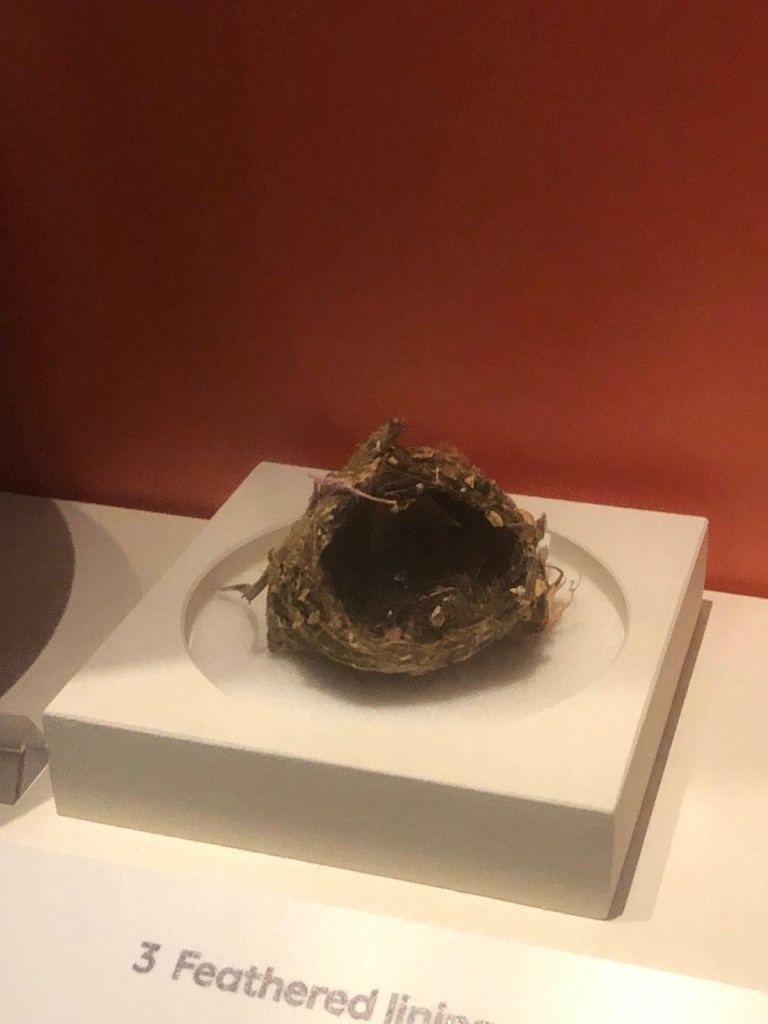
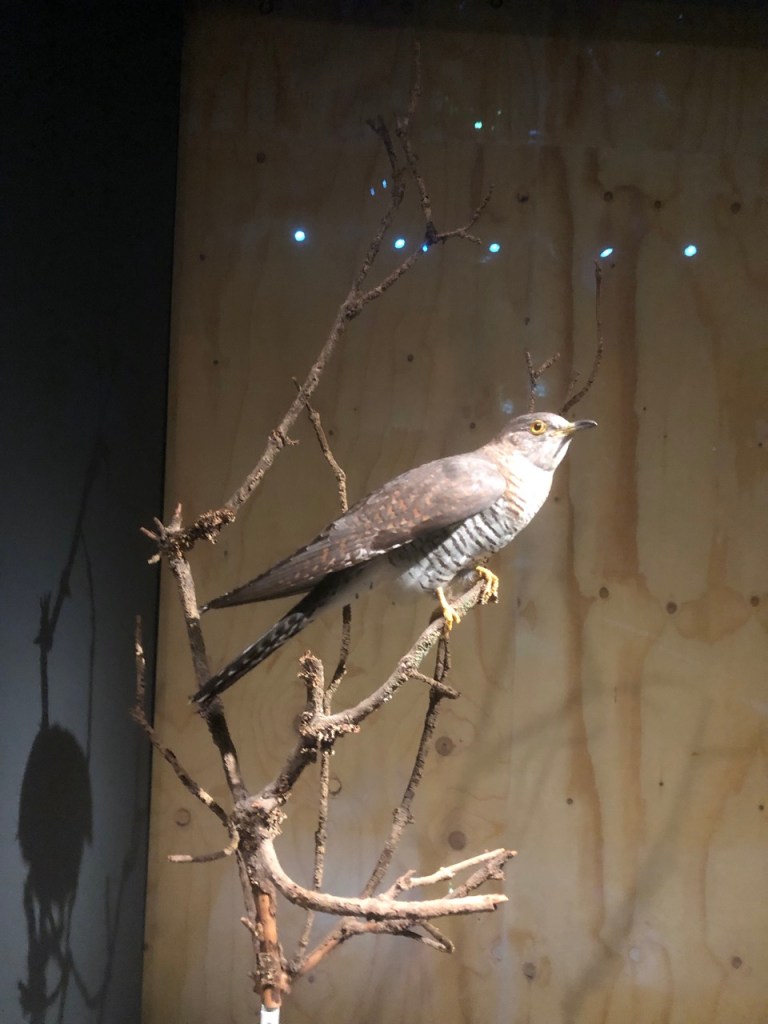
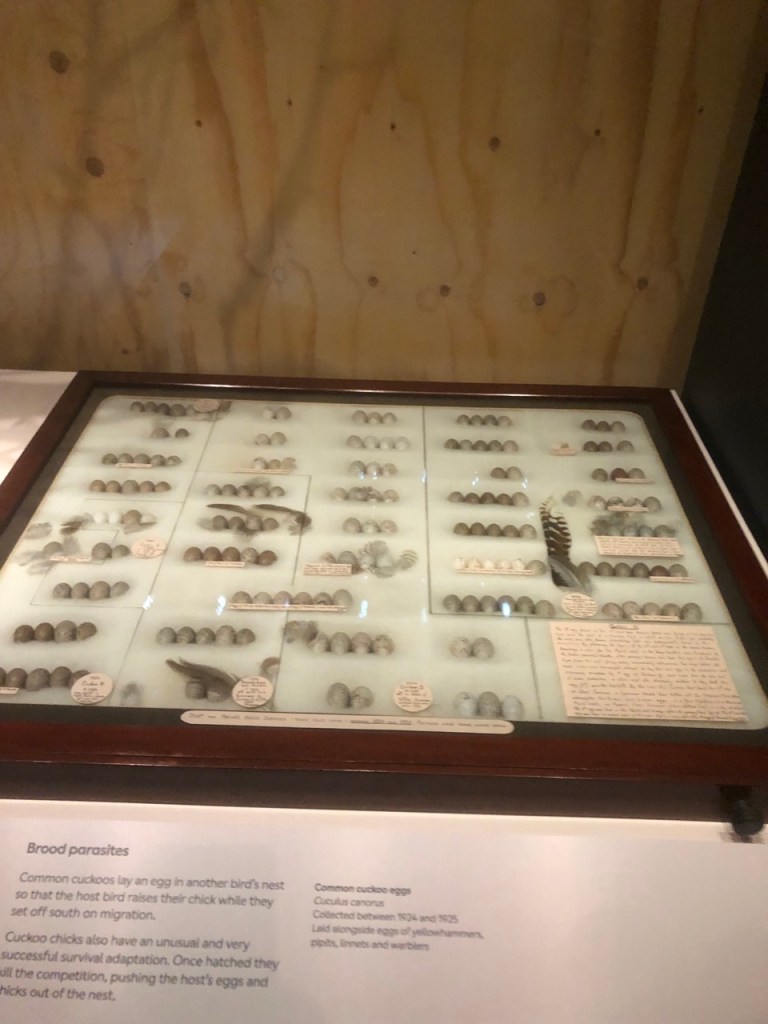
The Cuckoo case sat opposite us, featuring a Common Cuckoo perched in a leafless tree, and row upon row of labelled eggs. A brood parasite that lays its eggs in the nest of other birds, the Cuckoo referenced here was a certain Flappy McFlapperson, a satellite tagged bird that had been named by schoolchildren in China, who tracked the Cuckoo’s journey from Mongolia to South-East Asia. Flappy captured the world’s gaze and held it, but he isn’t the only Cuckoo to be satellite tagged. In fact, there are hundreds that have been tracked across the globe in an effort to learn more about their migration routes, and why they are declining so fast. Organisations like the BTO have run these projects in a bid to understand what’s behind these declines, and a lot of their data is made public through their website. I’ve learnt a fair bit about these birds from the maps, like the fact that European Cuckoos take several routes through Africa, and the threats they may face depend on the route they take. For example, if a bird flies across the Sahara it might die of heat and exhaustion, but if a bird skirts it, they’re more likely to succumb to illegal hunting.
Cuckoo!Eggs and feathers.
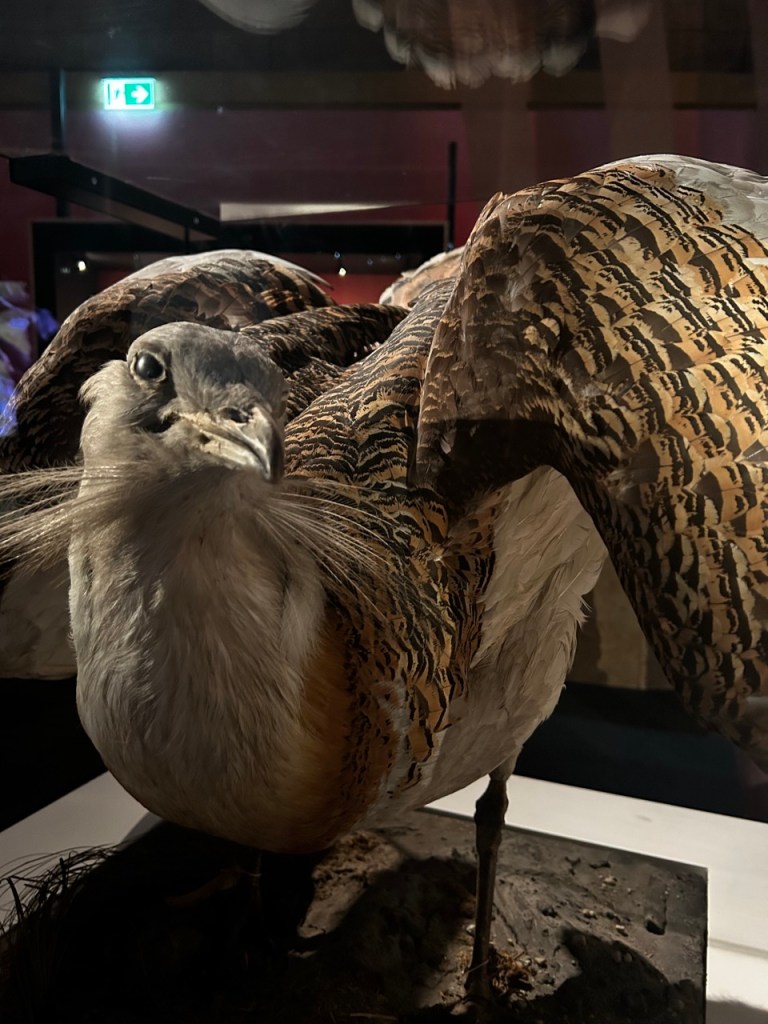
As we walked on, a displaying Great Bustard sat in the case before us, flanked by an adjacent Ruff lek. A Great Bustard’s display is known as a ‘foam bath’, when it tucks its head under its wings and exposes it’s white inner feathers, with this display beloved by females. There is a reintroduced population on Salisbury Plain, as the birds ceased to breed in Britain in 1832. It hasn’t been plain-sailing for the world’s largest flying bird here, having taken them four years to begin breeding, but the population is currently at a healthy 100 birds, and the Great Bustard Group is doing everything they can to restore this bird to its former glory. They are huge, majestic birds and their appearance hands them a certain wisdom. In the years to come, let’s hope their display comes to be a common sight across the country.
The Ruffs meanwhile, have several different morphs which the males put to good use on their display grounds. Morphs happen when birds of the same species regularly develop different colours and plumages. There are three male Ruff morphs; independent morphs aggressively defend a territory to impress the females, and Satellites build alliances with them. 1% of Ruffs are the rare Faeder males, that look and behave just like females. They can avoid any form of conflict, and sneak in to fertilise the ladies under the radar of their loud, cocky counterparts.
Great Bustard
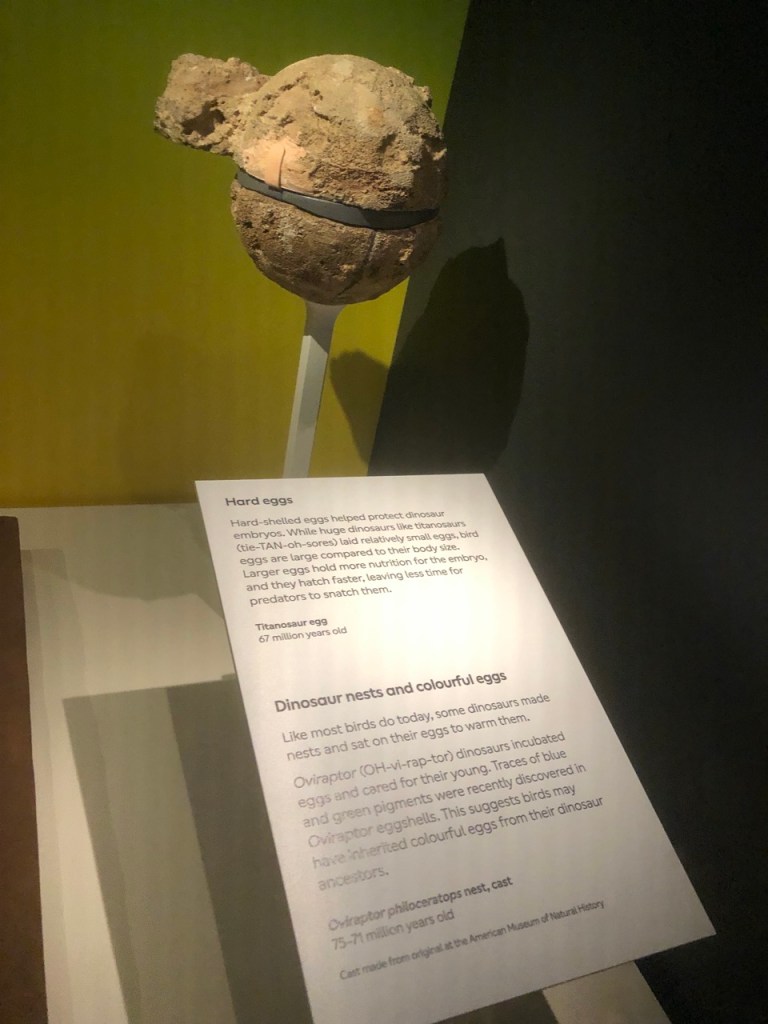
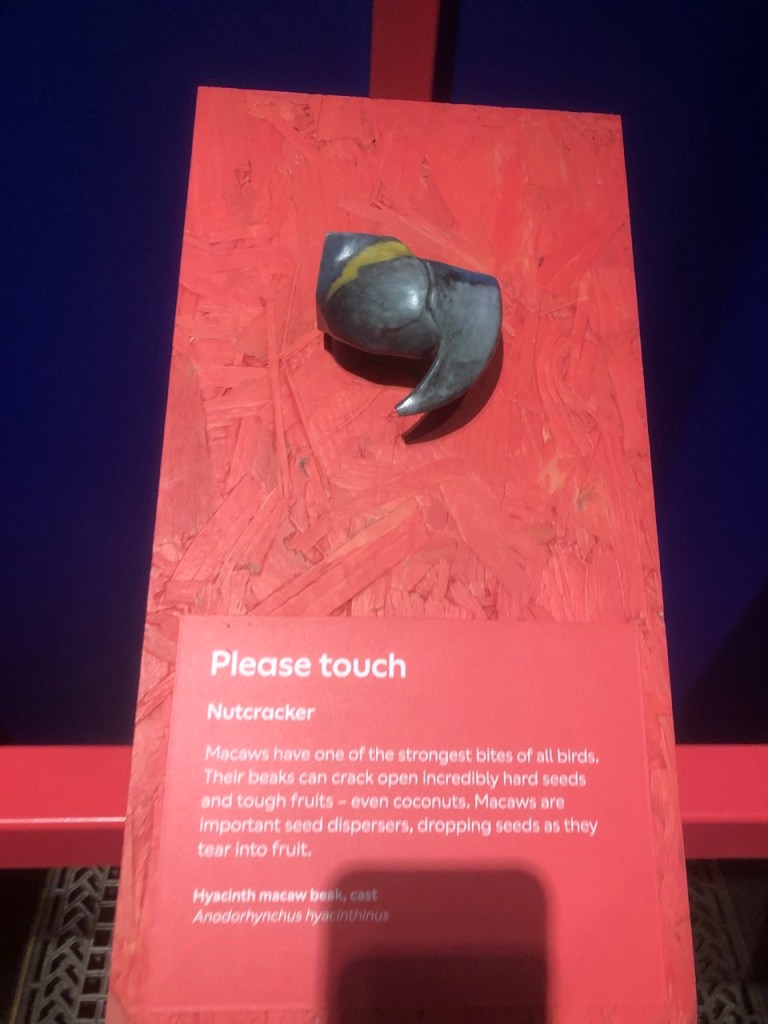
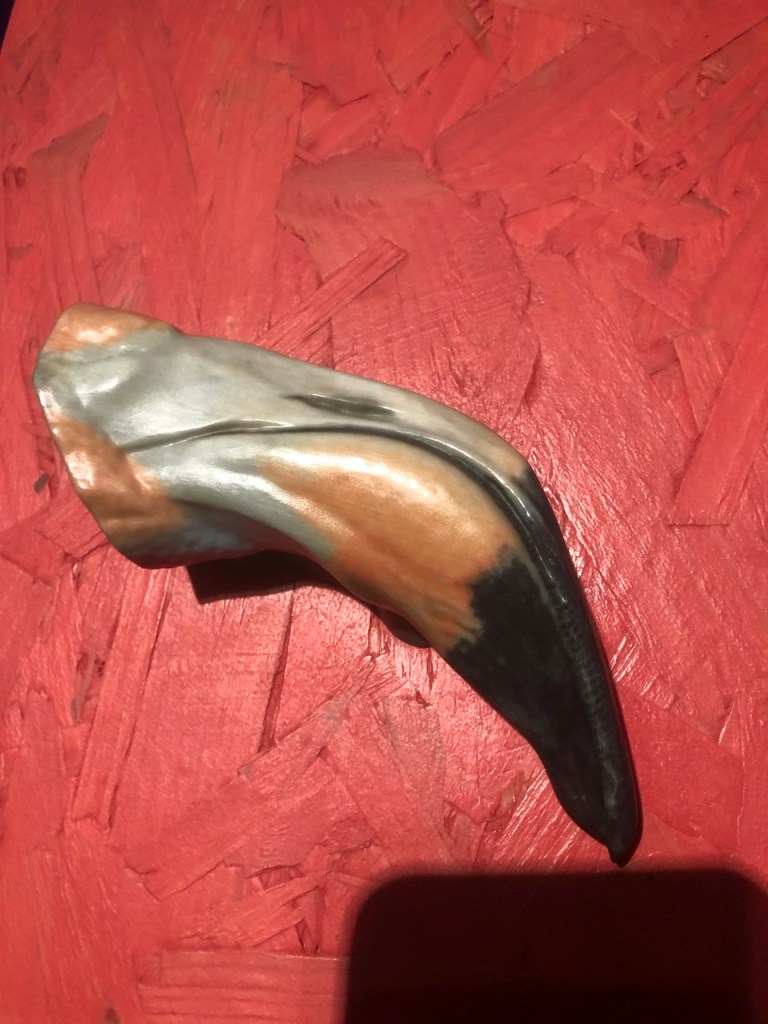
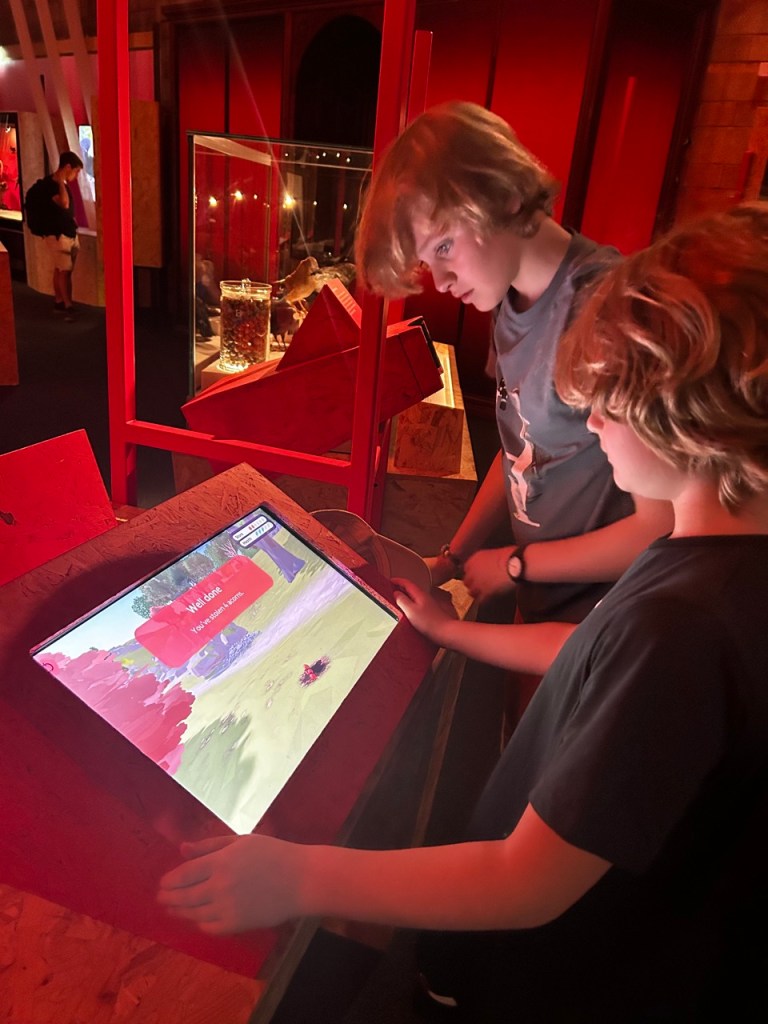
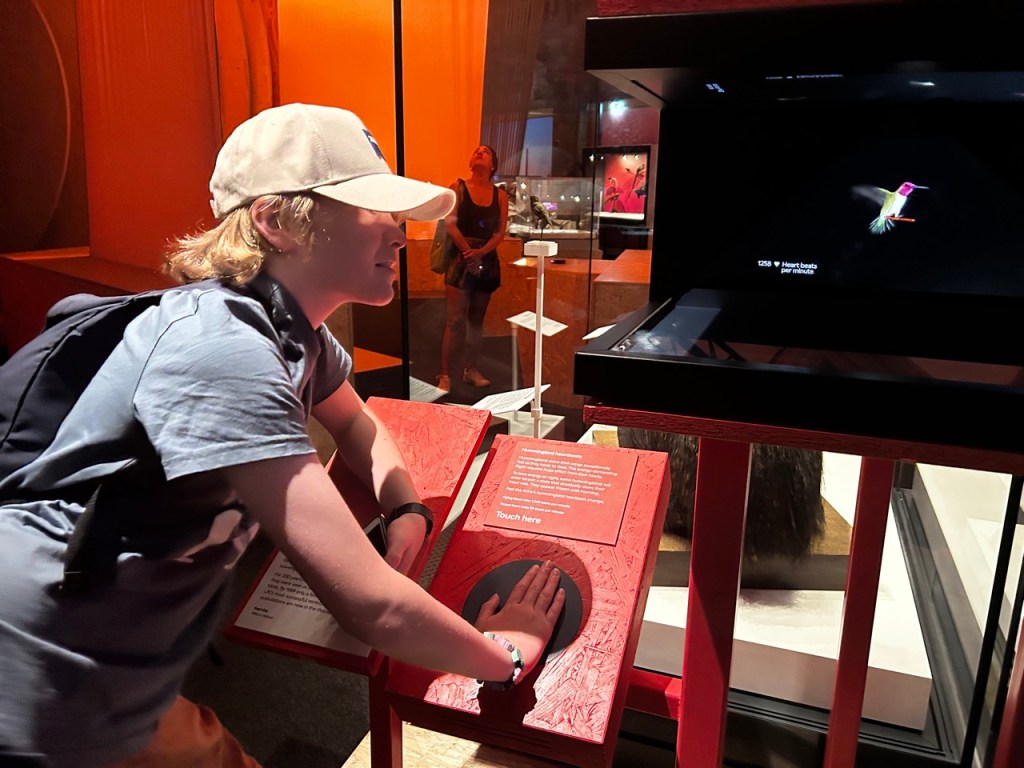
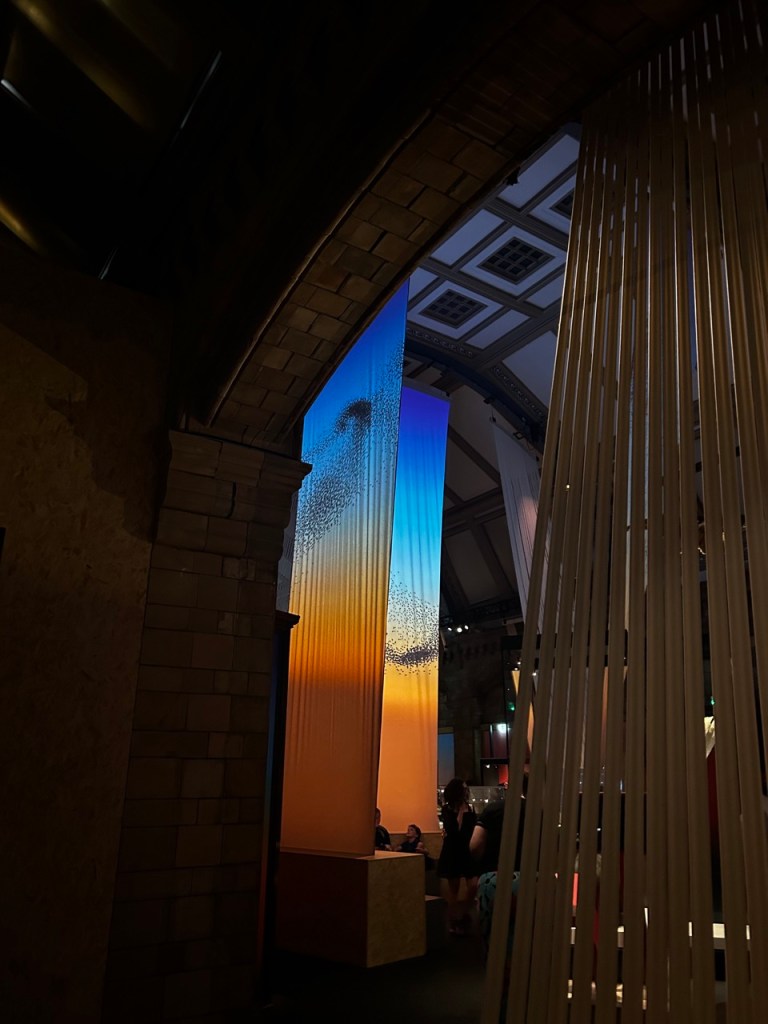
One of the best things about the exhibit was the interactivity that went alongside these amazing avian abilities. You could sit and be surrounded by a starling murmuration, awaiting a Peregrine Falcon’s arrival as the mesmerising birds swirl and twirl around you. A computer game simulated a Jay’s year, and anybody who attempted it had to try and survive from Spring through to Winter, by hiding acorns, stealing them and having to remember where you hid them! You can touch amazingly realistic models of dinosaur eggs, different bird beaks and bones. You can smell Hoopoe preen oil, or seabird guano. You can see as many birds would, through ultraviolet light, and you can watch as Hungarian Great Tits munch on bat brains, and witness a Vampire Ground Finch, one of Darwin’s finches on the Galapagos Islands, fashion a nasty wound in the back of a Blue Footed Booby in order to drink its blood. Inclusive and immersive for all, that’s what makes this exhibit special. The atmosphere of birdsong, the lighting and everything else makes this a masterpiece.
Feel the beaks!The Jay GameDid I mention you can feel a Hummingbird’s heartbeat?Starling Murmurations are a true wonder of our natural world,
I haven’t even mentioned the Honeyguides yet! These birds prefer to work with tribes and honey-hunters to find and access bees’ nests, and the arrangement benefits them both. When looking for honey, a person calls to attract a Honeyguide. Honeyguides in one area get to know the calls of the people it works with regularly, and the birds are less likely to respond to a foreign call. Once summoned, the Honeyguide will lead a person to where it knows there is a bee’s nest, with loud chattering calls. On arrival, the people use smoke to remove the honey, and share the wax with the birds. Win win!
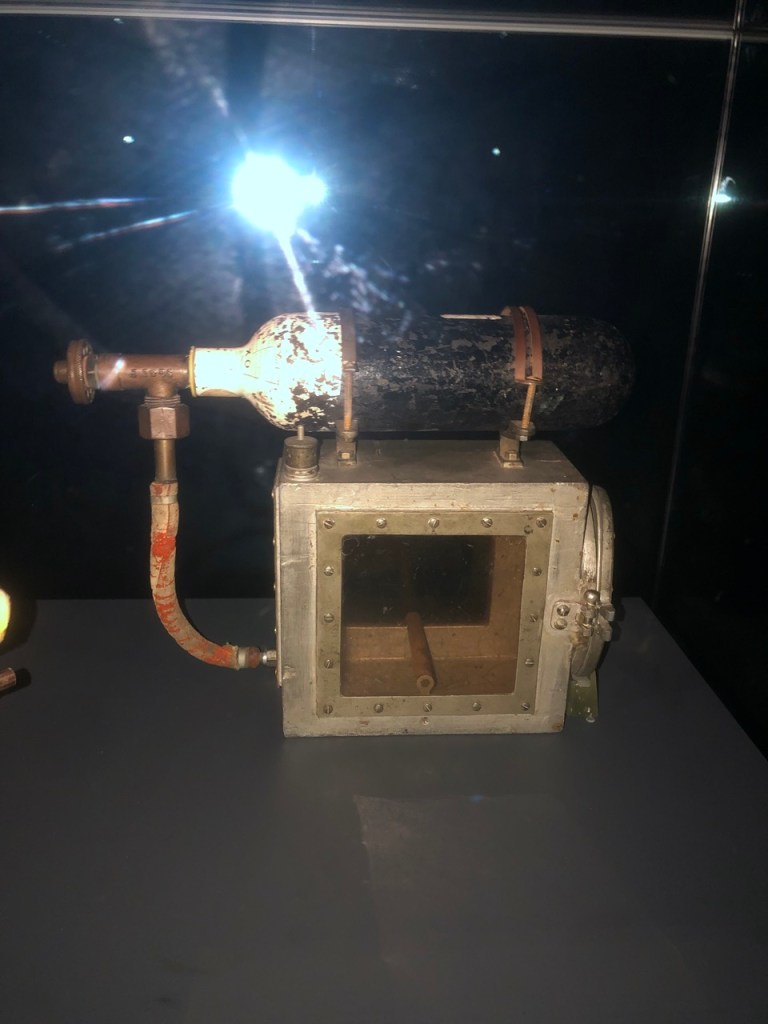
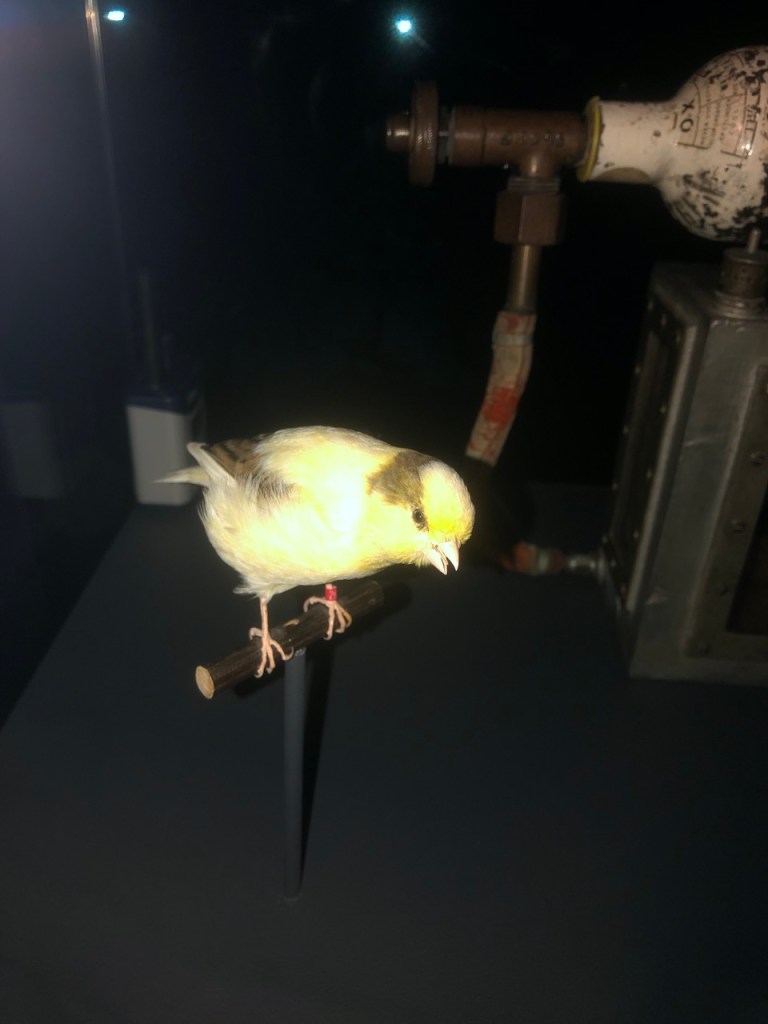
The penultimate room was slightly darkened, and an intriguing contraption sat in a case off to my right. An old canary cage, taken down into the mines as a precaution. If the canary stopped singing, there was toxic gas in the air, and the miners knew to get out. An oxygen pump on top revived the canary if it fell unconscious. We needed those birds, and in captivity, those birds needed us.
A miner’s canary cageBrave birds!
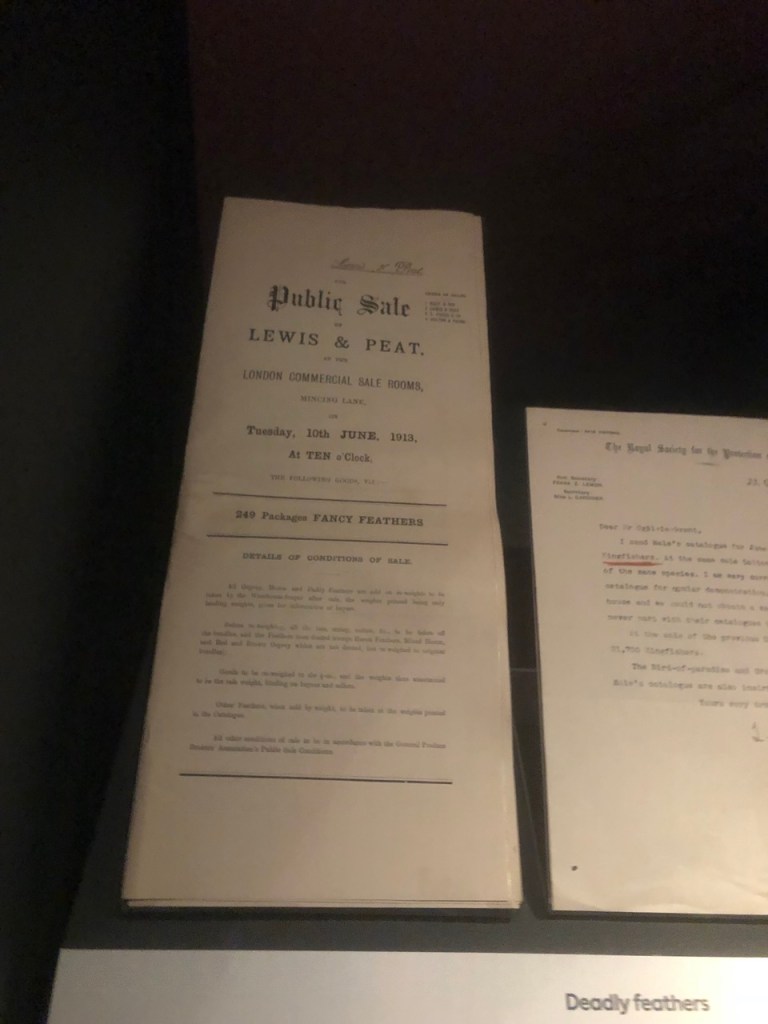
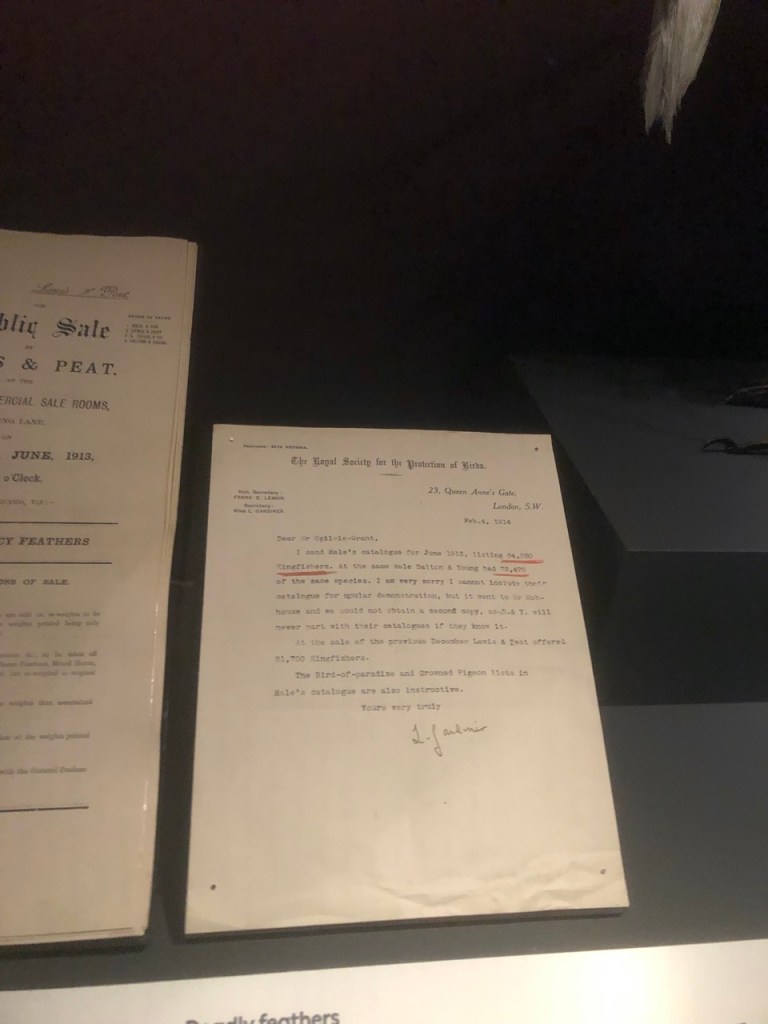
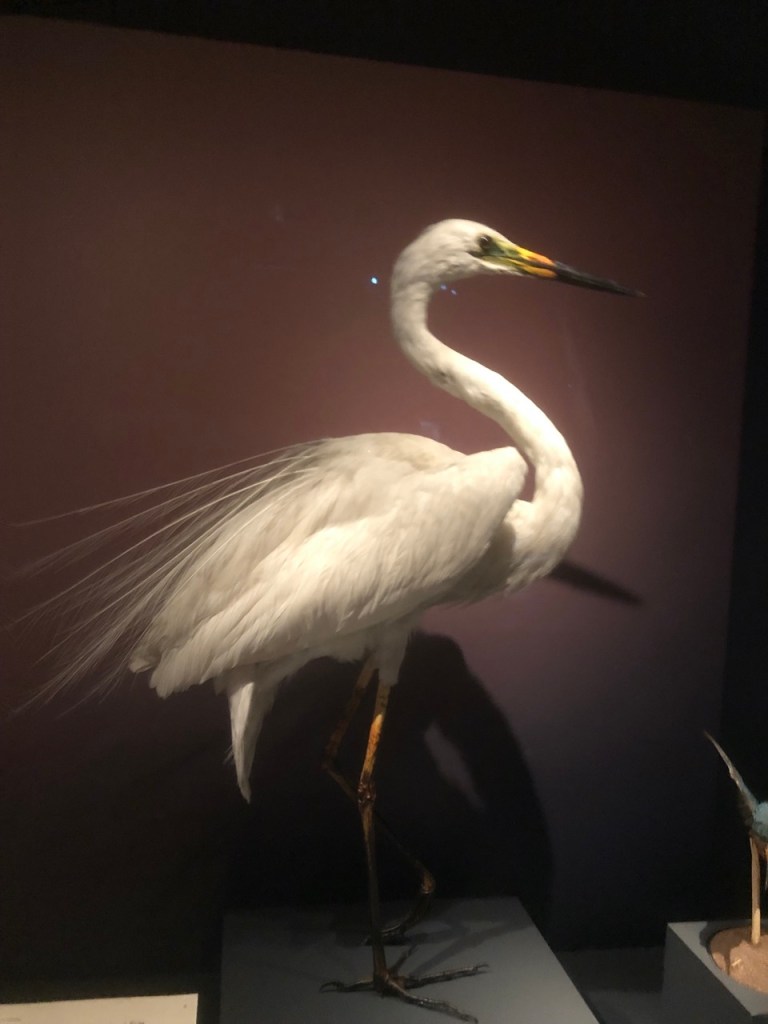
The RSPB was formed in 1889, when Emily Williamson founded the Society for the Protection of Birds, in order to wage war against the plumage trade. Fashion had been driving birds like Little Egrets and Great Crested Grebes towards extinction, for the simply daft reason of having a pretty feather in your hat, or in some cases a whole bird. The all-women movement received a Royal Charter in 1904, completing the full acronym and making them the Royal Society for the Protection of Birds. By 1921, the Importation of Plumage Prohibition Act was passed, and that was the RSPB’s lift-off. The exhibit featured documents, headrests and hats all highlighted in this gruelling campaign that ultimately culminated in a victory for nature.
The documents are on display in the exhibit.An EgretAnother of the RSPB’s successful projects.
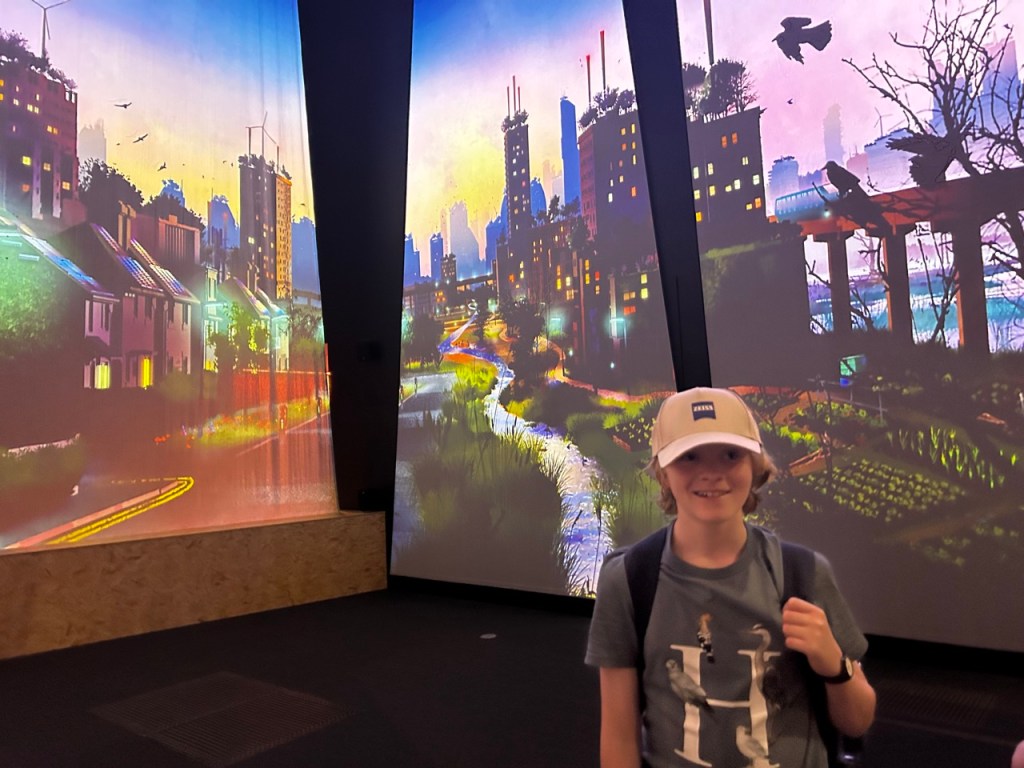
To reach the exit, you had to pass through a vision for the future. By 2050, if the government listen and everybody takes action, our country could be full of birds and nature. The UK is one of the most nature-depleted countries in the world, but we can change that. The immersive experience in this final room shows it. Wind turbines and solar panels on the roofs of buildings, as well as trees and entire farms. Rivers surrounded not by concrete, but by patches of woodland and meadows. White Tailed Eagles, powerhouses currently restricted to parts of Scotland, roam the city skies once more.
This and the other birds of prey whose numbers have been restored will counteract overgrazing, and keep numbers of animals like rabbits down. Kestrels and Owls will prevent large numbers of mice, rats and voles, and Hobbies will eat the plentiful insects. Who needs pest control when you’ve got these guys on the case? It may not be time just yet to reintroduce wolves and lynx, but if our raptor populations are strong then they can do a good job at keeping prey numbers and overgrazing to consistent levels.
And most importantly, everywhere is teeming with insect and pollinator life, allowing our rooftop farms and wildflower meadows to thrive, and don’t forget the birds have a plentiful food source now! Its perfectly possible, if people stop underestimating the threats to our natural world. If we start making changes for the good of the planet and our biodiversity. Its perfectly possible. If everybody, from the government to the young people of Britain, takes action. Perfectly possible.
Think about London. There’s the Thames, a huge river that runs through the centre. But did you know that there’s a River Fleet that runs beneath Fleet Street? London once had many rivers, teeming with life. But in the name of modernisation, these 12 rivers were forced underground, their size and flow greatly reduced, and became nothing more than sewers, teeming with waste instead of the life they once supported. If we could clean these rivers up, and reveal them once again to the city of London, surely that would be a huge step in the right direction to cleaning up our cities. And if we want to reach Net Zero by 2050, we’d better start now.
The message behind this exhibit is that birds and nature need our help. Awareness is key to that, and the more people who know about the wonders of the natural world and how we need to save it, the better our chances will be against the great beast that looms ever closer on the horizon; Climate Change. If we can restore our biodiversity to its former glory, we can stop this. We need to learn to live alongside nature, not push it away into the far corners of the globe. So, despite what I said earlier, there are two messages behind this exhibit. One of beauty and wonder, and another of a call to arms. To win the fight for our planet. And to save nature, so that it shall never need to be saved again.
Most people will never have given a seconds thought to Peat Bogs, or perhaps even know what they are. Until very recently I was one of those people, however a days hard work with the Dartmoor Youth Rangers has opened my eyes to their importance, and how vital it is that we protect and restore them!
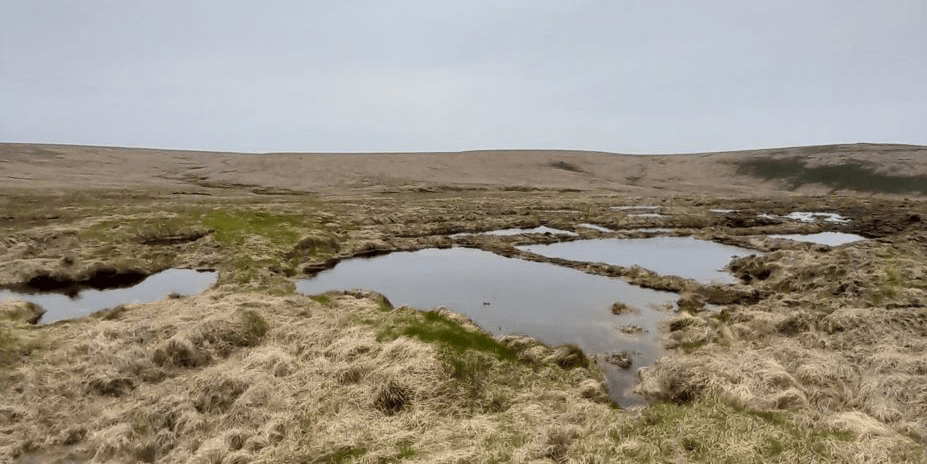
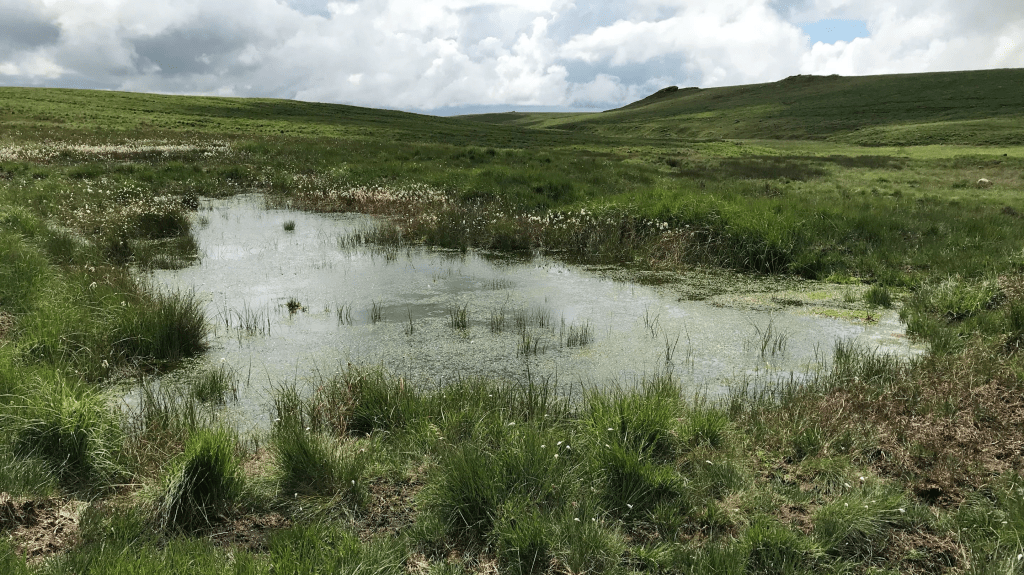
A peat bog is a dense mass of partially decayed vegetation. Both the bog’s acidity and its waterlogged wetland form stop the vegetation, on Dartmoor mainly sphagnum moss, from fully decaying and decomposing when it dies. Instead of this, over thousands of years it builds up to create what we know as peat. On Dartmoor, the layer of peat can be up to nine metres deep! Many Dartmoor hills are covered at their peak by blanket bogs, so named because their peat lies across the hilltops like a blanket. However, just 1% of peat on Dartmoor is estimated to be healthy, peat-forming bog. The rest of it has been damaged by drainage, cutting, drying and erosion. And that’s what the Dartmoor Youth Rangers were helping to do just a few weeks ago, and what the Southwest Peatland Partnership has been trying to do. Restore the peat bogs.
So, in the above paragraph I mentioned briefly the amazing sphagnum moss. Sphagnum moss is a genus of moss that form multicoloured, boggy carpets in Britain’s wetland, heathland, moorland and of course our peat bogs. But they have a certain superpower concealed within their unsuspecting spongy shapes. These moss species can hold water long after the surrounding soil has dried out, and it helps to prevent the decay of dead plant material. This, of course, is part of the formation of peat, and these mosses are compressed over thousands of years to make it.
And why are they important? Well, peat bogs across the UK store an estimated 3.2 BILLION tonnes of carbon, according to the UK centre for Ecology and Hydrology. Whenever peat is damaged or eroded, it emits the carbon its holding into the atmosphere, and with climate change currently one of the world’s biggest catastrophes, we don’t want to be fuelling it if we can help it. Peat bogs capture C02 through photosynthesis, as the plants that grow on peatlands do not fully decompose under these wet conditions, and they don’t release the carbon which would otherwise be released into the atmosphere. This carbon then goes into the peat as the moss is decomposed.
So how were we attempting to restore the peat? Well, the Southwest Peatland Partnership had recently put in several columns of peat bunds; walls of peat and turf where the peat had been exposed or eroded. The walls are designed to hold back rainwater and cause it to pool, and get the peat wet again. The peat, if its dry, becomes the colour and texture of charcoal and loses its carbon holding properties. So, by re-wetting it we can restore it, and return it to its natural form. But up there in the elements, the peat bunds had a few holes. It was our job to repair these holes for some of the bunds, and the Youth Rangers spent a day doing that.
But now what’s left is to explore why we need to restore our peatland. Often its for agricultural purposes, with land having been drained, or large sections of peat broken up for the rich compost it is. Worst of all, the peat is dried and burnt for fuel. This is a risky source of power, as the peat emits all the C02 its holding into the atmosphere, and therefore fuelling climate change. Also, where peat bogs and grouse moors overlap, the vegetation on top of the peat is burnt to encourage new heather growth, the preferred vegetation for Red Grouse. This exposes the peat, and it quickly dries, rendering it useless for the natural world. These are just some of the reasons that this work is necessary, and there are many others.
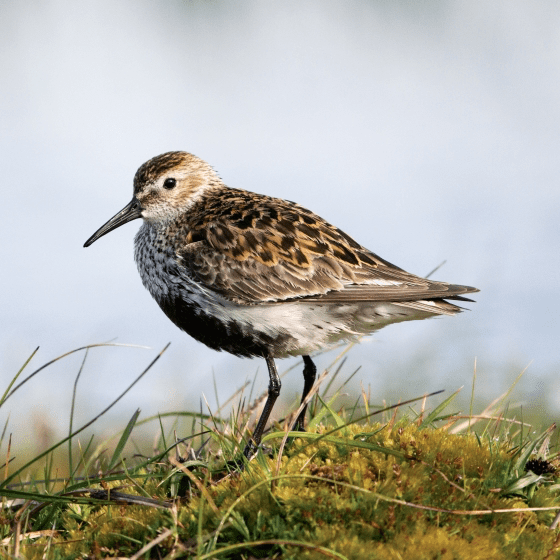
And then, there’s another question. What lives on the peat bogs? Well, to start with there’s the sphagnum mosses that form it, along with cotton grasses and other vegetations. Dartmoor also hosts Europe’s most southerly breeding Dunlin, which are also southern England’s only breeding population. Crucially, the species relies on blanket bog with its network of open pools. On Dartmoor, it is not present below an altitude of 500m above sea level. A fragmented population of breeding Golden Plover may also still exist on Dartmoor, and if they’re there, they’ll rely on these peat bogs. Scotland’s peatland are an example Dartmoor should be following. While 80% of their peatland is degraded, it still provides a home for Curlew, Hen Harrier and a host of invertebrates and amphibians.
One last thing. 12% of the UK is made up of peatland. So where are the others? As I mentioned above, most of it is in Scotland, among the mountains and the Highlands. Some of the most extensive lowland peat lies in the East Anglia fens, as well as in the Somerset Levels. The hills of Northern Ireland and Wales also play host to numerous peat bogs, as well as Exmoor and Northern England. However, 80%of this is degraded and needs restoring.
How can you help? One of the biggest drivers of peat damage is its use in gardening composts and soils. Try and go peat free when you visit the garden centre. There’s bound to be several other options for you and your plants, and if there isn’t, get in contact with your local garden centre, and ask them to stock more peat free options. Remember to spread the word! The more people we can stop using peat soils, the better!
To conclude, Dartmoor plays host to widespread peat bogs, both at high altitudes and low. As does the rest of the UK. But with drastic amounts degraded, damaged, eroded or sliced open, we run the risk of losing the special plants and wildlife that need this habitat, and what could be a huge factor in working our way out of this mess that is commonly known as Climate Change. We have 30,000 square kilometres. The world has 4.23 million square kilometres. That holds over 600 gigatonnes (according to the International Union for the Conservation of Nature) . Think about it. Restoring our peat bogs could be crucial in combatting Climate Change. And that’s what I’ll leave you on.
Hello and welcome back to Global Birdfair 2024: the final day. Can’t stop, we’ve got an appointment with Leica for a nature walk. Bye!
On arrival…
Just kidding, but we did have to move quite rapidly for that Leica nature walk. Anyway, Harry Read, handy with a camera, was leading another nature walk alongside Elle Kaye, birder and taxidermist and Katie from Wild Finca, sustainable living advocate. Now you have all the job titles, lets go on a walk. We set off on the same path as yesterday, again spending time with the Whitethroats in the exact same Hawthorn bush.
Green Woodpeckers and Chiffchaffs formed a duet as we found ourselves at the vantage point, over the meadow and the vastness of Rutland Water. A Kestrel, eager to please, hovered so close that you could see every little black spot on its gingery back. Kestrels are the definition of work smarter, not harder. They can track better than Steve Backshall or Bear Grylls, due to their ability to find and follow the UV light in a vole’s urine trail. Mind-blowing! The Common Terns were back too, surfing the air with their needle like wings.
And surprisingly, it didn’t take long for the king of Rutland to rear its head again. First its gull-like form emerged from behind the treeline, floating from invisible strings. Its movements are never wrong, each one calculated to be clinical and precise. Even just flying requires the utmost decency. Luckily, the avian monarch possesses that in bucketfuls. Its black, white and brown plumage gives the impression of smart and regal, dressed for a wedding or a grand opening. Even the way it kills requires dignity, the hover, the dive and the pinpoint accuracy to kill the fish on impact, and carry it away in one fluid swoop. Is there another bird that has a better claim to the throne? Surely it could only be the Osprey.
As the path led us down to the banks of Rutland Water, it brought us adjacent to the meadow. Curiosity led to stealing into the meadow, grass brushing against bare skin, a pleasant tickle in the warm air. But before I could get a tickle from one such blade of grass, a red object caught my eye. Two Red Soldier Beetles, clasped in each other’s legs, clinging to each other with passion while forming their own circle of love. I think you know by now what I’m talking about. Harry scooped up the two beetles in his hands, careful not to disturb their clearly intimate relationship. That’s right. They were mating.
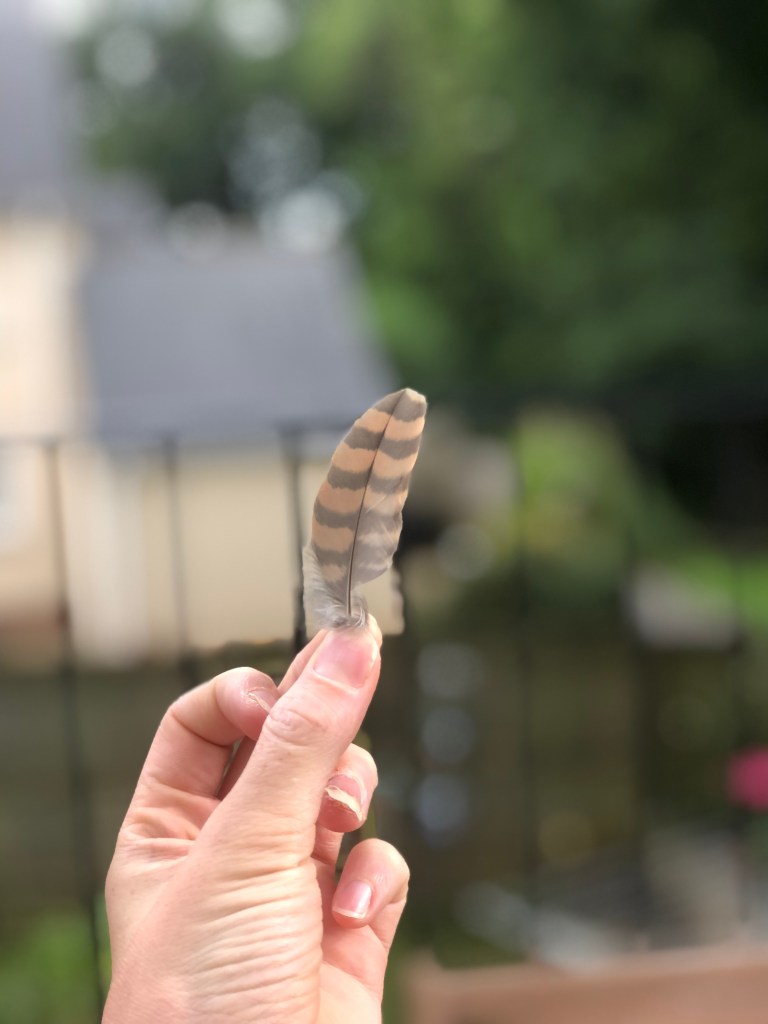
But I was distracted temporarily as there, on a bed of green, lay a feather barred with two different shades of brown; on more buffy, and one clearly darker. It turns out that Elle is a renowned taxidermist and expert in feather ID, having got up close and personal with many avian creatures. Don’t worry, she only works with birds that died of natural causes! She confirmed my train of thought. A Kestrel feather. Could it be property of the bird we had witnessed just 20 minutes ago. In fact, I held that thought, because here came that very male again, flying over our heads before hovering in a distant corner of the meadow. I must admit, I was glad I found that feather. It was only small, but beautiful. So beautiful.
The feather in question.
And now we returned to the Leica stand, feather in tow, to the news of a baby Cuckoo being fed by a female Dunnock right next to where we had just stood, by the Whitethroat nest. Naturally, news spreads like wildfire at the Birdfair, and Harry and Elle both headed off after saying goodbye. I had enjoyed walking with them and Katie, because I feel like there was a certain understanding between us after a while. We asked questions of each other (friendly quiz-based format, nothing nasty) and ended up identifying each other’s sightings. It had been another successful nature walk at the Birdfair!
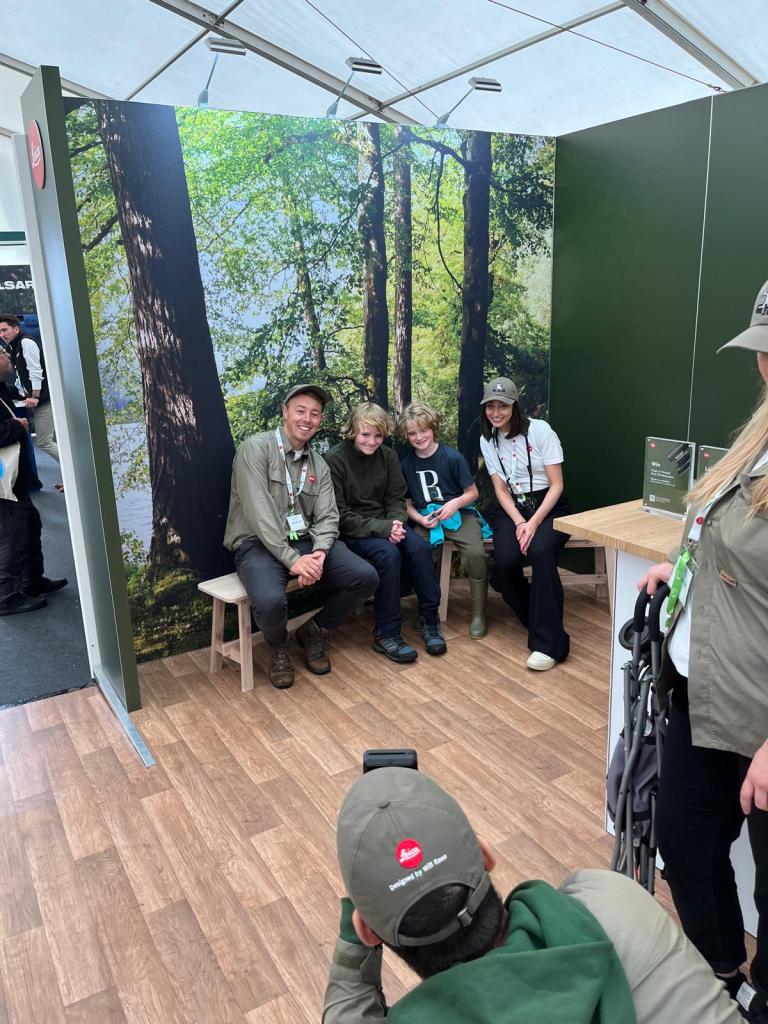
Harry, me, Bertie (my brother), Elle
We moved off to explore the marquees a little deeper, as we didn’t really do anything detailed yesterday. Birda was a good one to talk to, the new app rivalling ebird and bird-track. I have to admit to the fact that I use all three! Ebird I mainly use to keep track of life lists, bird-track I use because its run by the BTO and goes straight to a county recorder for data monitoring, and I really like the social media aspect of Birda, so I use that to interact with other birders in a huge global community. They’ve also got some really clever Star Wars slogans, used for their May the 4th recording challenges. ‘Obi Swan Kenobi’ and ‘Darth Wader’ really hit home!
Birdlife International also had a fun game that sent you on a wild goose chase to every corner of the show. You had to get a stamp from around 10 different stands, all partners of Birdlife International, and put them in your ‘Flyways Passport’. If you completed it all, you got a free pin badge. But Birdlife are one of the main driving forces in conservation and combatting climate change on the planet. They bring together over 100 organisations worldwide to form a tight-knit partnership. Their philosophy is that decline in bird populations shows a wider loss of habitat, pollination and other populations. In other words, they can be an early warning sign to any damage that is to be done in the near future. And this helps them to initiate conservation efforts before its too late.
We’ll enjoy this!
There were scores of other exhibitors at the Birdfair, all plying their trade and crucial work at the world’s biggest annual birding hub. But for now, we were back off to Zeiss again for an Osprey Walk with none other than Toby Carter, keen birder and Zeiss ambassador. Zeiss had played a huge role in my Global Birdfair 2024 experience, and it looked like that was set to continue. I know this is the one actual Osprey Walk we’ve done this weekend, but honestly more of the same and the walk will be a success.
Toby was leading the Osprey Walk
We had a larger party than the previous two we’d been on, but that was no deterrent for us or the Osprey. In fact, as soon as we reached that same vantage point, over the bird came, their majesty the Osprey. Dignified, regal, majestic, magnificent. Enchanting. It flew the same direction. In over the Water towards us, over our heads and then over the golf course and out of sight. It was hard to tell if it was the same bird because we couldn’t tell if it had a ring or not from this distance, but there was every chance it could be the same bird from this morning, or even yesterday. Well, that’s a job done. Osprey walk heralds an Osprey.
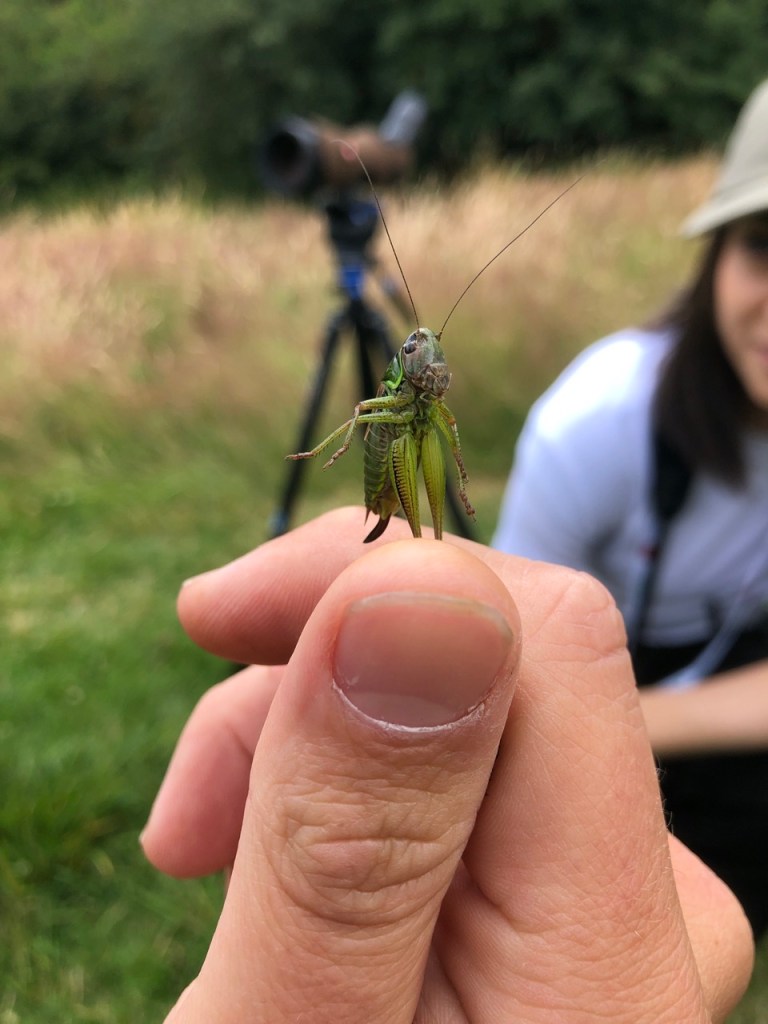
There was little else bird wise from then on, so exploring the meadow became a fixture for the younger people there. Crickets and grasshoppers, huge ones, sat on the stems, chirping away to form an endless white noise. No let-up. There were so many that if one dropped out for mere moments, the collective sound of its counterparts masked any blip in the buzz. Catching them proved to be a little harder than anticipated, but it was definitely worth it when you could see them up close. As widespread and common as they are, you can’t deny that they’re really cool insects!
Chirp chirp.
Looping back around the meadow, we rejoined our original path and were met with the site of two wheeling Red Kites, their forked tails, rusty red colours and angled wings distinctive from this angle and distance. According to Toby, they’d been flying and calling above the same cluster of trees for a while now, and it made sense that they must have a nest there. Right on cue, their resounding whistling began, ending in a ‘pluuuuu’ sound as they descended before rising again. Both the sound and the movement of the birds was enchanting, and the scene instantaneously portrayed serenity, calming a racing mind.
Red Kite through the binoculars (bad photo, sorry!)
On the way back through we came across the Whitethroat pair once again, flitting across the hawthorn bush by the gate. This particular couple and their nest had proved a mainstay of Global Birdfair 2024, and I was glad that their scratchy warbles had punctuated each and every nature walk we’d embarked on during this weekend. Back at the Zeiss stand, we had one last look around before setting off toward the Eyebrook Wild Bird Feed stand, in order to purchase a new feeder to replace our old stalwart that had been destroyed by the resident Grey Squirrels. Then, we indulged ourselves with the amazing array of collectable RSPB pin badges on offer, before returning to grab a bite to eat for the drive home.
Global Birdfair 2024 had been an incredible experience, going above and beyond my already sky-high expectations. A birder’s Glastonbury, many people call it, and I can definitely agree with that comparison. By scale, yes, but also by the huge array of events, activities and talks on show. Not to mention the few hundred exhibitors there from the ecotourism and travel industries, to the conservation organisations, artists and optics companies. Add to that the lectures and ringing demonstration, and dare I say Global Birdfair is, in my opinion, miles better than Glastonbury or any music festival for that matter. Thank you Global Birdfair. Its been unforgettable.
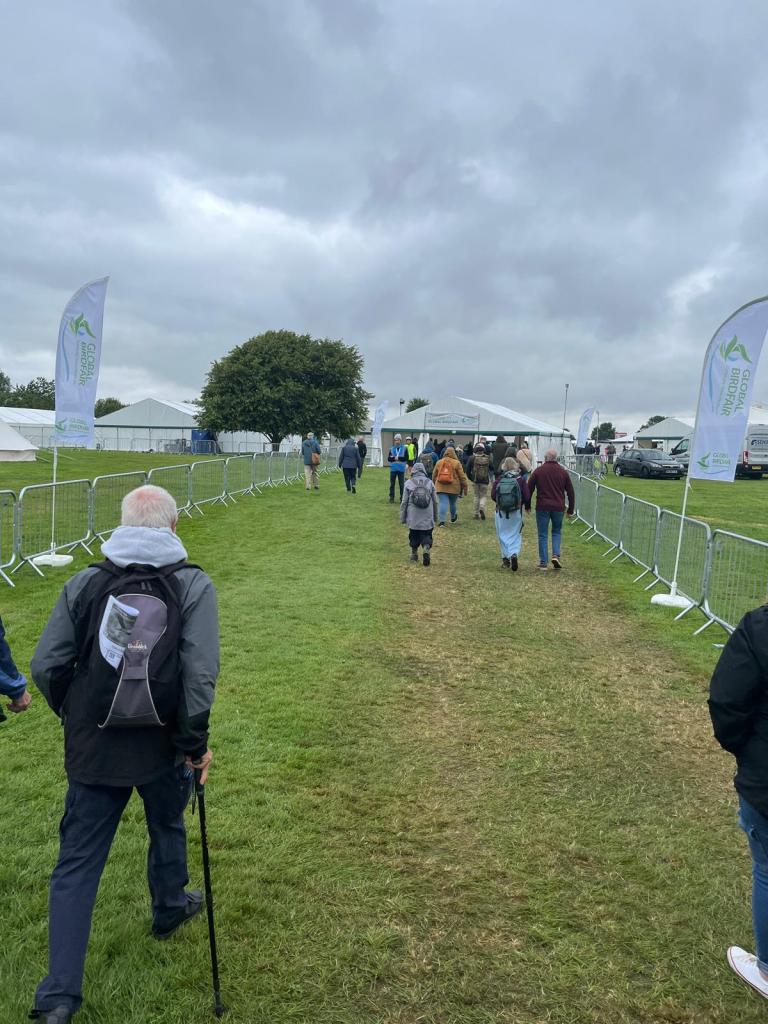
The wind howled in Rutland, England’s smallest county, but the weather was pleasant enough. Compared to last year, anything could be an improvement from the vast thunderstorms and the heavy rain outbursts, which punctuated 2023’s edition at some of the most inopportune times. It took nothing away from the event, which was incredible, but it gave us a good feeling about 2024 from the off. Another difference from last year was that we had arrived slightly earlier than I was expecting, due to us having booked onto a nature walk with Nick Baker for 9:45. Arriving for 9:23 seemed appropriate. But for those who haven’t read last year’s Birdfair saga, here’s a little rundown of its history and what exactly it entails.
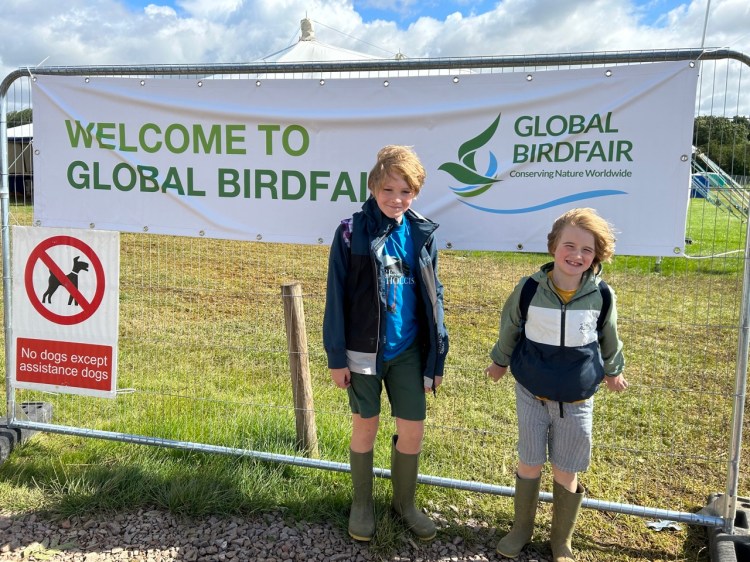
Welcome to Birdfair
Global Birdfair began as the British Birdwatching Fair in 1989, the brainchild of Tim Appleton MBE. He successfully ran the Birdfair for 31 years, before May 2020 saw the near demise of the Fair as people knew it. Following Leicestershire and Rutland Wildlife Trusts’ decision that it would no longer run the Birdfair, the whole thing was shrouded in uncertainty. Surely it couldn’t be completely cancelled? And it wasn’t. Enter the Global Birdfair, spearheaded by the very same Tim Appleton, to build a “program of events to interest all generations”. From lectures and quizzes, to ecotourism companies and tourist boards, to conservation organisations and optical companies. Not to mention the smorgasbord of activities, nature walks and classes available daily. All housed in several marquees and stages. Pretty cool, I’d say.
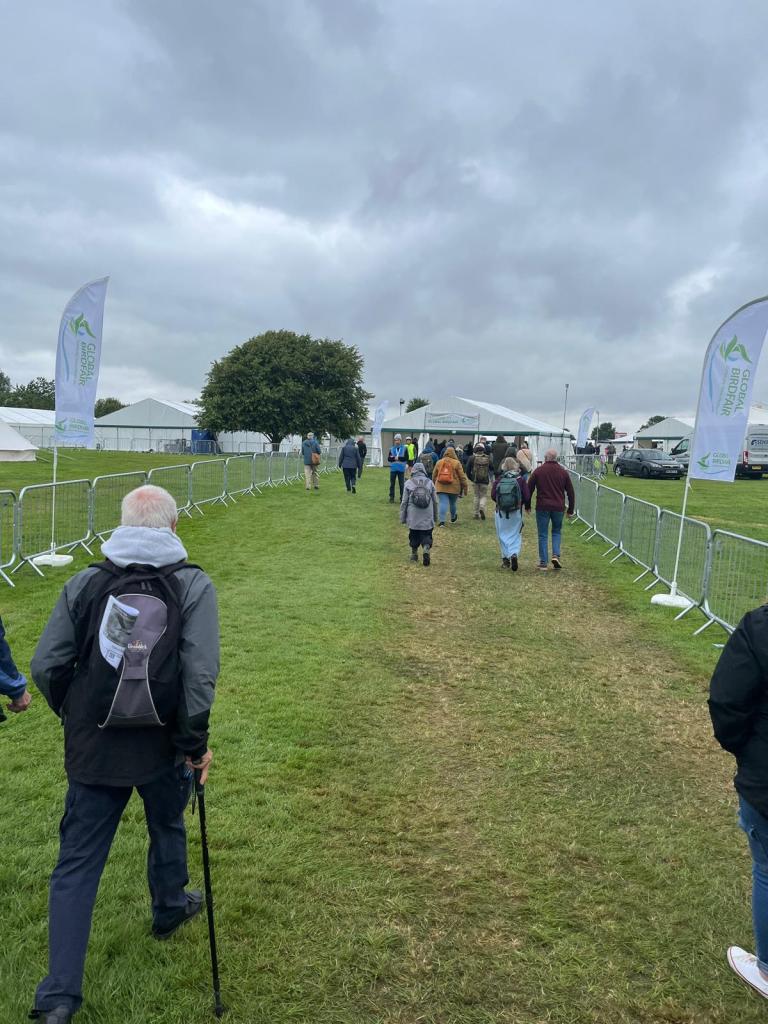
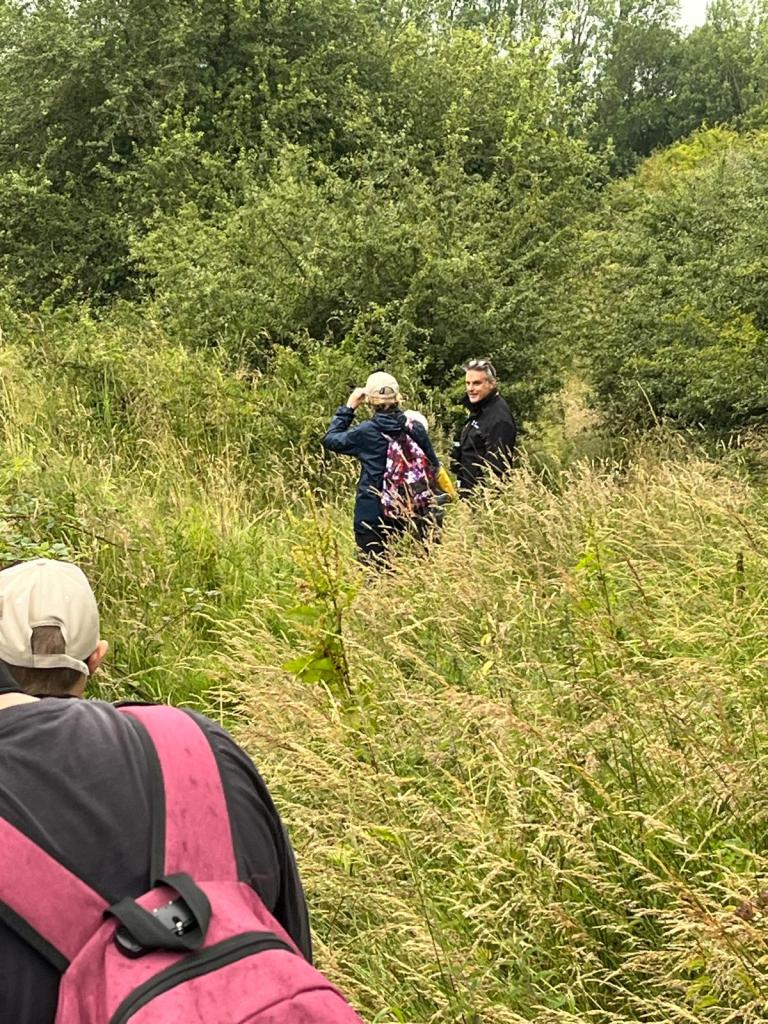
The entrance tent was filtering people into the event rapidly, and the sights and sounds of Global Birdfair soon graced my senses once again. We ambled across the show towards the Zeiss section of the Falcon Marquee, buzzing with the excitement that only the Global Birdfair could bring. Zeiss earned a fairly large chunk of this marquee, devoted to various items including binoculars, scopes, thermal imagers and the new Secacam, the next generation of trail camera technology. We would explore later, but for now we met up with Nick and the group. Armed and ready, we set off through Birdfair and in behind the ringing demonstration, trudging down the slippery, mud slick slope that descended through the meadow towards the banks of Rutland Water, home of the UK’s first successful Osprey reintroduction.
In the meadow
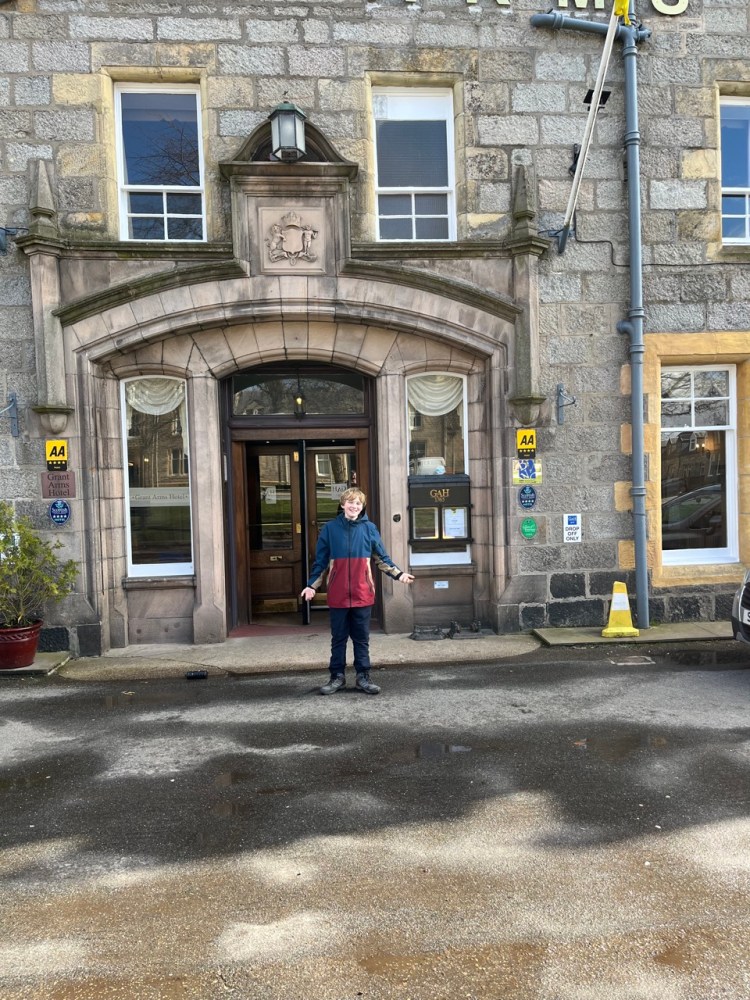
However, just paces from the gate, a Whitethroat’s hoarse, scratchy warble sounded from a dense hawthorn shrub directly in front of us, and Nick told us that there had been an active nest in there for a while. Speaking of Nick, we first met him at the Grant Arms Hotel, in the heart of the Cairngorms National Park, Scotland. His knowledge of insects and the natural world knows no bounds, and he’s always willing to share his experience and know-how with everyone he meets. If you want to read more about that particular encounter, head over here.
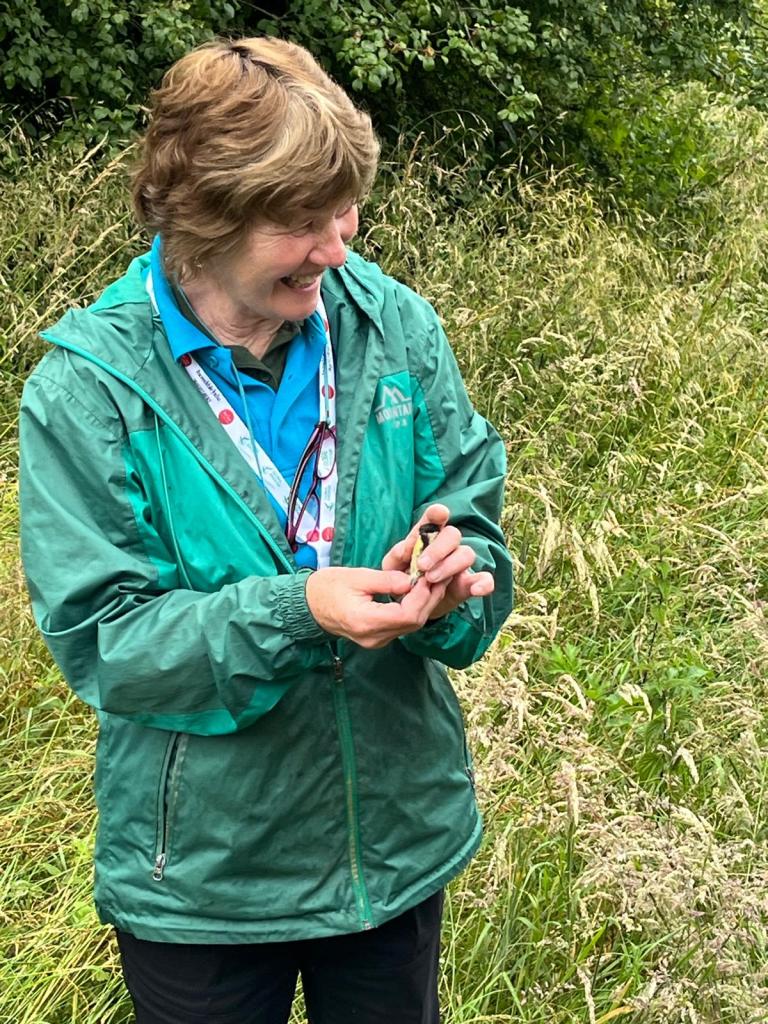
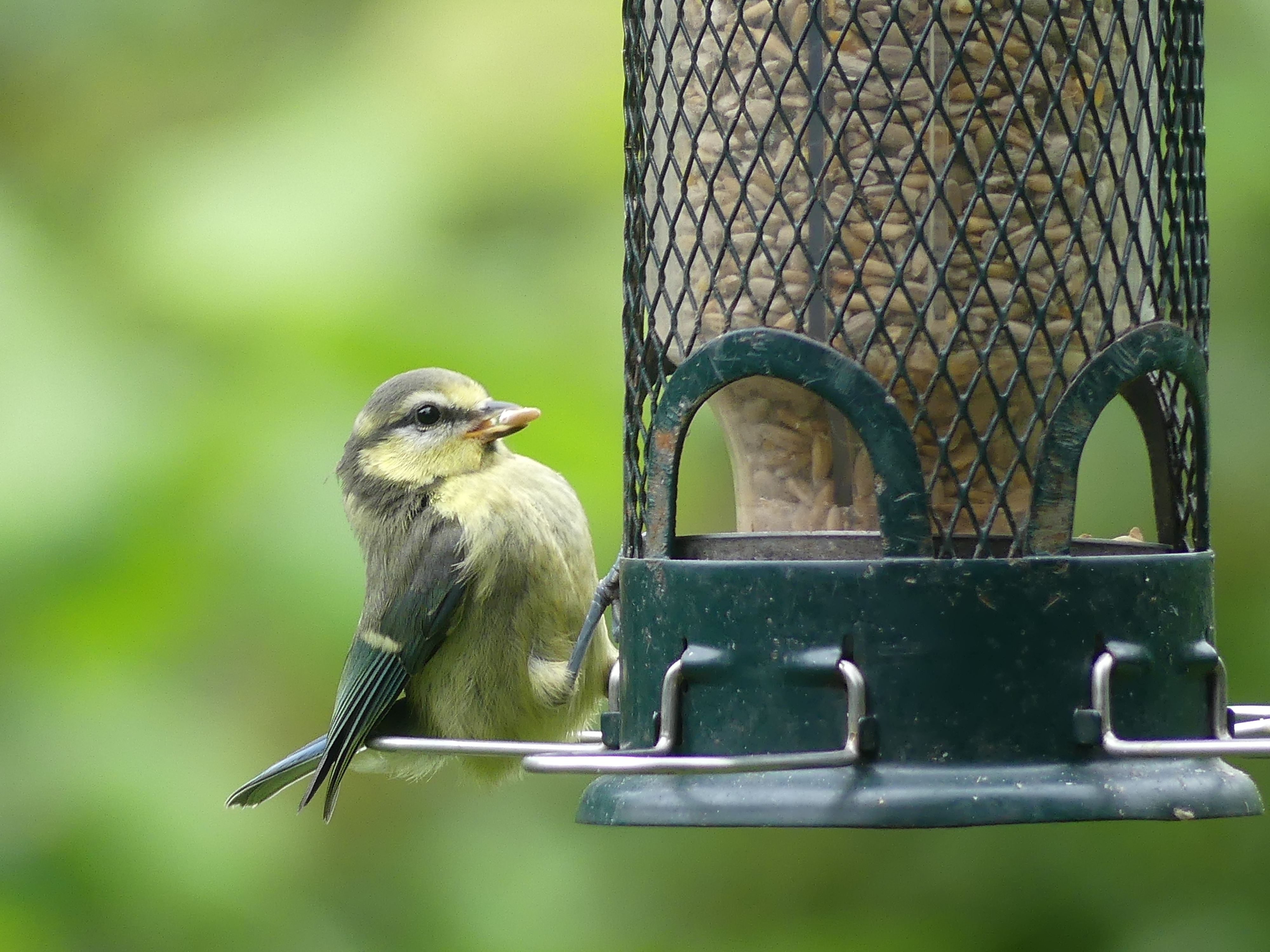
We caught little more than glimpses of the stocky little warbler, concealed as he was within some of the thickest boughs the hawthorn had to offer. But movement continually caught the eye, and when he darted from his cover for a nearby oak, its ID was certainly confirmed, if the distinctive song hadn’t done that already! Our party moved on after the song of a Garden Warbler was heard, seemingly close to where we stood on the precariously sheer hill. On our way down in hot pursuit of the bird, we came across two of the BTO’s ringing volunteers, collecting birds from the mist nets for the ongoing ringing demonstration happening at the crest of the hill. In her hand she held a young Great Tit, its plumage still carrying a yellow tinge.
Bird Ringing!
Almost every single birder based in Britain can guarantee that they have witnessed a Great Tit many many times. But there’s something about seeing a bird in the hand, up close and personal, that is almost as transfixing as a humongous Lammergeier drifting over English airspace. The creature takes on a whole new role in your life, and its a brilliant opportunity to try to understand these bird’s feelings and emotions from their intriguing facial expressions and actions. Some birds are calm, some proud, neither of these really creating a fuss, and seemingly enjoying the attention. And then there are those individuals who don’t enjoy it as much, though they can often be soothed by a handler after a slight fit of flapping and biting. No matter their reaction, a trained ringer will never hurt or distress the bird in anyway, and this line of work contributes so much of the data we have on species around the world. Its also really interesting to watch!
Enquiring about what they’d caught this morning led to the explanation of many of the songs we’d heard this morning. Don’t worry, the Whitethroat was definitely seen in the flesh but remember that Garden Warbler? Simply a tape lure, designed to lure birds into the mist nets where they would be immediately collected to prevent them from becoming truly ensnared and tangled. A recording, not an actual bird. It would’ve been disappointing had it not been so comical. Even we had been fooled, proving the strategy’s merits!
Something interesting?
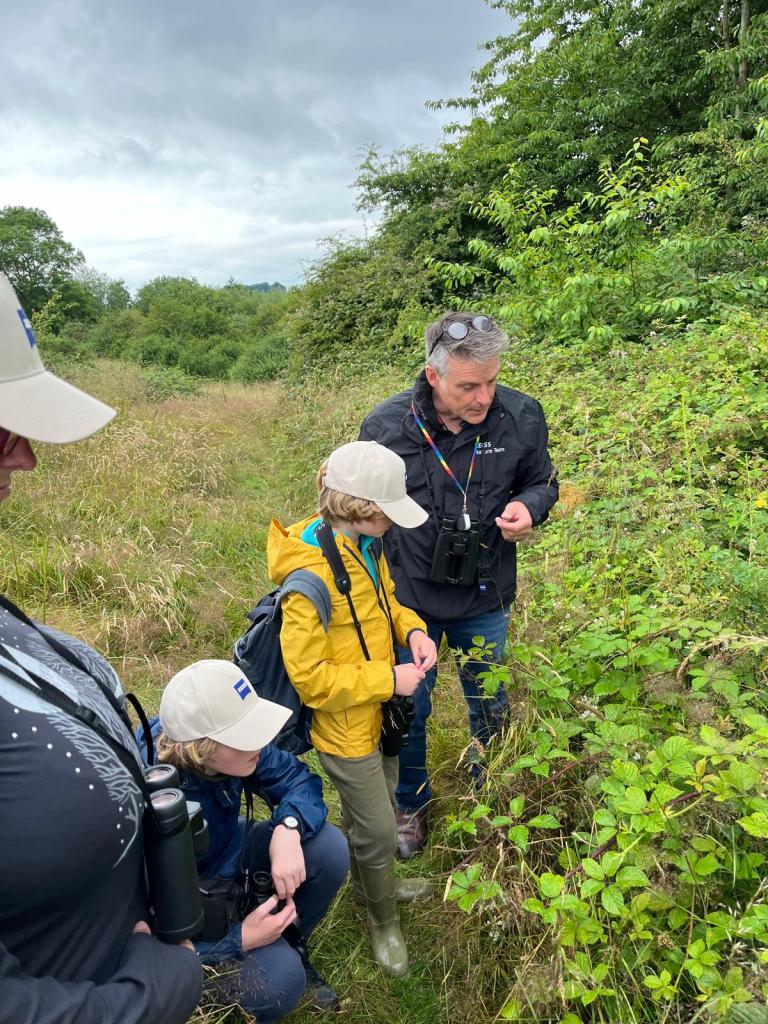
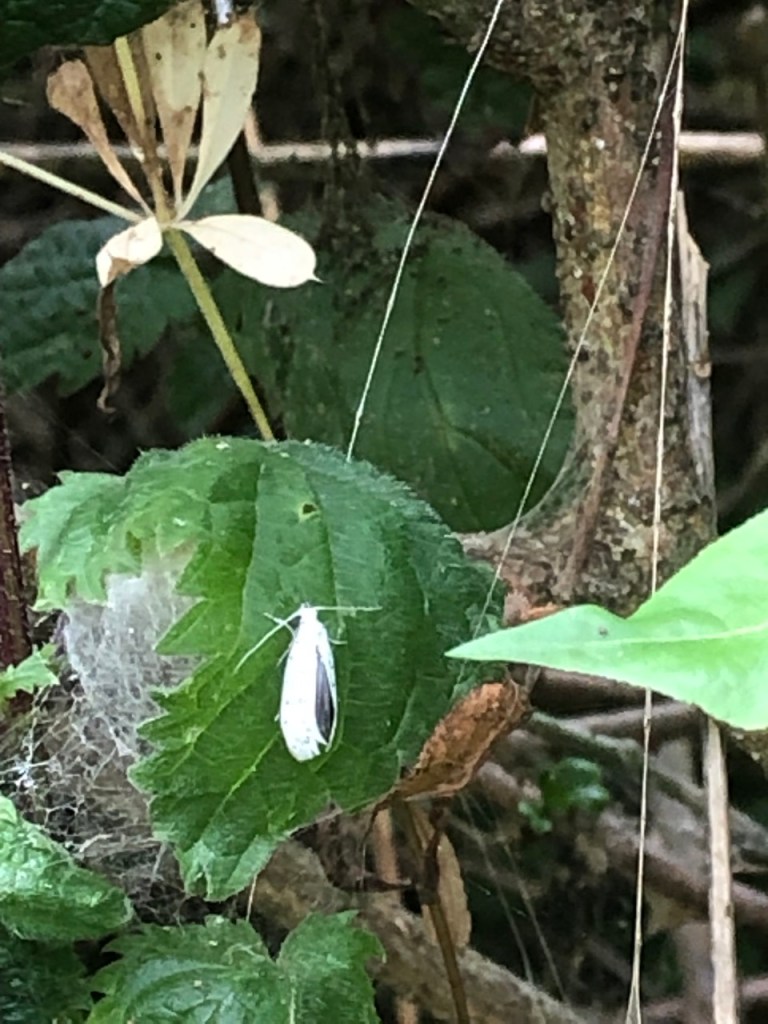
The walk led us down through several bramble patches teeming with insects, even with the sun putting a limit on its appearances. A scorpion fly was found on the fringe of a bush, armed with a scorpion-like curved ‘tail’ used for clasping the female during mating. We also came across several Ringlet butterflies, unsurprisingly named for the small rings that line its wings when they choose to open them up and a collection of White Ermine moths emerging from their cocoons. Several solitary wasps were sighted on our way up, but glimpses didn’t prove enough to get a definitive ID. Overall, a successful walk more insect-based than birdy!
White Ermine Moth (sorry for bad photo)
Back at the Zeiss stand, we spent some time trying out the amazing range of optics on offer. Having a pair of Zeiss binoculars myself, I knew firsthand how good they were, and they certainly lived up to their billing! But what I was really drawn to was the range of thermal imagers. I had used a couple with Nick up in Scotland, and they made long range spotting a lot easier. Anything with a heat signature would show up as a flash if white against a grey background, and it meant you could pinpoint where things were from miles away. We’d tried it out on a herd of Red Deer concealed against the bare grey rock of a distant ridge, and we were able to get these majestic mammals in the scope all because of this genius little package. The wish list grows!
On our way out through the marquee, we bumped into Dawn Balmer, Head of BTO Surveys and her husband Pete, just walking into the Zeiss stand. We’d met them earlier in the year, at the Grant Arms Hotel and enjoyed a morning’s birding with them at Spey Bay. Read more about that one here. It was good to see them again, and we had a brief catch up conversation about what had been happening since April. Dawn is, as I’ve mentioned, Head of Surveys at the BTO and Chairman of the Rare Breeding Birds Panel. Quite the dream job, for definite!
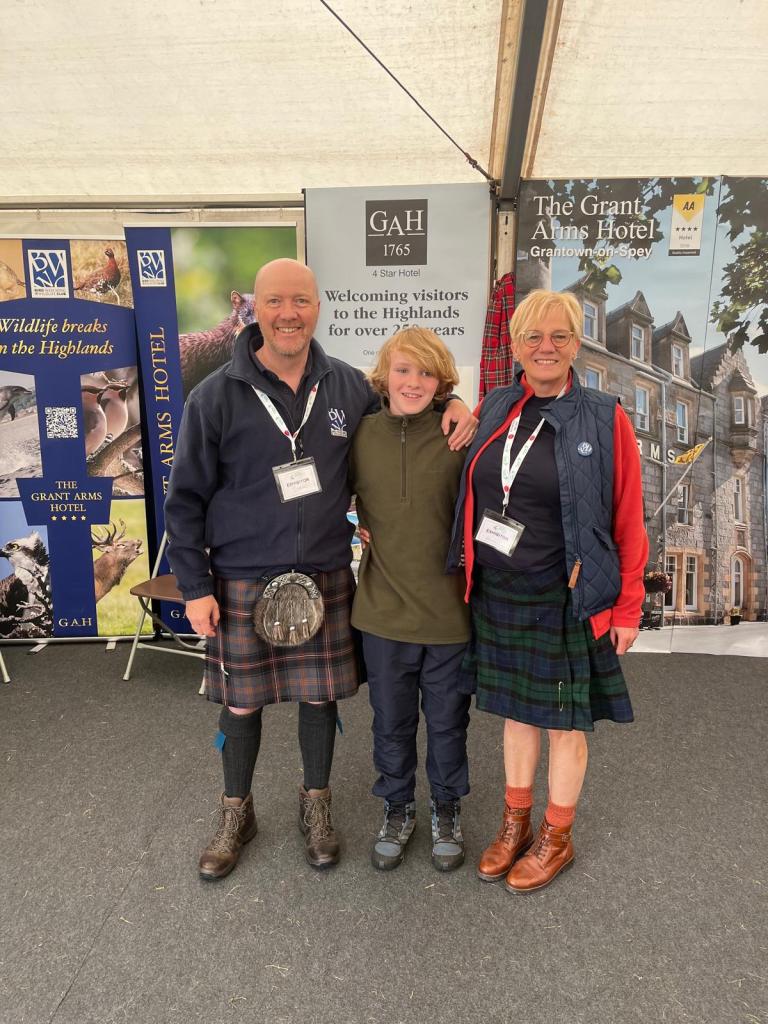
After grabbing a quick lunch, we made our way towards the Nightingale Marquee, where the Grant Arms Hotel had set up their stand. If you don’t know already, the Grant Arms are the ones who invited me and my Dad up to stay in the Cairngorms, which was one of the best five days of my life. For more information on that one, head over here. Simon Pawsey and Marion Muller had travelled a long way to be here from the opposite end of the UK, and we received a warm welcome. It was great to see them again, and we spent a short while catching up and discussing birding the opposite ends of Britain. Scotland is an awe inspiring place, and Simon and Marion both have plenty of experience of it. I’m definitely glad we got to pop in and see them again, and I think we’re going to have to return to the Grant Arms sometime in the future!
Simon, me, Marion
Simon was giving a talk the next day on the School of Birding he ran alongside Mark Pearson, at the Avocet Lecture Stage which was adjacent to the RSPB’s section (made the connection yet? Think about the RSPB logo). The School of Birding is, as the name suggests, a week’s course of birding instruction and lessons given by the experts in Simon and Mark, and runs from the Grant Arms Hotel. You learn things that you could never learn in school, simply because birdwatching isn’t part of the national curriculum, which it probably should be (at least make it a GCSE option). Anyway, Simon and Mark know what they’re doing, because they take you to the best spots, well-known or not, in the Cairngorms.
But soon we had to run, due to a different birding lesson back at the Zeiss stand. Titled “a Young Birder’s Masterclass”, a trio of young people (it was a very small group) were left in the care of Stephen Menzie, Toby Carter and James Lidster. Just to clear things up, I was one of those young people. But who exactly was leading us?
Stephen Menzie is a vastly experienced birder, and arguably one of the most enthusiastic. He worked on the Collins Bird Guide app version, and managed the Falsterbo Bird Observatory. He led the theoretical class, and with good reason; he holds a particular interest in moult and ageing!
Jamie Lidster has worked as a professional ecologist and in the eco-tourism industry for 20 years. He has been part of the Dutch and the English rarity panels, and has years of experience with bats, reptiles and amphibians. But don’t worry, he’s never forgotten about the birds!
Toby Carter is a keen birder, and has experience and knowledge aplenty, even if he is only in his early 20s. Birding since 5 years old, Toby is now armed with a BSc in Environmental Conservation, and his passion and sense of adventure know no bounds. Long story short, he’s brilliant!
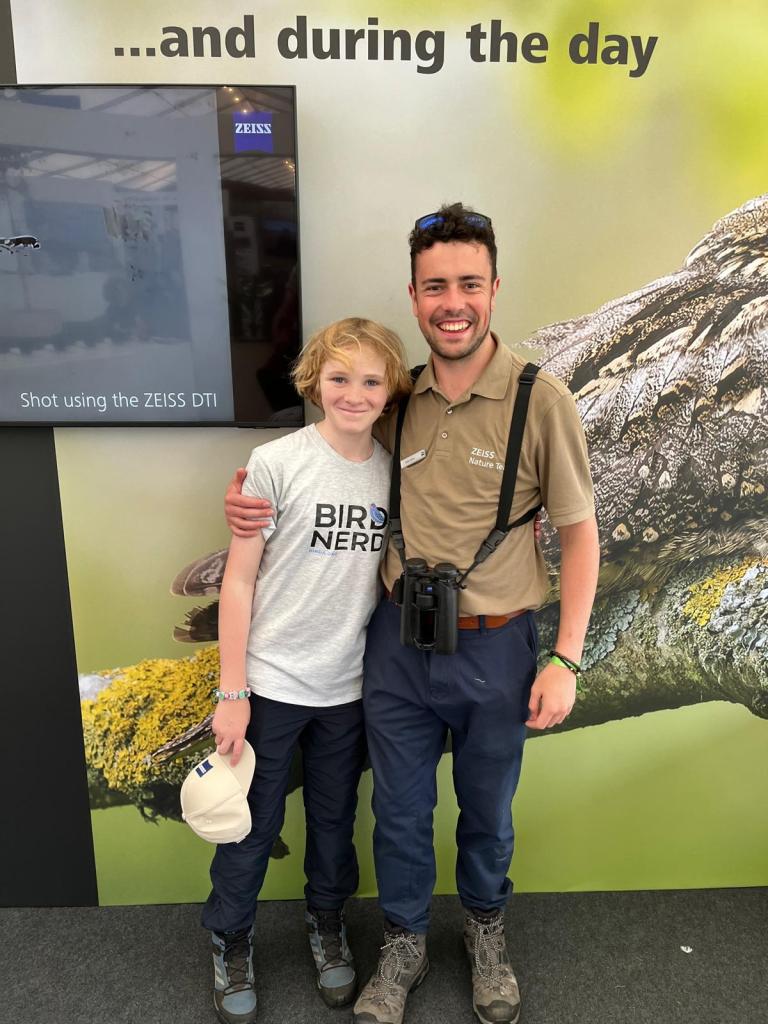
We met Toby on the Young Birder’s Masterclass
The mini course began with a short introduction to identifying birds, but then moved onto ageing and sexing the species you identified and their plumages in moult. All three of these Zeiss Ambassadors are incredibly knowledgeable, great with a camera and most importantly for this assignment, great with young people.
After the theory, it was time for the practical. We set off the opposite way to our route this morning, to the right at the mini junction instead of left and straight down. Our efforts were immediately rewarded with the same Whitethroat parents being active in the hawthorn bush, and this time we managed to get some decent views without it breaking its cover. A cackling call sent the Whitethroat pair back into the safety of their bush, and three Green Woodpeckers bobbed in the sky as if it were the ocean over our heads, their undulating flight reminiscent of a boat being carried by the waves. A juvenile and two adults, their calls eerie yet comical.
From up here, the view was pretty much unsurpassable anywhere along the track. Below us, the hill rolled into a teeming meadow, bathed in the now fully emerged sun. Ringlets, Meadow Browns and Marbled Whites fluttered lazily among the grasses, which groped above waist height in certain patches. From there it was the vast desert of liquid that is Rutland Water, a giver of life to so many birds, plants, mammals and insects that call it home. We backed up a good start with another Green Woodpecker, a Great White Egret and several Common Terns, all acting as rising action for a jaw-dropping climax. You couldn’t come to Rutland Water at this time of year without seeing the main event; an Osprey. They were reintroduced here as part of a project that was the first of its kind in England.
And one was drifting over the sparkling azure right now, its M-shaped wings arched in the middle like a gull, headed straight for the airspace above us. From this distance, it wasn’t unlike a gull. But up close, it’s superior size and strength became apparent, and no gull (sorry guys!) had the ability to manipulate a sunlit background like this raptor, majestic and powerful, and a brutal killer of fish. I was now craning my neck to keep it in view of my binoculars, because it had indeed reached our airspace, and was now entering the golf course’s behind us. Wow.
Nothing we saw could beat that encounter afterwards, but that’s not saying that Rutland Water didn’t try. It threw several Great Black Back Gulls at us, three sightings of hovering Kestrels and (resolve struggling now) a Little Egret ghosting in to land on the bank in front of us. Rutland Water determination and resilience had produced a good few hours birding but it had not won against a secret weapon that knows no master. The Osprey.
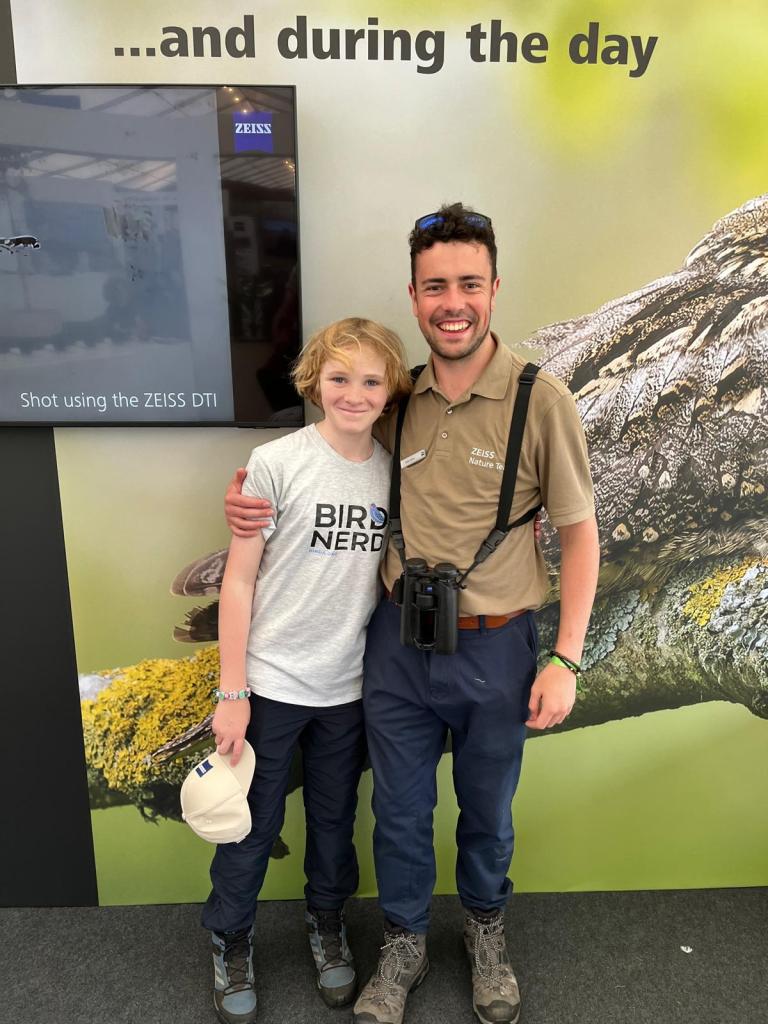
We headed back to the Zeiss stand (its becoming a bit of a common denominator now), and came across Petra Kregs, somebody who we had met last year via the Zeiss Young Birder Awards. We had a fair bit to talk about, and I enjoyed meeting her face to face rather than Instagram again. As Zeiss Nature’s Global Marketing Manager, she has a huge role in keeping Zeiss ticking along and is incredibly knowledgeable, enthusiastic and a great person to talk to. We’d been there for less than 5 hours, but it seemed we were meeting everybody at Birdfair.
It was by now 4:00, and we’d rarely strayed from the Zeiss stand all day. Tomorrow was to be a full day of exploration, but that’s not to say today hadn’t been worth it. We just got caught up in the tidal wave that is Zeiss Nature.
In order to reach Hawes End, it took a fair amount of staying power to negotiate the meandering lanes that snaked across the fells of the Lake District. Sheep, pheasants and wood pigeons constantly appeared on the road, and the sun beat down on the meadows and fields that lay at the feet of these mountainous hills. The driveway itself sat on an incline, and it took several flights of treacherously slick mossy stone stairs to reach the level of the grand old front door, that formed an entrance to the large three storey house that would act as a base for the weekend’s birding endeavours. Welcome to the BTO’s England Birdcamp.
A view of the fells from Wild Haweswater.
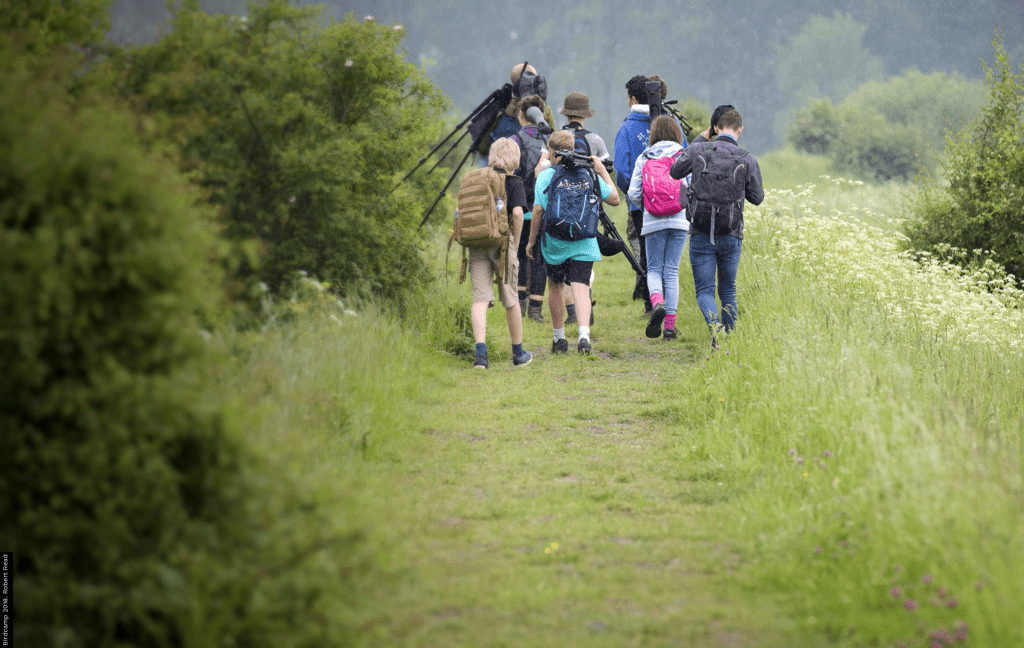
Birdcamp was a stroke of genius from the BTO Youth organisation, and incorporates young birders in each UK country assembling and spending a week together, alongside some of the best birds Britain has to offer (check out my previous blog for more Birdcamp ). There were 14 young people here, all set for a wowing weekend deep in the heart of the Lake District. But meeting new people is never the easiest thing, and it did begin with slight awkwardness at first. However, as the group trickled into the cushy living room, I think we were all put at ease, and any nerves quickly subsided. I mean, we’re all here because we love birds, right?
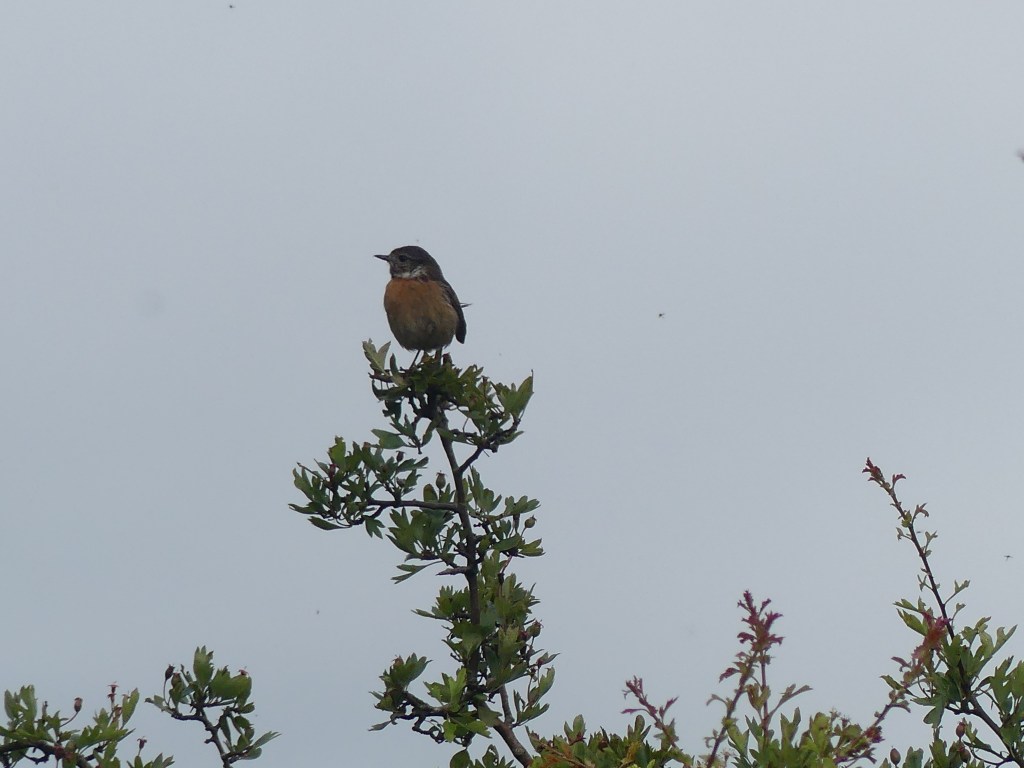
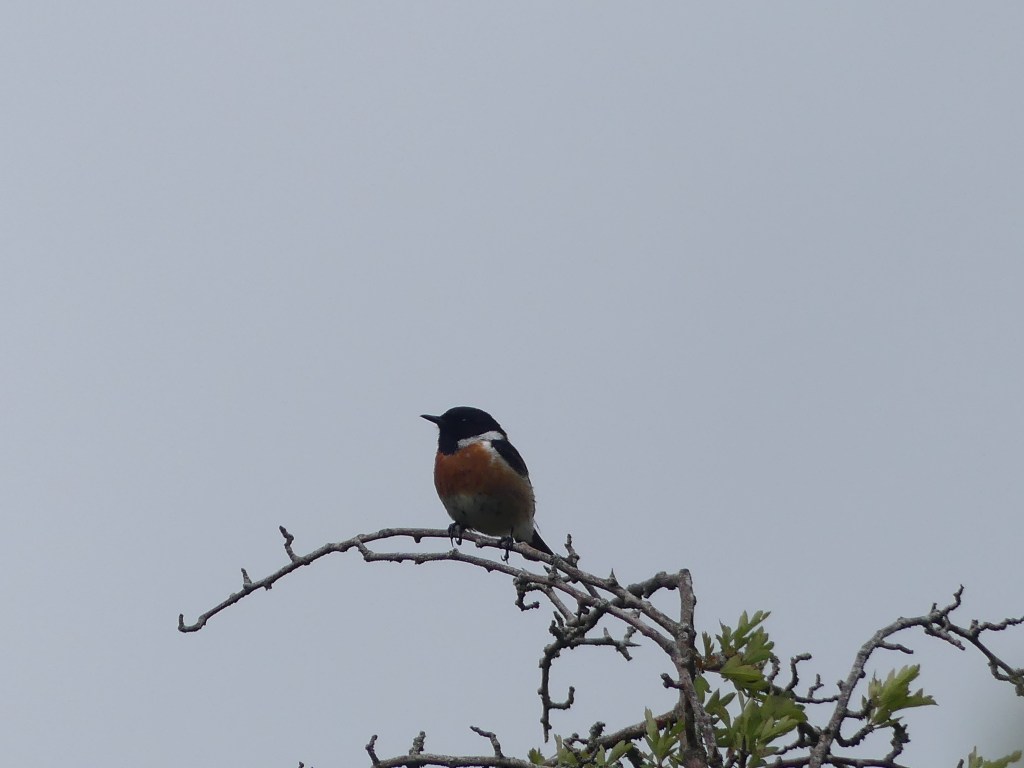
A female Stonechat.
And as we all tramped up the many maze-like staircases, laden with the required articles to make up the beds, the talk was casual and birdy, continuing far beyond the completion of our bed linen task into the evening, and across dinner. By now, pretty much everybody had met everybody, and we all received a BTO gift bag containing notebooks, magazines and more. Following a risk assessment (safety first, of course), Samuel Levy, one of several knowledgeable adults on the trip and member of the BTO Youth Advisory Panel, led a talk in birdsong, describing sonograms, tips, tricks, and a very odd bird call on the opening slide. The Sharpbill’s sound was fearfully reminiscent of a bomb whistling towards the ground. So, rather interesting then?
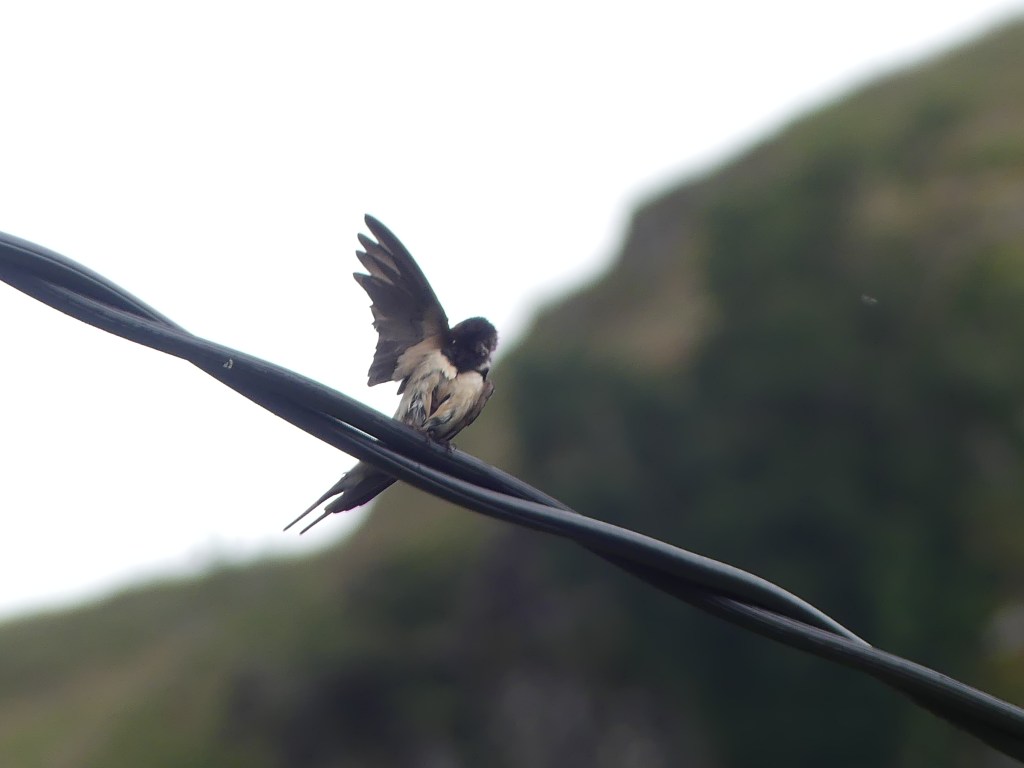
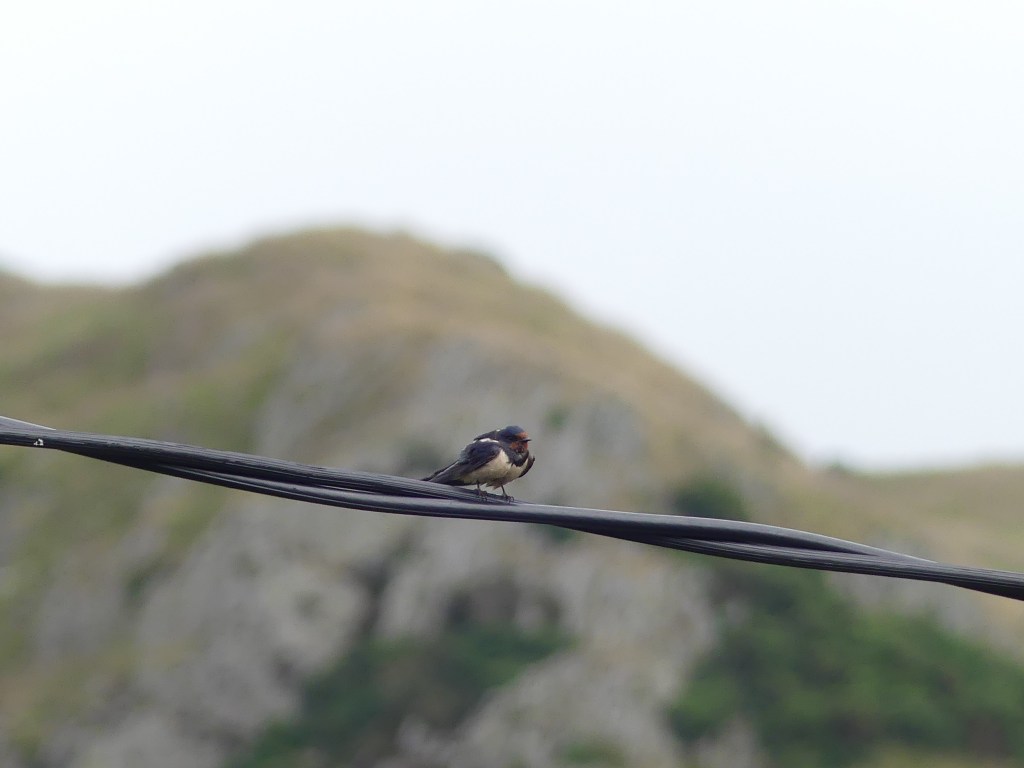
A Swallow caught mid-preen.
By now it was really quite late at night, and after another quick get to know each other session involving a stark orange ball and some intriguing favourite birds, we retired to rooms for more free time and bird chat, with several other subjects sneaking their way in. One thing for sure, we didn’t fall asleep that night until late. Having been told that we were to be awake for 5:15AM, this probably wasn’t a great move, and yet it didn’t really affect us. We must’ve gone to sleep early enough after all…
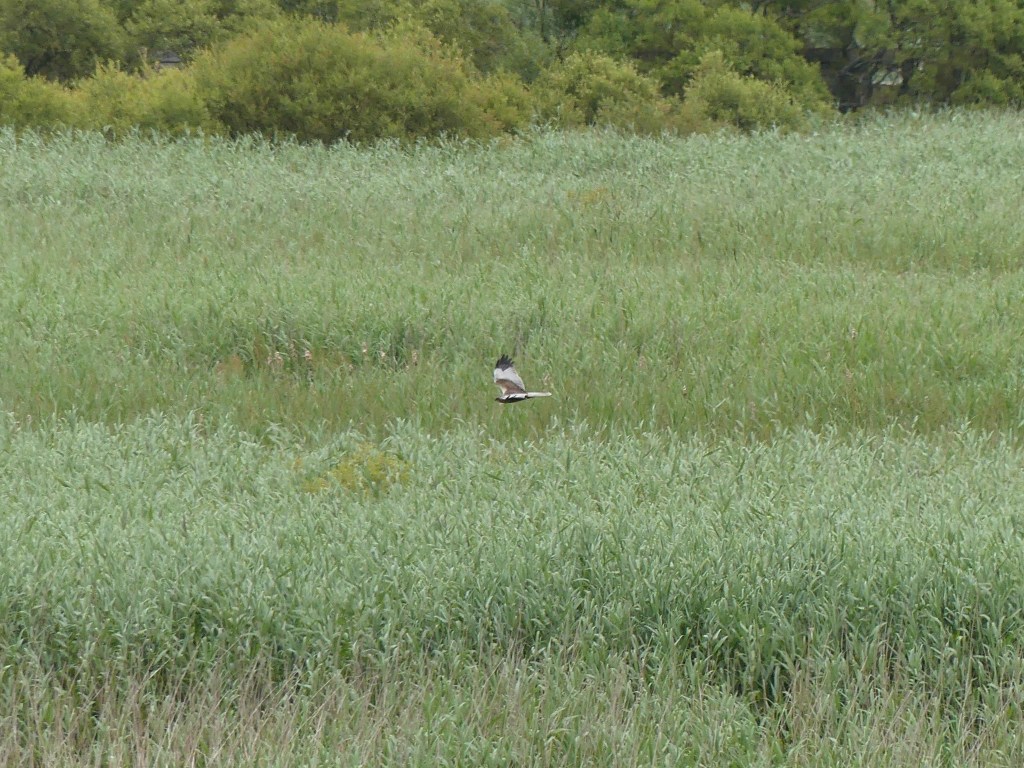
MARSH HARRIER!!!
The reason for us awaking at the crack of dawn was in order to reach the site for the bird-ringing session early enough in the day to catch something interesting. Breakfast was a rapidly talkative affair, and we set off in the minibus towards the RSPB Haweswater reserve, which was quite literally, several hills and a valley. The old farmhouse, which now served as a basecamp for the RSPB, sat in the blustery rain, whitewashed but proud at the foot of the valley. Opposite it was the perfect example of Britain’s unique temperate rainforest habitat, wet and ancient woodland, full of life. The tops of the trees stretched high above us, but began far below us, some of the tallest English Oaks I had ever seen.
And they were alive with bird calls, from Siskin to Green Woodpecker, with Chiffchaff in between for good measure. While we scanned the canopy for the constant flitting glimpses, everybody fell silent in unison, preceding a magically haunting call, floating on the damp, cold morning air. A call reminiscent of dim Dartmoor mornings, obscured by mist and trudged by boots. A Cuckoo’s mournful tune drifted from the ridge.
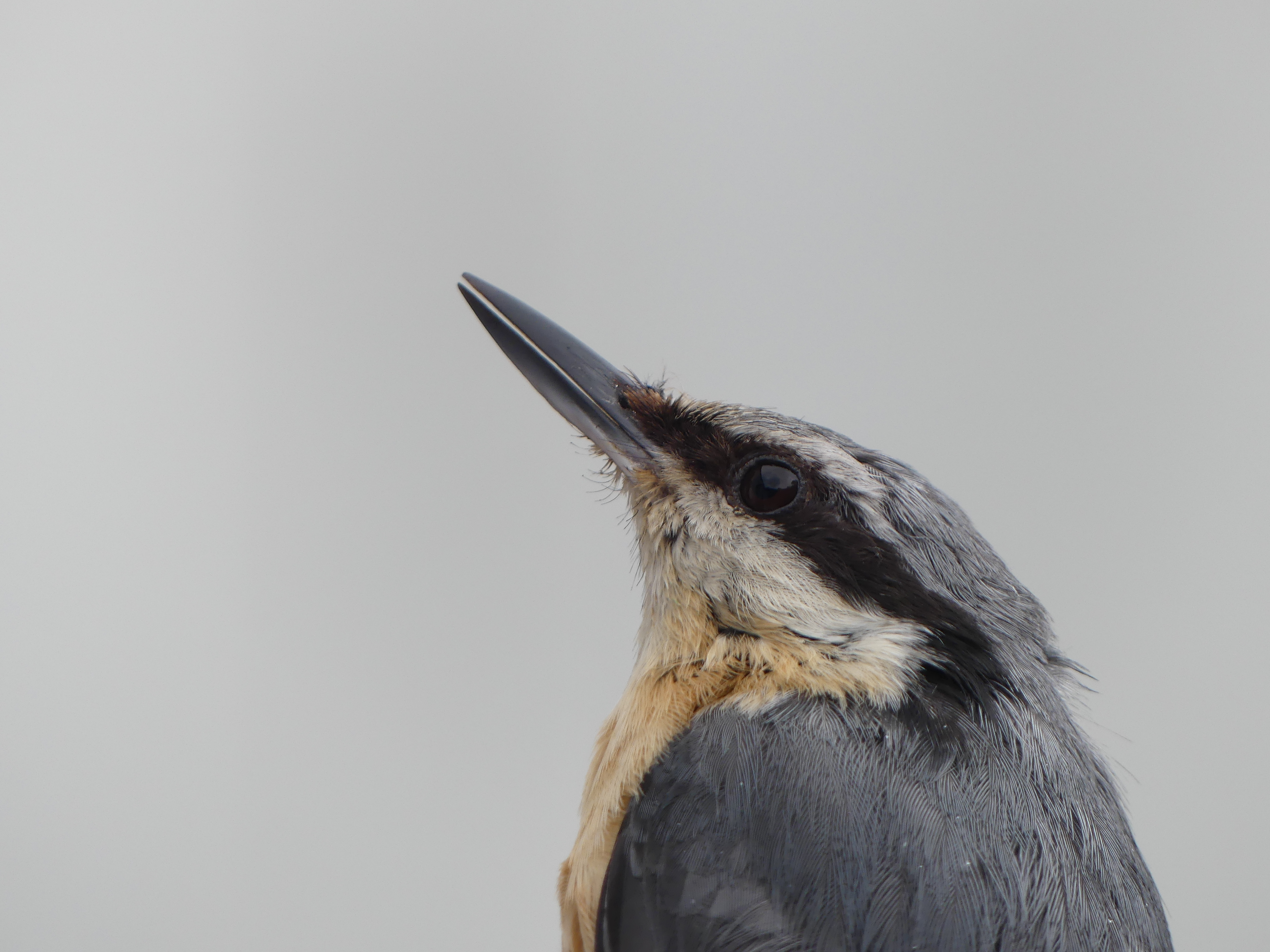
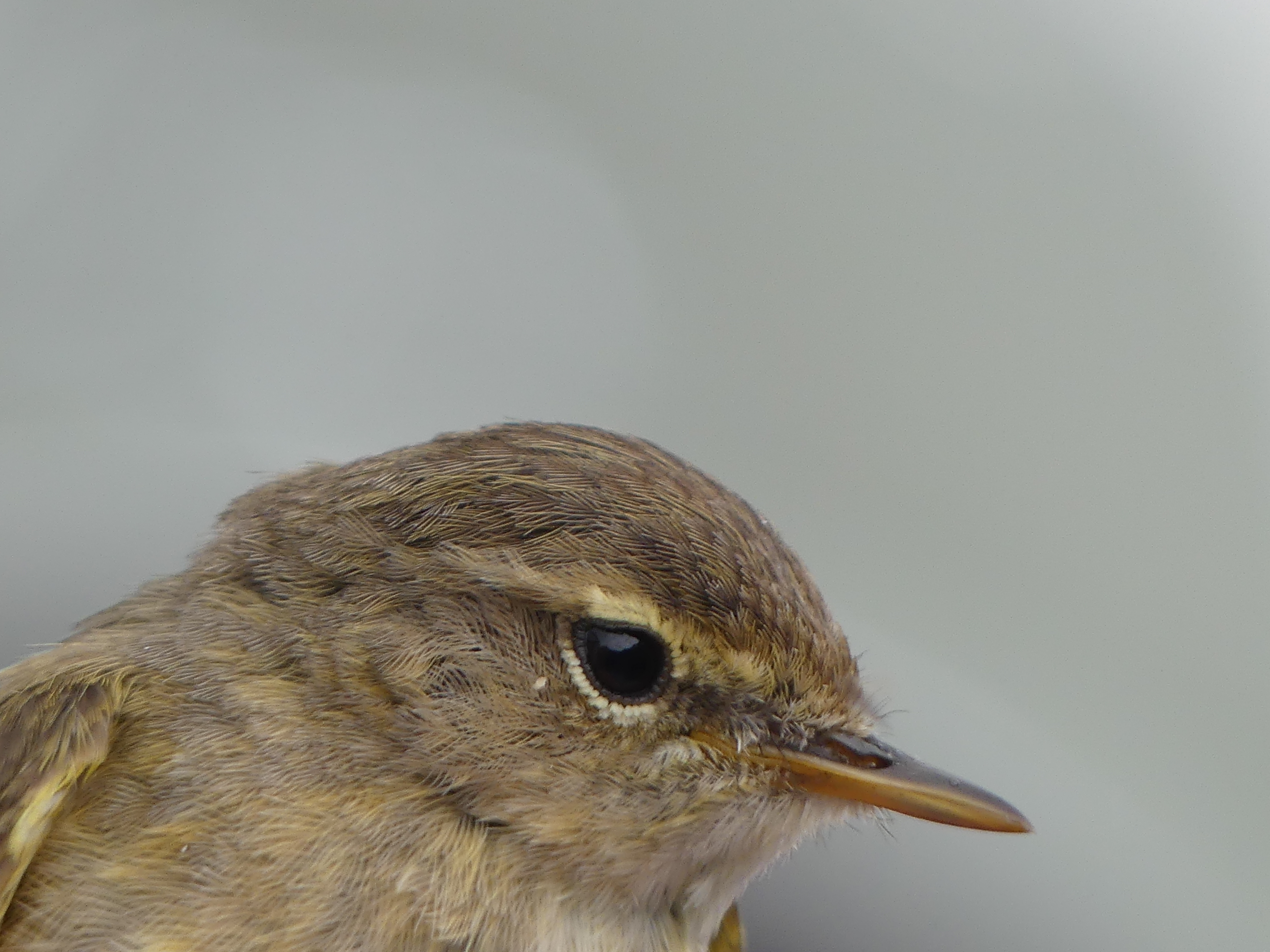
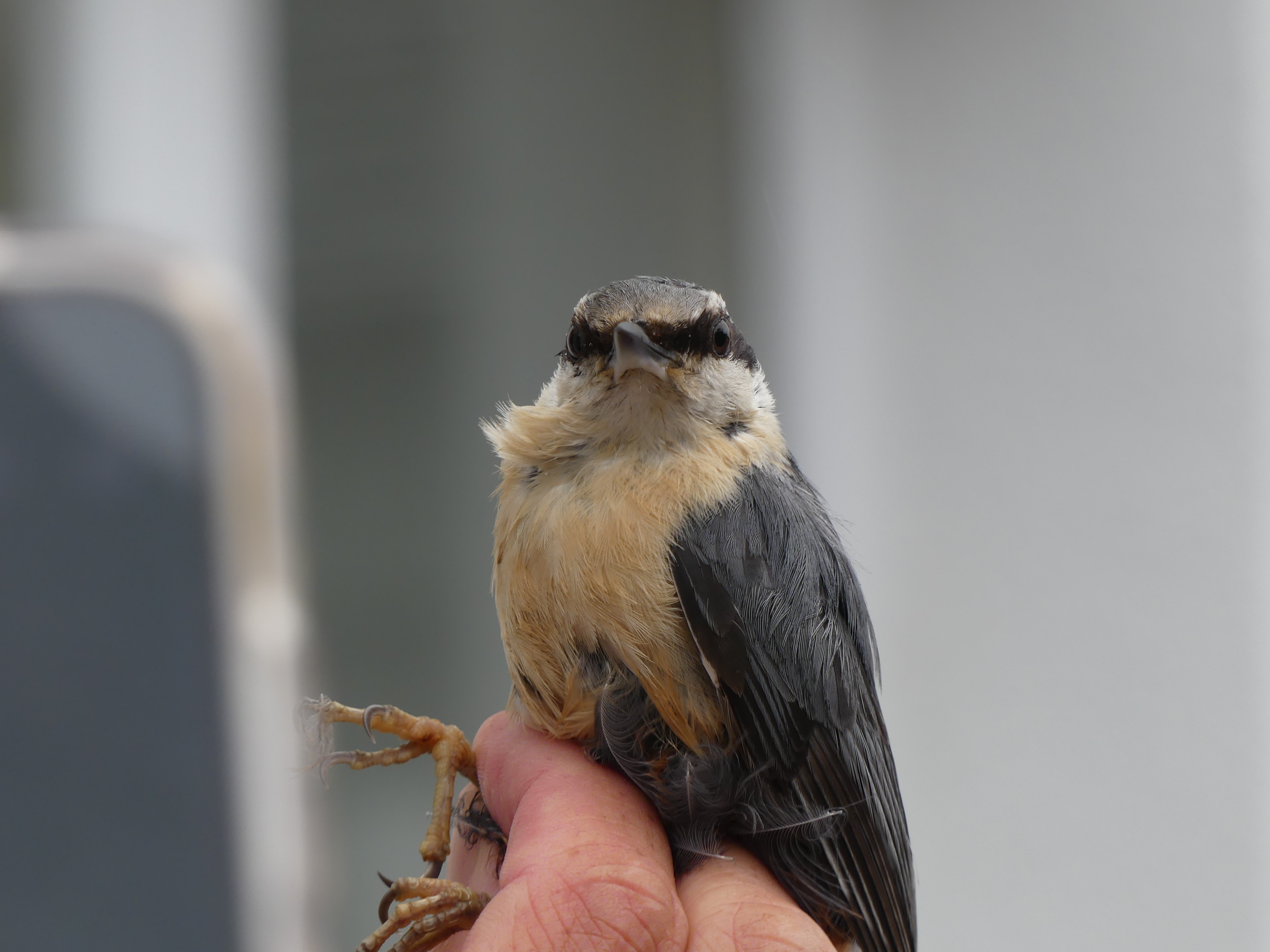
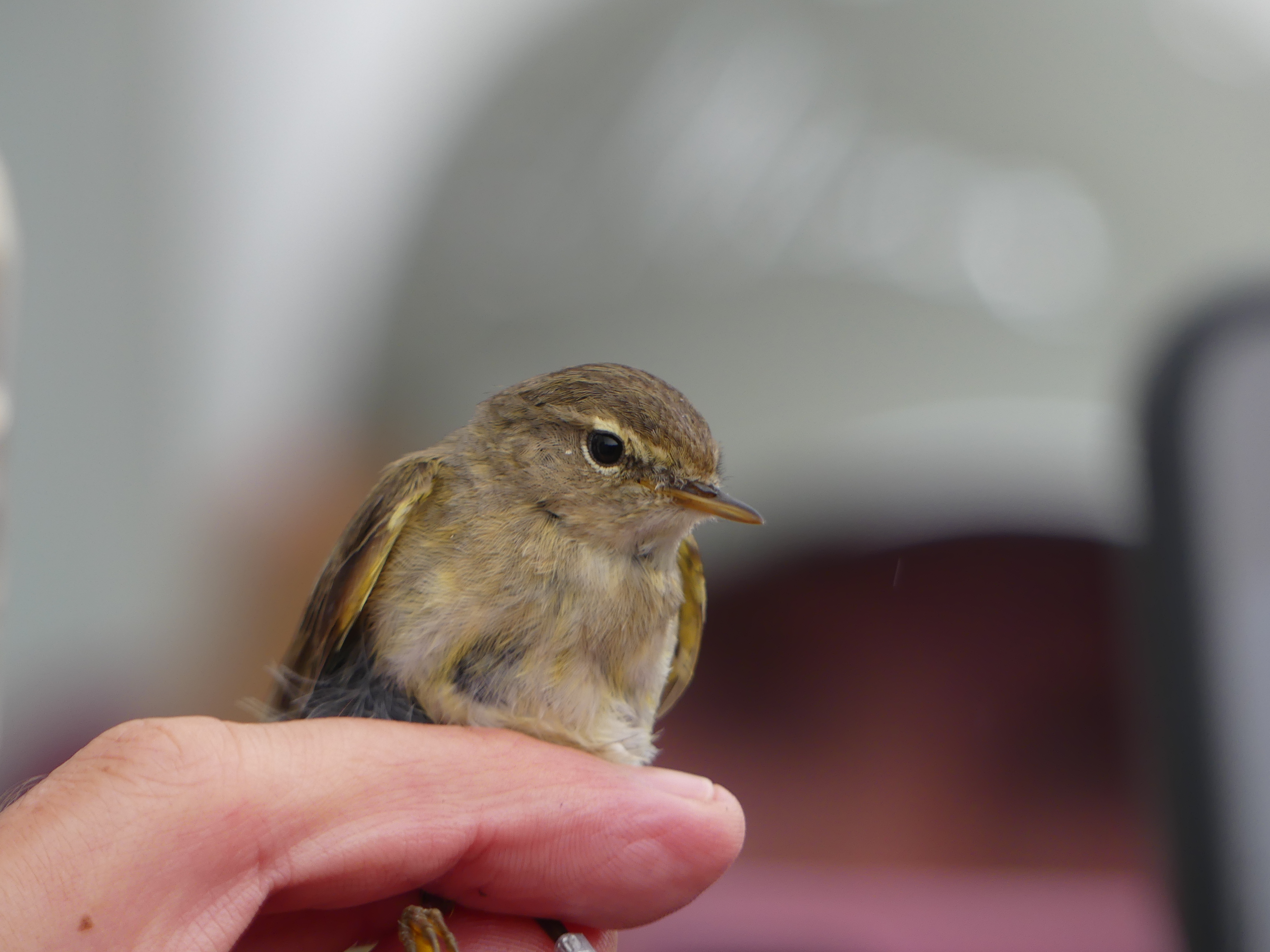
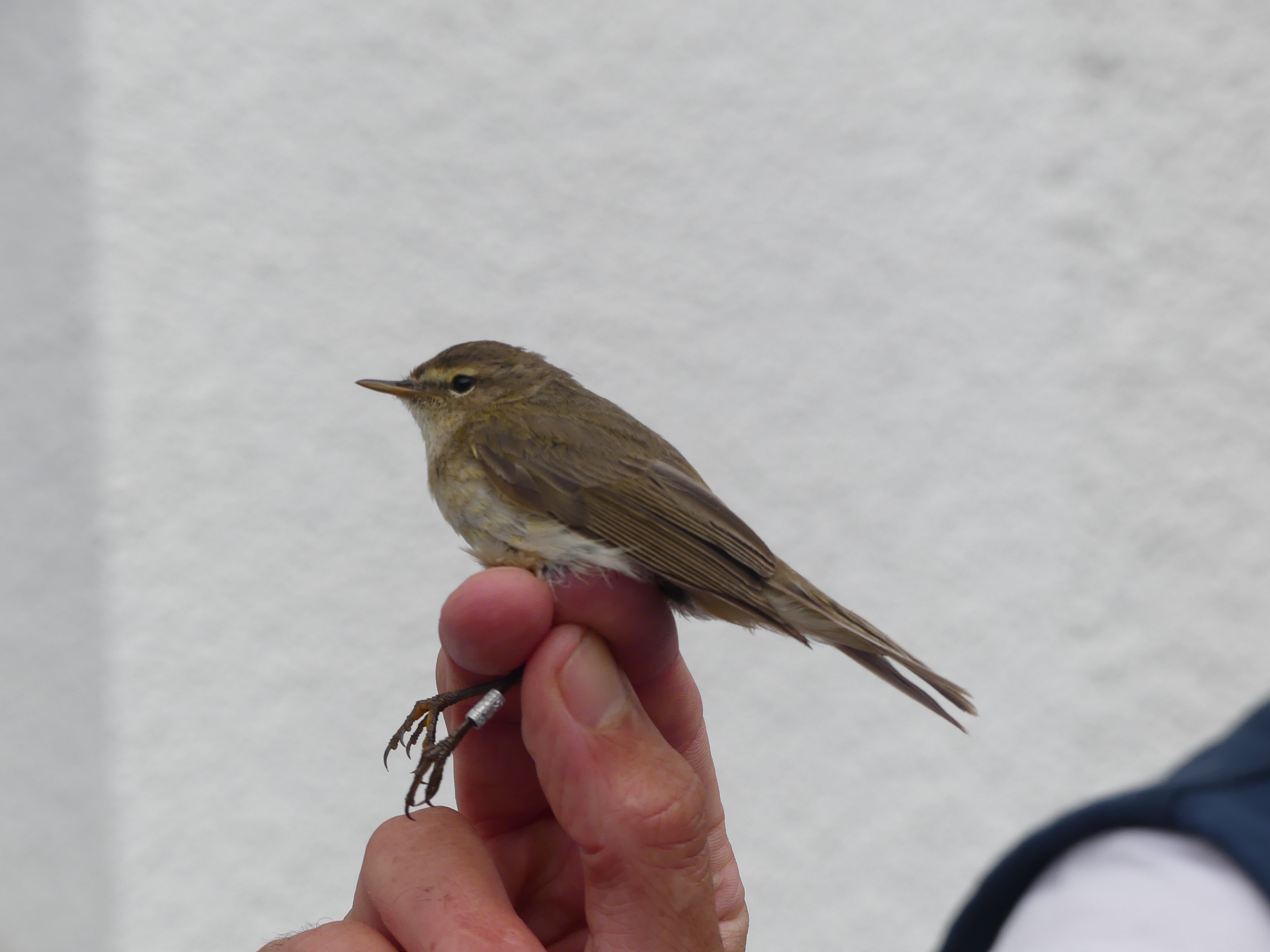
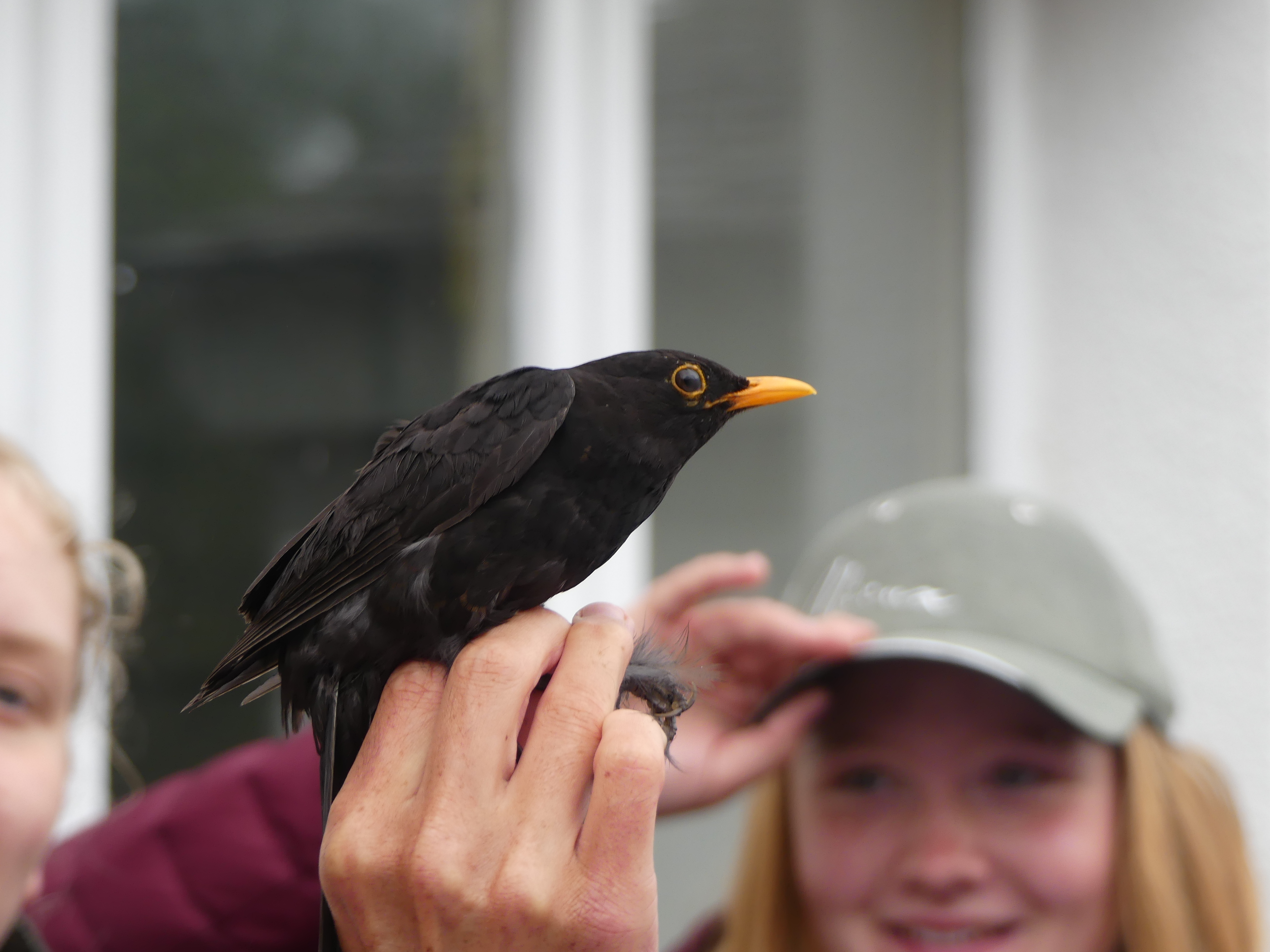
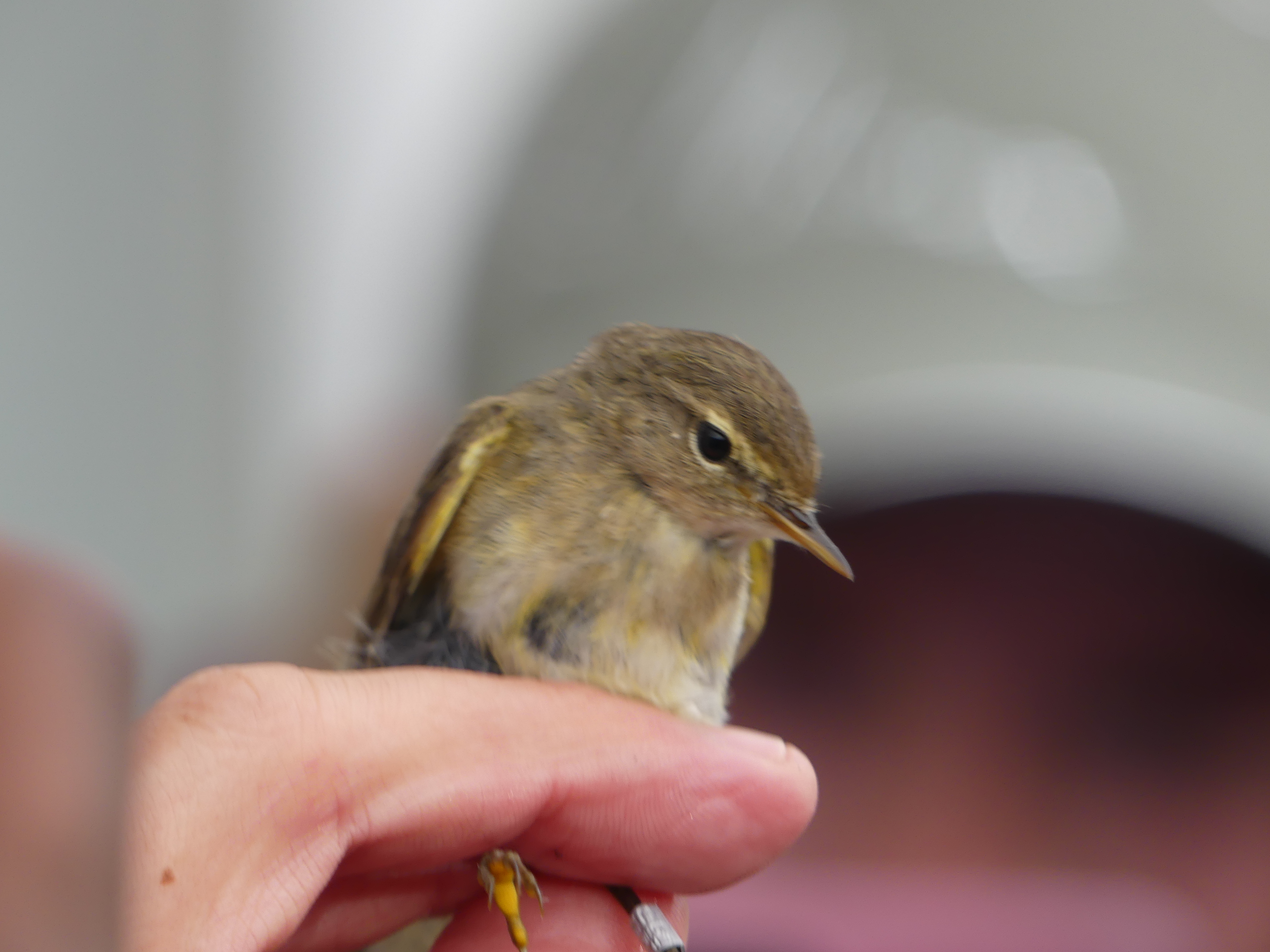
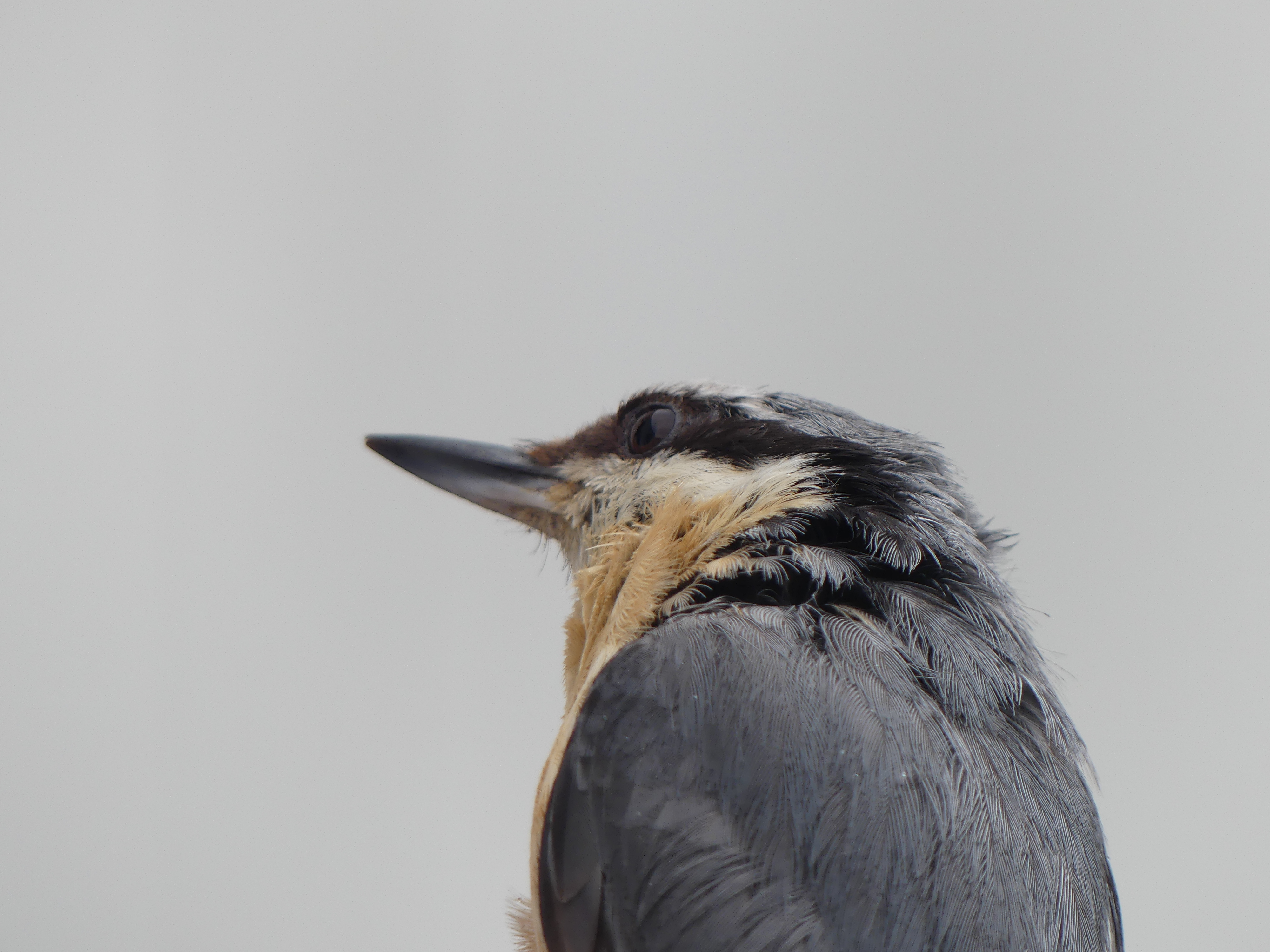
A Green Woodpecker’s undulating, cackling flight interrupted our unified trance, and just like that the Cuckoo fell silent. And now, back came Ian with several white bags, wriggling slightly, as their precious cargo adjusted their body positions. For me, the session went by in a blur. Blackbird to Blue tit, continuing on with a lovely Chiffchaff and a rather handsome Nuthatch. Weigh, measure, sex and age the birds. Its almost impossible to get up this close and personal away from a bird ringing expert, and with good reason too. You need a license for the handling of wild birds.
An example of our unique temperate rainforests, fenced off within a reserve to protect its fragmented state.
But RSPB Haweswater is no ordinary nature reserve. Just paces away lay the tree nursery, thousands of native British trees being prepared to be planted back out on the fells. From juniper to birch, these trees form the future of the valleys. The Lake District came out of the Ice Age coated in woodland, hosting wolves, bears and lynx, but due to our apparent desperate need for timber, there is very little remaining, to support our native birds and wildlife, but also to lock in the carbon and keep up the fight against climate change.
And adjacent to this centre of rebirth and hope lies a seemingly unremarkable long wooden building, narrow but comfortably furnished inside. We pile in to shelter from the now driving rain, and find ourselves in the Haweswater Badger Hide. From April to October, you can watch one of Britain’s most secretive mammals at point blank range, with photography opportunities rife. Albeit, there is a fee, but the donation goes to a brilliant, crucial cause!
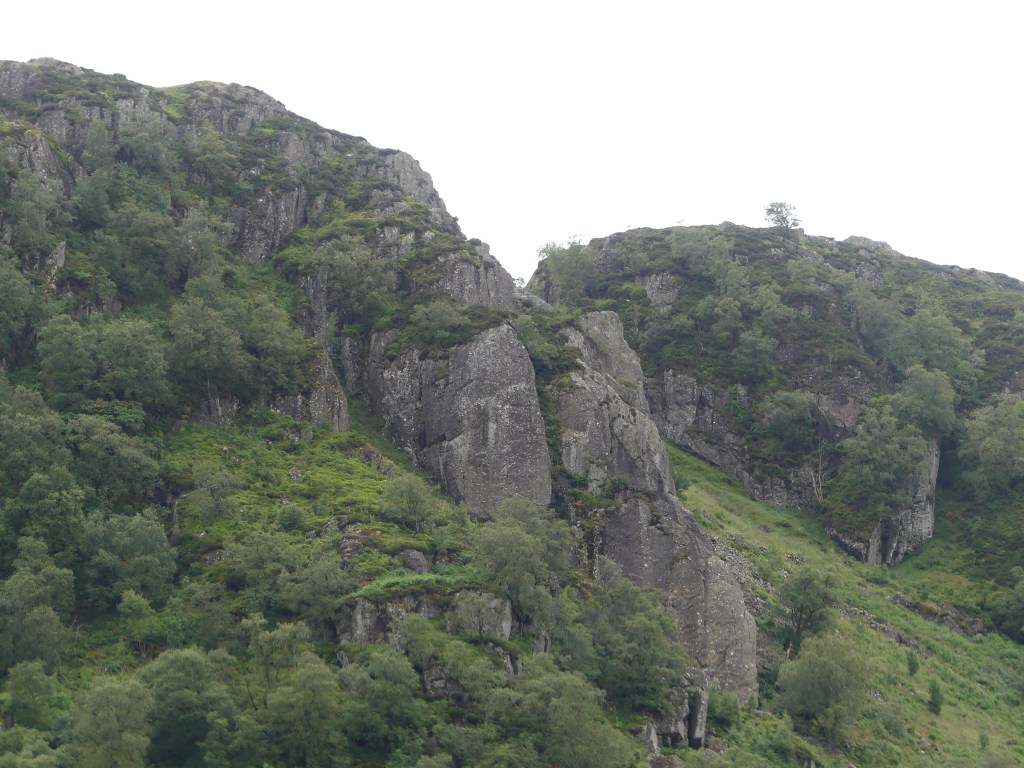
The rain in no way ends as we sprint for the minibus, and drive off on the pebbly track towards Swindale Valley, on the other side of the Haweswater reserve. Right off the bat, there is a gathering of young people centred on one corner of stone wall, concealed by a tangle of willow and birch. A gorgeous male Redstart, foxy-red fronted and grey backed, echoed by a Meadow Pipit’s parachuting songflight behind it. A possible Whinchat sighting has everybody on the other side of the track, but the bird’s disappeared in the thick green scrub coating the side of the road, before vanishing itself as the ground climbs into the ridge that forms this side of Swindale valley. By the way, the ridge is huge and precariously steep, but good habitat for many of the birds that make Haweswater its home.
The ridge’s side was certainly a dramatic backdrop.
When you think about it though, its hard to imagine this entire valley being wooded, like it was in its completely natural state historically. Without a single human hand laid upon it. This general idea of ‘moorland’ seems to us now abundant in small patches across the country. Dartmoor, Exmoor, the Cairngorms, the Brecon Beacons, to name a few. But the scientific truth is that this would have been an incredibly scarce habitat long ago, even more than it is now, because Britain was originally a wooded country. It was intended to be by nature, for its trees to flourish and create a vast temperate rainforest very rarely interrupted, from Axminster to Aberdeen. Us clearing it out did in fact create a new habitat, even if it was then earmarked for agricultural purposes. The wildflower meadows, moorland and wetland that we are trying to protect and restore may have been, to some extent, brought on by us in the first place. Today’s philosophical thinking for you.
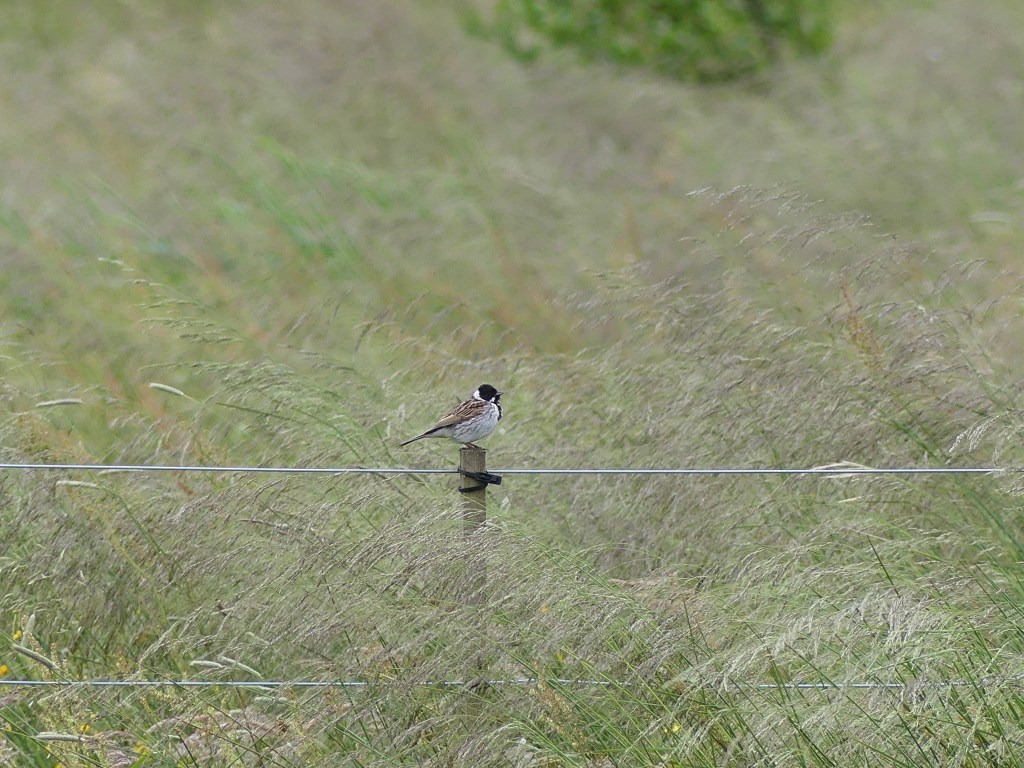
But back to the Swindale Valley and RSPB Haweswater. We began to walk deeper into the valley, Swifts and Swallows and House Martins actually swooping among us to much applause and admiration from the group. We pass several older farmhouses, which explains the abundance of all three hirundines, and now we were on the central groove that had been carved by the valley and the Beck, us being adjacent to the river among the wildflower meadows which surround it.
Reed Bunting in the hay meadows
The Beck had been straightened by those who lived there long before us, to reduce flooding on their crops. But this increased the risk of flooding downstream with only marginal benefits, and the river was restored to its former meandering self along this stretch (mostly), its history tracked by the silt and sand it left behind, all those years ago. You can still see the former, unnatural form of the river, a ghost that still haunts Swindale Valley. And its now that a Common Hawker appears, as we sit beside the Beck to eat lunch, a species of dragonfly almost absent from the south. And as its elongated black body floats past our faces, pockmarked with blue, its just a little bit special.
A dashing male Stonechat.
The hike back up the slightly less steep side of the valley heralds a pair of Carrion Beetles, jet black exoskeletons glistening in the sunlight focused by its misty lens. A Garden Warbler (unsurprisingly) warbles from a nearby shrub, accompanied by a dozen Chaffinches and a female Redstart, tail up like a wren, flashing its rusty underside. Redstarts were becoming one of our more dependable birds, with three sightings already over the weekend. It wasn’t one you’d particularly expect, but it’s certainly hard to not notice how much of a feature they have been so far!
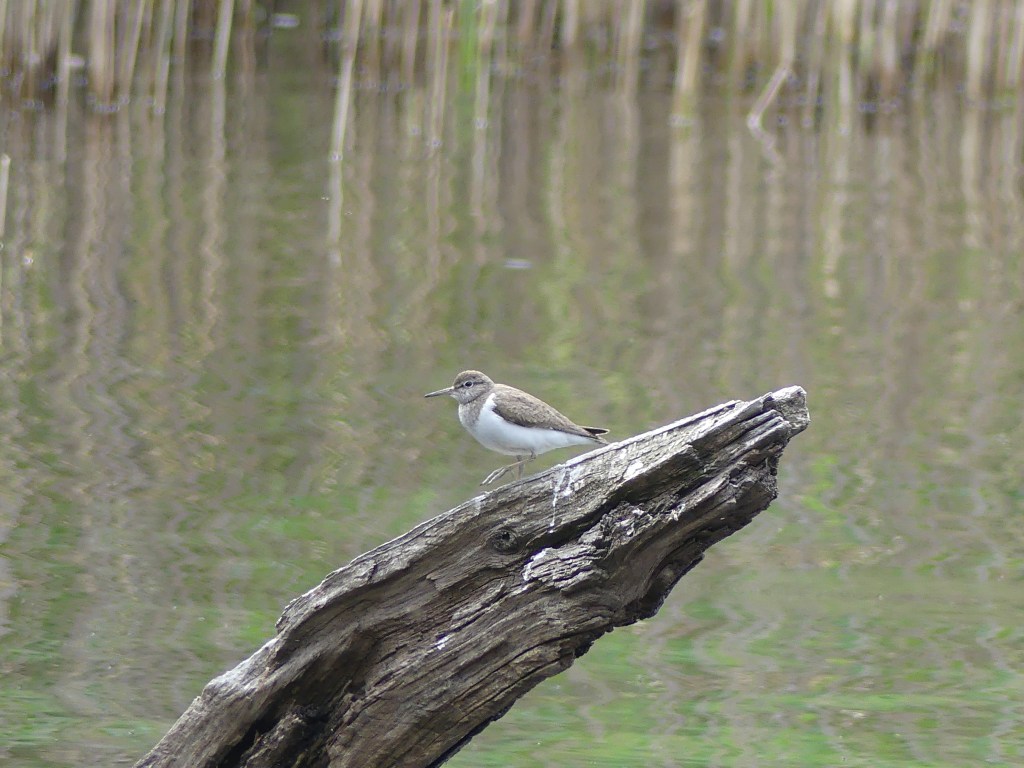
We doubled back on ourselves as morning wore into late afternoon, overrunning our loose plan time wise, but nobody was really worried about that. A late evening walk around Derwentwater, a two minute walk from where we were staying, would satisfy those who wanted it following the drive in the minibus back into the woods. The sun was setting as our slightly diminished party ambled down to the lakeside, immediately rewarded with a Common Sandpiper bobbing on a log that jutted sharply out of the rippling water.
A rather sleepy Common Sandpiper.
We circled the lake to get closer to the bird, a rather interesting prospect, when guess what handsome little bird flitted in, leaving its partner in the scrub concealing the lake from us on this side. A male Redstart perched proud and sung with a sunset backdrop, grey back and head dripping into a foxy red breast and stomach. What a bird!
A gorgeous male Redstart.
Just then, attentions were diverted once again to find a Red Breasted Merganser skittering to a halt on the water, stirring up the greenery below and causing its image to bloom to the surface of the shallows. Mergansers are one of our resident Sawbill ducks, so named for their ‘teeth’ which are revealed when they open their mouth. There are three native species in the UK, as well as the rare vagrant from North America named appropriately as the Hooded Merganser. Our other two have some more imaginative names; Goosander and Smew. I’ll leave you to puzzle out the motives of the namers.
Sorry for the bad photo!
After setting several Greylag and Canada Geese to flight with our sudden appearance on the gravelly beach, we trundled off back to the house, slipping on the slimy stone steps and pausing to admire the House Martins which built their mud cup nests beneath our eaves. The little blue and white faces peering out are set to begin their fledging routine in the coming days, and the adults are constantly swooping about, feeding them up ready for the big world. It would be quite a jump to get down from there though!
Not a House Martin, but a Swallow.
And after a game-filled evening and a lot more chat, bed was called for at around 10:00PM. Waking up that morning was something else, featuring a pretty rare bird for north-west England. Confirmed through the seven people present, Merlin Bird ID and google, as well as prior experience, a Firecrest was deemed to be calling from the dense woodlands opposite our window. Itself and the Goldcrest are the UK’s smallest birds, with the Firecrest weighing in at around the weight of an average pencil. The Goldcrest its a widespread and fairly common bird across the UK, even if they are a little hard to see, but the Firecrest is an elusive passage migrant and winter visitor, although it can now be found breeding in some parts of southern England. You’d have to be either lucky or slick to get good views of one, let alone a nest.
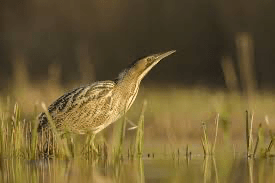
The day was Sunday, our last day at BTO Birdcamp. One last trip awaited us, but it could be argued that was the biggest and best one yet (I thought it was!) – we were off to RSPB Leighton Moss, England’s home of the Bittern. That’s not its only claim to fame, but its a pretty special one. The Bittern is a thickset heron, mottled brown and black like the reedbeds it makes its living in. One of our most secretive birds, it was pushed to the brink of extinction just decades ago, and at one point Britain was left with just 14 singing males. They have made quite a recovery since then, with 228 singing males recorded just last year. But what, you may ask, is their song exactly like? Well, take a plastic bottle and blow across the top of it. You should get a sort of booming noise. Now multiply its volume and range by about 100, and you get the boom of a male Bittern!
Leighton Moss, home of the Bittern.
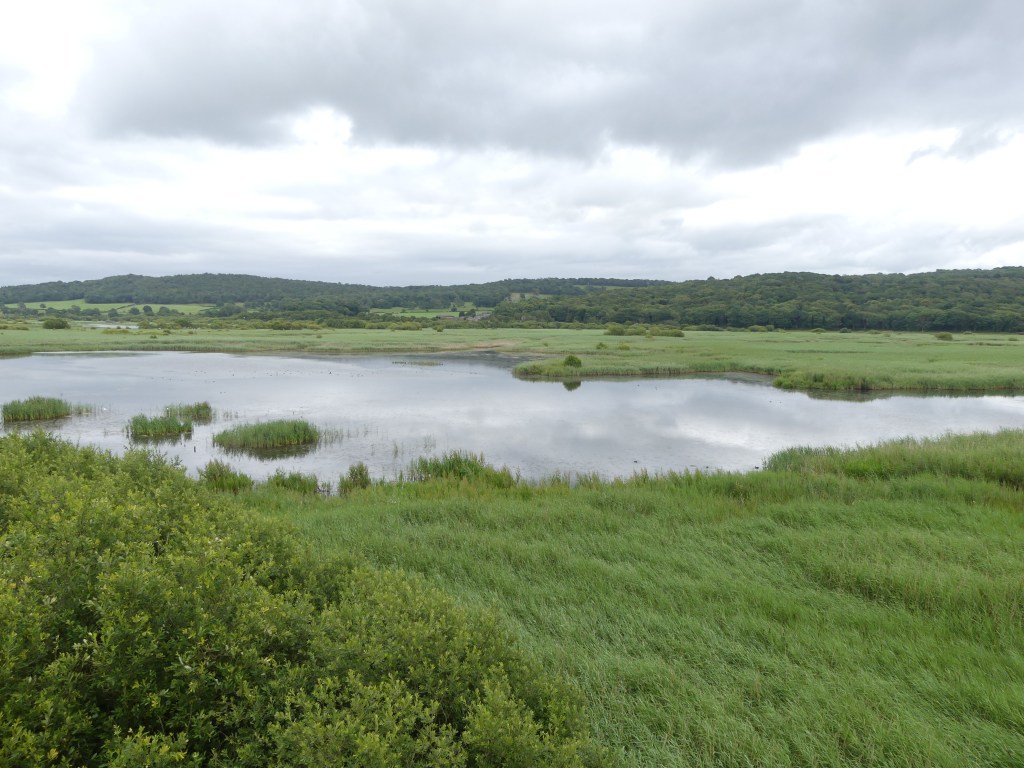
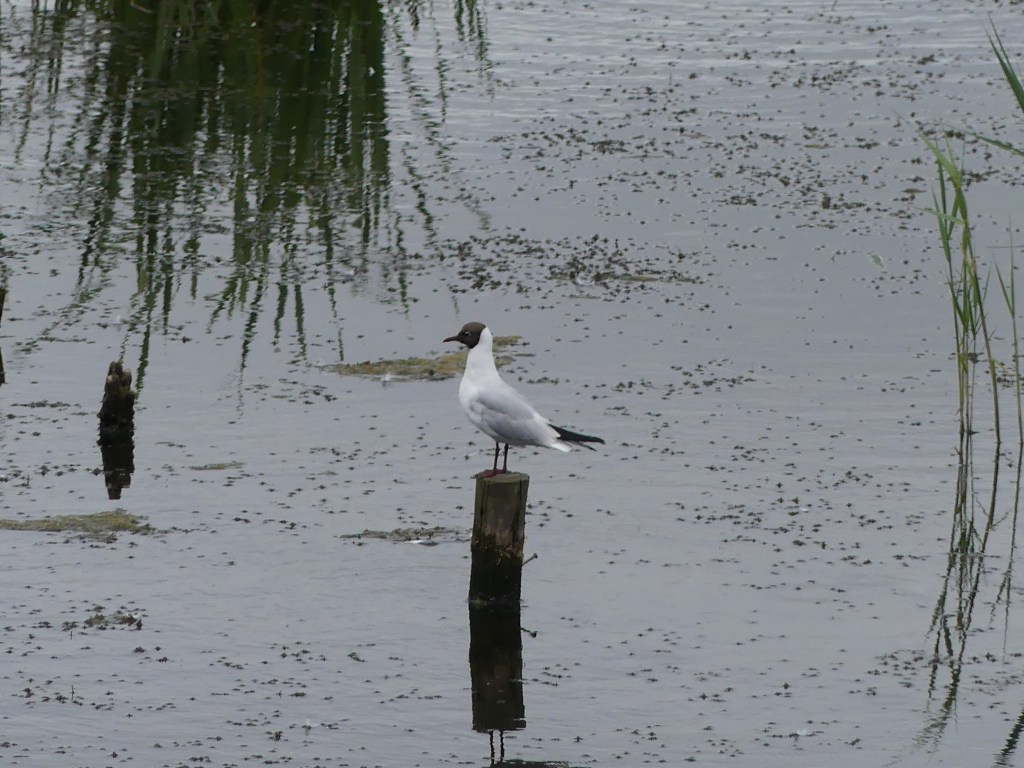
Leighton Moss is made up of a stretch of woodland sliding into the largest reedbed in north-west England, with the RSPB recently adding another 200 hectares to the reserve. From the top of the Skytower, it really hit you just how huge this place was, stretching from Morecambe Bay to where we stood now, at the top of a four storey viewpoint, and then even further. The pools in front of us, interspersed with the reeds, were dotted with Coots and Black Headed Gulls, with the explosive song of a Cetti’s Warbler slamming the air from a hardy, dense shrub hanging low over the rippling water. Every now and then, a Reed Warbler would complete its singing and leap from the reeds, before flying to its next vantage point.
Black Headed Gull
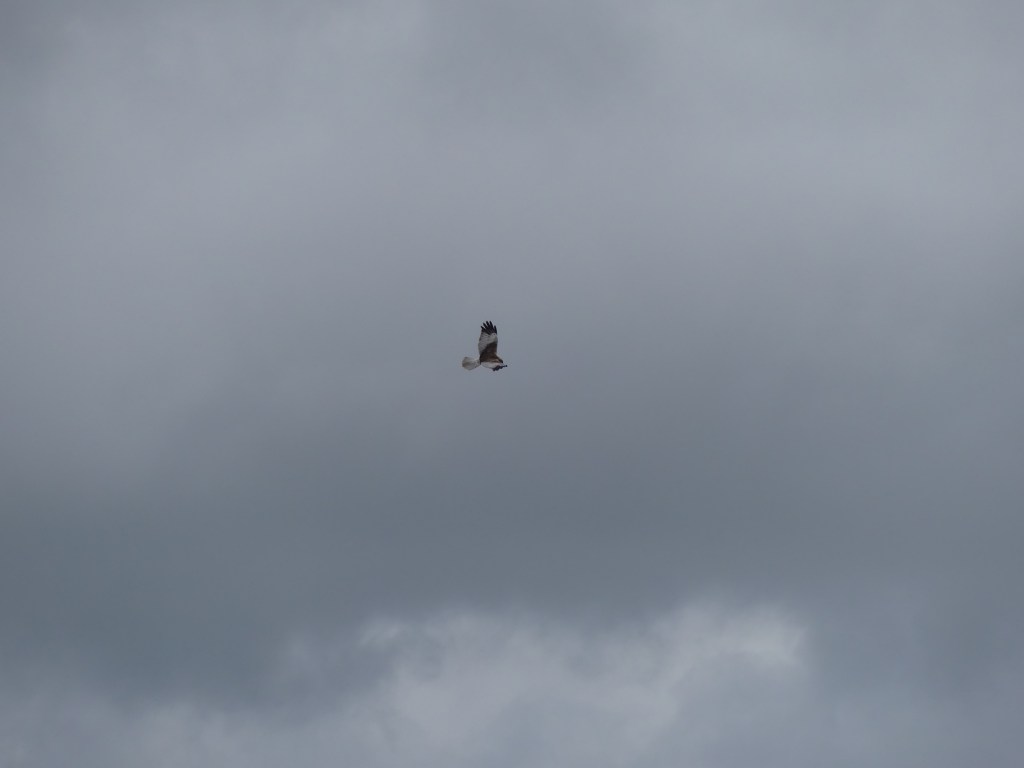
A distant flock of Knot, numbering a few hundred, rose up over the distant bay, identifiable by their size and the location. In winter, the wader flocks would grow tenfold, and would swarm the bay, feeding and recharging after a busy season’s breeding. Despite this spectacular, rolling distraction, a shout rippled through our party as a young pair of Marsh Harriers glided low across the reeds in front of us, the male rusty and grey, the female chocolate brown with a buffy patch on the head. I could count the number of times they flapped their wings on one hand, such was their graceful floating until behind a stunted beech. As they vanished, you would be forgiven for thinking that that would be the end of that. But another young male arrived, wings open and voice loud as it dived for the leafy tree, sending the defendant catapulting into the air to face the intruder.
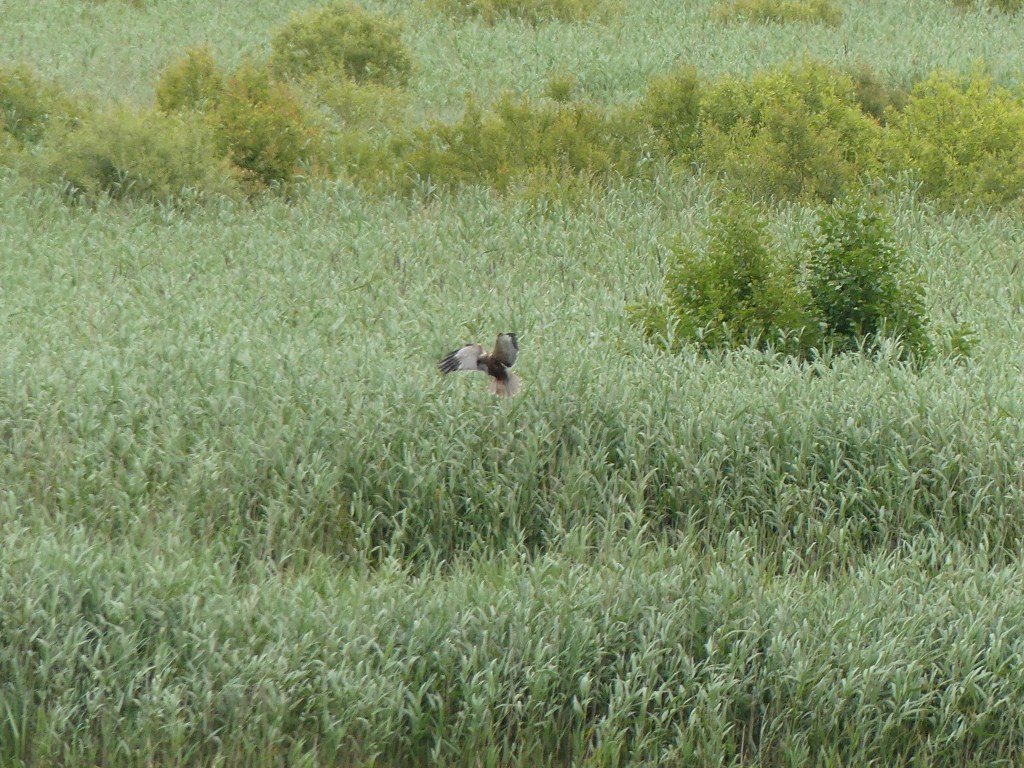
The male Marsh Harrier coming in for a landing
A mock-battle ensued, with the birds circling each other warily and occasionally jumping at each other with malicious intent. This was not destined to last long, and the challenger soon gave it up and flapped away, preceding an even more dramatic event. The remaining male plunged into the reeds, talons poised, and came up burdened with a small mammal, unrecognisable from this distance. As the male climbed up higher, the female appeared from the beech in all her glory, her plumage looking very much like somebody had just poured a drop of cream into their cup of coffee. She seemed to understand immediately, as the male abruptly dropped its cargo, directly into the upturned talons of his mate. A Marsh Harrier food pass! One of the Britain’s greatest natural spectacles (bear in mind that it is not unique to Britain or Marsh Harriers), had just happened before my eyes. The coordination that evolution had so willingly gifted them was astounding to witness.
The male preparing for the food pass.
After that, it was harder to tear myself away from the skytower than I had expected it to be, but we headed down a gloomily shaded boardwalk, surrounded by tree boughs and the poisonous flowers of Woody Nightshade, with the high pitched calls of Nuthatches emanating from above us, hidden by the leaves that shrouded the branches. The whole scene was in itself slightly eerie, and it was to a small section of my relief that we entered into the boards that cut into the reedbed, meandering its way between the swaying stalks that concealed everything from Bitterns to Bearded Tits. In the autumn, these birds that weren’t actually related to tits at all, will visit grit trays, needing something to break down the hard outer shell of the reed seeds they eat outside of the breeding season. Some of them are barely metres from the path, but for now we were satisfied with their pinging calls drifting from the reeds
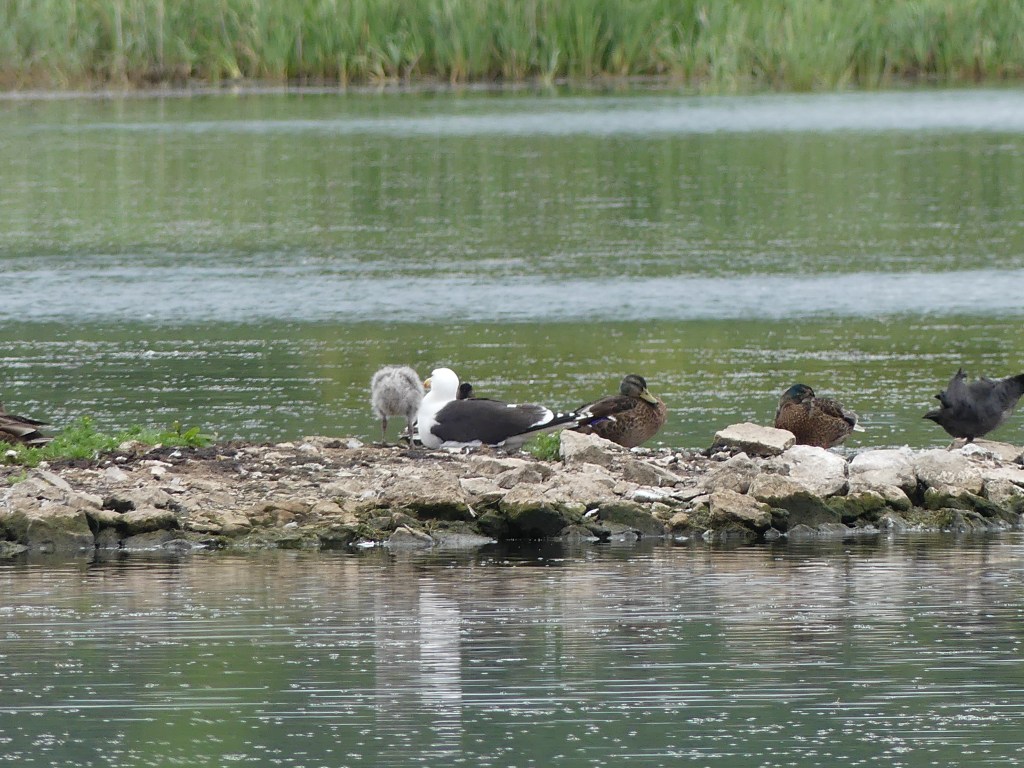
I swung my binoculars to the heavens, still glued to my eyes, when the first sighting of the Osprey rippled through the group. It emerged from behind the treeline just ten paces from us, banking right with M-shaped wings to wheel over us, drawing excitement from each and every one of us. At such close proximity, its large size was clearly apparent, this brutal killer of fish. At a distance, it’s often reminiscent of a gull, and when it fishes amongst gull flocks, its never easy to distinguish! Here though, it was simply massive, with its pied plumage creating a flashy contrast. When it finally wafted out of sight behind the same impenetrable treeline, our short walk to the Causeway Hide was complete, and we were instantaneously rewarded with a Great Black Backed Gull chick, easily dwarfing most of the Mallards and the Common Sandpiper next to it, exploring its narrow island under the watchful eye of a parent bird, agitated by the arrival of a Cormorant in mid swallow, a fish tail still sticking out of its gullet, and a large bulge in its neck.
The gull chick had its back turned, but you can clearly see its size!
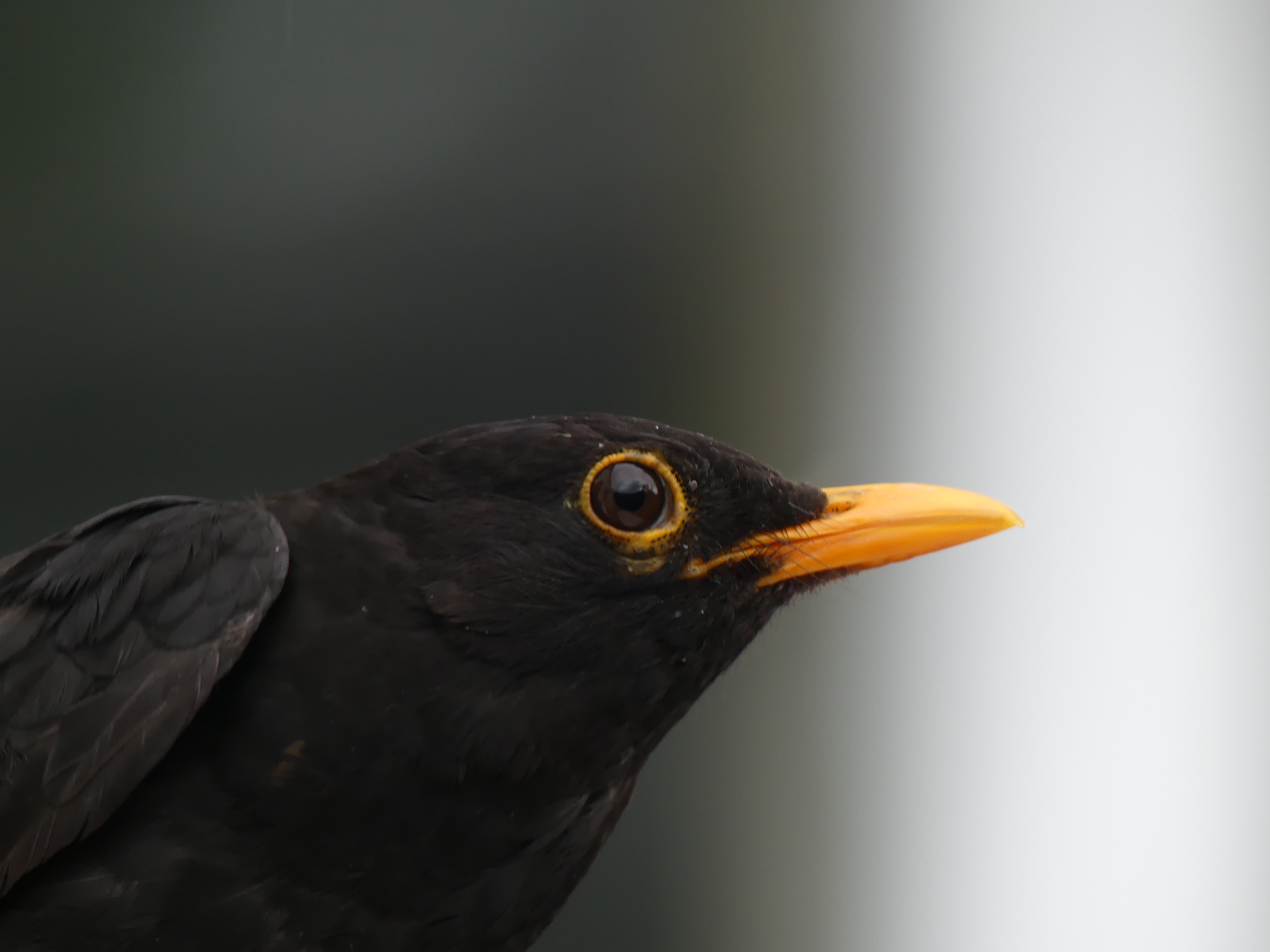
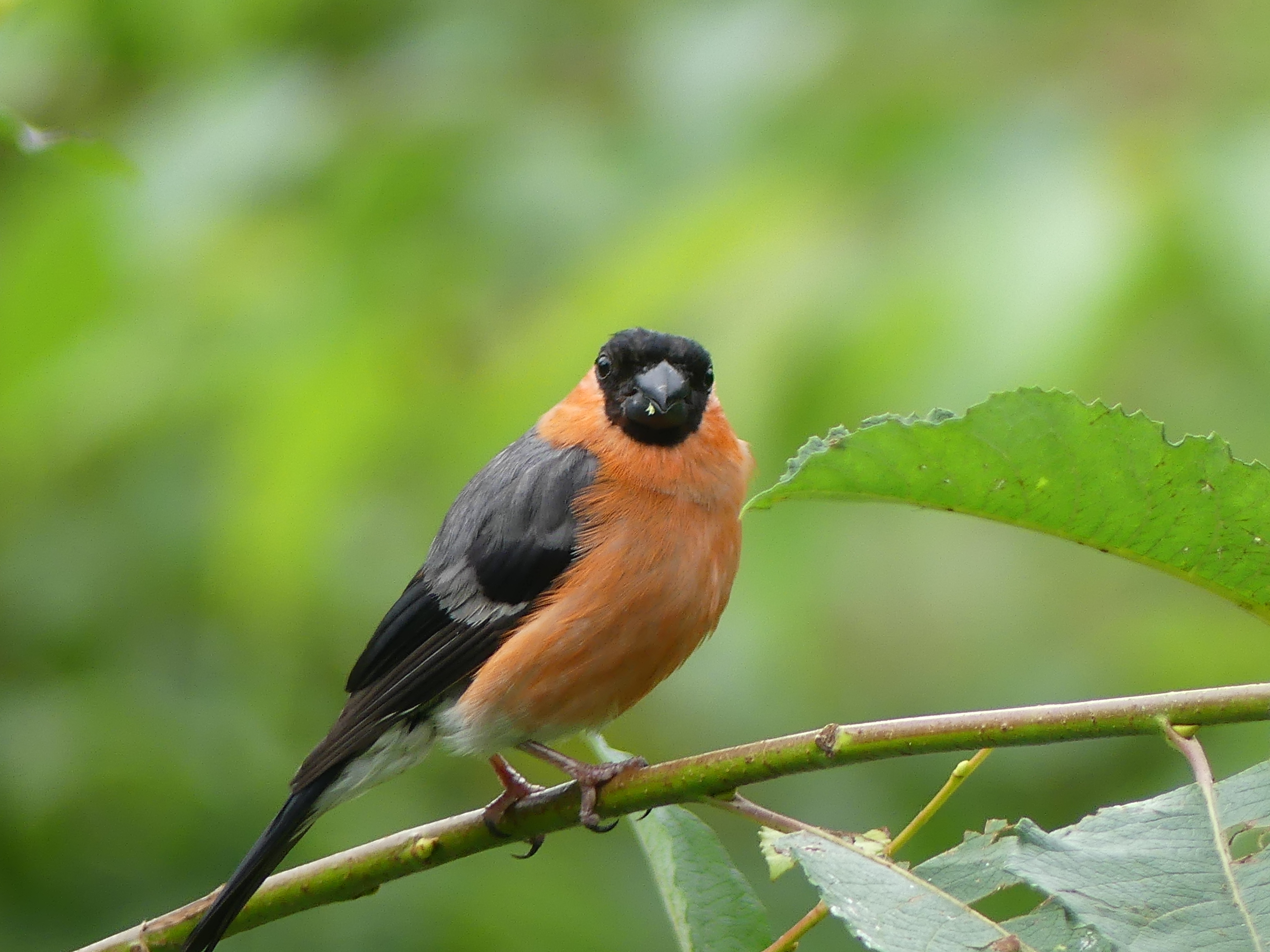
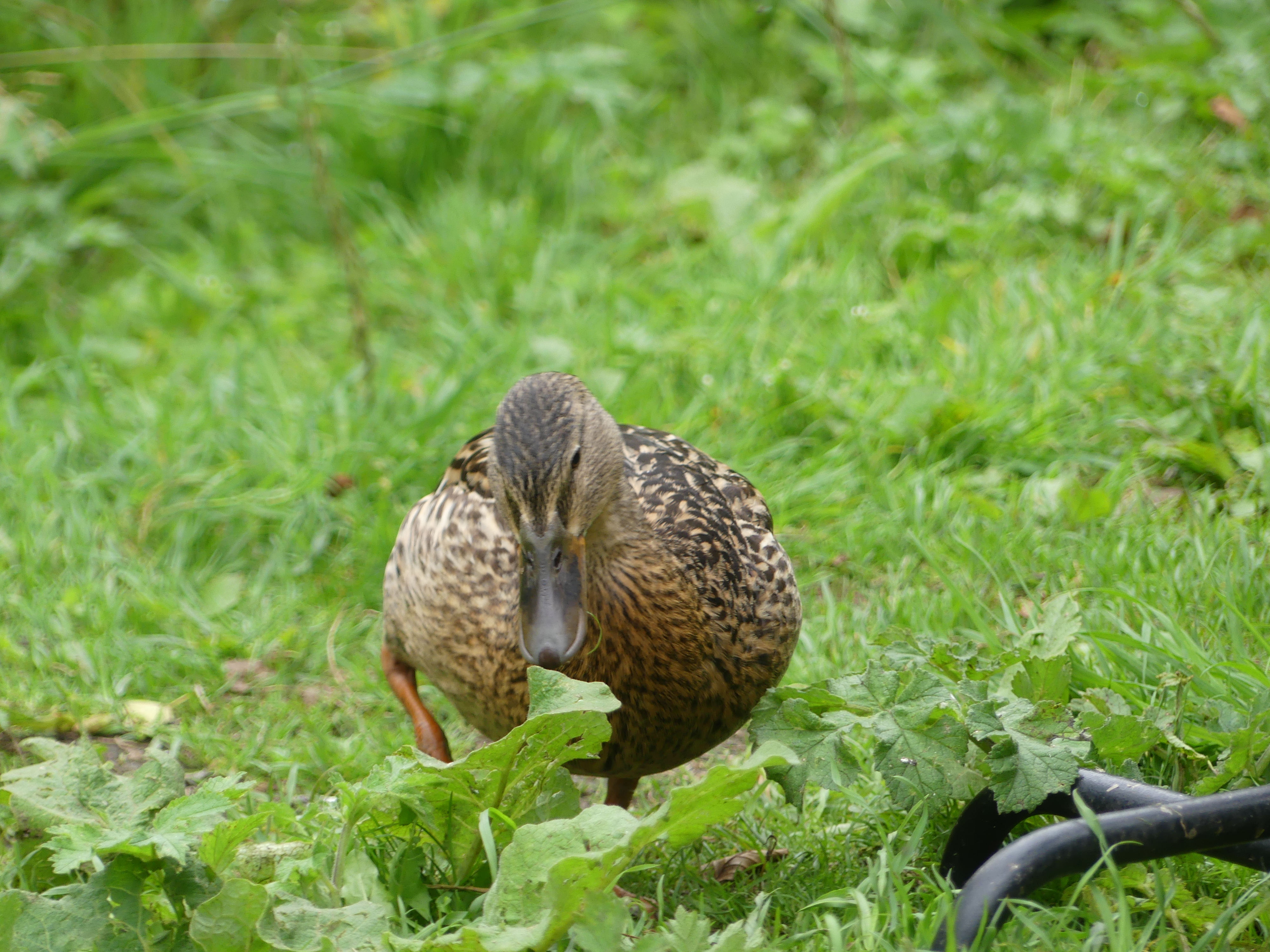
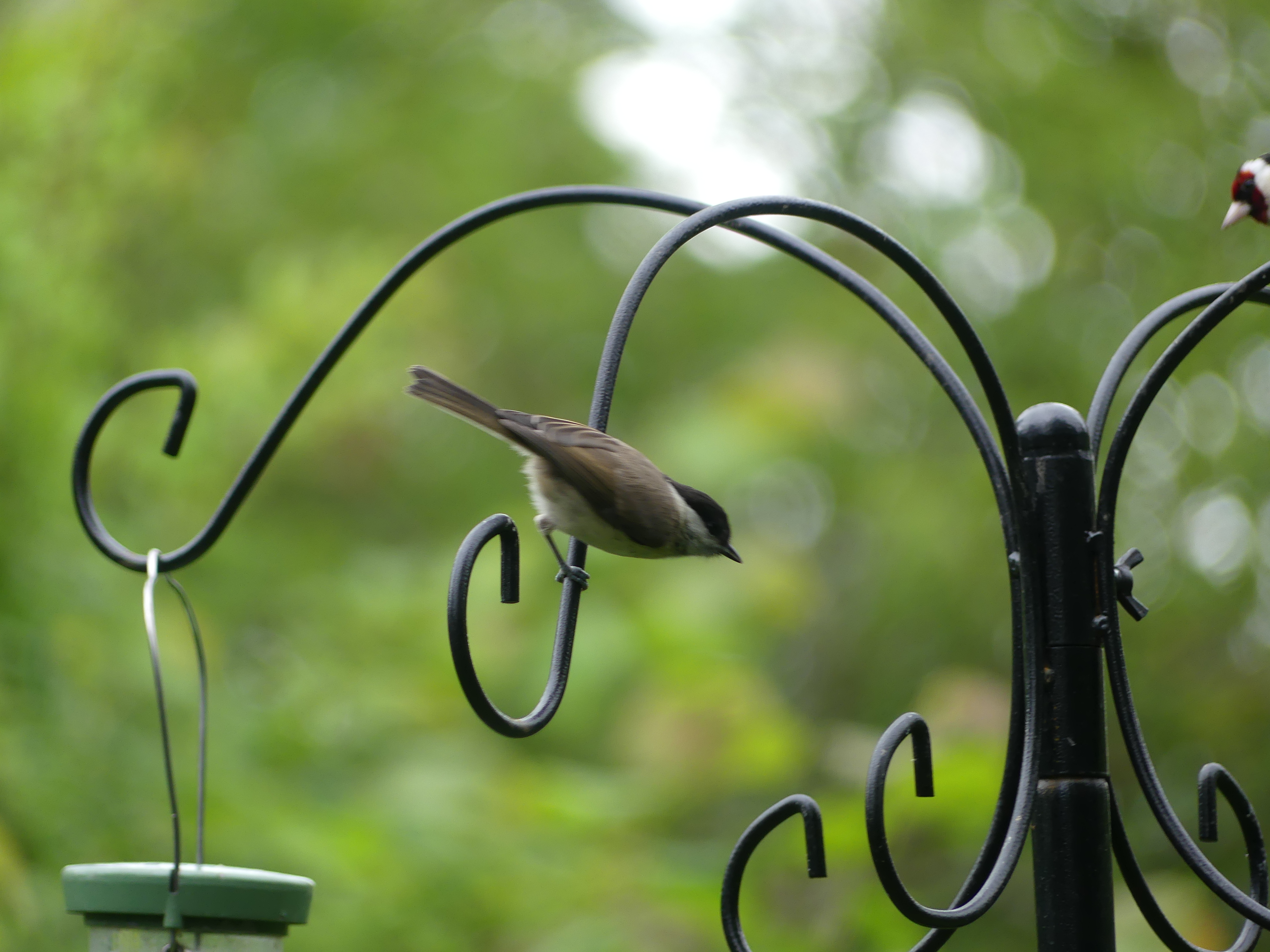
Back at the feeding station, 30 minutes before the official end of BTO Birdcamp, birds arrived at full throttle from every angle, with a rather unbothered female Mallard winding between our feet. Bullfinch to Marsh Tit to Robin to Blackbird, a Blue Tit and a Great Tit to a Chiffchaff and a Magpie. Everywhere, all at once. The amount of feeders didn’t help the dilemma my mind faced, with split-second decisions having to be made at every turn. Each bird posed fairly well for photographs, but it just depended on which one you wanted to go for. You’d have to be there for less than five minutes and you’d easily see over a dozen species! Young birds to mature adults, both make and female, diverged on the RSPB peanuts and sunflower hearts, until it became a sort of school lunch queue. Three in, three out. Three feeders. An almost uniform, patterned frenzy.
Here we found out that we had broken the official species record for BTO Birdcamp, with a running total of around 97 species (I didn’t do the counting). It was a bonus to an already unforgettable trip, a trip that had left an unspeakably special impact on me. And the birds jostling for position on the feeders emphasised this. The whole weekend had been for the birds, and meeting people who also liked birds. It was that simple.
But one of the other crucial takeaways from the weekend had gone a little deeper than our feathered friends, but it certainly involves a fierce love for them. So many people around the world have that love, that passion. I meet a lot of them via bird hides and reserves, but let me tell you a little secret. Easily less than 5% of these birdwatchers, birders, twitchers, whatever you want to call them are close to my age. And don’t even mention school, because nobody my age gets it there. When it comes to birdwatching, its important to learn from those around you and pick up from them. That’s a lot easier to do with somebody close in age to you, because everything seems just a bit less awkward than if you were talking to somebody twice your age. Please don’t misinterpret this and think I don’t like talking to adults, because I do. But young people get what its like to have so much out of your hands in this rapidly changing, modern world. That’s what I enjoyed the most about this weekend. Being amongst those who get it.
Next week I shall be setting off up the country towards the Cumbrian wonders of the Lake District, packed and ready to go for a weekend to remember. The BTO Birdcamp, part of a youth programme designed to inspire young people and create a desire to learn more about the avian world. And I’ve been lucky enough too be selected
But before we go any further, what is the BTO Birdcamp? Well, the BTO itself is the British Trust for Ornithology, basically meaning they keep an eye on everything birds in the UK. From conservation to public engagement, they do all the heavy lifting. The Birdcamp is one of the brilliant ideas to come out of their youth programme, and enables 14 young people, who following an application process, travel to a residential base (don’t worry, its not camping!) where they will live, eat and sleep together for the weekend. There’s one for every UK country, so that’s four in total. The Birdcamp is engineered to bring young people with a passion for the avian world together, and engage them even more with the natural world. And so they’ve been doing a very good job of it for the last few years. Here’s hoping it continues!
Nestled alongside the impressive Derwentwater, the home site itself promises large amounts of birding prowess already. By the way, I just want to clear something up; there is only one lake in the Lake District, due to the rest of them being classed as waters or meres (I was shocked too, don’t panic!). Right, let’s get started.
This is the second nature-based camp I will be embarking on this year, following a highly successful Wild New Forest Camp back in April. This one promises to be just as memorable as its predecessor, albeit in a completely different location, one ages away from our usual birding radius. But it will also offer a completely new habitat, with the Lake District’s mountainous hills interspersed with the highest densities of waterbodies in the country, not to mention the previously experienced heathland, wetlands and boggy mires. And with new habitats brings new birds, so fingers crossed!
The itinerary has been released by the BTO, and it seems jam-packed. I guess I’ll be tired when I return! From moths to bats, as well as the expected birds, early mornings and late nights are to be expected! But they give you enough time to relax and to stay inside, even more opportunities to break the ice and enjoy the camp with your peers. However, don’t expect to be on downtime for too long or believe me, you’ll be surprised!
Itinerary-wise, we will be branching out from camp to several brilliantly birdy locations, including Wild Haweswater and Leighton Moss, both of which the RSPB carries out crucial conservation work on. Leighton Moss is northern England’s biggest reedbed system, and is a haven for Bittern, Marsh Harrier and Otters. However, its range of habitats extends into saltmarsh, lagoons, shingle and woodland, as well as the less common but equally crucial habitat of limestone grassland. There’s so much scope for exploration and discovery, with the site being so huge it would take me days to absorb every single little bit!
Bitterns are thriving at Leighton Moss. Photo from the RSPB.
Haweswater is also an RSPB reserve, and as I mentioned before, we may be in the Lake District but this one’s known as a water. There’s not such a range of habitats here as Leighton Moss, but different ones, and with that brings different species to be watching out for. From the woodlands that are filled with the elusive Red Squirrel, to the Mountain Ringlet butterflies that glide through the alpine wildflower meadows, and the salmon that leap upriver in their effort to reach their spawn grounds. Avian wise, there is no less to look forward to with Ring Ouzel being the star species of these hills. But Haweswater also offers proof that we can find a way around the conflict between modernised farming and nature, with several active farms operating on the reserve. We’ll have to look out for the flocks of sheep and cattle herds!
But, similar to the last camp in the New Forest, I’m cautiously looking forward to being among those who just get what it’s like to be into birds. I know very few around me who can relate to such a love and passion for nature, and even then, they’re often adults who are easily twice as old as me. It’s always good to learn from experience, but it can be just as important to learn from your own peers, those your age who know what it’s like to be a young person in this modernised, rapidly changing world. And that’s what I’m looking forward to on this camp more than anything. Being with those who understand more than anyone.
To help prepare for the camp, the team got in touch via a video call to meet us personally beforehand, and they did that with everybody in the group, hopefully allaying any concerns. It’s a good practise for a camp-running organisation to get into, simply because it breaks the ice early on, and you have somebody that you know, even if slightly, a friendly face to say hello to upon arrival. They fill you in with an amply filled document, and include a full itinerary and accommodation details. Whenever you’re off somewhere away from home, you just have to know where you’re staying!
So, to summarise, the BTO Birdcamp is going to be an incredible new experience, even if I am feeling the nerves a bit. I guess meeting new people is always going to be like that, but a whole weekend of birds? I can’t turn that down. Stay tuned for a complete report following this weekend…
By the way, if you are reading this and looking to apply for an upcoming BTO Birdcamp, do take a look at the blogs that I’ll put out following this incredible weekend, and hopefully you’ll know what to expect.
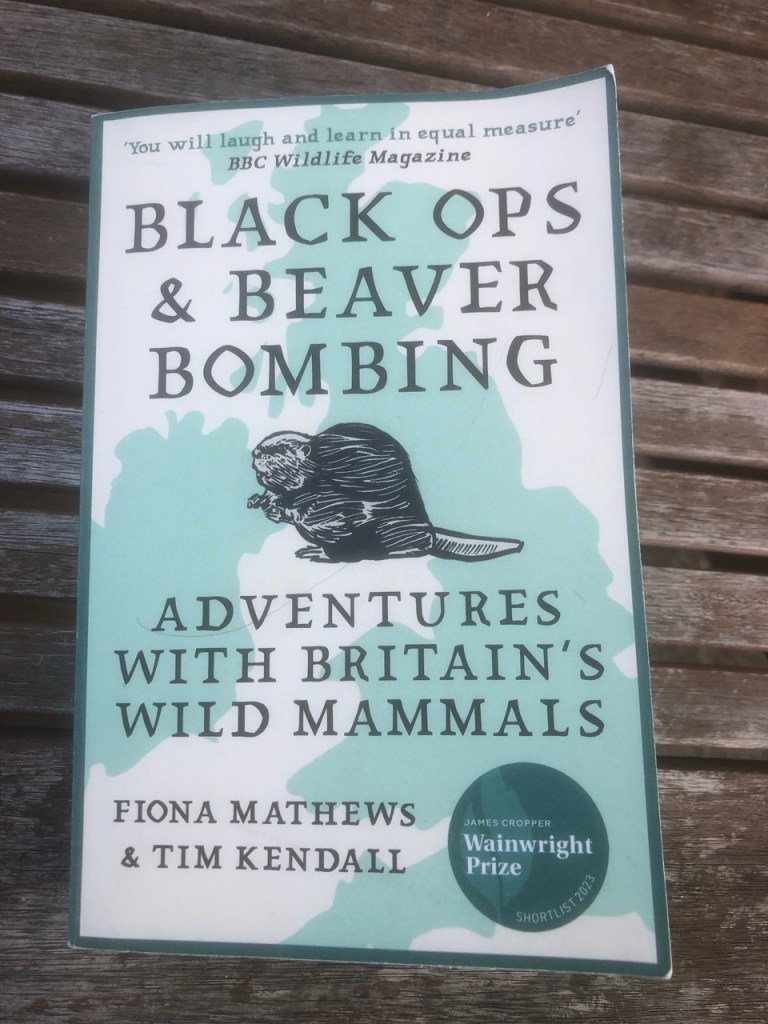
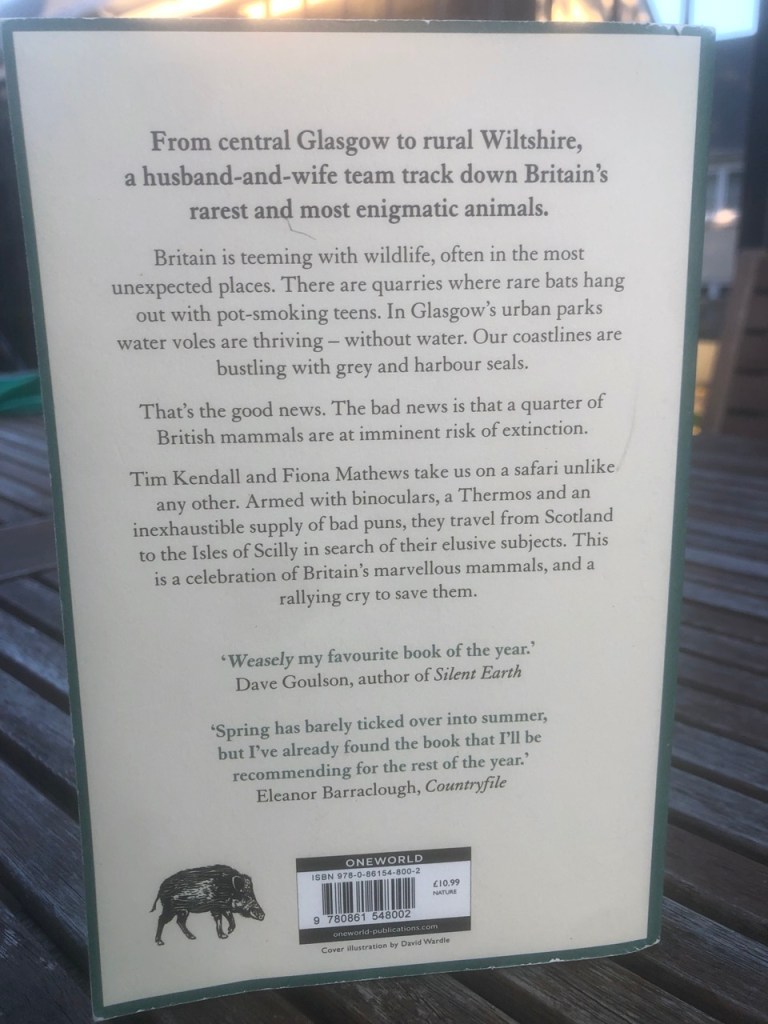
On a warm Spring evening a few weeks ago, I was sat inside Grace and Favour Home listening to a book talk, organised by Leslie at First Draft Books. The book was of a peculiar title; Black Ops and Beaver Bombing. The former was certainly an unexpected mention for a book on Britain’s mammals, but the second completely showed it up oddity wise. Who’s been bombing beavers? I mean, I know they’ve been a bit controversial with farmers since their reintroduction, but surely this was a bit drastic? Who would hate such a crucial keystone species this much? I can gladly tell you that it wasn’t meant as literal as you might expect, but all will be uncovered in this review of Black Ops and Beaver Bombing by Tim Kendall and Fiona Mathews. Read on…
But, back to the actual book talk, there were at least 30 people in that one room, all intrigued and expectant, young and old settling down to listen to the witty, anecdotal and brilliantly well-presented words of Tim Kendall and Fiona Mathews. They shared readings from the book, wonderfully surprising tales and the pros and cons of the proposed solutions to our scores of natural crises.
So, lets kick things off with the front cover. A calmingly pale colour palette, together with a flawlessly drawn Eurasian Beaver make for an intriguing beginning, and a map of the British Isles complete with curved edges gives a sense of what the national setting for the Black Ops will be (hopefully not the literal Beaver Bombing!). Its also helped on by a subheading titled ‘Adventures with Britain’s Wild Mammals’. If you haven’t already got my hints, the book is based in Britain.
The 10 chapters of the book give detail and factual truths, combined seamlessly with some of the wittiest (and some of the worst) jokes relevant to Britain’s mammals. If you’re looking for cracker jokes, here’s your chance! But, on a more serious note, it really is a beautifully written book, and highlights the impactful and gripping stories, cliffhangers and romantics carved by these animals and our relationships with them.
And this book came out in expert timing, as many of the creatures that have learnt themselves chapters are, in Britain, struggling. Whether its, umm, accidental reintroductions or mass culling to prevent a 0.000001% chance of disease being carried by them, which may also have a 0.00000000000001% chance of being transferable to humans. So basically, we have done a lot of damage over the last few centuries that we now have to reverse.
And now a little segment on the authors. Fiona Mathews is Professor of Environmental Biology at the University of Sussex, and is the Founding chair of Mammal Conservation Europe. She spends a lot of her time advising the Government of various pressing conservation issues, and is also author of their official British mammal census. She had some good experience before writing this book then!
Then there’s Tim Kendall, Professor of English Literature at the University of Exeter (a little bit closer to home), and he also had prior experience to writing Black Ops and Beaver Bombing, as an author of poetry and literary criticism, as well as editing Britain’s Mammals 2018. Him and Fiona live in East Devon, with two daughters, two rabbits, a Labrador and a rehabilitating Common Pipistrelle. And with good reason too, for Devon has many wonderful mammal highlights; the Greater Horseshoe Bat has declined by 90% in the last century, and has chosen Devon and the south west of England as its stronghold. There is also discussion of a new Pine Marten project on Dartmoor, but it just depends on whether the habitat and inhabitant requirements can be met. Hopefully, we’ll be seeing these charismatic creatures make their Devonian return very soon!
But now for the moment you’ve all been waiting for. The exact definition of what is meant by ‘Beaver Bombing’. Well, one of the strangest stories I had ever heard was shared by Tim and Fiona during the talk, and it involved a plane, the state of Idaho and crates full of beavers. In the 1950s, Beavers in the wilds of Idaho were struggling under modern pressures, many of them by human creation.
So, Fur for the Future was launched, an animal translocation project quite unlike any other. Beavers were trapped from various other sites where they were faring well, and were sorted for even size and weight, before being loaded into a plane, enclosed in crates that came with their very own parachutes. The planes were used due to the struggle it would take to get to the release sites on foot or by car. So the craft flew over the release site, which were just as you would probably imagine an American wooded wilderness to look like.
And finally, the crates were dropped, and broke open on impact (they were designed to do this, and posed little risk to its precious cargo). The Beaver would go off in search of its favourite habitat, a river or stream to make its home (don’t worry, they were always dropped purposefully close to these kinds of sites). And that was that; The Idaho Fish and Game Department were doing some good for wildlife, even if a lot of it was for fur and hunting purposes, and the beavers were happy in their new homes.
I highly recommend the book, equally as an enormously beneficial source of learning and a humorously enlightening read. It has received brilliant praise, and quite rightly, as it is a simply wonderful book, a ray of light on any shelf. I also recommend taking into account the wise words of these two, as they sure know what they’re talking about when it comes to expertise in the area of Britain’s, and indeed the world’s, mammals. Enjoy the book!
Spring at Emsworthy Mire was exactly how I remembered it, bringing on a wave of younger nostalgia; crisp wind, stone wall snaked valley and parachuting Meadow Pipits wherever you looked. Following one plunge into the heather, was as exhilarating for me as it must be for him, so small, yet powerfully prepared against the air it plummets into. There’s always at least something here to take joy in and experience, whether its attempting to prevent yourself from toppling in the wind, or vaulting walls and fences, in search of new lands.
Abruptly, I came out of my trance. A Wheatear, grey and proud, stood on a flatly curving granite rock, one of Dartmoor’s famed traits. Just paces away from it, a pair of ears stamped in children’s folklore emerged from behind a tussock, fluffily brown and long. I looked away for a moment, and continued the steep stroll down towards the wooden barred gate. When I looked back again for another peek, the Wheatear had chosen to position itself directly in front of the rabbit’s curious nose. It seemed an unlikely occurrence, and since both creatures seemed lazily oblivious (or was it accepting?) of each other, it seemed fitting to begin that Wednesday evening.
Forget the Tortoise and the Hare; there’s new racers in town.
But I was again pulled away from an unnoticed spectacle, by the call of a countryside icon. Left to the ages through the pages of legends, the intriguing call flew high on the wind, its amplitude signalling its close location. Slightly eerie in the relative mist of that night, but welcoming enough to attract me almost magnetically across the moor. The second gate would, to my every frustration, not open (or perhaps it was my slight weakness), so I clambered over it in desperate excitement, and sprinted as fast as I could, due to the weight of camera and binoculars, down the hill until I bumped into a collection of shapes that I deemed to be my family.
And there, just 10 paces away, was the hallowed bird, grey and dignifiedly elongated, as if it knew it was the centre of human attention. Contrasting starkly against the bright green flourishes of boughs laden with new growth, it obligingly flicked its tail to the points of the compass, picturesque above the deep cerulean.
CUCKOO!Cuckoo continued
Its call became a chorusing conversation as another bird answered its cries, and it provided an acquired taste of a choir as we walked, cutting across the valley towards the barn, flanked by wisened lime-green trees, and on one side by thoroughly spread nettles.
Which leads me on nicely to the groundbreaking new research on female Cuckoo’s, and their productivity in egg dropping. Two morphs of Cuckoo exist (plumages, colours); a grey one, reminiscent of a Sparrowhawk (if you do see a Cuckoo in flight, its easy to see the similarities. At a distance, its also easy to mistake for a pigeon); and a rufous brown one, speckled and rather unremarkable. Studies show that the rarer morph in the area tends to be the more successful, as the host birds gradually become wise to the trick, and more wary of potential smugglers. The grey morph has the added bonus of looking like a predator, a sparrowhawk, which discourages the host bird from getting too close while the Cuckoo is around. But generally, the former is true; whichever morph is rarer, grey or brown, fares better within that area. Thank you to Sue Williams of the BWWC for getting me on to this quite brilliant research. Take a look at the article here.
Side by side example of the two morphs: Photo from the Advanced Science Research Centre; The Graduate Centre; City University of New York.
It really seems amazing that evolution can create this seesaw, back and forth between populations that thrive and might eventually struggle. Imagine an entire population of the males and females of the grey morph. The population is thriving, but the host birds are slowly evolving to recognise this troublesome species. One day, along comes a bird of the rufous brown morph; suddenly, the hosts are caught unaware and over many generations, the browns begin to outnumber the greys through their sly success. But soon the population becomes all brown, and its success begins to work against it. The host birds again become wise to this morph. Along comes a grey morph bird, and the whole process begins again. Its almost like evolution works against the Cuckoo, trapping it in this pendulum that swings over centuries.
Abruptly, the Cuckoo call was interrupted by the bubble of a bird clinging on by a thread here on Dartmoor. The upland breeding birds have plummeted in population here, from Dunlin to Dotterel, Golden Plover and Pied Flycatcher. We even once had Black Grouse here, lekking in the dawn air. But it was clearly not to be according to agricultural pressure, and now here we are. Some of the last pairs of Curlew left on Dartmoor, and we were hearing one of those birds right now. A call that should have released so much happiness and curiosity, now brought melancholy shame on the British population for suspending it from the precipice, when just decades ago it was miles away from the edge.
There are of course, projects in place to bring back these once commonplace species, but we have pushed Dartmoor to its utter biodiversity limits, and I am afraid we are about to push the whole national park off the same precipice that the Curlew is desperately clinging to. But there is still time. I feel like I should leave the topic here, but I hope the thought stays in the back of your mind.
Emsworthy Barn
A Pied Wagtail alighted on a rogue stake, rotting underneath. It made the right decision in abandoning this precarious perch, and flicked onto a rock, miraculously holding its tail still (it is a phenomenon I am never likely to witness again, such is its rarity!)! The sunlight caught its back, glinting off the pure black feathers. I’ve recently mused on how black and white birds fare in direct sunlight. If black conducts heat and holds it, while white deflects it, surely it cannot be a pleasant experience? Yet a number of birds use this plumage, from the humble Magpie to the originally named Pied Flycatcher (guess how this bird feeds), so therefore the logical conclusion is that it must have some benefit, or evolution would not allow it.
He’s not actually wagging!
But the evening amble was to be a brief getaway from our bustling everyday lives, and all too soon it was time to return to school, deadlines and the garden feeders. The same Cuckoo put in a farewell appearance, perhaps forlorn at itself no longer being admired by an enthralled human audience. Emsworthy that night was serene, picturesque and flawlessly perfect, with its valley of stone fields in essence with what people think of Dartmoor as. The reality is often quite different, but tonight it fit the bill perfectly.
The final morning dawned bright and early, and the frantic packing governed those last precious few hours we could afford at the Grant Arms Hotel. Breakfast was a frantic affair packed with goodbyes, beginning with Dawn and Pete strolling towards us. It would be the last time we saw them for what would probably be a very long time, but farewells were surprisingly brief and everything that needed to be said was spoken aloud. As a parting gift, they gave us yet another tipoff for a local woodland, a sure site for Crossbills, which was the one bird on Scottish Bucket List we hadn’t managed to find. Poorhouse Woods, part of the Anagach Community Trust, had chosen an odd location, being in behind a bustling leisure centre, but I guess it had its methods. But then again, Anagach was no normal woodland, although it felt secluded enough to be. It was sandwiched beneath Grantown-on-Spey and the River Spey (spot the similarity between these locations), and therefore it seemed fitting that it should be run by local residents as part of the Trust. It is a huge swathe of Scots Pines, and is perfect habitat for so many species.
Next were Simon and Iolo, who were again at the big long table in the corner. We all shook hands and thanked each other, and I must admit, although I was sad to leave, it still felt amazing to be able to talk to such brilliant, renowned people in this manner! After handing out my business cards (because why not?), we left the dining room for what would be the last time. We threw the last few things we had left out into the suitcase, and met Sue and Marion in reception. It had been the best few days of my life, and these two had taken a huge role in instigating it. Sue, seeing my slight upset at the end of it all, whisked us off to her office, where the Club’s magic happens, in order to meet two of the biggest and friendliest dogs.
It was quite the farewell, and I have to be honest I wasn’t expecting it! It was such a kind gesture, and I will never forget it. But for now, we left through the rotating doors for the final time, and clambered into the car, bound for Poorhouse Woods. On arrival, we found several Chaffinches and a Great Spotted Woodpecker scoffing lazily at the feeders. We ambled through the sunlit Scots Pine woodland, with the uneven ground often dipping into the undergrowth, giving a truly wild sense despite us being 100 metres from the car park. It was fittingly picturesque, and even though we didn’t see the Crossbills, that just gives me more reason to come back! The trees’ thin branches allowed the warmth to bathe everything around us, and birdsong floated into the eardrums of our minds as we followed a Treecreeper hopping up a distant trunk. It seemed fitting that for so long we had endured the brunt of the Scottish wind and rain, but on our final day the sun had reared its head and blessed us with its pleasant power.
Eventually, time grew short and it was finally time to go. The foxy red MG pulled off down the lane towards Inverness, filled with compiled memories of six of the best days of my life. And they all exist in my mind, but also on the pages of this blog. Its been an amazing month-long journey to relive it all, and the feelings have returned to their true form on The Bovey Birder. Beneath us, a patchwork of moorland, fields and mountains spread for miles in every direction, and it provided a fleeting final glimpse of what we had experienced over the last six days. These moments, they make the memories skip through your mind at 100mph, and it’s almost involuntary. Its just what happens.
I really hope you’ve enjoyed this series, and keep an eye out for some more posts soon!