The wind howled in Rutland, England’s smallest county, but the weather was pleasant enough. Compared to last year, anything could be an improvement from the vast thunderstorms and the heavy rain outbursts, which punctuated 2023’s edition at some of the most inopportune times. It took nothing away from the event, which was incredible, but it gave us a good feeling about 2024 from the off. Another difference from last year was that we had arrived slightly earlier than I was expecting, due to us having booked onto a nature walk with Nick Baker for 9:45. Arriving for 9:23 seemed appropriate. But for those who haven’t read last year’s Birdfair saga, here’s a little rundown of its history and what exactly it entails.
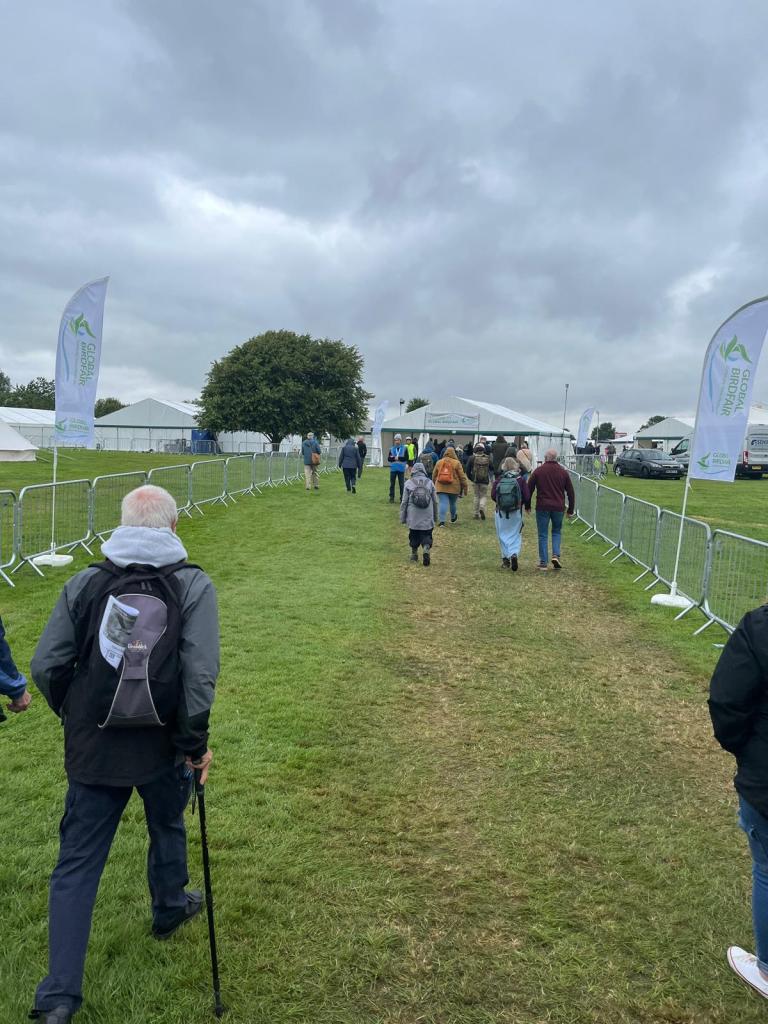
Global Birdfair began as the British Birdwatching Fair in 1989, the brainchild of Tim Appleton MBE. He successfully ran the Birdfair for 31 years, before May 2020 saw the near demise of the Fair as people knew it. Following Leicestershire and Rutland Wildlife Trusts’ decision that it would no longer run the Birdfair, the whole thing was shrouded in uncertainty. Surely it couldn’t be completely cancelled? And it wasn’t. Enter the Global Birdfair, spearheaded by the very same Tim Appleton, to build a “program of events to interest all generations”. From lectures and quizzes, to ecotourism companies and tourist boards, to conservation organisations and optical companies. Not to mention the smorgasbord of activities, nature walks and classes available daily. All housed in several marquees and stages. Pretty cool, I’d say.
The entrance tent was filtering people into the event rapidly, and the sights and sounds of Global Birdfair soon graced my senses once again. We ambled across the show towards the Zeiss section of the Falcon Marquee, buzzing with the excitement that only the Global Birdfair could bring. Zeiss earned a fairly large chunk of this marquee, devoted to various items including binoculars, scopes, thermal imagers and the new Secacam, the next generation of trail camera technology. We would explore later, but for now we met up with Nick and the group. Armed and ready, we set off through Birdfair and in behind the ringing demonstration, trudging down the slippery, mud slick slope that descended through the meadow towards the banks of Rutland Water, home of the UK’s first successful Osprey reintroduction.
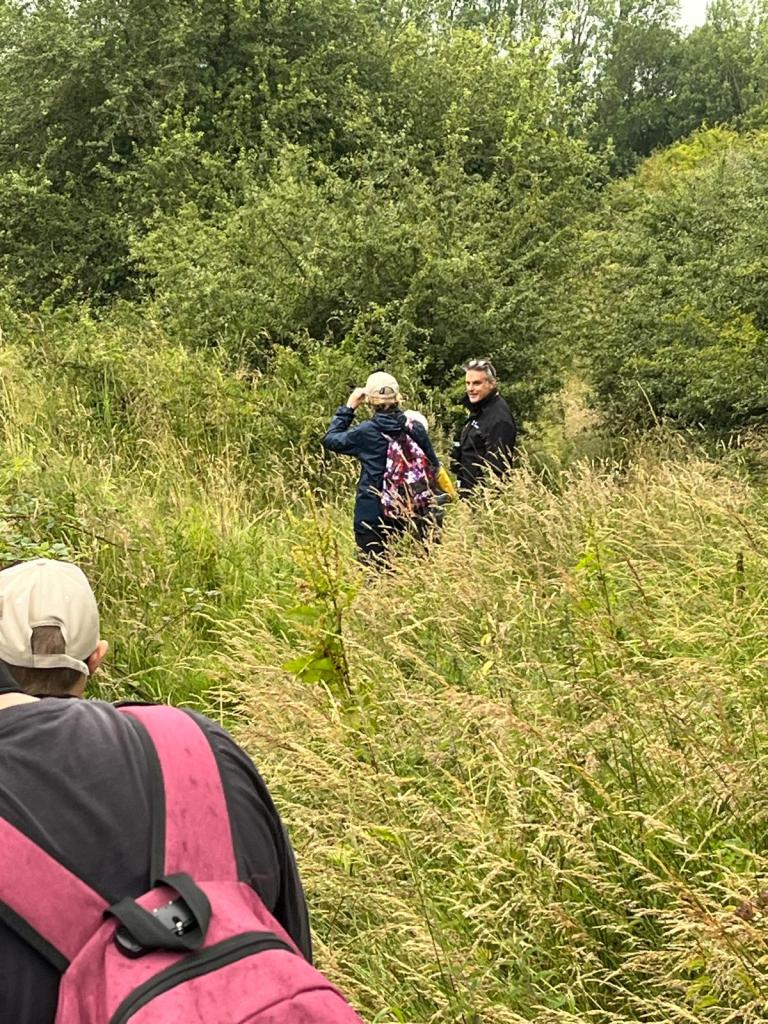
However, just paces from the gate, a Whitethroat’s hoarse, scratchy warble sounded from a dense hawthorn shrub directly in front of us, and Nick told us that there had been an active nest in there for a while. Speaking of Nick, we first met him at the Grant Arms Hotel, in the heart of the Cairngorms National Park, Scotland. His knowledge of insects and the natural world knows no bounds, and he’s always willing to share his experience and know-how with everyone he meets. If you want to read more about that particular encounter, head over here.
We caught little more than glimpses of the stocky little warbler, concealed as he was within some of the thickest boughs the hawthorn had to offer. But movement continually caught the eye, and when he darted from his cover for a nearby oak, its ID was certainly confirmed, if the distinctive song hadn’t done that already! Our party moved on after the song of a Garden Warbler was heard, seemingly close to where we stood on the precariously sheer hill. On our way down in hot pursuit of the bird, we came across two of the BTO’s ringing volunteers, collecting birds from the mist nets for the ongoing ringing demonstration happening at the crest of the hill. In her hand she held a young Great Tit, its plumage still carrying a yellow tinge.
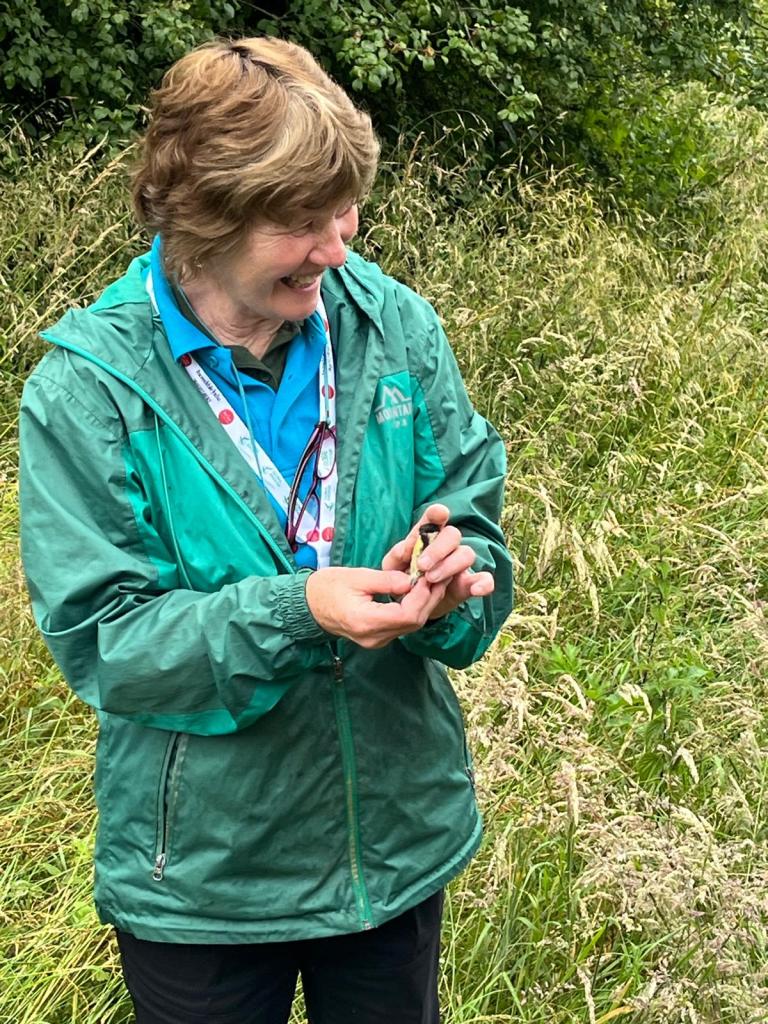
Almost every single birder based in Britain can guarantee that they have witnessed a Great Tit many many times. But there’s something about seeing a bird in the hand, up close and personal, that is almost as transfixing as a humongous Lammergeier drifting over English airspace. The creature takes on a whole new role in your life, and its a brilliant opportunity to try to understand these bird’s feelings and emotions from their intriguing facial expressions and actions. Some birds are calm, some proud, neither of these really creating a fuss, and seemingly enjoying the attention. And then there are those individuals who don’t enjoy it as much, though they can often be soothed by a handler after a slight fit of flapping and biting. No matter their reaction, a trained ringer will never hurt or distress the bird in anyway, and this line of work contributes so much of the data we have on species around the world. Its also really interesting to watch!
Enquiring about what they’d caught this morning led to the explanation of many of the songs we’d heard this morning. Don’t worry, the Whitethroat was definitely seen in the flesh but remember that Garden Warbler? Simply a tape lure, designed to lure birds into the mist nets where they would be immediately collected to prevent them from becoming truly ensnared and tangled. A recording, not an actual bird. It would’ve been disappointing had it not been so comical. Even we had been fooled, proving the strategy’s merits!
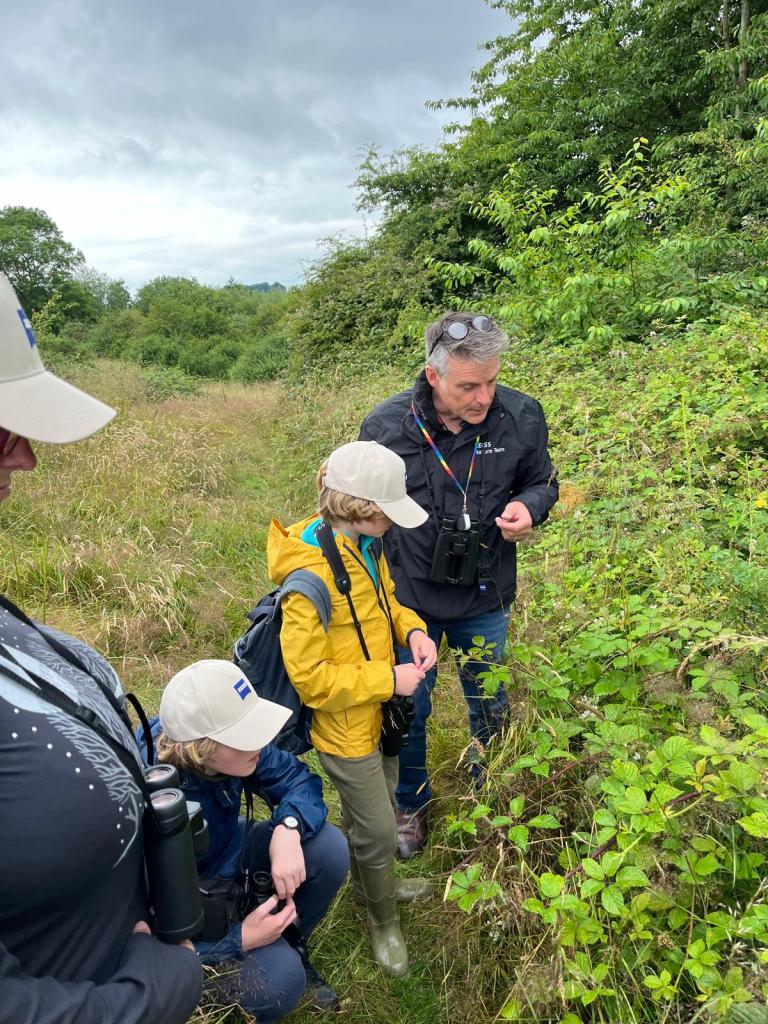
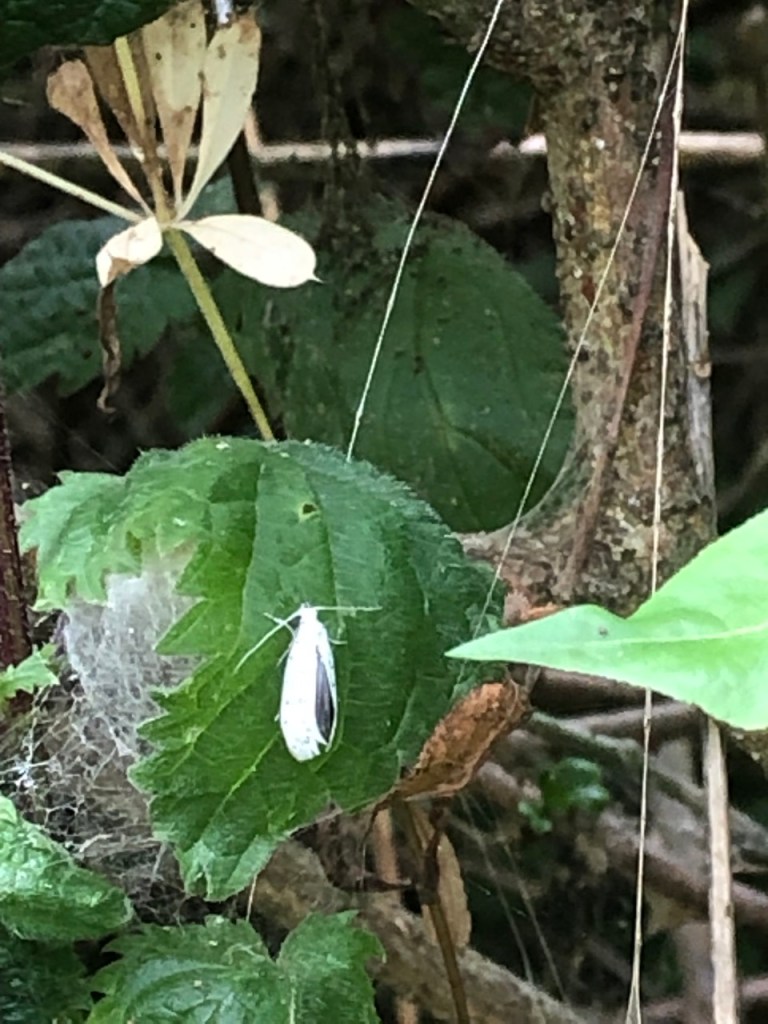
The walk led us down through several bramble patches teeming with insects, even with the sun putting a limit on its appearances. A scorpion fly was found on the fringe of a bush, armed with a scorpion-like curved ‘tail’ used for clasping the female during mating. We also came across several Ringlet butterflies, unsurprisingly named for the small rings that line its wings when they choose to open them up and a collection of White Ermine moths emerging from their cocoons. Several solitary wasps were sighted on our way up, but glimpses didn’t prove enough to get a definitive ID. Overall, a successful walk more insect-based than birdy!
Back at the Zeiss stand, we spent some time trying out the amazing range of optics on offer. Having a pair of Zeiss binoculars myself, I knew firsthand how good they were, and they certainly lived up to their billing! But what I was really drawn to was the range of thermal imagers. I had used a couple with Nick up in Scotland, and they made long range spotting a lot easier. Anything with a heat signature would show up as a flash if white against a grey background, and it meant you could pinpoint where things were from miles away. We’d tried it out on a herd of Red Deer concealed against the bare grey rock of a distant ridge, and we were able to get these majestic mammals in the scope all because of this genius little package. The wish list grows!
On our way out through the marquee, we bumped into Dawn Balmer, Head of BTO Surveys and her husband Pete, just walking into the Zeiss stand. We’d met them earlier in the year, at the Grant Arms Hotel and enjoyed a morning’s birding with them at Spey Bay. Read more about that one here. It was good to see them again, and we had a brief catch up conversation about what had been happening since April. Dawn is, as I’ve mentioned, Head of Surveys at the BTO and Chairman of the Rare Breeding Birds Panel. Quite the dream job, for definite!
After grabbing a quick lunch, we made our way towards the Nightingale Marquee, where the Grant Arms Hotel had set up their stand. If you don’t know already, the Grant Arms are the ones who invited me and my Dad up to stay in the Cairngorms, which was one of the best five days of my life. For more information on that one, head over here. Simon Pawsey and Marion Muller had travelled a long way to be here from the opposite end of the UK, and we received a warm welcome. It was great to see them again, and we spent a short while catching up and discussing birding the opposite ends of Britain. Scotland is an awe inspiring place, and Simon and Marion both have plenty of experience of it. I’m definitely glad we got to pop in and see them again, and I think we’re going to have to return to the Grant Arms sometime in the future!
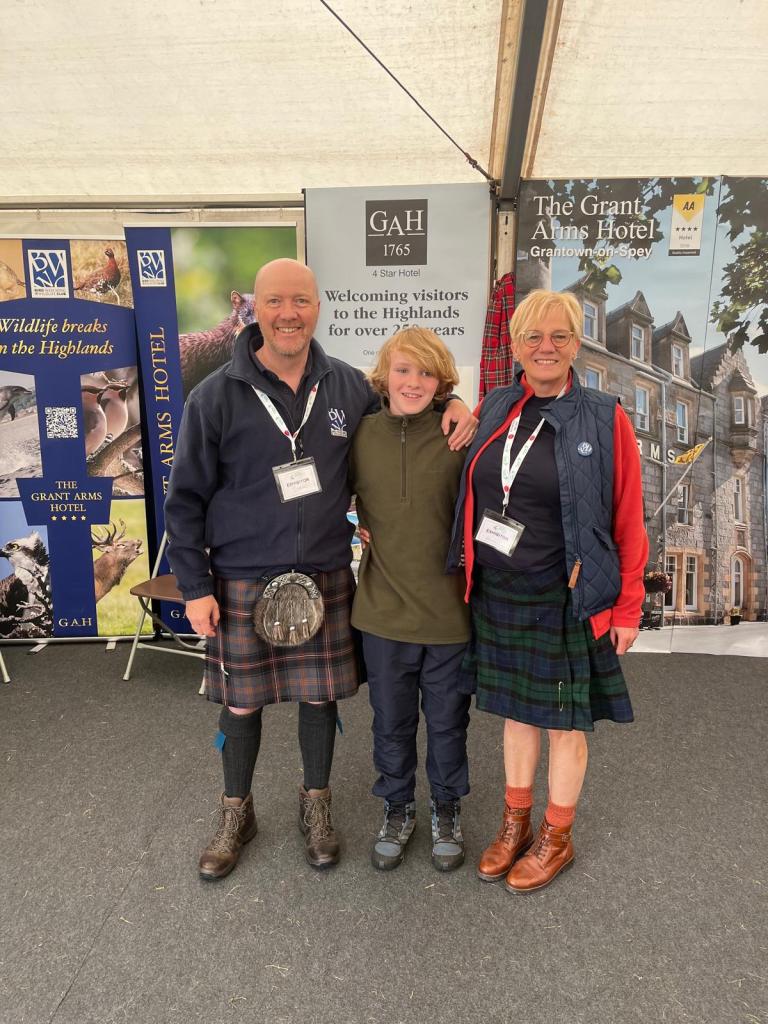
Simon was giving a talk the next day on the School of Birding he ran alongside Mark Pearson, at the Avocet Lecture Stage which was adjacent to the RSPB’s section (made the connection yet? Think about the RSPB logo). The School of Birding is, as the name suggests, a week’s course of birding instruction and lessons given by the experts in Simon and Mark, and runs from the Grant Arms Hotel. You learn things that you could never learn in school, simply because birdwatching isn’t part of the national curriculum, which it probably should be (at least make it a GCSE option). Anyway, Simon and Mark know what they’re doing, because they take you to the best spots, well-known or not, in the Cairngorms.
But soon we had to run, due to a different birding lesson back at the Zeiss stand. Titled “a Young Birder’s Masterclass”, a trio of young people (it was a very small group) were left in the care of Stephen Menzie, Toby Carter and James Lidster. Just to clear things up, I was one of those young people. But who exactly was leading us?
Stephen Menzie is a vastly experienced birder, and arguably one of the most enthusiastic. He worked on the Collins Bird Guide app version, and managed the Falsterbo Bird Observatory. He led the theoretical class, and with good reason; he holds a particular interest in moult and ageing!
Jamie Lidster has worked as a professional ecologist and in the eco-tourism industry for 20 years. He has been part of the Dutch and the English rarity panels, and has years of experience with bats, reptiles and amphibians. But don’t worry, he’s never forgotten about the birds!
Toby Carter is a keen birder, and has experience and knowledge aplenty, even if he is only in his early 20s. Birding since 5 years old, Toby is now armed with a BSc in Environmental Conservation, and his passion and sense of adventure know no bounds. Long story short, he’s brilliant!
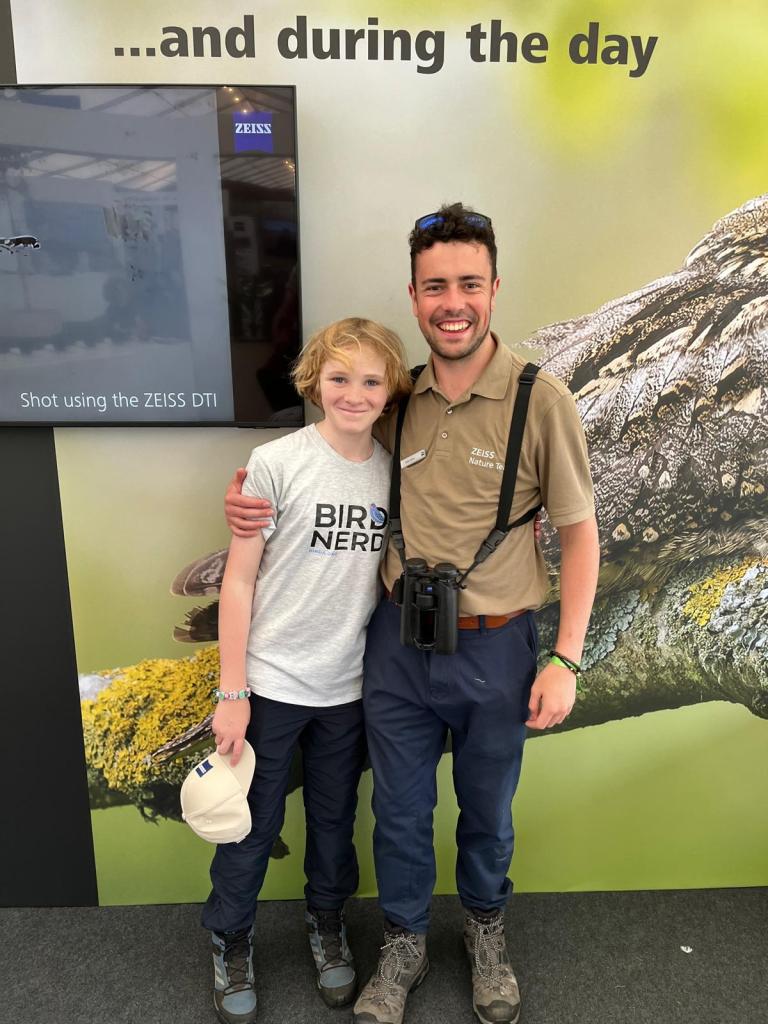
The mini course began with a short introduction to identifying birds, but then moved onto ageing and sexing the species you identified and their plumages in moult. All three of these Zeiss Ambassadors are incredibly knowledgeable, great with a camera and most importantly for this assignment, great with young people.
After the theory, it was time for the practical. We set off the opposite way to our route this morning, to the right at the mini junction instead of left and straight down. Our efforts were immediately rewarded with the same Whitethroat parents being active in the hawthorn bush, and this time we managed to get some decent views without it breaking its cover. A cackling call sent the Whitethroat pair back into the safety of their bush, and three Green Woodpeckers bobbed in the sky as if it were the ocean over our heads, their undulating flight reminiscent of a boat being carried by the waves. A juvenile and two adults, their calls eerie yet comical.
From up here, the view was pretty much unsurpassable anywhere along the track. Below us, the hill rolled into a teeming meadow, bathed in the now fully emerged sun. Ringlets, Meadow Browns and Marbled Whites fluttered lazily among the grasses, which groped above waist height in certain patches. From there it was the vast desert of liquid that is Rutland Water, a giver of life to so many birds, plants, mammals and insects that call it home. We backed up a good start with another Green Woodpecker, a Great White Egret and several Common Terns, all acting as rising action for a jaw-dropping climax. You couldn’t come to Rutland Water at this time of year without seeing the main event; an Osprey. They were reintroduced here as part of a project that was the first of its kind in England.
And one was drifting over the sparkling azure right now, its M-shaped wings arched in the middle like a gull, headed straight for the airspace above us. From this distance, it wasn’t unlike a gull. But up close, it’s superior size and strength became apparent, and no gull (sorry guys!) had the ability to manipulate a sunlit background like this raptor, majestic and powerful, and a brutal killer of fish. I was now craning my neck to keep it in view of my binoculars, because it had indeed reached our airspace, and was now entering the golf course’s behind us. Wow.
Nothing we saw could beat that encounter afterwards, but that’s not saying that Rutland Water didn’t try. It threw several Great Black Back Gulls at us, three sightings of hovering Kestrels and (resolve struggling now) a Little Egret ghosting in to land on the bank in front of us. Rutland Water determination and resilience had produced a good few hours birding but it had not won against a secret weapon that knows no master. The Osprey.
We headed back to the Zeiss stand (its becoming a bit of a common denominator now), and came across Petra Kregs, somebody who we had met last year via the Zeiss Young Birder Awards. We had a fair bit to talk about, and I enjoyed meeting her face to face rather than Instagram again. As Zeiss Nature’s Global Marketing Manager, she has a huge role in keeping Zeiss ticking along and is incredibly knowledgeable, enthusiastic and a great person to talk to. We’d been there for less than 5 hours, but it seemed we were meeting everybody at Birdfair.
It was by now 4:00, and we’d rarely strayed from the Zeiss stand all day. Tomorrow was to be a full day of exploration, but that’s not to say today hadn’t been worth it. We just got caught up in the tidal wave that is Zeiss Nature.

