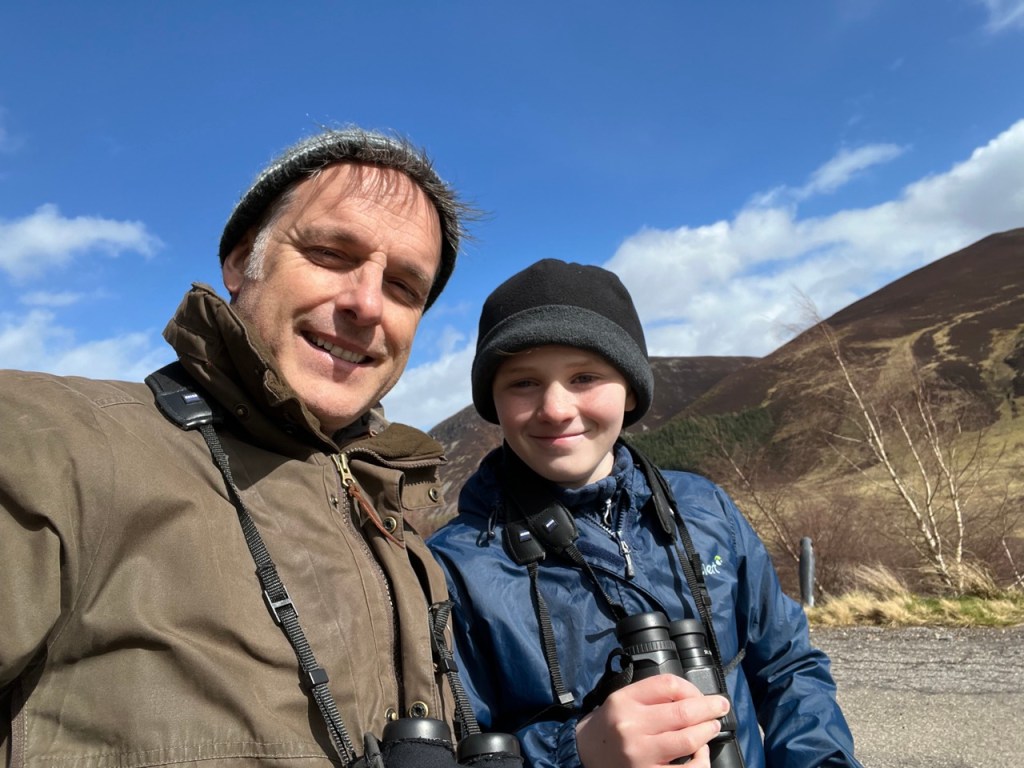
We awoke early on our final full day, a grey but dry Wednesday morning ready to welcome us. Unlike previous days, breakfast was a bit more of a feature in the day, with a few special encounters coming to call. So as we prepared for the morning’s outing to Spey Bay, we reflected on the last four days. It had truly been one of the greatest experiences of my life, with all that time spent either out in nature or with those whose passion is for nature. Nothing could’ve torn me away from it!
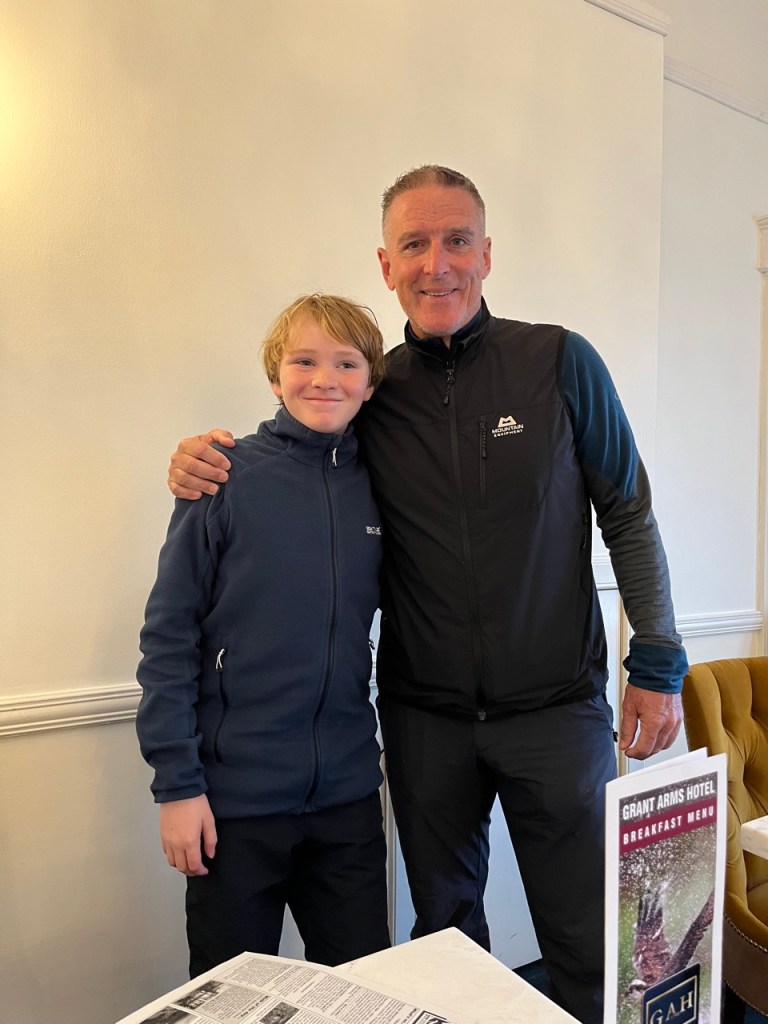
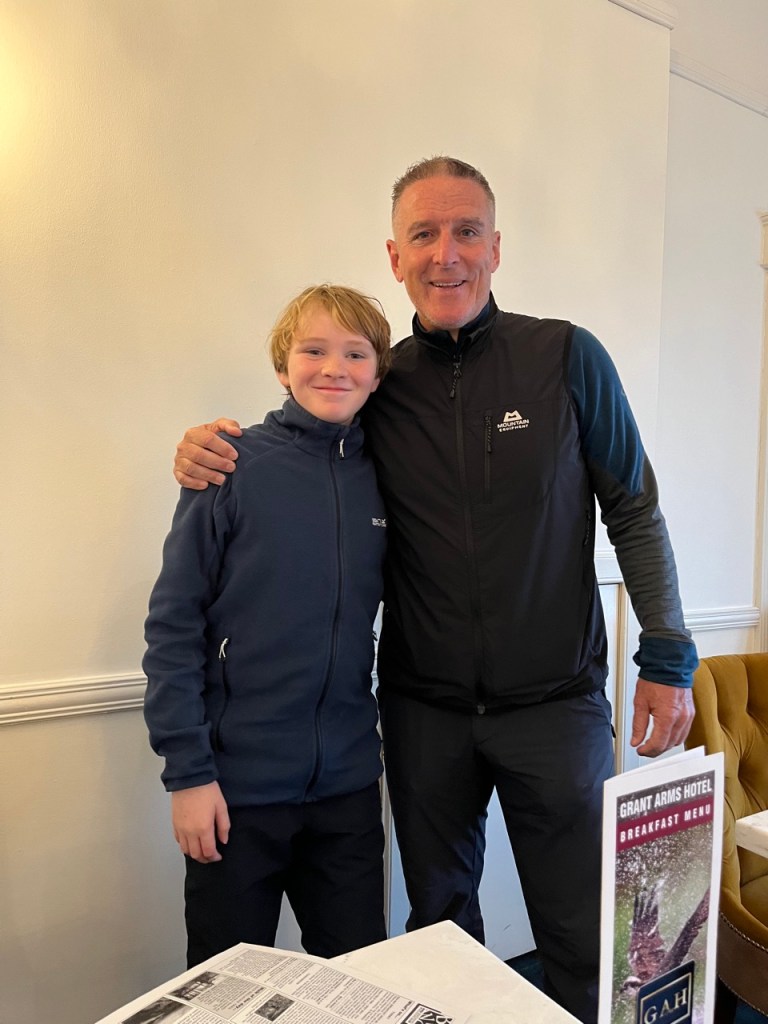
And now, back to breakfast. We’d just sat down when over came a certain Iolo Williams, whose guided group had last night visited a nocturnal hide, in search of Pine Marten and Badgers. We exchanged details and sightings from the previous day, and it was a really positive, if brief, talk, and it was incredible to be able to talk so casually to my childhood idol. But it wouldn’t end there. The next meeting would be with somebody who had played a huge role in making this all possible, and I had first met him at Birdfair on the hallowed Grant Arms Hotel stand. Simon Pawsey, of course, needs no introduction among Bovey Birder readers, but just in case you’ve been forgotten, Simon is an incredibly knowledgeable individual, who guides birding trips across The Highlands, and is rather clever in his methods, knowing all the tricks of the guiding trade. He also runs trips for the Hotel, and this week was out with Iolo’s group.
We discussed plans for the day, and recounted our previous Eagle story to him. And then he asked if we had seen the other famous Scottish species, the Golden Eagle, which of course we hadn’t. Suddenly, Daddy was sent off to retrieve our map and I was whisked over to the table of Iolo and his group, which was in the midst of breakfast. It was really quite incredible, and it all happened pretty quickly! One minute I was chatting with Simon, the next I was sat at a long table with Iolo Williams as its head! But all too soon, Daddy returned (he spent too short a time rifling around our room) with our large-scale map, and we played it out on a spare table. Simon proceeded to mark out two of the best sites in the area for Eagle-chasing, as this was our last day, so we could check some of the sites out before we flew back to Devon the next morning. Dorback Lodge became our next target, and it would yield great things in the next 24 hours. But first up was a quickfire trip to Spey Bay, alongside Dawn and Pete.
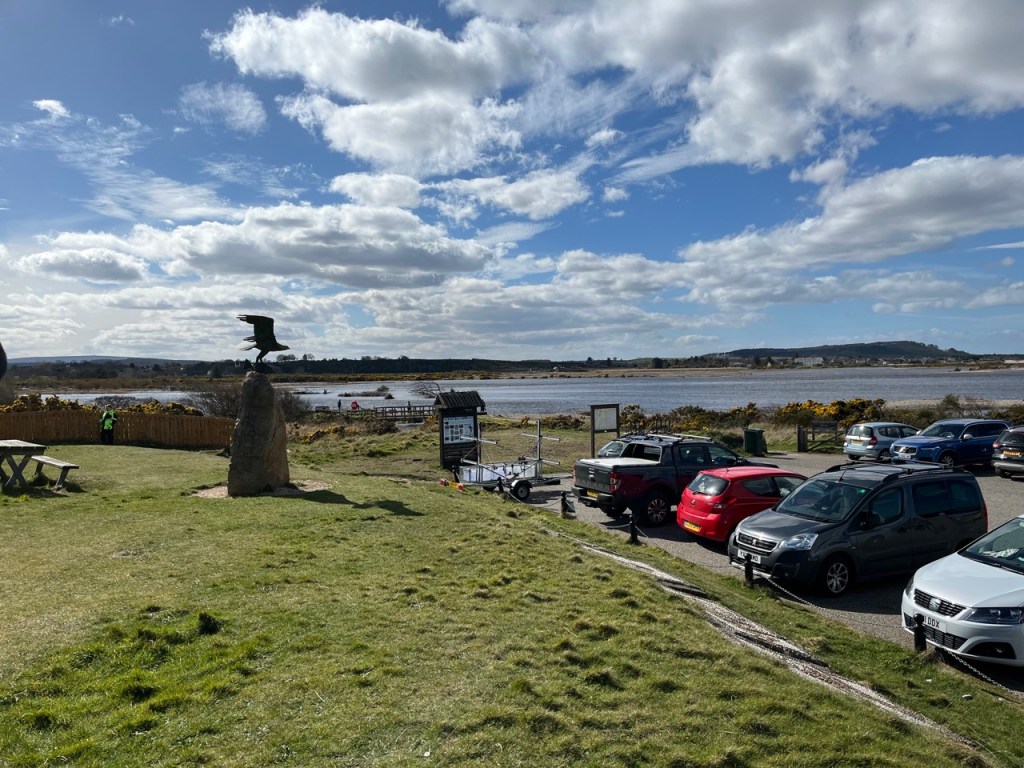
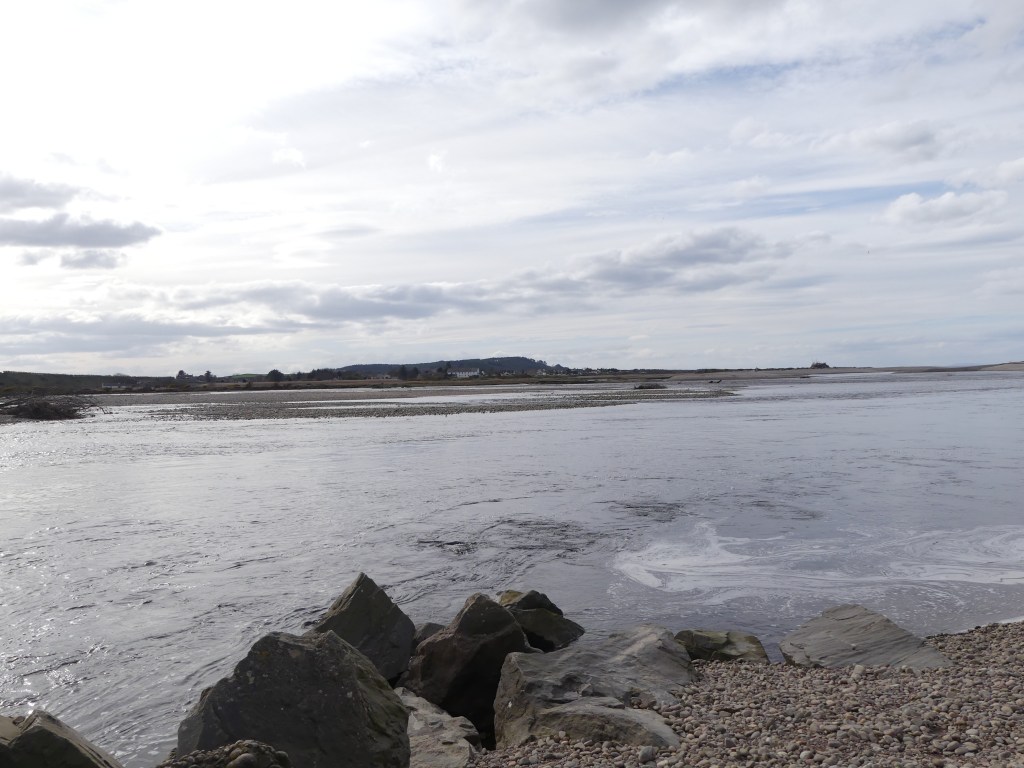
The mouth of the Spey
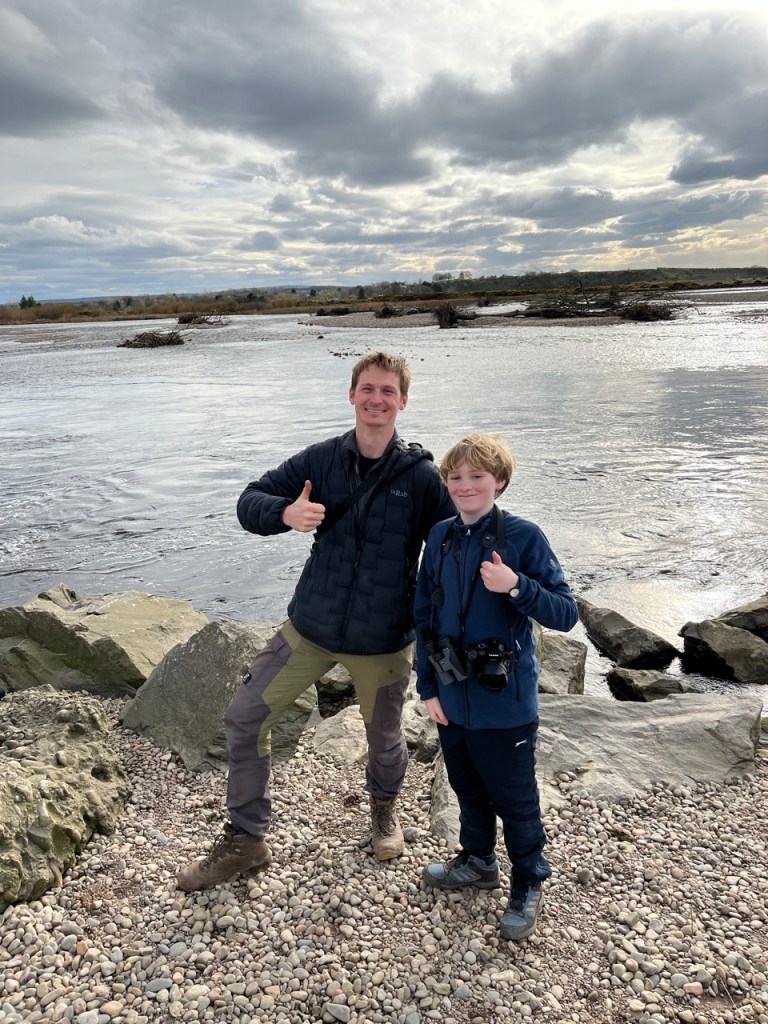
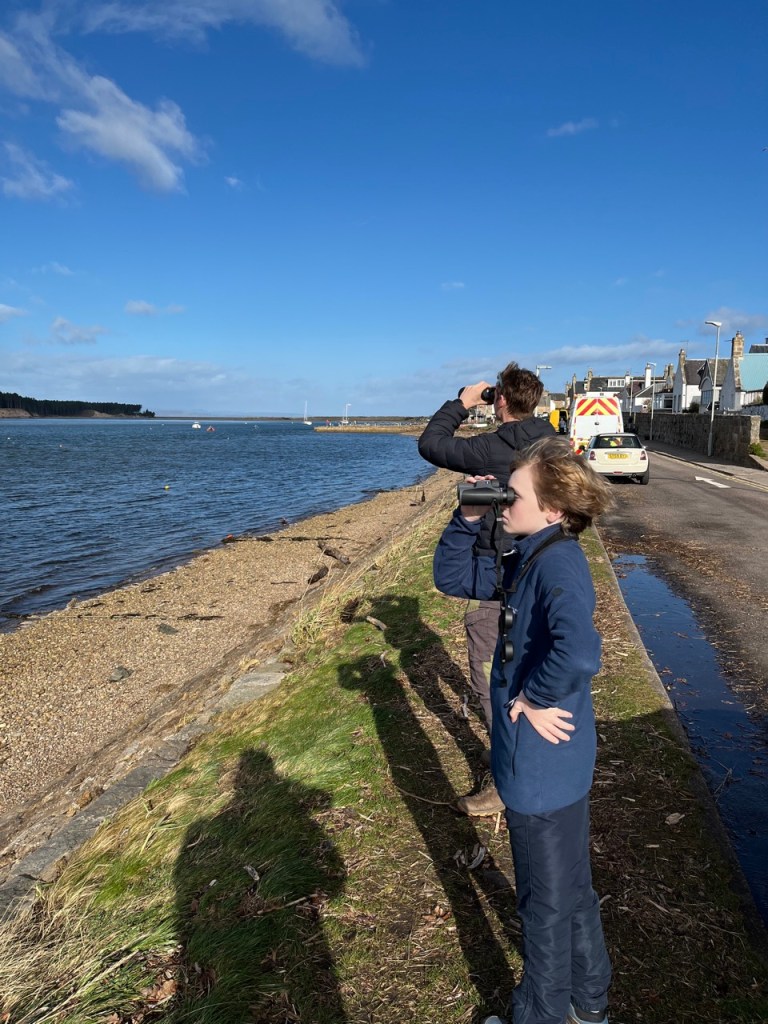
With little time to spare, we raced along the lanes for the hour to Spey Bay, and as we rambled through the little holiday town, memories of the Monday returned, of Osprey watching and Diver dating. On our arrival, the two leaders for the morning were up on the hillock, scanning the shingle streaked mouth of the Spey, for anything new that might have turned up. Before we get into this however, you need to understand the level these two were at when it cane to spotting birds. Years of experience and knowhow meant they were really a bit of a dream team, and the ability to find so much, not just skim the surface of the species here, was uncanny!
Scanning…
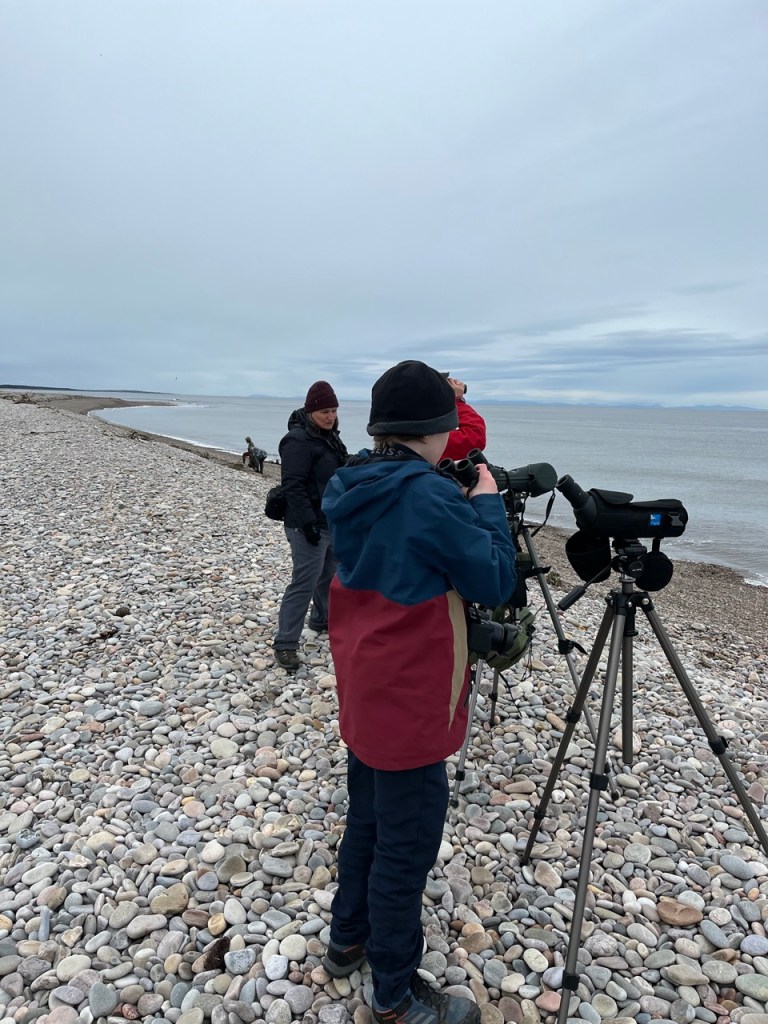
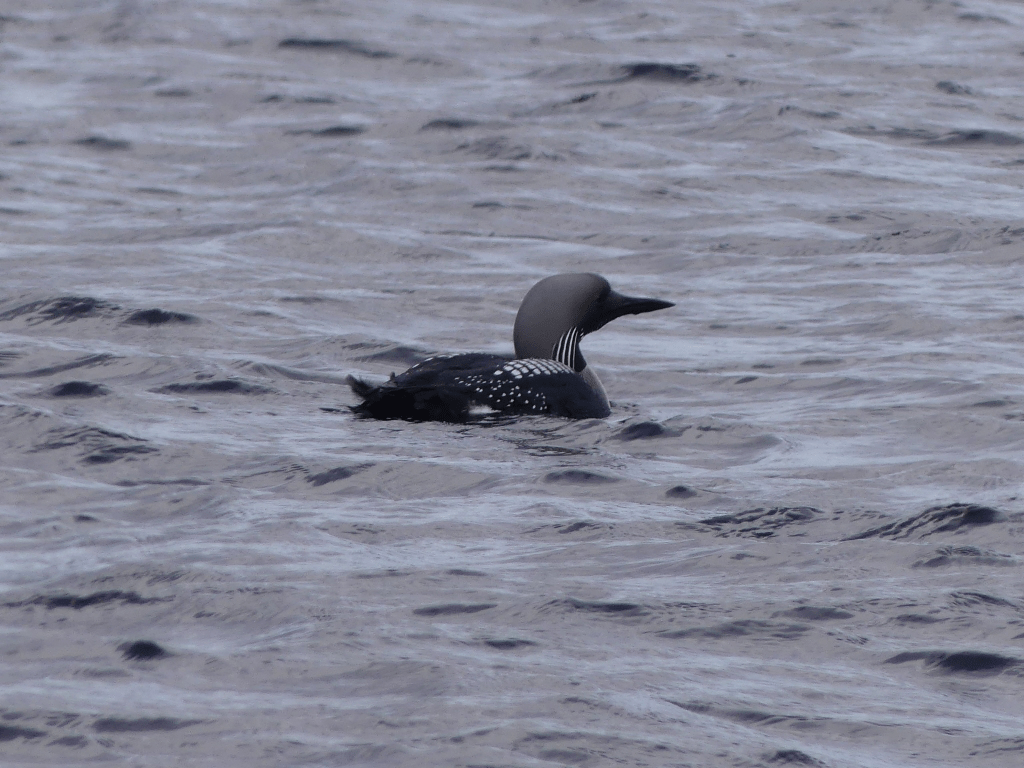
A high count of six freshly in Common Sandpipers kicked off the morning, and our guided group moved swiftly onto the beach, the pebbly ridge separating us from the sea a perfect vantage point. The choppy waves proved more productive than you might have expected, with all three diver species to begin our North Sea search, that is Black Throated, Red Throated and Great Northern. The birds are known as Loons in America, which is understandable, as their breeding attire does seem like something to come straight out of Cbeebies’ Mr Tumble! What was most surprising however, was the sheer numbers; 13 Red Throated alone, in this one stretch of the Moray Firth!
A Black Throated Diver
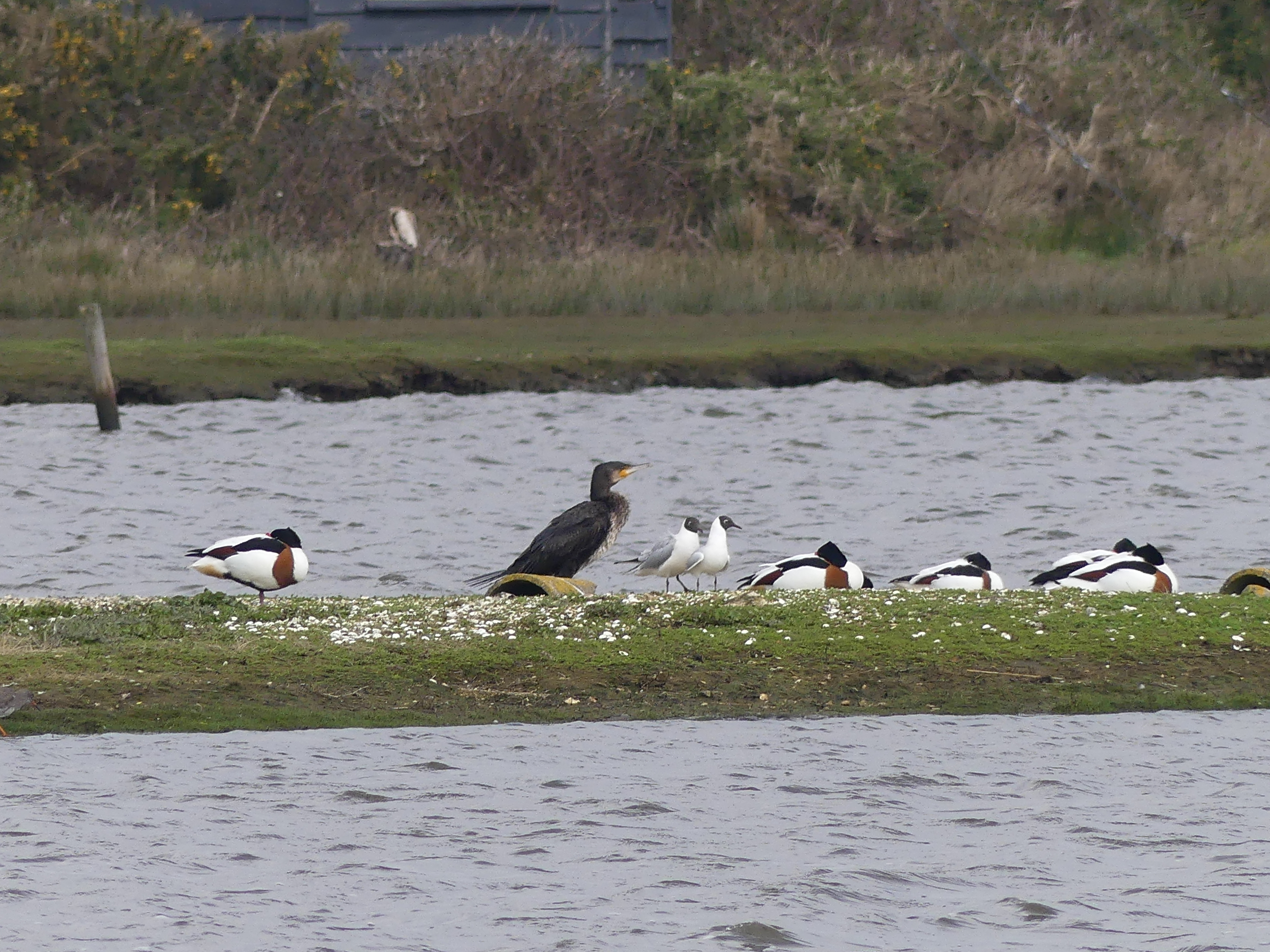
Another unexpected lifer, which I honestly had not given any thought to, was a lone flyby Black Guillemot, one of the smartest and dapper birds in the British Isles. Perfectly piebald, jet black and snowy white feathers gleaming against the dark skies. Everywhere we looked something new cropped up; Red Breasted Merganser, a ruffled Cormorant, even a plummeting Gannet! Variety sure is the spice of life!
After a quick check down the woodland path, we said our farewells to Dawn and Pete. They are truly incredible people, and sure know how to get a good morning’s birding in! I’m sure you know by now from previous blogs, but Dawn is Head of Surveys at the BTO and Chair of the Rare Breeding Birds Committee (RBBC). Following a tipoff on potential Corn Buntings, we snuck down a farming lane with no luck, and so we headed off for a rapid lunch before driving along some rather wild roads up to another, more remote tipoff site, Dorback.
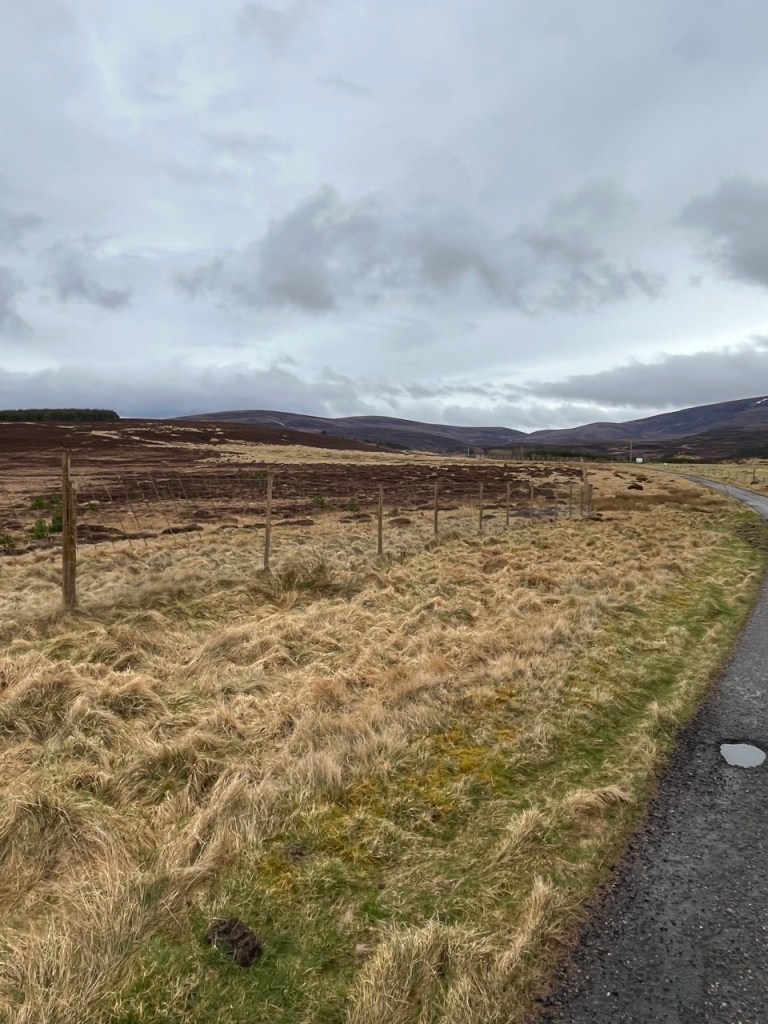
The road to Dorback ends rather quickly!
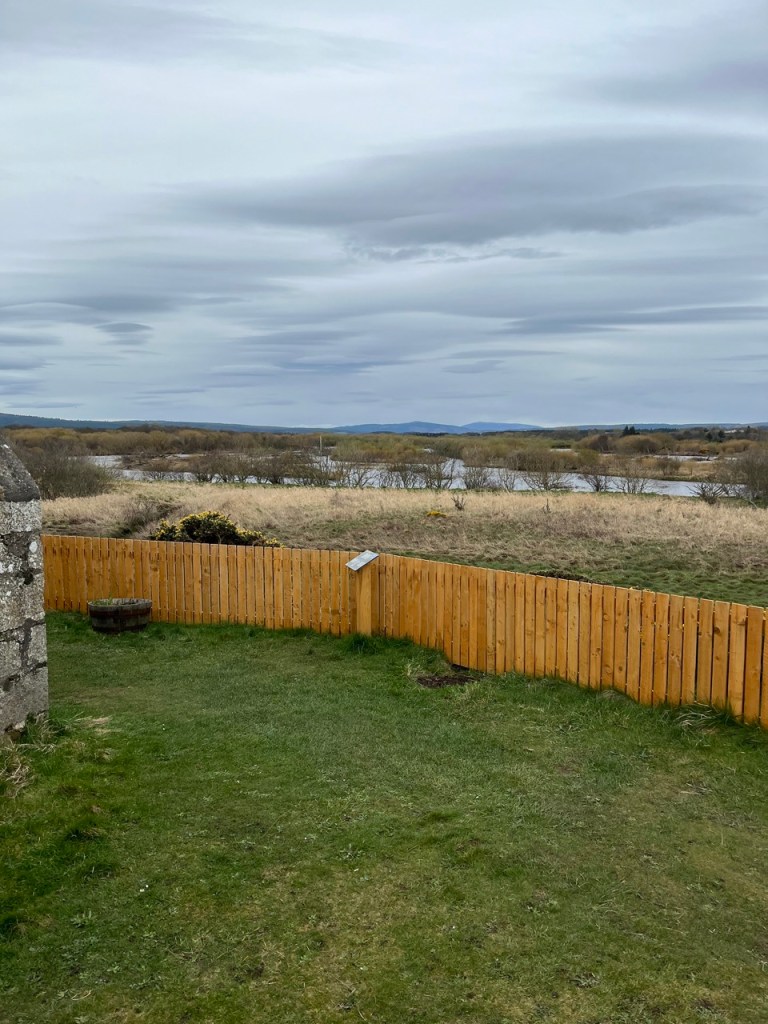
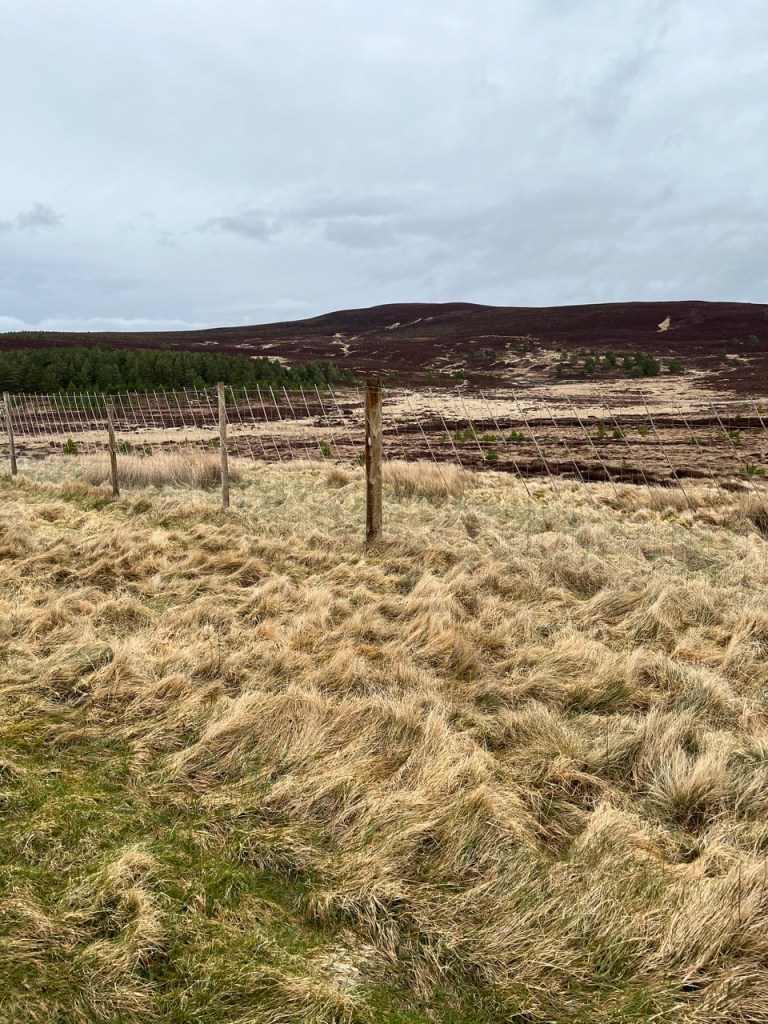
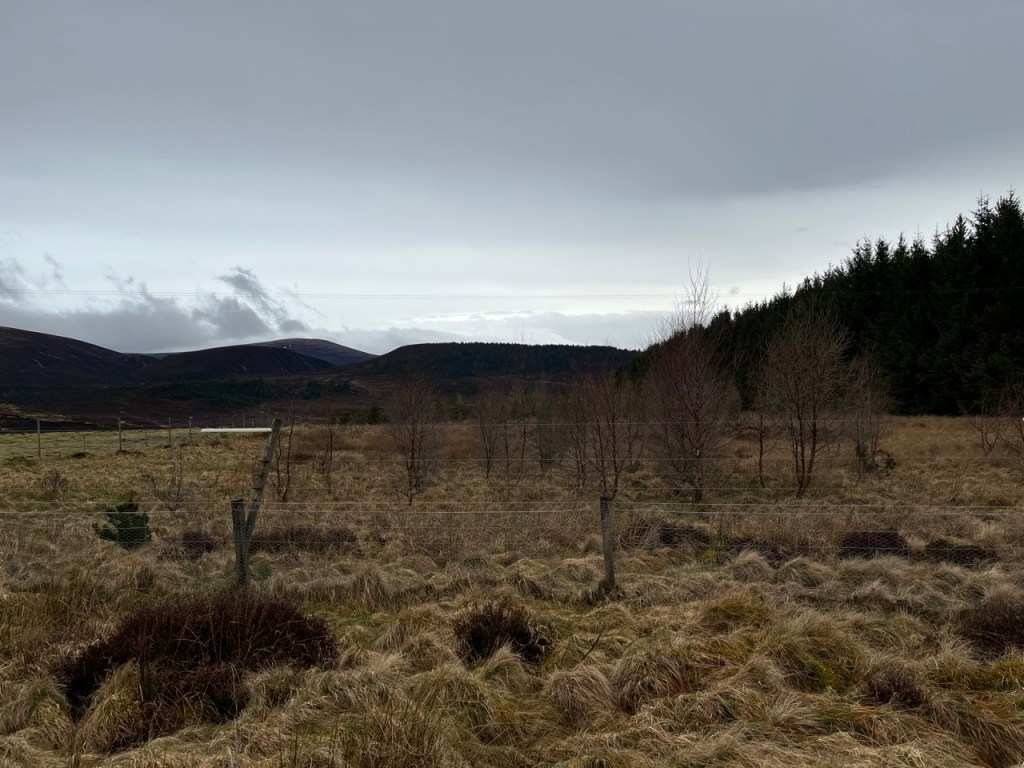
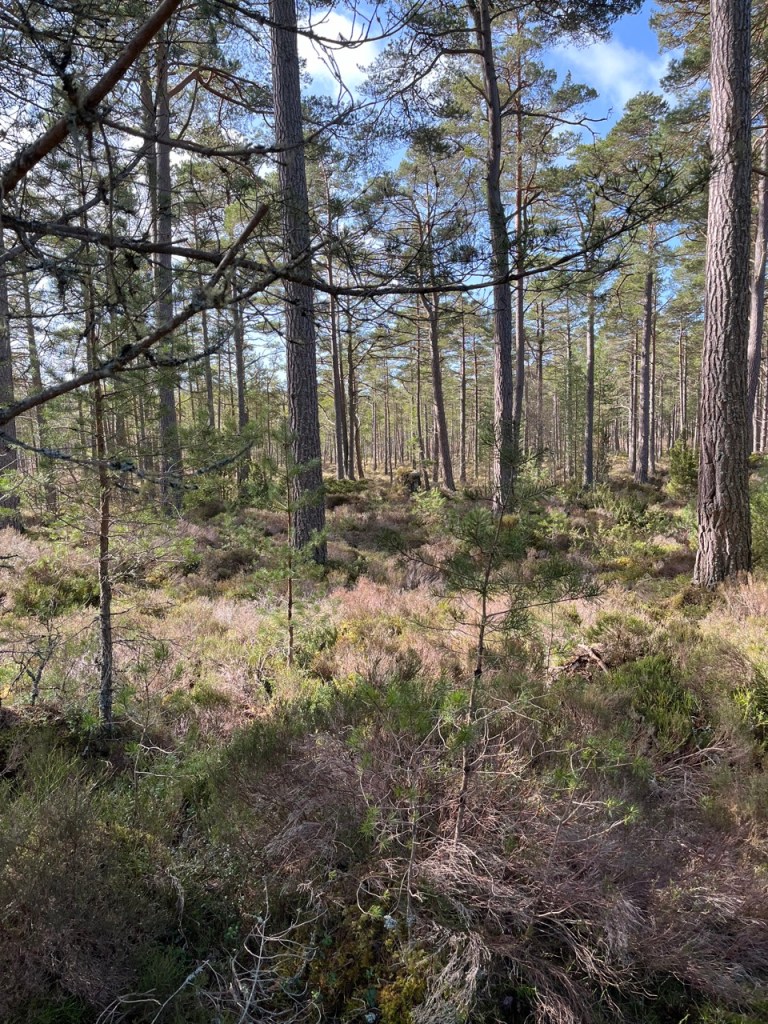
We pulled into an overgrown layby, and shivered in the cold gale determinedly as we scanned the skies for sign of life. There was little sign of human intervention up here, and it really felt like the wildest place I could reach within my current circumstances. The road ended within a few hundred metres, and a weathered deer fence ran alongside us, with the heather culminating into a ridge crowned with a young Scots Pine woodland, not planted within a plantation’s boundaries, but naturally spread out, young and regenerative. This was the kind of woodland that logging plantations could not replace, and this was also the kind of woodland that proves to support the most life.
You can see the young woodland.
Suddenly, it all kicked off with four Buzzards rising above the ridge, mewing and giving chase to each other. A territorial encounter, it seemed, with their cries audible from open car windows. But the real fun was yet to begin (I know!). The wind was bitterly cold, streaming against our bare faces, but it would all turn out to be worth it, we just had to stick around.
And our patience paid off when a large gull-like raptor, M-shaped wings prominent against the blue, glided low overhead, black and white contrasting through the binocular lenses. As you’ve probably already guessed, an Osprey flew directly above us, magnificently majestic in Scottish skies. And then another joined it, coming in east over the a spruce plantation. They circled together, each equally unbothered by the other’s presence. And in came a third, as if it was the most normal thing in the world, joining the circling spiral vertically up from our craned necks.
And this was getting scripted now, with a FOURTH OSPREY entering our eyeline, calling out to its counterparts. His attraction was apparently great, as they all migrated over to the newcomer. But that wasn’t the end of it. Now a FIFTH bird (honestly!) put in an appearance, joining in with no reaction from ther other birds. What had we just witnessed? I had heard nothing of this sort of thing thus far in my birding adventures, and this felt as unprecedented as it was unexpected! By now they were all calling repeatedly, sometimes a rapid succession of whistling chirps, and sometimes a simple high pitched whistle. It fitted this bird’s majestic profile almost perfectly, not harsh and cawing like other raptors.
The Crested Tit woodland is on the right!
The wind by now was howling with vigour, and we crouched beneath the boughs of a small section of spruce, when a static electric trill ground into our eardrums. Both Nick and Will had alluded to the Crested Tit’s call fitting exactly the description I have given you, and the call which we heard at that moment. However, the trees were planted so close together (as this was a section of plantation) and the branches so thick with dark khaki greenery that it was hard to make out anything.
The visit was topped off by something else a little special, with a brief glimpse of a young Hen Harrier dipping beneath the ridge. Hen Harriers are persecuted highly across the UK, but with new science suggesting Scottish numbers are steadily on the increase, this raptor’s fortunes may just be swaying to the right side of the pendulum they have so unsteadily existed on for decades.
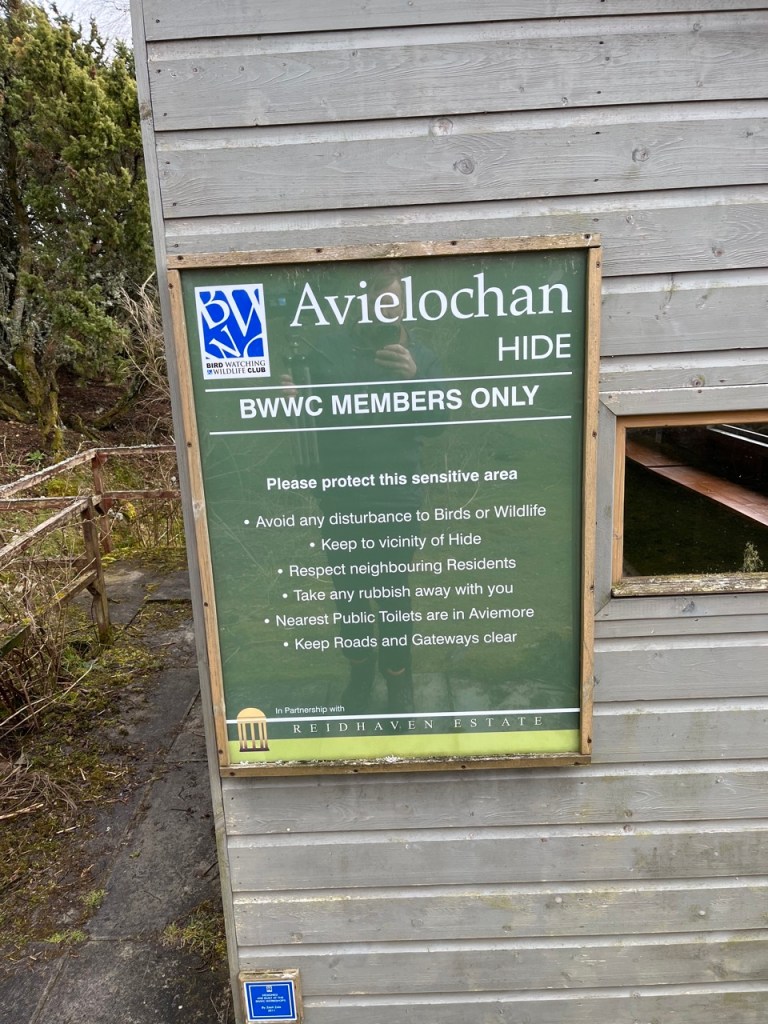
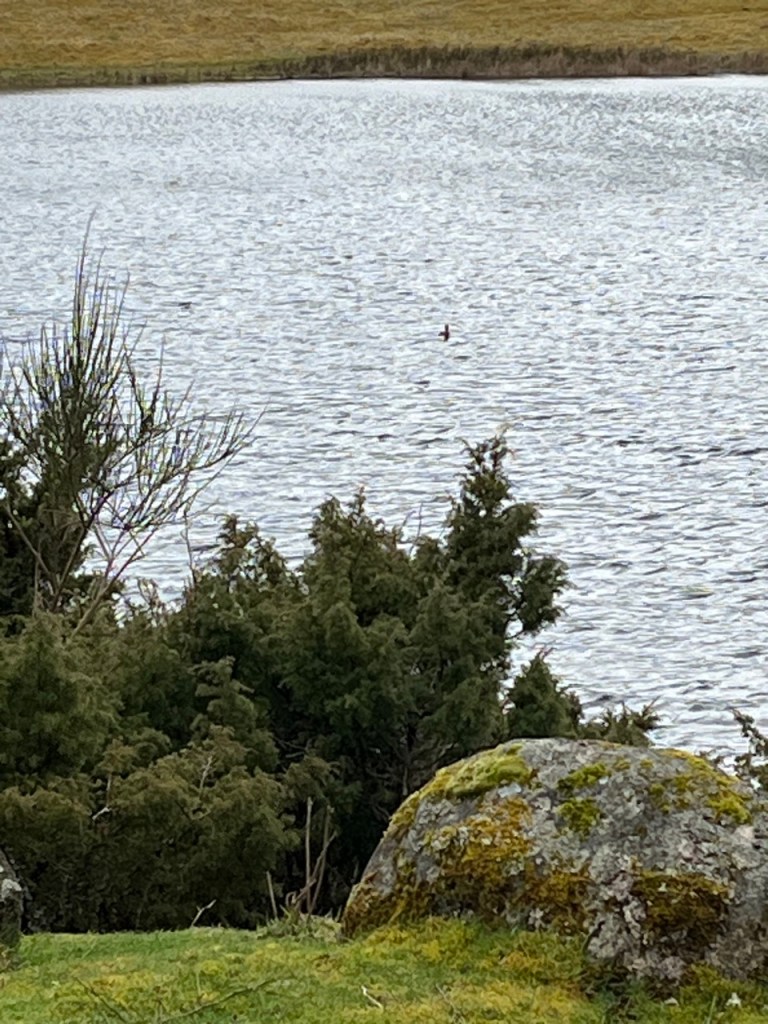
Our final stop of the afternoon would be Avielochan, a small lake that features Slavonian Grebes each year, beautiful richly coloured waterbirds, complete with macaroni crowns, crests and eyebrows. They truly are decked out, and treated us to some incredibly close views from the banks. These birds are among Britain’s rarest annual breeders, and are restricted to just a handful of Lochs across the Highlands, as are many species these days. A wonderful last hurrah, and with slightly heavy hearts but no regrets, we drove the short way back to the hotel.
Avielochan HideAvielochan Lake
But there was one last thing we had to enjoy that night. Directly after dinner, we funnelled into the Osprey Suite for the last time, taking the three successive rooms (Club Room, Library and aforementioned Osprey suite) in for the final time in a while (we will be back!). Dawn’s talk that evening was an A-Z of British Breeding Birds, describing the populations of one bird species for every letter of the alphabet, based off the latest BTO British Bird Atlas.
The bird atlas is a set of surveys completed in both the winter and breeding seasons, in order to provide accurate information for all Britain’s species. These take a number of years to compile, and the last one was in 2007-2011, although the BTO are planning to do another one in the near future. Dawn, as head of surveys at the BTO, had a big role in the completion of the atlas, and I think we are all rather grateful! We said farewell to everybody after an intriguing talk, and set off to bed again, for what would be the final time at the Grant Arms Hotel.
Here we go again! Another day at the Grant Arms began earlier than even the previous morning, with alarms set with one goal in mind; Black Grouse. And while the building still slept in the dawn air, we set off onto Dava Moor. The moor was huge, with heather and intermittent trees stunted with the wind as far as the eye could see, well at least until they found the various ridges and hills that enclosed this section of the Highlands.
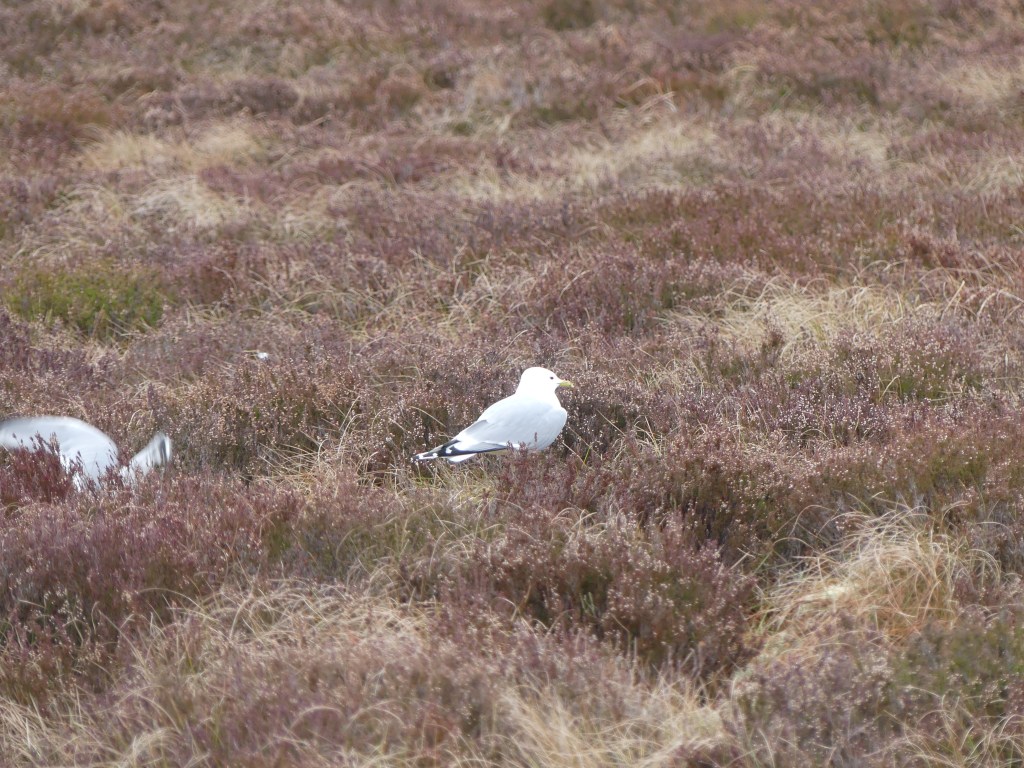
Common Gulls on the moorland
With the rain pelting down on us, we pulled into a lay-by that I will try not to give away too much, as the Black Grouse is one of Britain’s most sensitive species, and their leks are highly prone to disturbance. And what’s a lek you ask? Its essentially a battleground, which all the male ‘Blackcocks’ (no pun intended) in the local area descend on each morning during the courting season, and march against each other, circling warily before engaging in a war unlike any other in the human world. Their tails are fanned out, their scarlet brows raised with tension, and their snowy-white rumps flashing against the flat green grass. Later into the season, the greyhens (females) will arrive to scout out their future partners, and that’s when the competition really heats up.
Wet and rainy!
From here, they were simply black specks with the occasional glimpse of white, but through the scope the tales of conflict became clear, and we could easily hear their bubbling and hissing from where we stood. The weather was miserably wet and attempting everything it could to hinder us. But our quest for this rare species didn’t end until exactly 6:53AM, when we quickly realised the time and raced back to the hotel.
Again, (I’m assuming you won’t be surprised) not long ago we would have been able to find these magnificent birds on certain sites across Dartmoor, but the most recent Black Grouse survey showed a 49% decline in the South West; and that was in 2005. By now, they have all but vanished from moorlands across England, with just under 1500 pairs left in England, but even this England-only survey is outdated, having been undertaken a decade ago. Reasons for their decline are disputed, but the main source of their demise has come from habitat loss, namely the removal of their favoured partly wooded moorland being cleared out to a large extent across the UK, to make way for the apparently ‘hugely beneficial’ sheep farming industry, with these creatures overgrazing and leaving a path of land useless to the birds.
And now we cut back to the Grant Arms, where breakfast has just begun. And we were just flicking through April’s edition of The Watcher (the hotel’s very own publication) when a certain Iolo Williams walked up to our table to talk to us! It was just a general chat, but it was frankly incredible to be able to speak to somebody I had grown up watching on Springwatch, and he had grown to become a bit of an idol for me. The manner in which he talked immediately put me at ease, and he spoke to me as if I was on his level, which to be honest was brilliant! It was, to be quite blunt, a pretty good start to the day!
Iolo and me!
We also met Dawn at breakfast, somebody I mentioned in the Sunday post, and it turned out her and Pete had been at the same lek site as us that very morning. If you need a reminder, Dawn had quite the dream job, being Head of Surveys at the BTO and Chair of the Rare Breeding Birds Committee. To top this perfectly, both Dawn and Pete’s birding knowledge was completely second to none! We would meet them again later, but for now it was time to prepare for another day in the field. A quick foray up the grand old staircase, and we were back down once again by the reception noticeboard, hanging out with Nick Baker ready for a morning’s group walk out into Anagach Woods, an underrated gem just behind the Grant Arms.
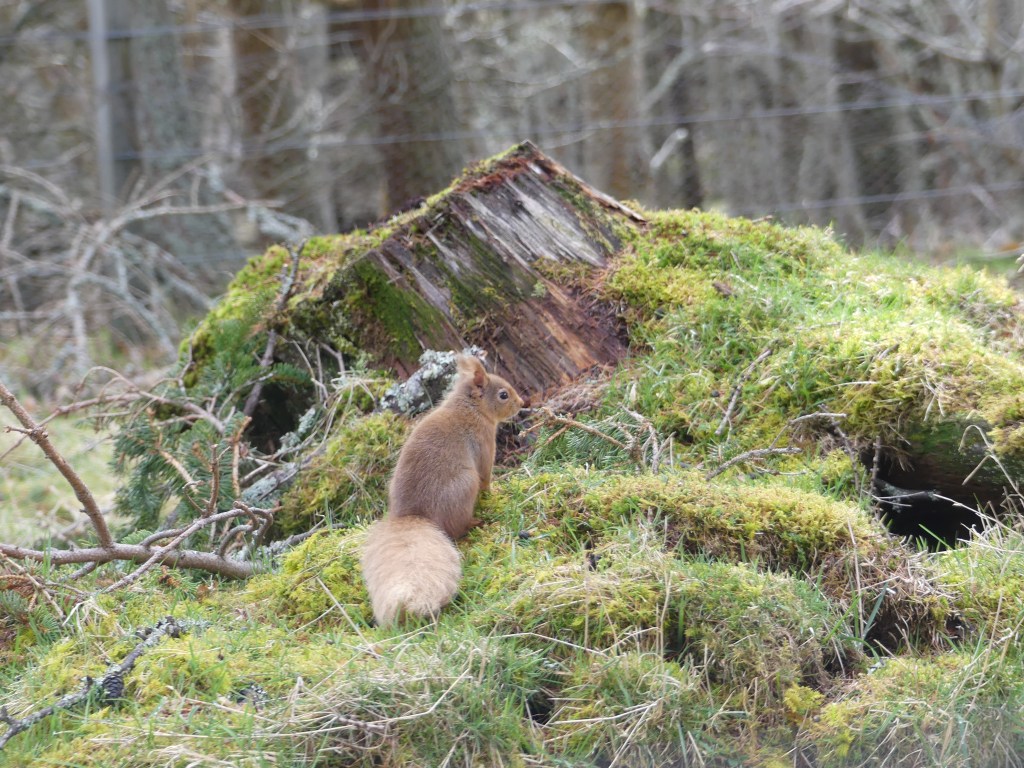
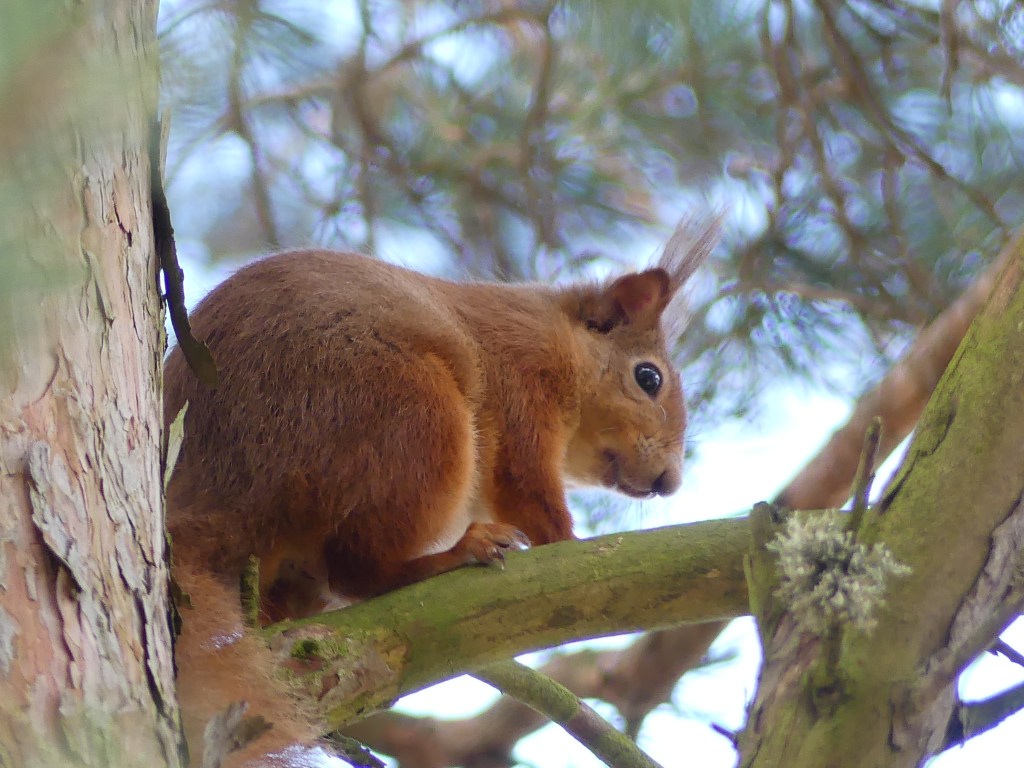
Strathdearn Squirrel
It was exciting to be out with Nick again, and talking to him seemed so simple and casual, featuring topics we both were interested in, and that he was so knowledgeable in. Our party of 5, armed with binoculars and a scope, set off via the golf course into the pine woodland. By the way, the weather since those drastically early hours had not changed in the slightest, so beneath the trees thudding drips on hoods were a constant sight and sound! Anagach was silently wonderful, with welcoming trees and gates, and an early finch flock as a good omen. At this time of year, large finch flocks are really quite common, with many birds coming together to roam the forests, searching for a sustainable food source. They are often inter-species, with Chaffinch, Goldfinch, Greenfinch, Siskin and Brambling (in winter only) all the norm up here.
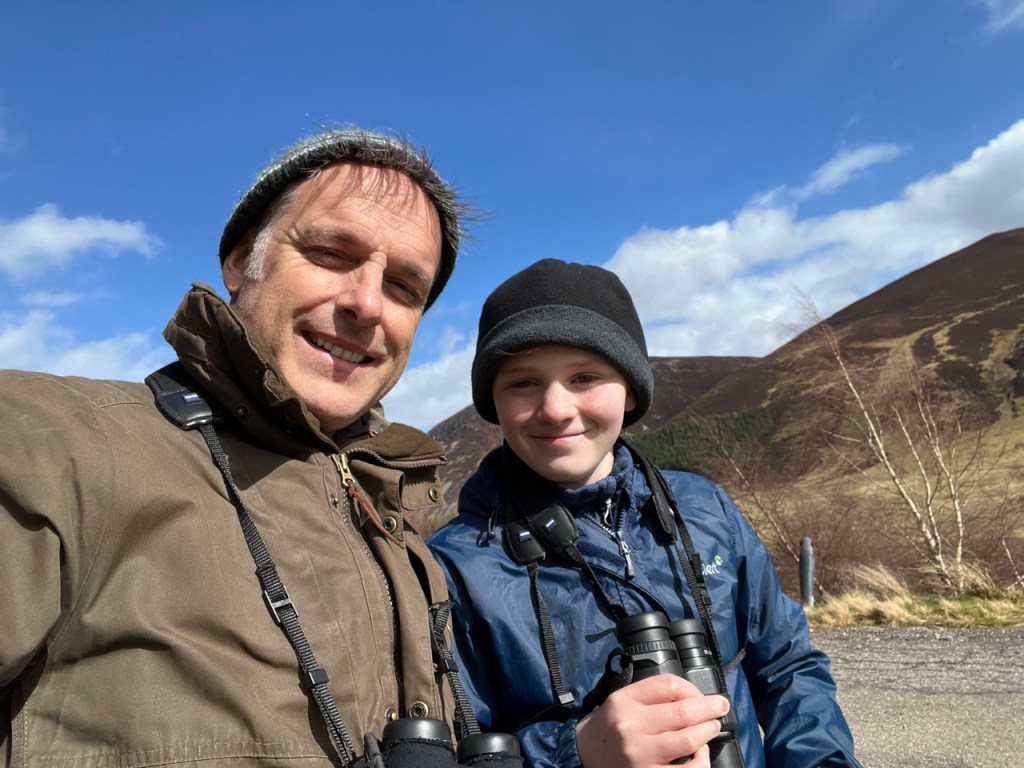
Nick and me!
These birds were targeting a feeder in an adjacent garden, and so we left them to it as we continued deeper into the trees. Nick and us had arranged a loose sort of target species, something to be on the lookout for as we trudged through the sodden leaf litter. And at our first stop for a bird feeder, we heard a certain distinctive call; ‘chirp chirp chirp chirp chirp’, in rapid succession, uttered by a deep-throated voice. We all immediately looked up in perfect synchronisation, and Nick rapidly released the legs of the scope to scan the tops of the trees, for not just a silhouetted bird, but for falling pinecones and rustling branches. We had, of course, just heard a Crossbill, and everybody had binoculars glued to faces, eagerly searching the pines around us.
But it seemed that the bird had eluded us, with not a single trace of it even when we fanned out into the undergrowth. It didn’t call again, and we continued on to higher ground, for there were many small hillocks and ridges in these woods. The path was narrower and wilder here, entangled with brambles and thorns, and dropping steeply away on either side. More finch flocks were ever-present, and they roved through the trees, searching for food.
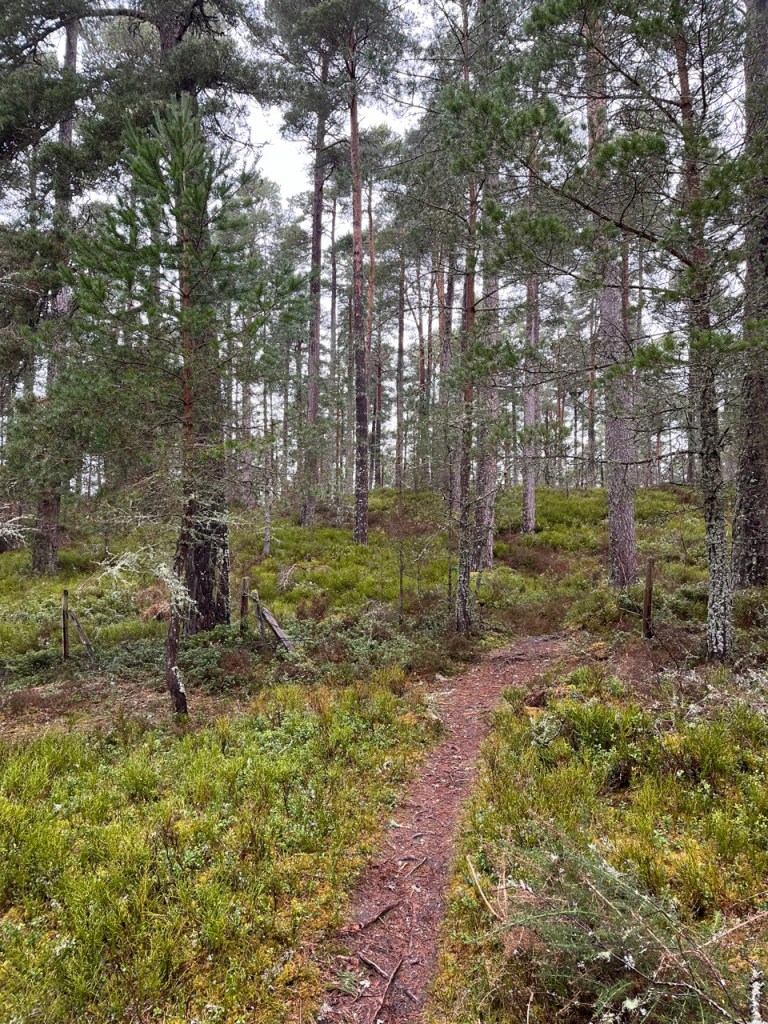
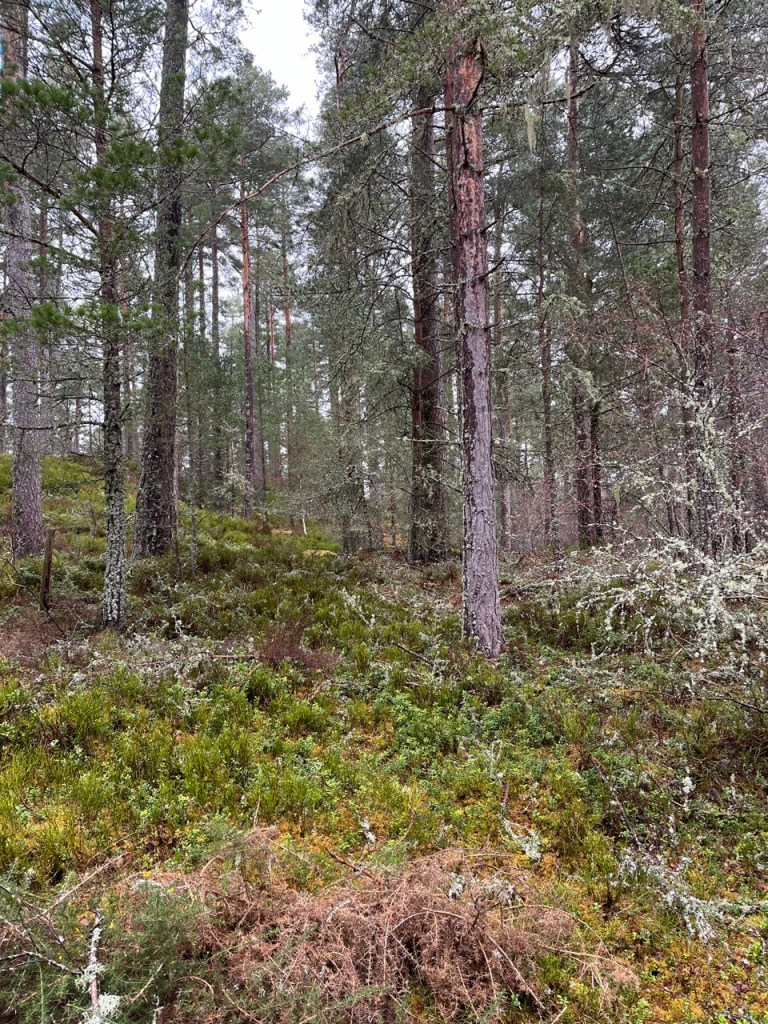
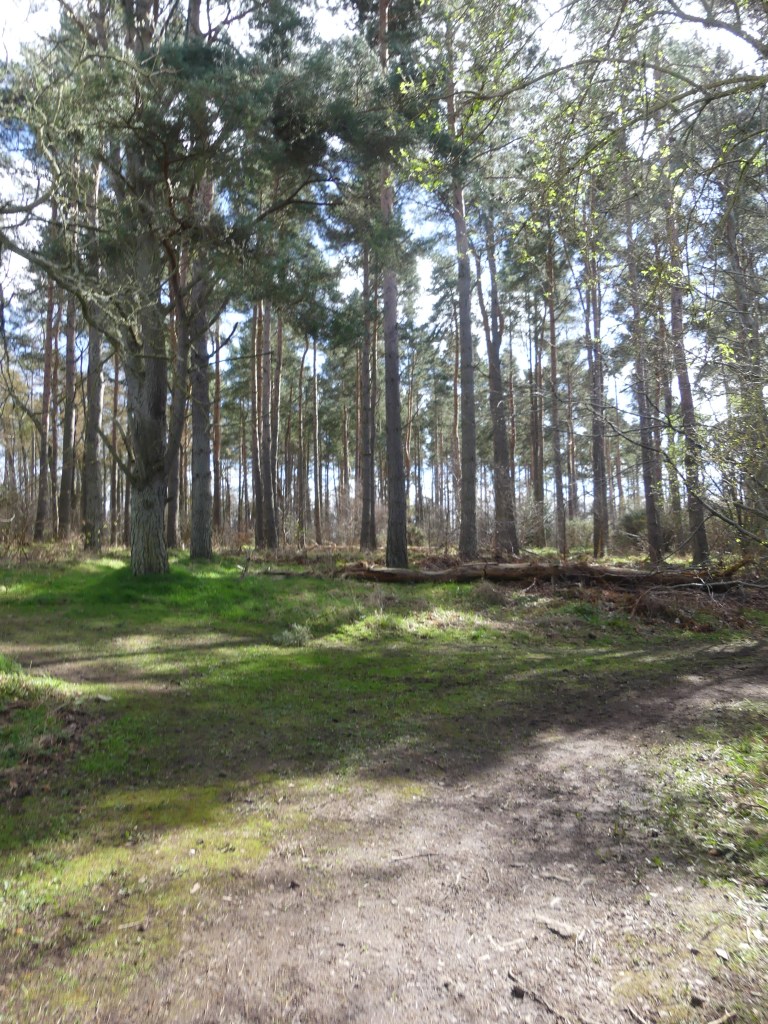
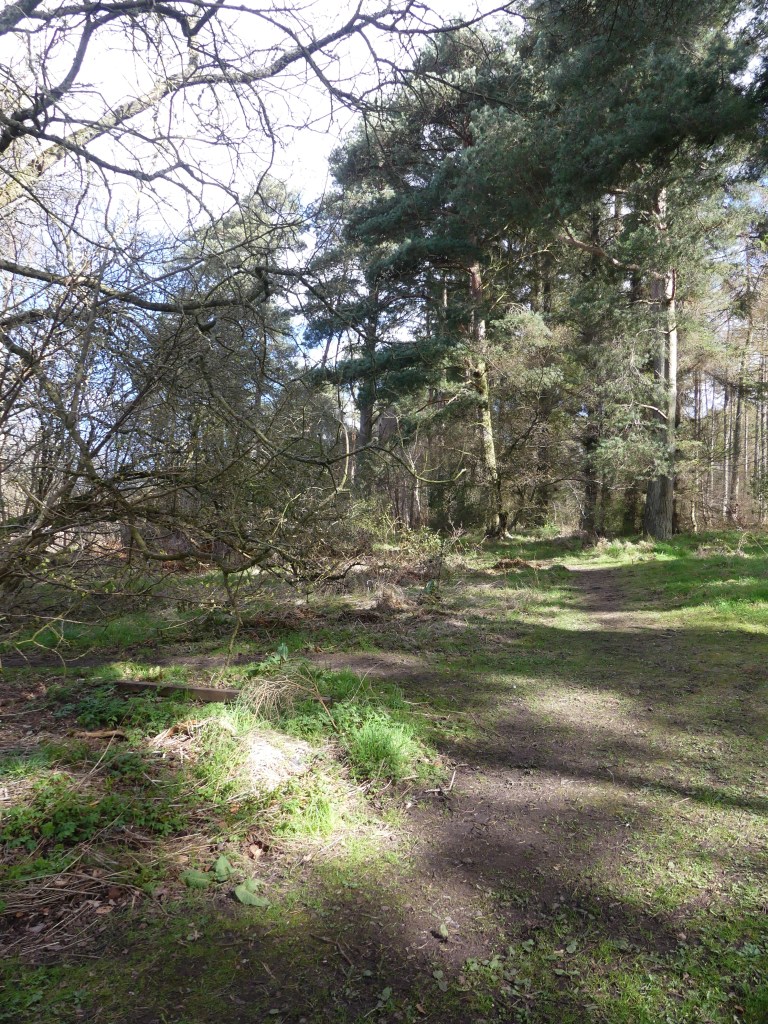
Anagach Woods
We came to a tree, however, which did seem to be different to the others. It stood in the centre of the path, and on closer inspection seemed to have been hacked at with a powerful axe, the bark stripped away around these slicing marks. And then Nick explained his thoughts, giving a new perspective on the woods as a place of historical and natural value. He described the tree as a pine-candle, as before electricity became readily available, people would brighten their homes by candle-light, and these homeowners chose candles of pine-sap, which burned for a prolonged amount of time. You could also see the faint evidence of scratch marks and engravings on the weathered trunk. If you looked hard enough, you could make out a name and initials. This further supported the theory, as people would come out into the woods before winter and mark the trees they would collect the sap from, so others knew not to lay hands on their ‘property’.
People would travel long journeys to collect these little slivers of pine bark, enriched with the sap, for in the depths of winter in the highlands, you would often be stuck in 17 hours of darkness out of 24. But why were these trees so good at this purpose? Well, that’s a long story of ecological evolution. Just like the famous Californian Redwoods, these pines have learnt to adapt to the occasional forest fire, and this provided a slow burning, long-lasting candle. The bark of a Granny Pine is tough and burns awfully slowly, and in this way the tree hopes to outlast the flames, with the bark taking such a long time to burn completely that the tree has a better chance of survival, simply because forest fires don’t burn forever.
Further on, to our left was a pine covered slope, layered with thorny tangled like landmines, laden with new growth. A Blackbird chattered its alarm, and emerged with tail erect, before undulating away into the trees. To our right was a boggy selection of pools, connected by channels of sphagnum moss and protected from the driving rains by watchful alders. The former was our next destination, heading down the slope and dodging the cascading mud, before coming through a stile and entering a… house estate? Well, Anagach Wood is a community woodland, run by and for the local community by the charity Anagach Community Trust, and this explained why the woodland was so well managed, by those who had its best interests at heart.
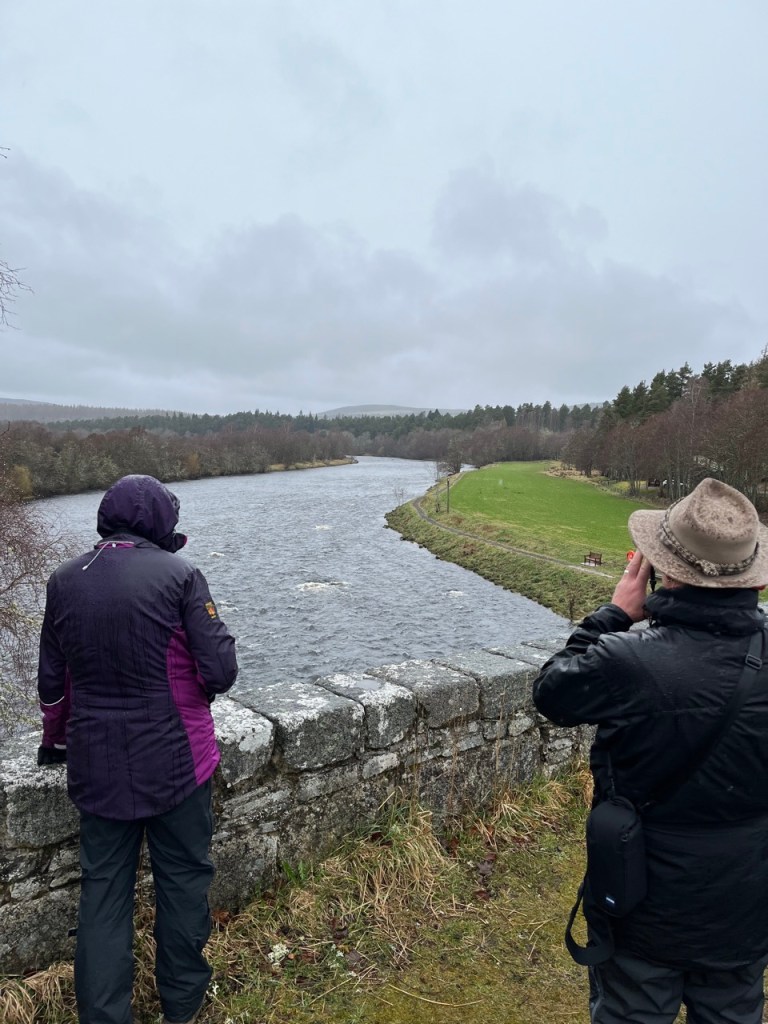
Fair enough I guess, and it delivered to begin with, as a singing Song Thrush presented itself for inspection, perched prominently on the top twig of a garden cyprus tree. But we soon left the red brick bungalows, and came to a long stone footbridge, arcing over the River Spey. To provide you with more Scottish historical knowledge, this bridge formed a crucial route over the Spey as part of the Old Military Road, which allowed soldiers to move rapidly in response to a threat over long distances. The road was essentially a dead straight line, reminiscent of the Roman roads which still exist in England. Of course, the Romans never managed to conquer Scotland, so this is probably the closest thing they have up here.
The River Spey
Immediately we saw a displaying Goldeneye male, throwing his head back a surreal distance onto his back and essentially harassing the chocolate brown female, chasing after her and throwing his head in her face. It seemed to work, and they flapped off downriver together, wings whistling in the morning air. This, like many of our Scottish encounters, was a courtship phenomenon I was unlikely to ever see further south, with the birds preferring to breed north of us, in Scandinavia, Iceland and of course Scotland. These birds are one of the few British ducks to actually nest in tree cavities along the Scottish rivers, and will even take to specialised, deeper nest boxes if provided! Even one of the local Scotch whisky distilleries had put up many of these nestboxes along the banks, in a bid to be more nature friendly!
We saw a few more pairs exacting the same ritualistic behaviour, with perfect nesting trees lining the riverbanks. But there was also something I hadn’t seen up here yet, in fact never in my life. Everybody was gathered on the corner of the bridge, and Nick was pointing and following a Dipper with his binoculars, directly below us. But what was special here was a certain mossy cup attached to the stone cracks of the sheer walls that made up the bridge. You’ve probably made this assumption, but this was in fact the bird’s nest, and most likely scenario a female was concealed inside.
A pair of Goosander flew at head height across the bridge, and that marked our continuation of the walk, along the riverside, with the path in some areas having become one with the river (flooded) and featuring the occasional staring Oystercatcher. A Grey Wagtail bobbed and wagged, following our progress and flashing its yellow underside in encouragement. It’s such a positive bird to find on a grey day (ironic, given its name), and we watched awhile as it leapt in and out of the shallows.
We reentered the woods at a second stile, slick with rainwater. This section levelled out, and the first spot was something I hadn’t really expected to see, due to their secrecy and general concealment. It camouflaged flawlessly against the pine trunks, bar an occasional flash of snowy white from its underside. It was, of course, a Treecreeper, and the positive mood climbed higher among our party as we walked out back into the grim skies of Grantown-on-Spey. The last few moments of that walk provided a friendly but provoking talk with Nick, on the issues that still surrounded nature even here in one of the wildest areas I had ever had the fortune to visit. It still felt incredible to discuss these matters with somebody who knew so much about them.
Anagach Woods again!
We would be out with Nick once again that afternoon, but for now we bid him farewell and hopped over the road for a rapid lunch, before a quick change of clothes and equipment and being picked up by Nick, bound once again for Strathdearn, where we had spent an afternoon one our first full day that weekend. One of the foothills of the Monadliath Mountains, it felt like a truly wild place (though its wasn’t completely), with one road heading through enclosed by plains, ridges and the Findhorn River. A more detailed description can be found in my previous post here, but for now we travelled up the Strath to meet with our guided group team for the afternoon.
After meeting in the very end car park, we traversed the Strath in convoy, searching for the golden target for that afternoon; an Eagle, of any shape or form. But over the first three car parks, despite the wind and rain we had many good Mountain Hare sightings, and many a Red Kite flew overhead. And even the Golden Plovers remained in the exact field where we had left them, two days on. But (to my deep sadness) our Merlin friend didn’t put in a second appearance.
This car park would provide something special, albeit distant. Our cold and wet group had gradually dispersed, bound for various locations, because the weather clearly had little sympathy left over for us today. And just as it began to clear, we were stood in the layby scanning the skies as a distant group of gulls swirled above a tractor. But Nick was sure something seemed odd about these birds, and after some verification taking 20 minutes, he was able to confirm that the the larger broad winged bird among them, with its feathered fingers just visible from here, was in fact a White Tailed Eagle. Immediately, I was giddy with excitement, for this was a species that really was once in a lifetime for many. Also known as the Sea Eagle, the majestic bird was simply a speck on the horizon, but the scope allowed a simplistic shape to be viewed, and it had to be. At the last minute, we had found our Eagle.
However, we had (again) overran our time quota, and had to race back to the hotel for the evening meal. There was, for the first time, nothing on in the hotel that night, so we caught our breath in the bar with Dawn and Pete, talking of subjects that varied as the night went on. It was the first time we had actually sat down with them since Sunday’s quiz, and it was one of those conversations that I didn’t really want to end, it just seemed so easy to talk and keep it going. And as soon as we left the bar, we signed up for their guided group meet at Spey Bay the next morning. What remained of our stay would fly by, however.
Will Hall might not be a familiar name to you, but he will become one I’m sure. A talented zoologist, photographer, presenter and filmmaker, he has extensive knowledge and skill in the wild from skulls and taxidermy to on-point wildlife ID. Not only this, but he’s spent years getting involved and teaching young people, the next generation, the vast swathes of knowledge he holds, and he was very generous with sharing his knowledge. His grasp of local history, as well as the wildlife in the area, makes for an exciting trip, and you will always learn something from him. Naturally, when Sue told us we would be going out with him, I couldn’t wait!
Scanning the Bay
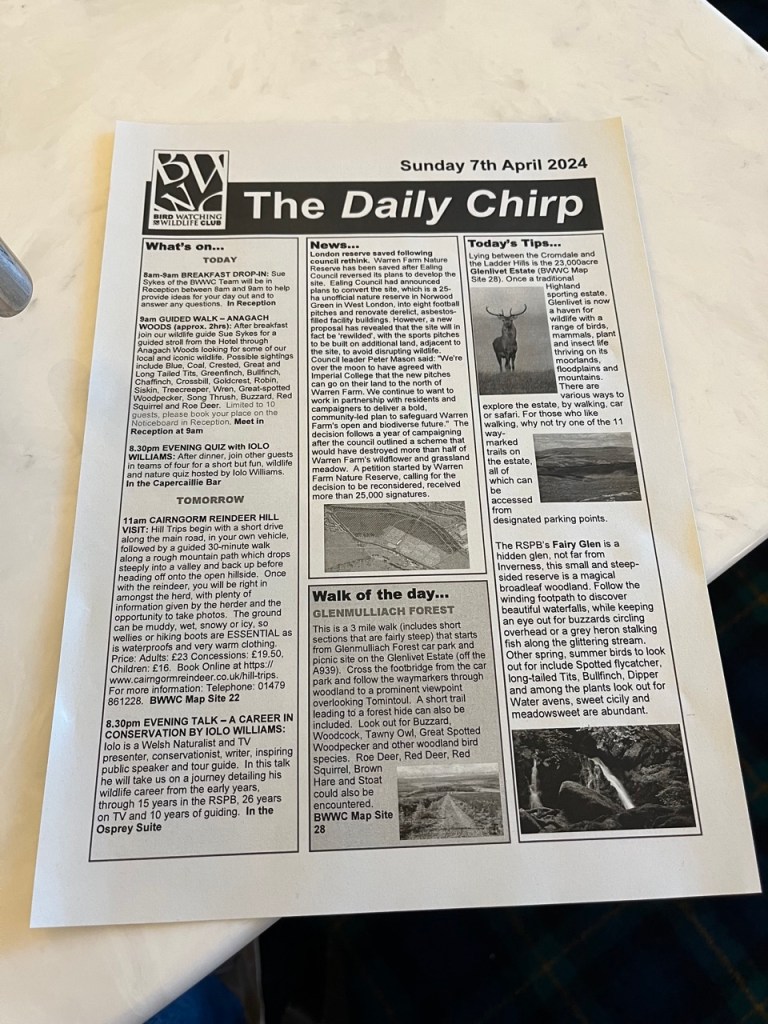
After another early start, we spent breakfast calm with anticipation (it doesn’t make sense, but its true!), with the Daily Chirp laid between us. It was a fairly rapid affair (all serene thoughts forgotten) and we rushed back upstairs to pack bags for the day ahead, at exactly 8:55AM we ambled down the grand old staircase to meet Will and Sue in Reception (reception was essentially the hub, with all the comings and goings centred there). Despite this being the first time we had met, there was never an awkward moment and arrangements were swiftly made before we followed Will outside.
Findhorn Bay was to be the first stop along the line, as today the plan was to spend some time away from the woods and stick close to the sea. Yet we still ended up driving through plantations, and here we learned a lot about the actual trees around us. Spruce is an invasive species (introduced by humans) and was brought here from Scandinavia to fund Britain’s wood production. It played a huge part in the 1940s war effort due to its swift growing capabilities, only taking about 50 years to become ready for use. But we were soon left with so many of these Spruce plantations that we still use them, and most of them still dot the countryside with foreboding pine-green.
But then there were the Scots Pine plantations, which supported Scotland’s original famous tree, known for towering over the once vast Caledonian Forest. But these were nothing like the impressive woods of old, and these trees were cramped and just paces apart from each other, to maximise output. They let in huge amounts of light compared to the Spruce, with their thinner, less than leafy branches higher up their nimble trunks. But these plantations, as I mentioned before, had nothing on their ancestors, which had inhabited the kingdom of Caledonia (Caledonian Forest. Colourful name, right?). These woodlands were not dominated by Scots Pine, but interspersed with many species of tree and bush, supporting such a vast variety of wildlife.
But our desperate ‘need’ for industrial quantities of pine-wood led to us wiping out this beautifully scenic habitat, which gave us tonnes more than we realised (before we cut it down). And humanity simply cannot perfectly replicate nature’s expertise and placements, meaning we might never regain this habitat to its greatest extent. The small pockets we have attempted to replicate will never be flawless, and are interspersed with birch (an indication of young woodland) when the best friend of birds and bugs is ancient woodland, centuries of age.
Brilliant weather for the brilliant blue!
On a more positive note, we continued up past the River Findhorn and came to the village of Findhorn, bordering the east side of the Findhorn Bay (immediately south of the Moray Firth). A quick drive along the harbour wall and we came to a halt, beginning to stroll down the narrow road. This place was truly as wild as a village can get, with gulls screaming in the air and darting Terns plummeting with the expertise of an Olympic diver and emerging with a beakful of sandeels. Nobody seemed perturbed by the presence of so many boats, with Mute Swans and Mallards weaving in between. Well, even the Turnstones scampered across the decks!
And the geography of Findhorn Bay was made it so many unique compared to so many other river mouths along the coastline. Where the river met the sea was a surprisingly narrow channel, a spit enclosing the rest of the Bay from the Moray Firth. This also highly increased the spot’s cetacean potential, with the Findhorn’s fish being funnelled through this channel, and this is where the Dolphins (and others of course) cut them off, effectively creating a pinch point where all the predators have to do is lie in wait for their prey.
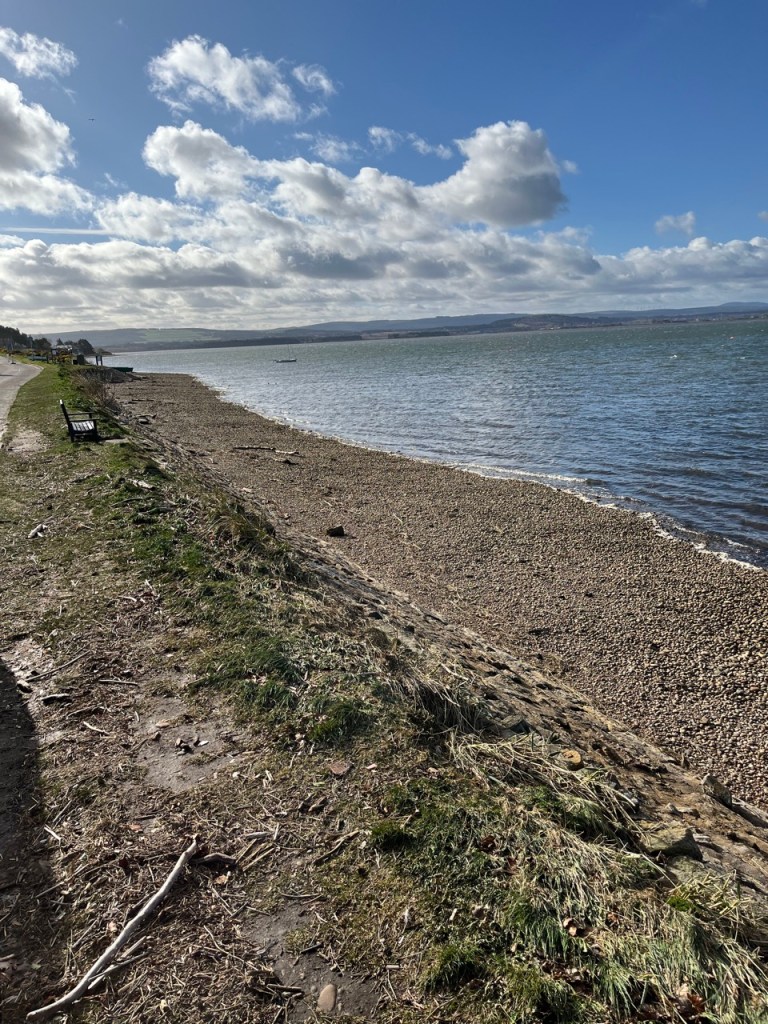
Findhorn Bay
But bang in the centre, away from all the boats and warring gulls, five duckie gems floated and dived intermittently. Long-Tailed Ducks, two males and three females. Their plumage just seems like their favourite Scottish Season (they over WINTER here. Big clue) the males a snowily patterned white with patchy browns, and the females chocolate brown with sporadic white. And the males certainly lived up to their billing, with delicate arrows protruding from their rears. The path was lined with seaweed and stones, among which a Crow posed and poked in the early morning light. But this was not the glossy black we were used to down south, but a much more balanced blend of grey and paler blackness. A northern specialist, the Hooded Crow, a new bird sighting for me, had decided to give us the tour of its domain.
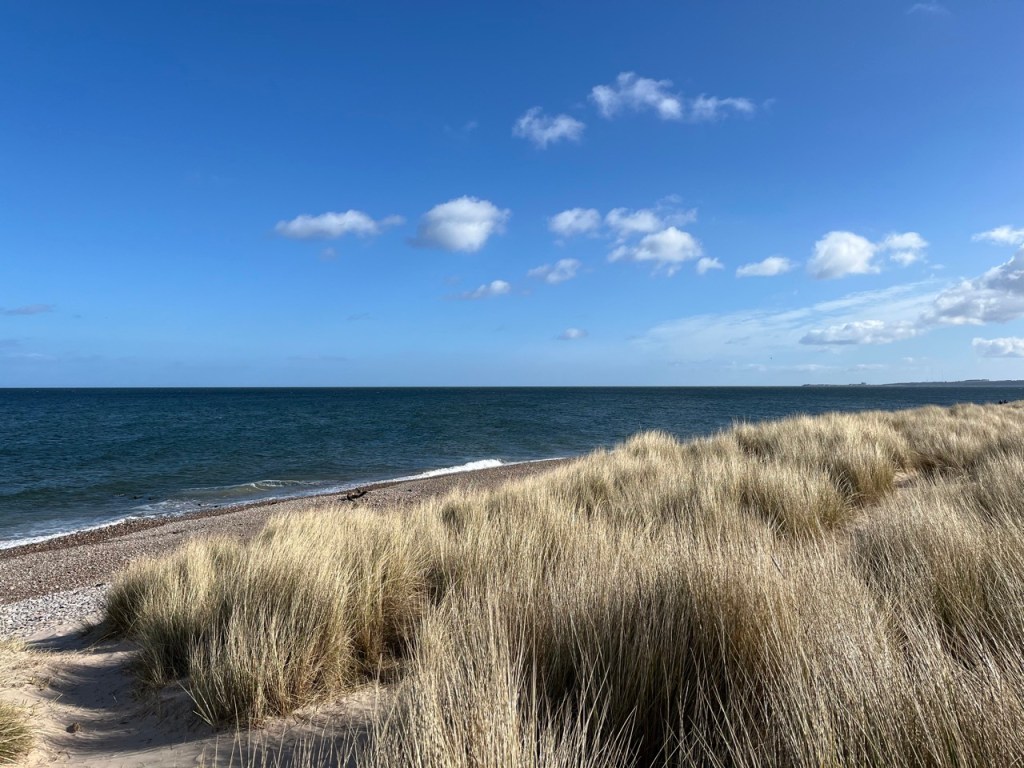
The dunes were mightily grassy, yet welcomed us through its narrow tracks. What lay on the other side was truly breathtaking. We were now stood on that spit I mentioned earlier, and the Moray Firth lay before us, ocean as far as the eye could see straight ahead (not if you looked left or right). We sat on the fidgety pebbles, and scanned the lazy, lapping waves which hid such a bounty. Nothing in the way of cetaceans put in an appearance (this was a really good spot for them, but our luck was maybe slightly dry here), but fishing Gannets and more Long Tailed Ducks provided some well-earned entertainment.
The beaches on the Findhorn spit
After a while however, we set off once again, following the coastline until we reached the former Pictish Capital, AKA Burghead. The Picts had built their fort on the sandstone headland, and in its shadow was where we began, scanning the seas from the harbour walls, scattered with skittish Turnstone groups and slightly too trusting Feral Pigeons. Immediately you would notice the proudly vain Cormorant that dried its wings in the emerging sunlight, perched on a jutting raft of driftwood bobbing with the waves. But the Black-Throated Diver trapped in the gusty turbulence and choppy seas was a little bit more of a challenge, with the bird in its dandy breeding plumage continuously moving in and out of our eyeline.
The harbour was almost completely submerged when the rain came in
The next port of call was the calmer (but still blustery) behind of the clifftop, which provided ‘some’ respite from the chilling, skin-assaulting gales. And immediately we all managed to lock on to a Red Throated Diver, rolling in its winter plumage, blacks and whites contrasting against the azure. Just as we were watching this splendid bird, 7 birds flew in and out of frame within moments, chunky and flapping like mad. Razorbills, their heavy bills easily visible at this range. Almost immediately, its Auk cousin flew in the same direction, 5 Guillemot individuals (also known as the Common Murre. Very fun to pronounce). Also, two more lifers!
We continued along the wall, accompanied by Turnstones bobbing and weaving before us. Occasionally, they were startled by our presence and skipped away, but they would always come back. They were used to the people who inhabited Burghead, and three individuals weren’t going to bother them that easily. But we lost them as we came to a winding clifftop path, which, somewhat precariously, led to the top of the sandstone headland and the worst of the wind. Naturally, we had to go up, and keeping in close to the rocks, we meandered up to its peak.
A slightly dizzying path
Soon, these cliffs would be alive with breeding Fulmars, but for now one or two birds wheeled above the waves, their tubenoses at the ready. These specialist apparatuses extract the high levels of salt from the seawater, allowing them to drink to their heart’s content. And despite their apparent similarity to the Gull family (a common misconception that they are in fact part of it), they actually belong to the Shearwaters and Petrols, relating them to birds as wizened as the Albatross. Pretty great, eh?
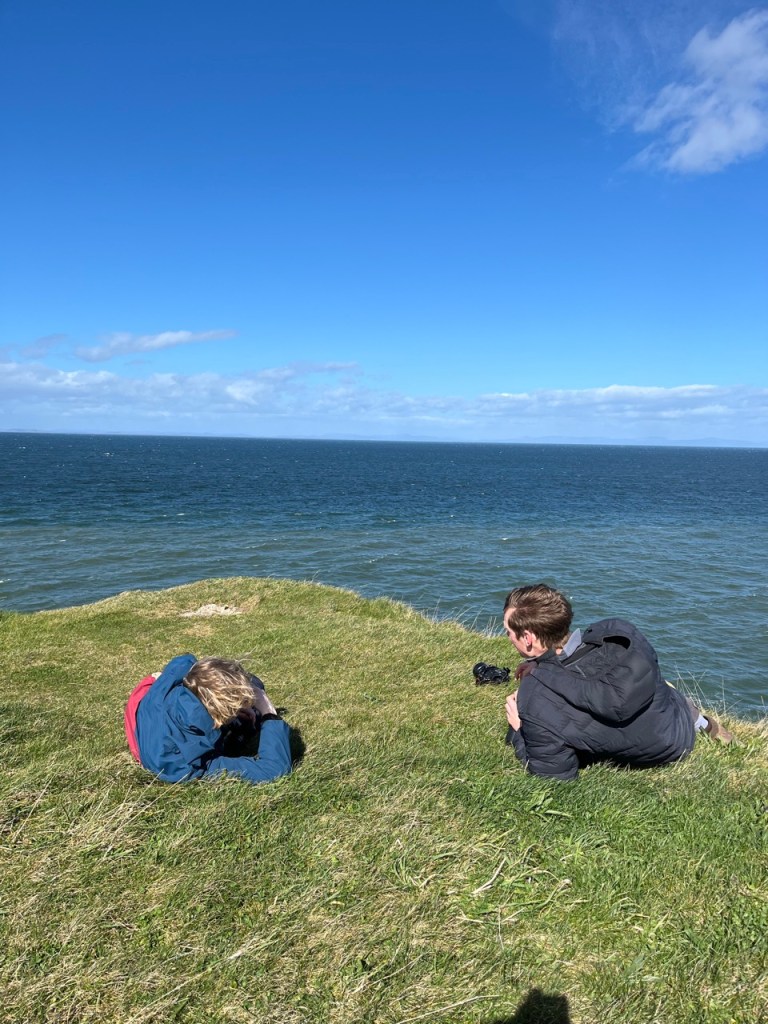
As expected, the flat crest of the sandstone rock jutting out into the currently unmerciful weather was certainly being battered by the elements, and we ended up sitting and lying among the swaying grasses in a bid to avoid being swept away in one of nature’s greatest powers. As we watched, more Razorbills flapped their wings furiously against the gale, but seemed to be going slower than they should be. In fact, all the birds who were flying higher than sea level seemed to be struggling. A skein of Pink-Footed Geese, their v-shape under great pressure, looked as if they had been edited into slow-motion. It felt very exposed to be up there, alone against nature’s unpredictable grasp. Yet it also felt truly wild, and this was enhanced by the distant presence of an extinct volcano, a dark smudge in the horizon. But it also felt like an experience that all should have at least once in their lives, to experience the elements and their capabilities.
Windy on the cliffs!
Eventually, we set off again on the long winding road that led us towards Lossiemouth, home to one of Scotland’s main RAF bases. You could hear the roar of the Typhoon jets as they practised landing and takeoffs, and it echoed through the town all the way to the estuary, a beautiful sight almost unaffected by the presence of these defence planes. We didn’t pause here, however, and continued on the road before heading down an unsuspecting lane guarded by watchful pines on both sides. We emerged from this small pocket of trees into an area of ploughed fields, and then turned down what looked like a farmer’s dirt track, for tractors and pickup trucks. But that was the illusion. What this apparent ruse hid was something special, bathing in the now scorching sun.
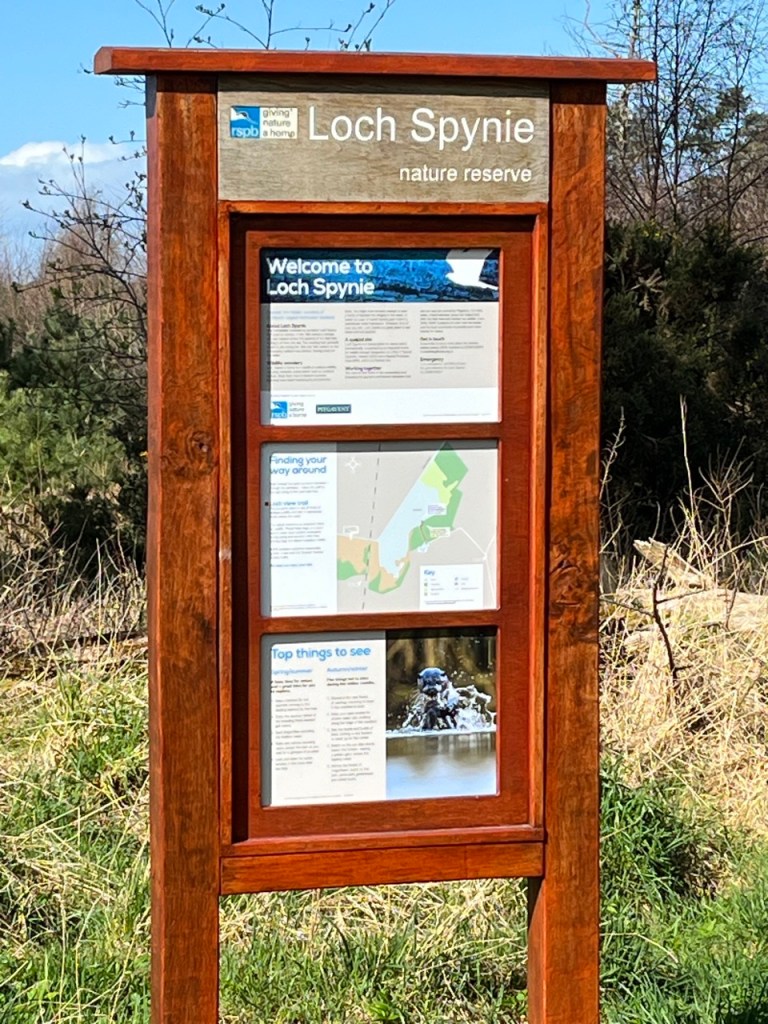
Loch Spynie was a loch drained to a large extent, and is connected by an intricate canal system to Spynie Palace, home to the Bishops of Moray for 500 years. The amount of different habitats here, all working in harmony, is a great example of nature at its best, and the alliance here between the RSPB and Pitgaveny and Spynie Farms sets a great example for the rest of the country, that agriculture and wildlife can coexist, alongside each other.
Welcome to Loch Spynie
The car park was small, but the usual mud had been cracked to the bone by the all-powerful sun, that had reared its godly head for the first time of our trip. As soon as we had emerged from the car, a falcon flew low over our heads, bound for the reedbeds that thrived around Loch Spynie. We had seen a Peregrine on the previous day, out in Strathdearn, and this bird was more streamlined, smaller with a longer tail. Will confirmed that it was probably a Hobby, one of our few migratory raptors. It comes in the Spring to breed, and depends on the abundance of our insects, from dragonflies to midges. This was a bird that was high on my British bucket list, and it was incredible to see one in such an unlikely spot.
The Hobby is an incredibly scarce breeder in Scotland, compared to the English and Welsh populations, and to was a bit of a surprise to see one here. They nest in open, mature Scots Pine Woodlands, and use disowned crow nests, as in similarity to other falcons, they do not build their own nests. They are opportunists when it comes to hunting, and they have been known to take almost 100 bird species as well as their main insect food.
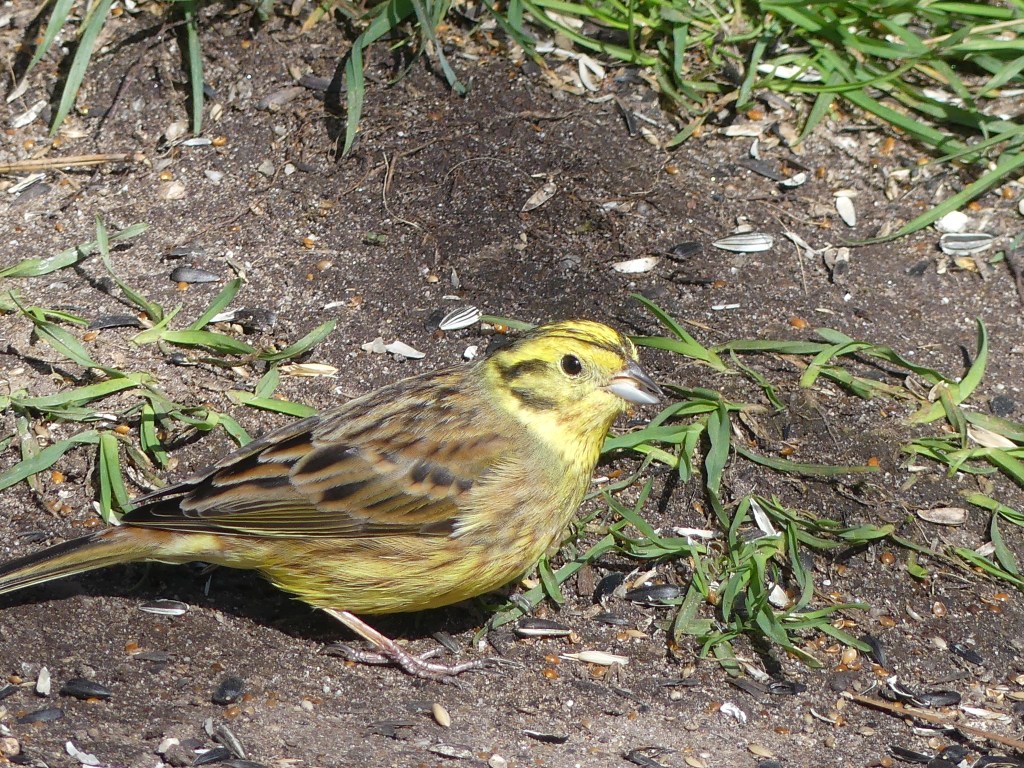
Following the bird’s departure, we sat on a bench facing a scattered set of feeders, for squirrels and birds alike. Proof of the farmland-nature alliance was abundant here, with a count of around a dozen Yellowhammer feeding here. This was a bird which had declined by over 50% across the UK, and a bird which had suffered greatly due to rapid changes in farming practices. Will knew of a Grey Heron heronry just through the trees, and pointed it out to us. Within weeks this would be alive with these huge birds, deafening noise drowning out motors and engines. They would breed here, and eventually their enormous chicks would be sent on their way.
A Yellowhammer, part of a flock of a dozen!
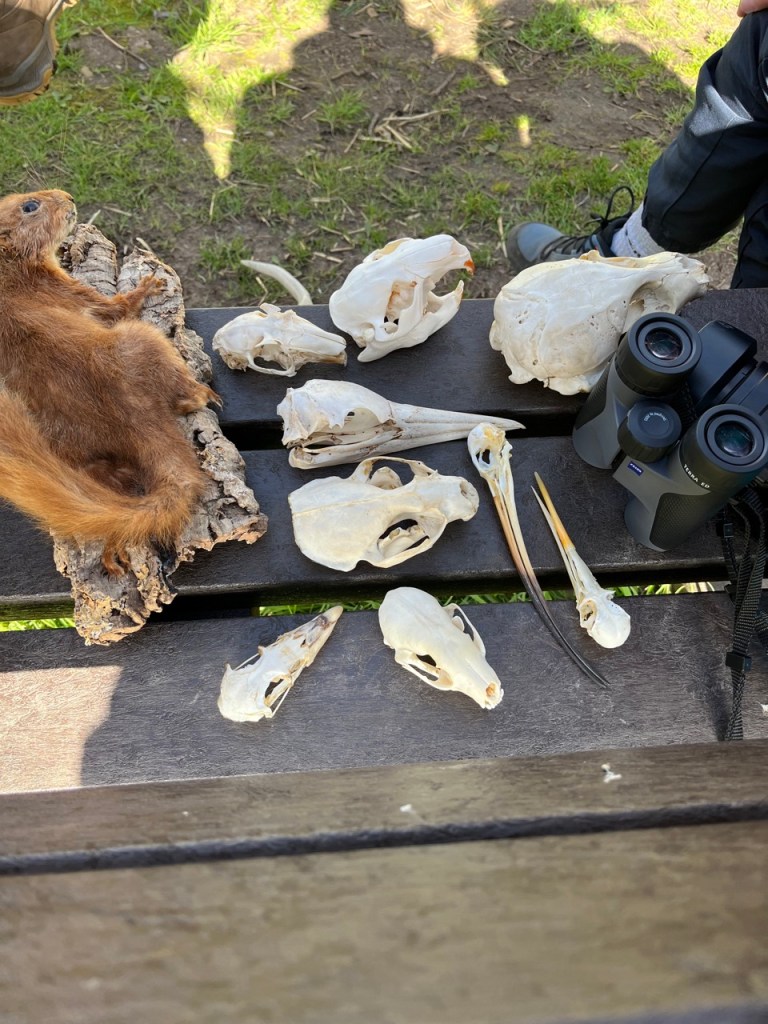
While we rested here, taking stock of our surroundings, Will brought out a deep red box, filled to the brim with skulls, wings, and taxidermied roadkill. First out was a Red Squirrel, preserved well with its original foxy fur. We spent well over half an hour on this (very much like the Corridor), with some skulls easily guessable and others taking a little bit more brain-power. We got there in the end with most of them, and their was incredible variety, from Curlew to Otter, and Porpoise to Grey Heron. As daft as it sounds (given the fact that I am a child), I felt younger than I had been for a long time, and it felt freeing to let out a bit of childish and silliness at this point, with guess the skull the perfect way to do it.
Skulls!
With that, we ambled into the wetland’s woodland, and the calls of ducks and gulls emanated from the Loch just through the reeds. But first came the wizened trees, still considered young by their ancestor’s standards. Birch lay scattered along the edges, an indicator of a still fairly young woodland (as I mentioned earlier). And the first find among these trees would prove to be a true Scottish specialty, driven north by its originally American counterpart. A Red Squirrel, scampering up the trunk of an oak. It crouched in one of its many forks, munching something out of our sight. It was one of those moments, when you feel the connection to nature is no longer estranged, as the human’s lifestyle suggests, but is very much interconnected and most importantly, real.
A distinctive Red Squirrel
We would get to the main hide in good time, but first Will took us to the banks of the Loch, where the alders hung tangling tendrils over the reedy water. Otter spraints, a whole set of them, scattered around us. White and brown, encased in fish scales, these droppings provided a convenient way to mark out territories, but also gave us an invaluable insight into their lives. Some of them held fur and bones, as well as the inevitable fish scales, and some even encased feathers.
The path towards the Spynie hide
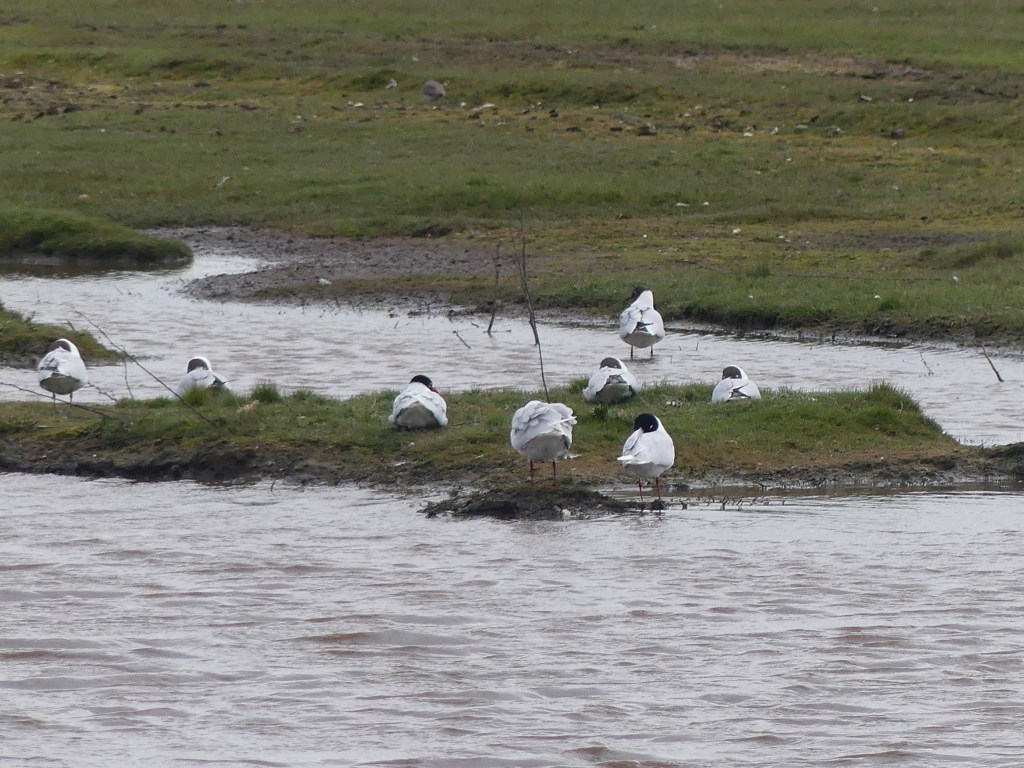
Now we headed to the hide, and the main source of the din was immediately obvious, with a Black-Headed Gull colony scrapping for space on an artificial breeding island. They seemed to be surprisingly averse to the outcrop’s counterpart, another one seemingly the exact same, but empty. Out of the side window facing into the reeds, a male Reed Bunting (very original name), smart and dandy, hopped with surprising agility from stalk to stalk, each one bending ever so slightly with his momentary alighting.
The Loch Spynie Woodlands
But he hopped away as a pair of Little Grebes emerged from beneath the surface, male and female, both dainty and long necked. The male had a rich chestnut neck, glorious in the sunlight glinting off the water. The neck of the female was a sandy brown, so that it blended with the reeds. When she went through a thicker patch, it was as if a detached head floated from the body. They were in suitable breeding habitat, and seems to be sticking together, so it seemed more than likely that there was a nest somewhere nearby.
View from the Loch Spynie Hide
There was so much more out on the Loch, from Tufted Duck and Mute Swan, to Mallard and Goldeneye. That’s another difference between north and south. Goldeneye are on almost every body of water up here, but down in Devon they are a true scarcity, and I have only seen them thrice back home. They breed a fair bit up here too, in trees along riverbanks.
After a while, we (almost) silently exited the hide and headed back into the boggy woodland, such a perfect habitat for life. And there were many a treat to be found here, as Will found a particularly large patch of Wood Sorrel (highly recommended), which actually tasted like green apples. Will’s knowledge, not just of wildlife, but foraging and bushcraft, was on point, and it would continue to show through as the day went on.
A good example of Horsehoof Mushroom. Its density gives it properties as an effective natural fire starter, and they found several pieces of it on Otzi, the Ice Man, who lived 5000 years ago and was preserved almost perfectly in the ice.
And on our return to the car park, we would get that day’s first taste of a spectacular creature, as it glided effortlessly overhead with M-shaped wings. Through the binoculars, you could just make out the black and white, contrasting greatly in colour. The Osprey flew off into the horizon, vanishing behind a distant treeline. Surely it could only be a good omen?
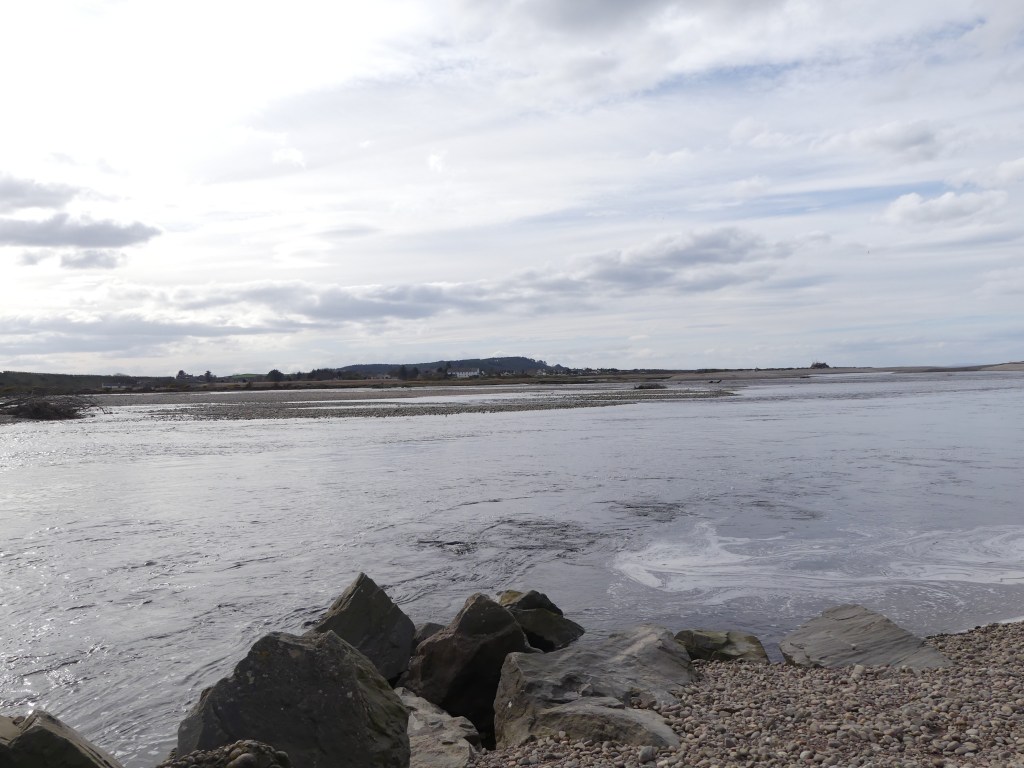
So we set off back down the farmer’s track, bound for Spey Bay, where the River Spey (for which Grantown is named) ricochets around rocks and islands to meet the sea, forming bands of bays and pools, and creating a unique habitat. It was better for us to leave now, in order to make low tide, when the Osprey’s preferred to hunt, when the shallower water made it easier to fish.
This was also the site of the Scottish Whale and Dolphin Centre, a hub of conservation and observation, complete with a museum and live web cams. We had a brief lunch here, and then set up facing the river mouth, complete with vegetated islands and shingle bars.
Spey Bay; an introduction
The water was alive with waterfowl and waders, the air filled with avian noise. This was usually a brilliant Osprey spot, but none showed up in that first hour, so we set off down the track towards Garmouth Bridge. It followed one of the many channels that fed into the Spey at this point of its journey, and it was lined with House Sparrows, Reed Buntings and the occasional Grey Heron, intent on the water. But all of them hid in the cover of the many alder and birch trees that lined the banks.
Patches of Dog’s Mercury were also abundant, indicating that this was ancient woodland and therefore incredibly beneficial for wildlife. It actually has nothing to do with dogs, but is highly toxic to them, as well as us. But it does seem to provide a good habitat for many species. Many bugs and insects find it a suitable home, and for some reason it seems to draw many ground-nesting birds, such as Woodcock.
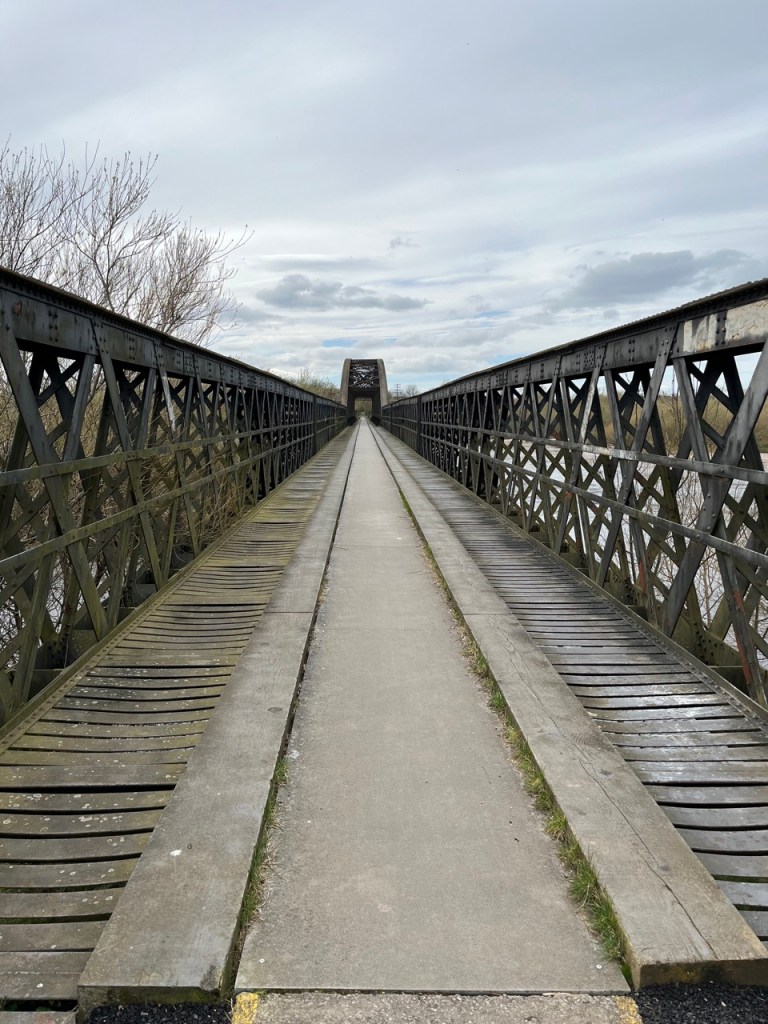
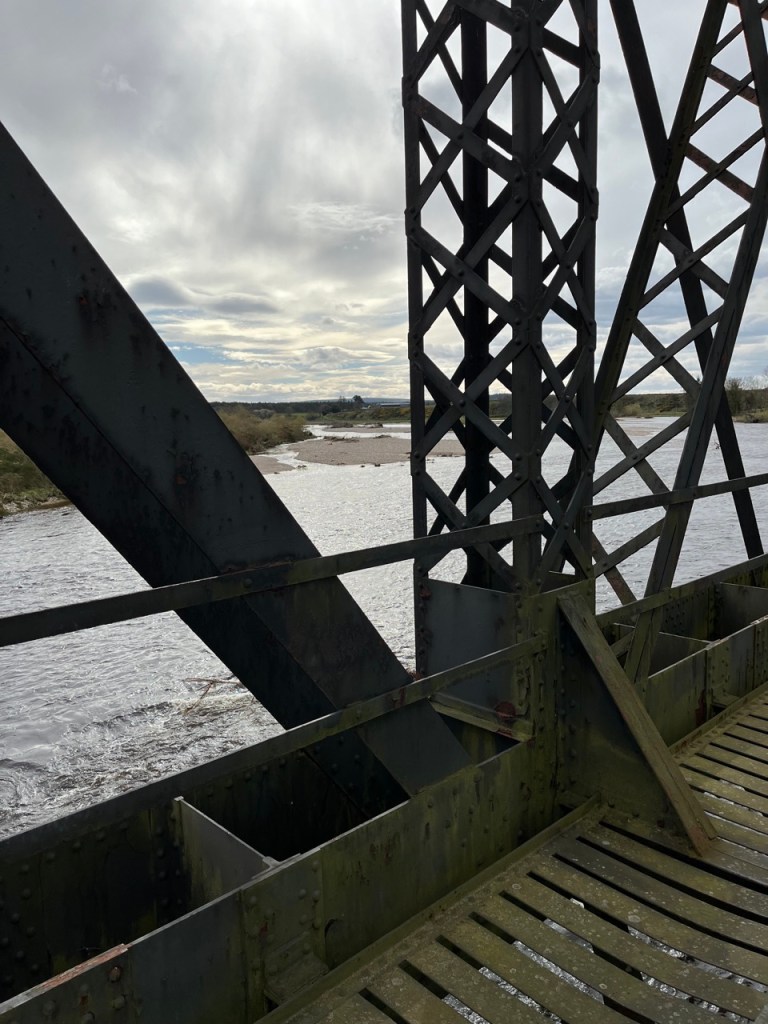
After a while, we came to Garmouth Bridge, an old railway bridge that spanned the Spey. Oystercatchers piped overhead, and a Kingfisher squeaked softly from somewhere hidden. Looking through the slats to the river below was dizzying, and I tended to try to stay on the solid central path!
Garmouth Bridge. Try not to peer between the slats!
Following an inspection of the iron bridge and its surroundings, we headed off the beaten track (literally) and into the undergrowth. Will had found several mammal signs here before, and together we crept down the stone wall. Will challenged me to search for and track the signs. Although this was out of my usual skillset, it was really enlightening to see and follow in the steps of elusive creatures that we otherwise might not see. We found more Otter spraints, fox scat and several badger latrines, where they had dug holes to soil the leaf litter. Recommended day out, searching for scat in brambles!
The River Spey flowed rapidly underneath us!
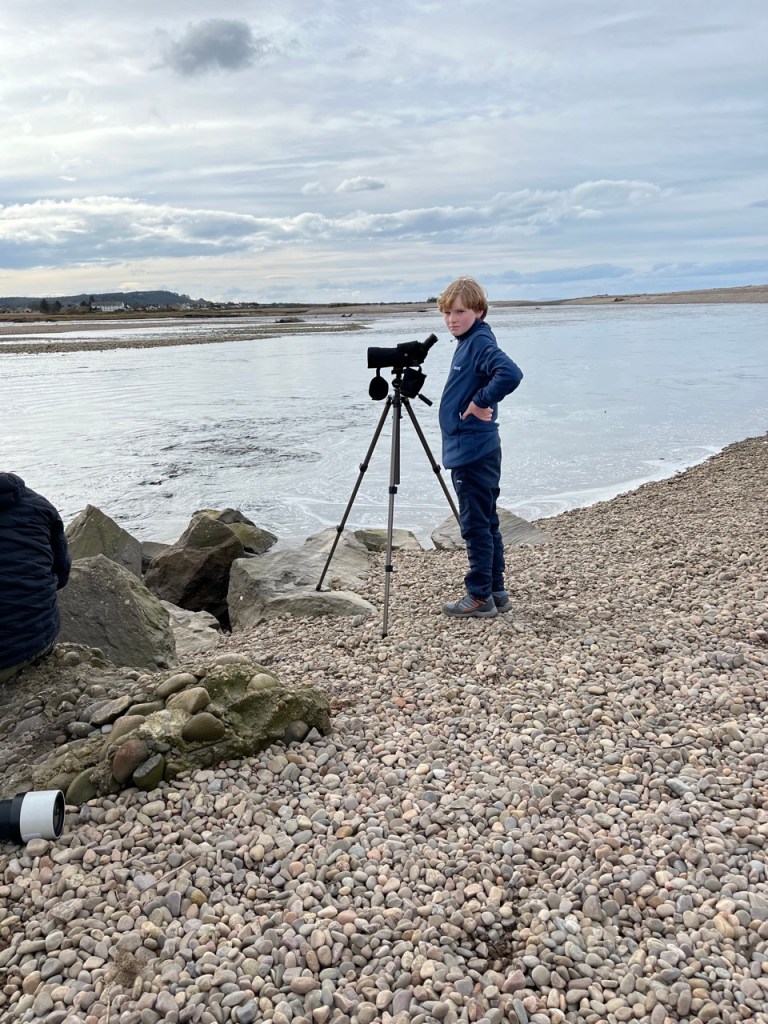
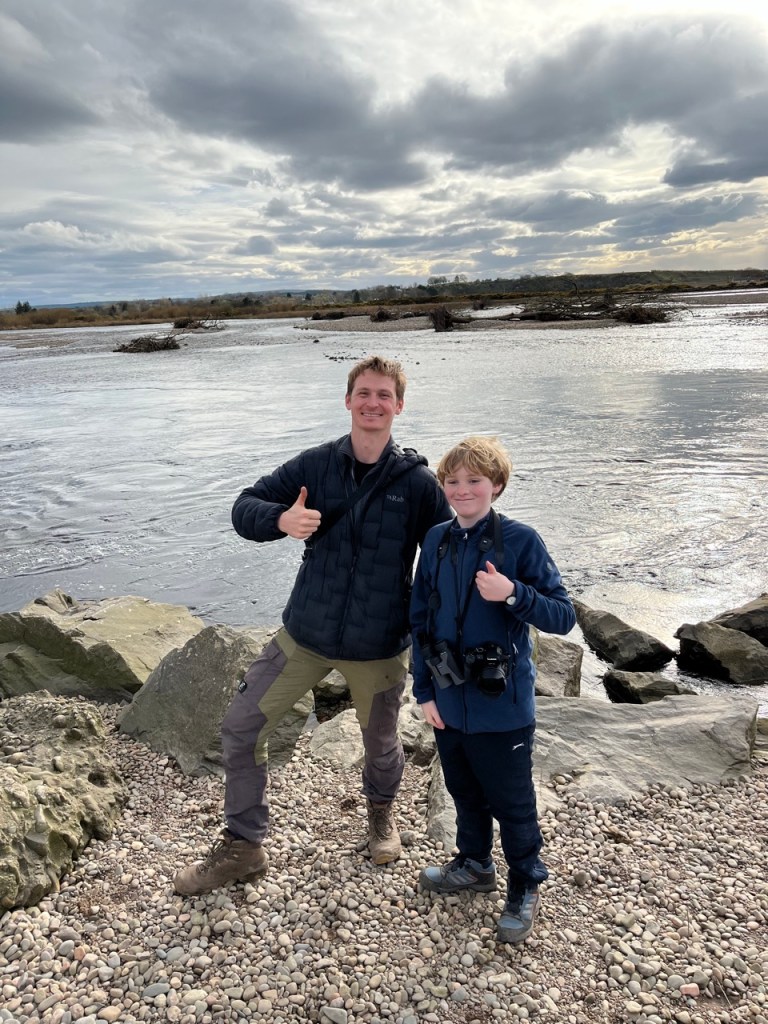
We made it back to the mouth with heaps of time to spare, and set up scope and cameras, before hunkering down to see what would put in an appearance. Funnily enough, we weren’t actually watching for an Osprey, which was our target. From this distance, it would look just like a gull in with all the birds currently in the air. But by watching the gull flocks for a behavioural reaction, such as louder noise or grouping together or even divebombing, we could probably find it without too much scanning. The gulls would chase and harry any raptor that turned up, and that could just be our Osprey. That was the master plan, anyway.
And it did end up working. 20 minutes later, just after being told we had missed it, the gulls went crazy, climbing higher into the air and creating the din of hundreds of individual threatening squawks. And then there it was, pursued by seven brave Lesser Black Backed Gulls, one of them even going for a tail-feather. By now the drama had drawn closer so as it was almost directly above us! Purely majestic and composed (even when being chased by a mob!), its M-shaped wings were incredibly dynamic, moving from a hovering position reminiscent of a Kestrel, to far spread and clearly black and white. At regular intervals, it would fold in its wings and swoop vertically at the surface. It dropped so rapidly, that it didn’t feel conducive to the effort it had to put in to get to the desired height.
However, its hard to believe that we had to travel this far to see a bird which should be widespread across Britain. Here in Scotland, you have one on almost every loch. Across the rest of these islands, the same would be true if it weren’t for illegal persecution, and loss of nest sites to egg collectors and shooters. But it really isn’t that simple, with many factors intertwined in their decline. Chemicals and pesticides leached into the environment affect the entire food chain, but those at the top receive the worst. Another is persecution along their migration route. Of course we’ve never been the only one who wish the death of Ospreys, and its the same story across the world. The beautiful and wondrous must die, for ‘the greater good’ (AKA giving us more opportunity to overfish, which is already a huge problem). If it wasn’t for the unnecessary follies of the human race, they would be everywhere, coexisting perfectly with their ecosystems.
Osprey scanning is serious business.
But there is proof that we can feel some affection for this specialised raptor, and that it’s presence can in fact be advantageous. Some fish farms are plagued with Ospreys, which is natural (not the presence of the farms, but the attraction of the food). But many are willing to pay to get up close and personal with the birds, and one of the best places to do this is at a Hebridean trout farm. So we can live alongside these birds, and humanity has essentially contradicted themselves here. The argument was shaky, after all. And surely this proves that a lot of our prejudice towards nature is, as we are only just starting to realise, unfounded too?
Hello again!
Yet the exhilaration of the encounter was heightened by the species’ plight, and it makes you realise that you want this to be close to you, every day of your life. This is what motivation feels like, saving nature the end goal. But this is a plight that nobody can listen to alone. People need to be doing more, because if everybody does a little, we can do a whole lot more than you realise. If nature goes, so do we. And I’m going to leave you to stew on that point now.
Spey Bay
The bird, to our delighted surprise, was not Spey Bay’s famous returning individual, but a new bird with a blue ring, not a yellow one. It looked like it could be one of the younger birds, ringed in Lossiemouth just up the coast. We tried not to lose sight of the bird as it drifted further down the river, until just a speck above the now distant Garmouth Bridge. It stayed in this area for a rather long time, and even the scope could only see it as a pointy dot. But we knew it was our Osprey, having not lost sight of the individual since it had left the mouth of the river. However, the excitement was about to be increased greatly, in the form of a local Spey Bay celebrity. Again the Gulls grew raucously restless, and even the Greylag Geese took flight through agitation, as the yellow ringed bird, over 10 years of age, flew over surveying his kingdom. This was his domain, and he knew it, flying with a confidence only the avian world could truly understand. The gulls still attacked him, but everyone else present became hesitant, and everything certainly quietened down. It seemed as if the mouth of the Spey was in fact an Osprey dictatorship, ruled over by this black and white fish stalkers.
Eventually he followed the same path as his previous counterpart, following the river upstream until reaching Garmouth Bridge, still followed by the same courageous (foolhardy may be the better word) gulls. We still hung around, and maybe slightly overran our time quota, in the hope of another special experience. But I guess the birds had given us enough of their time, and neither returned. And so we returned to the car, jovially merry and talkative (exhaustion might have been another factor!). The drive home was long, but the general chatting was enjoyable, both to listen and contribute to. And it felt sooner than it should be as we pulled back into Grantown and outside the Grant Arms once again.
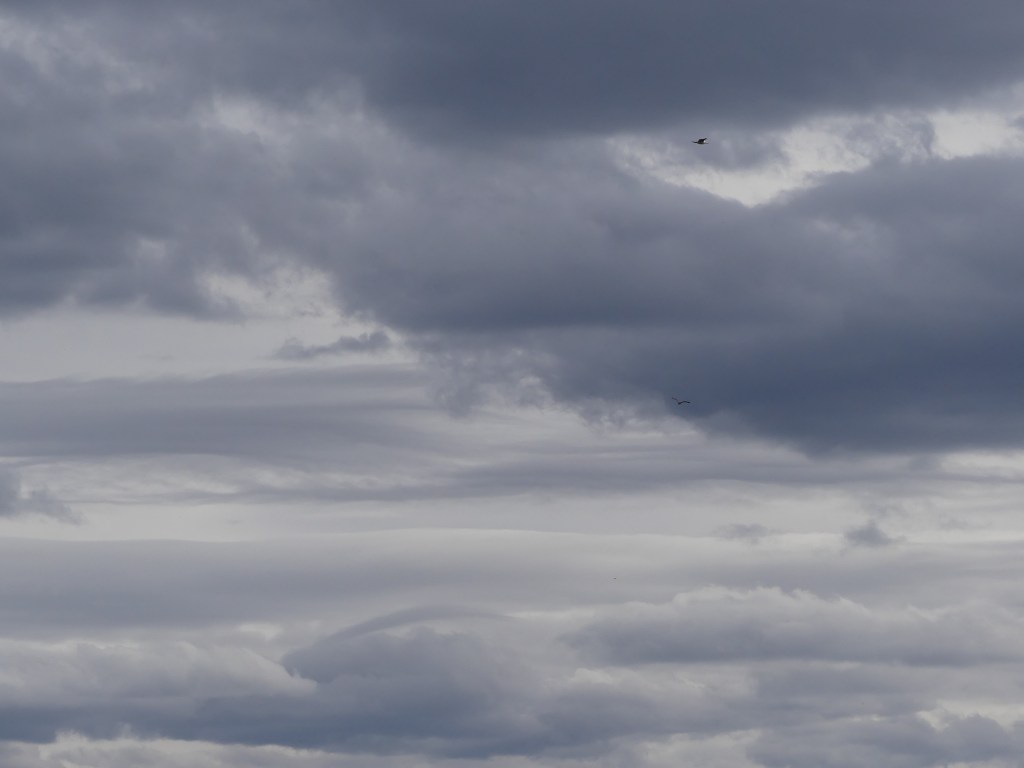
Gulls against the clouds
We walked back through the rotating doors, and said our farewells to Will. It had certainly been one of the greatest few days and experiences, the like of which I had never really experienced enough before this trip. These last two days had really been the pinnacle, something I had dreamt of for a long time, and it seemed like it had ended too soon. But our Scottish Stay was not at all over yet, and there was still so much more to come!
We strolled back up the grand old staircase, and half an hour later we emerged again for dinner. The meal was again a pleasant affair, but we were bound by anticipation to sprint through it as quick as humanly possible, so as to be ready for Iolo’s talk on a ‘Career in Conservation’.
And at long last, we finished and took the short walk (don’t be deceived, you could so easily spend decades in there) down the Half-Hour Corridor through to the Club Room, and then to the library ( a true gem). But through these esteemed double doors lay the single room we had not yet thoroughly explored. The Osprey Suite, complete with stage, rows of seating and (naturally) brilliant bird photography hung from intermittent wooden bars.
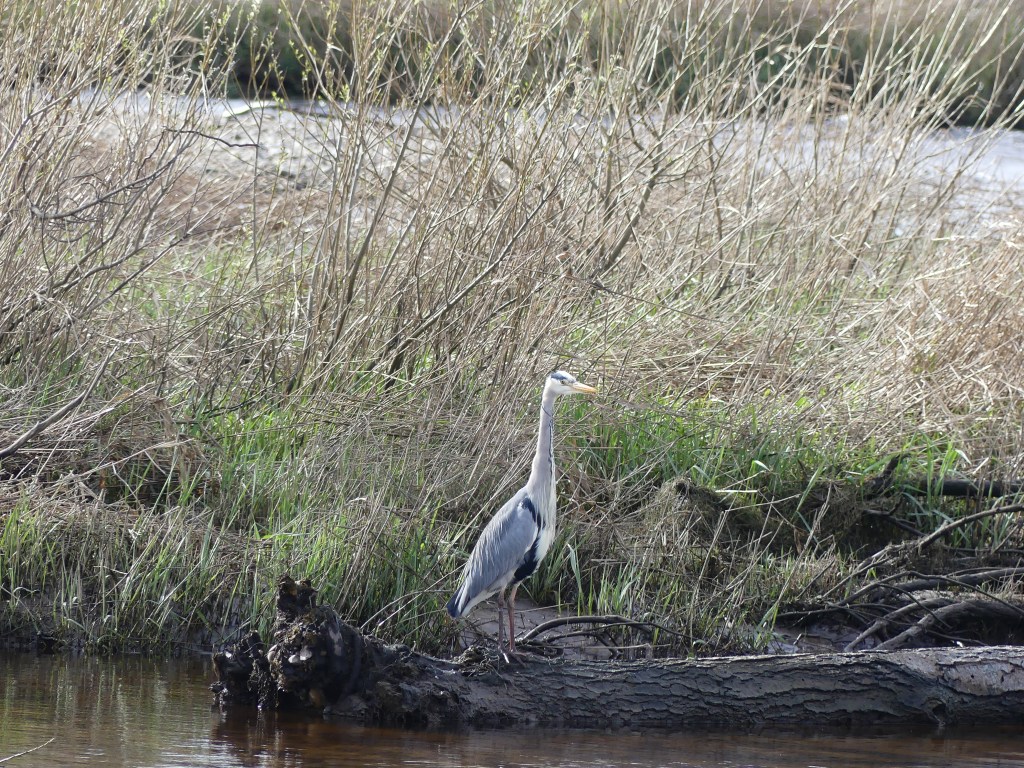
A Grey Heron, because why not?
It soon filled, not just with hotel guests but many from the Grantown-on-Spey community, with the talks open to all. Iolo was as funny as he is knowledgeable. Often the slideshow was paused to allow for hilarity, and he talked about his career in an anecdotal way, with never a dull moment. He’d done everything, from filming bears in Alaska, to helping save Red Kite nests in the Welsh Uplands. He got quite the applause by the end, I can tell you!
By then it was late, and time to retire back up the grand old staircase. It had been another unforgettable day, and I couldn’t wait to find out what tomorrow would bring!
Sunday was an early arisal, in order to get to know the breakfast routine for the duration of our stay. As we rapidly got ready for the day ahead, I couldn’t help but remember the amazing events of the previous afternoon. Meeting everybody right off the bat made me feel welcome immediately, and there were some exciting prospects awaiting (including Grantown’s cake shops).
Breakfast was a delightful affair, with great food and service, as well as a few extras. One was the mornings newspaper, but the other was a very handy guide to the hotel for the day, giving advice on guided walks, places to visit, who to talk to and and another few features. The bold letters at the top of the page read ‘The Daily Chirp’, and it was a marvellous idea. I know of very few other hotels who offer this sort of service, but then again this is the UK’s best Wildlife Hotel, so I guess I’m not surprised that they pull out all the stops.
Today was also the day when Iolo Williams arrived at the hotel, to lead his guided week with his group. Iolo is about as much of a nature celebrity as you can get. He is phenomenal, and with me having grown up watching him on Springwatch, I couldn’t wait to see him in person! On top of his week at the hotel, he would be leading a quiz that night and a Careers in Conservation talk the following evening. More on Iolo later…
The hour after went by in a blur. The packing of bags, the dressing of layers and all the other jobs that had to be done. The skies were slightly grey outside, but hopefully we’d outrun the rain before it began its attack. Everything seems oddly familiar in the corridors, despite us having been there for just over a day. It felt almost as homely as my own home, to be honest! And when we got to the foot of the stairs, Sue and Nick were waiting by the doors.
This was to be one of the biggest highlights of the trip, a full day with one of the UK’s best naturalists and huge part of why I was looking forward to this trip as much as I was. When I first met Nick at Global Birdfair, I couldn’t have imagined that I would soon be able to spend a Sunday bird and wildlife spotting out in the wilderness of Scotland with him. It was truly the perfect plan, and it still felt surreal, despite us meeting up the previous evening to discuss the details. I’ve grown up watching him on TV and social media, and many people will remember him from the BBC’s Really Wild Show, but he’s also a superb writer, with some brilliant books already out and a few more in progress (keep an eye out) – I would particularly recommend ‘Rewild’ which I bought from the hotel bookshop while I was there and devoured on the plane home!
As soon as the travel arrangements were complete, we waved goodbye to Sue and all jumped into Nick’s truck. It was something else as we rumbled out of Grantown and onto Dava moor, before pausing at a large curving lay-by.
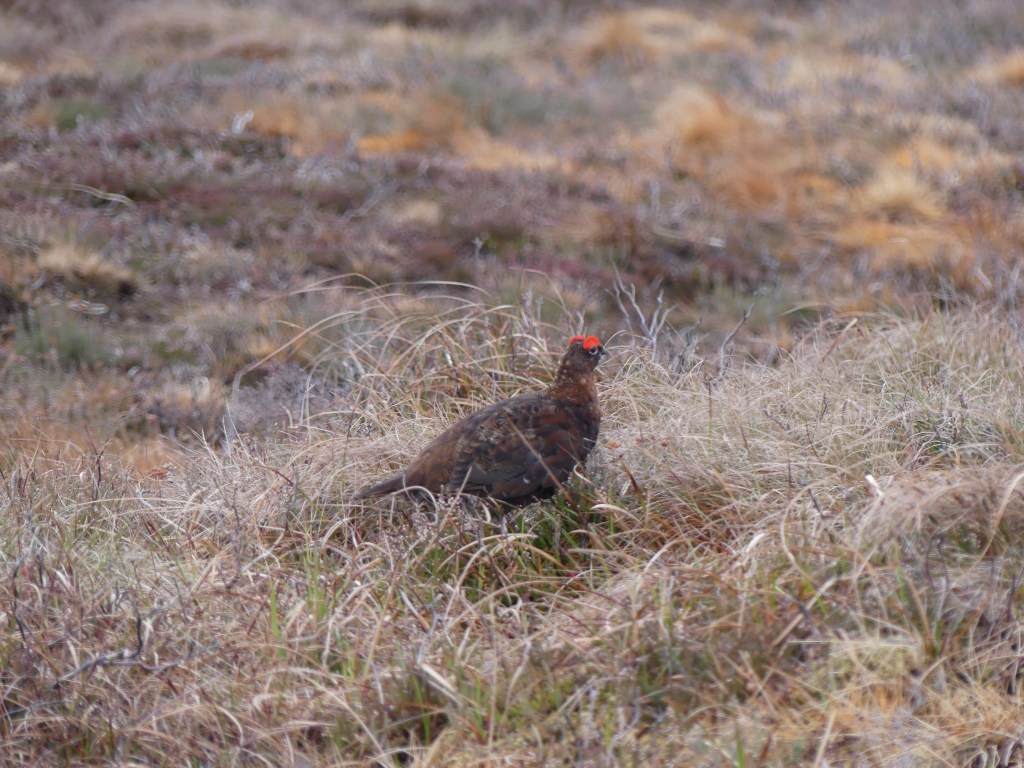
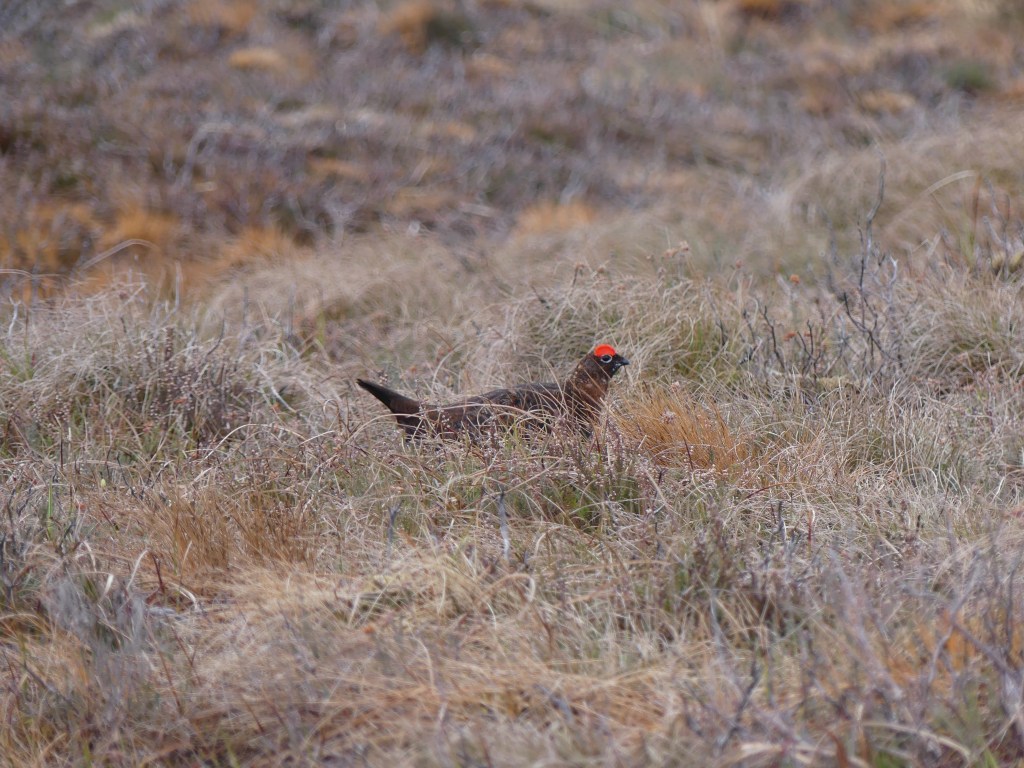
The moorland surrounding us was vast and heather-coated, with various ponds spread across it. A field of short grass perched upon a sloping ridge, and two Greylag Geese flew low over our heads, their calls deafening in the chilly morning air. Nick told us that we were on the lookout for Red Grouse, but this proved easier said then done, as they blended perfectly into the low layer of heather.
But Nick was experienced in this sort of thing, and soon he spotted one beneath a stunted tree, munching on the buds of the heather. Within moments we were all onto it, and with it around 20 metres away, we got decent views via binoculars and scopes. A lifer you would struggle for anywhere else in the UK, the Red Grouse is Britain’s version of the continental Willow Grouse, but as it remains Red all year round, it is likely to soon become its own species.
We continued on down the lane and came to a mass of squabbling Gulls, hundreds of them scrapping for space to nest. The ground was carpeted in them, and many pairs had already assembled. The best spots were in behind rocks and crevices, in order to shelter from the wind. But many had scuffed deep into the heather, and were relatively protected from the elements. It was incredible to see a real-life drama unfolding in front of us, and many were clearly unhappy with each other. Others were engaged in romantic interactions, and yet others surveyed the colony. And these were actually Common Gulls, a bird that isn’t actually very common down south. In fact, it could be considered a bit of a scarcity back home in Devon.
There is a fairly simple way to tell Common Gulls apart from other species, and this is the fact that they have white ‘mirrors’ (patches) on their otherwise black wingtips. Also, the red eyes are really cool!
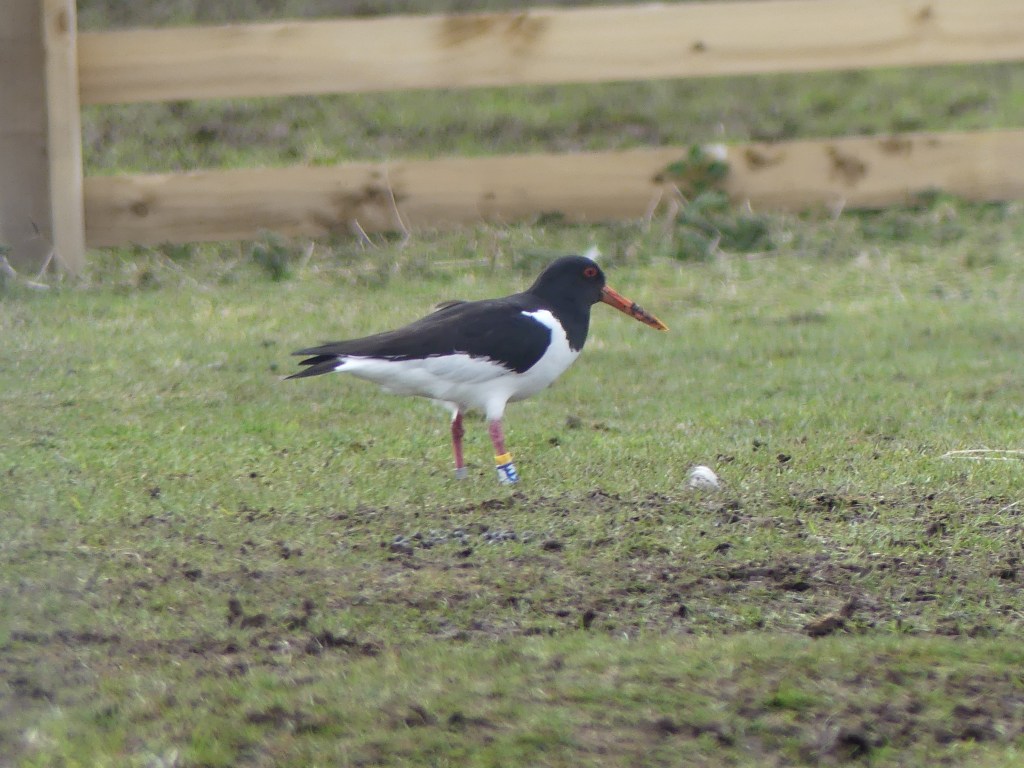
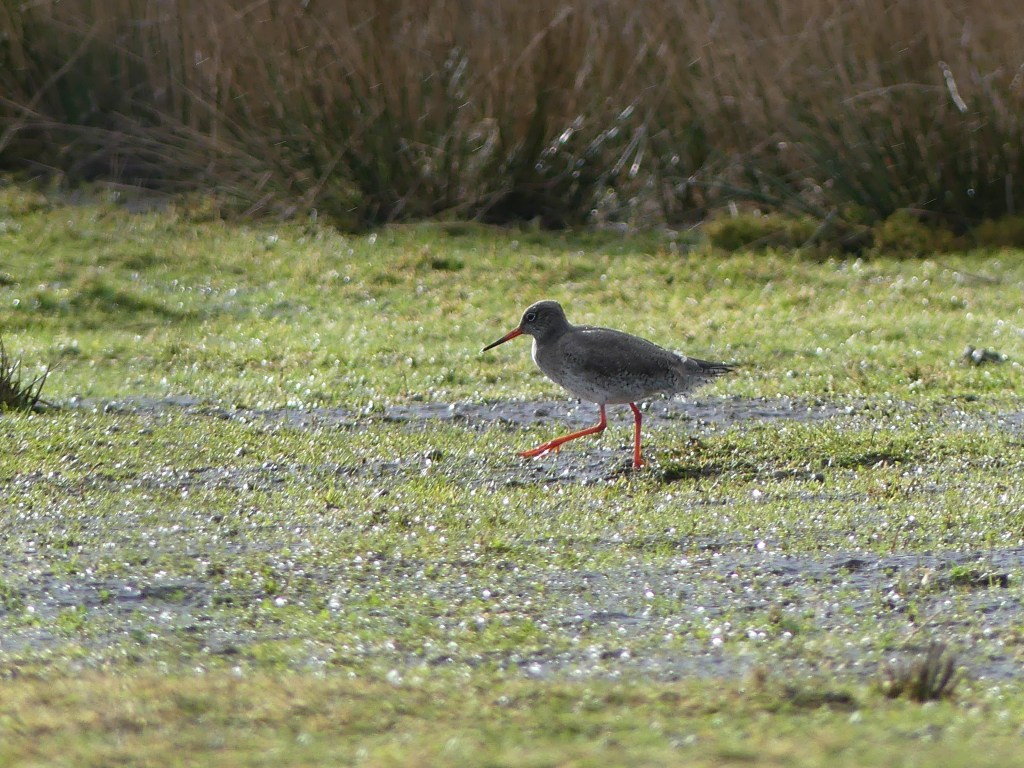
But something that really surprised me was the fact that we always seemed to be passing calling Curlews, scrapping Lapwings and Redshanks on fence posts. It all seemed a little abnormal, but I guess we’ve just lost so much of our biodiversity in Devon, and this is what it should be like driving on Dartmoor. But a certain Devonian did in fact put in an appearance on the banks of a loch (its a sensitive location and I’d rather not disclose it). An Oystercatcher, unremarkable to the naked eye bar two colour rings on its leg.
He had first been ringed on the Exe, an area local and well-known to us. Who knows, we might have seen him some time without realising quite how incredible he is? For the past six years it had bred in Scotland and wintered in Devon, completing the round trip every year. Nick had told us to keep an eye out for it, as this was a very special individual indeed. It looked ruffled and weathered in the wind, but the admiration for this bird showed in all of us. These stories make birding just that little bit more intriguing than it is already.
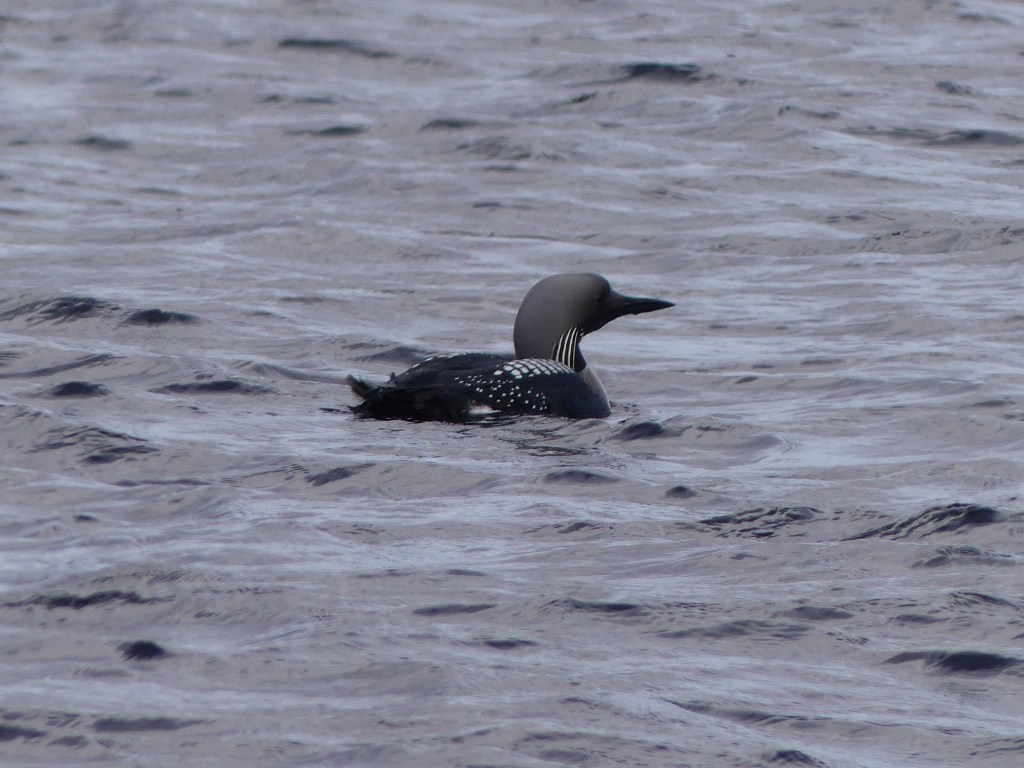
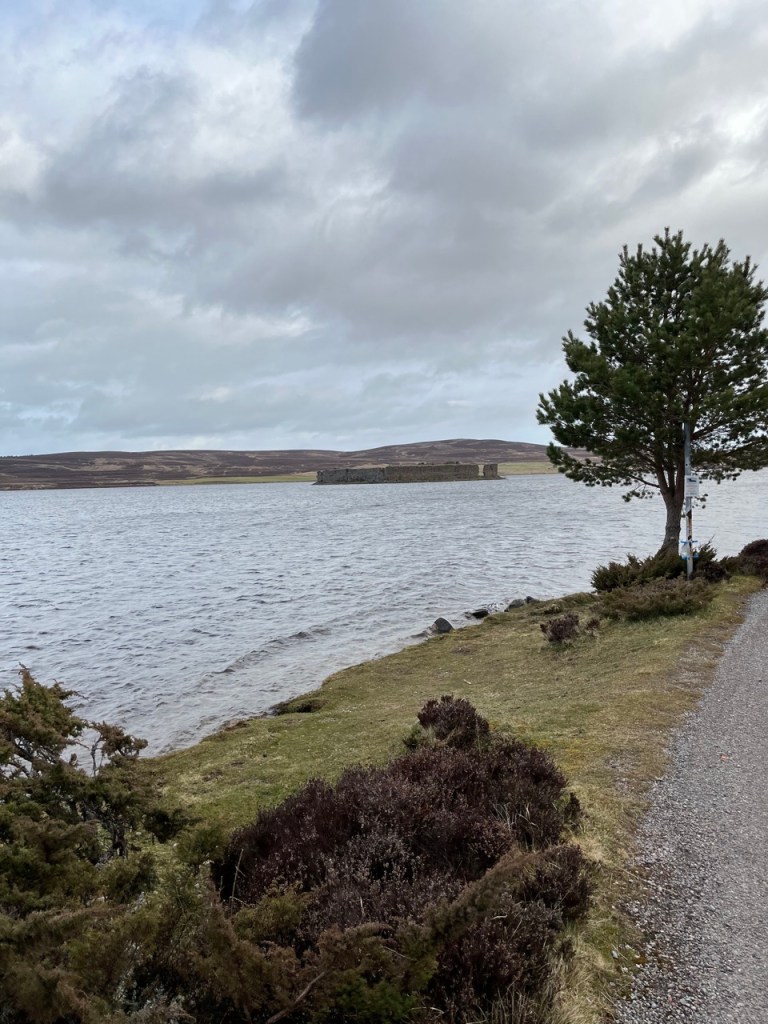
But then the winds of luck turned even further in our favour. Black Throated Divers, forced into the shore by the wind, and all in their glorious, suit-like breeding plumage. Again, it is a sensitive species so I’m not going to say anything more about the sighting, but I just felt so privileged to get such good views of a bird I’d only ever seen as a distant speck. We were mere metres away from the Divers, and it was one of those rare experiences where you just get to feel one with nature.
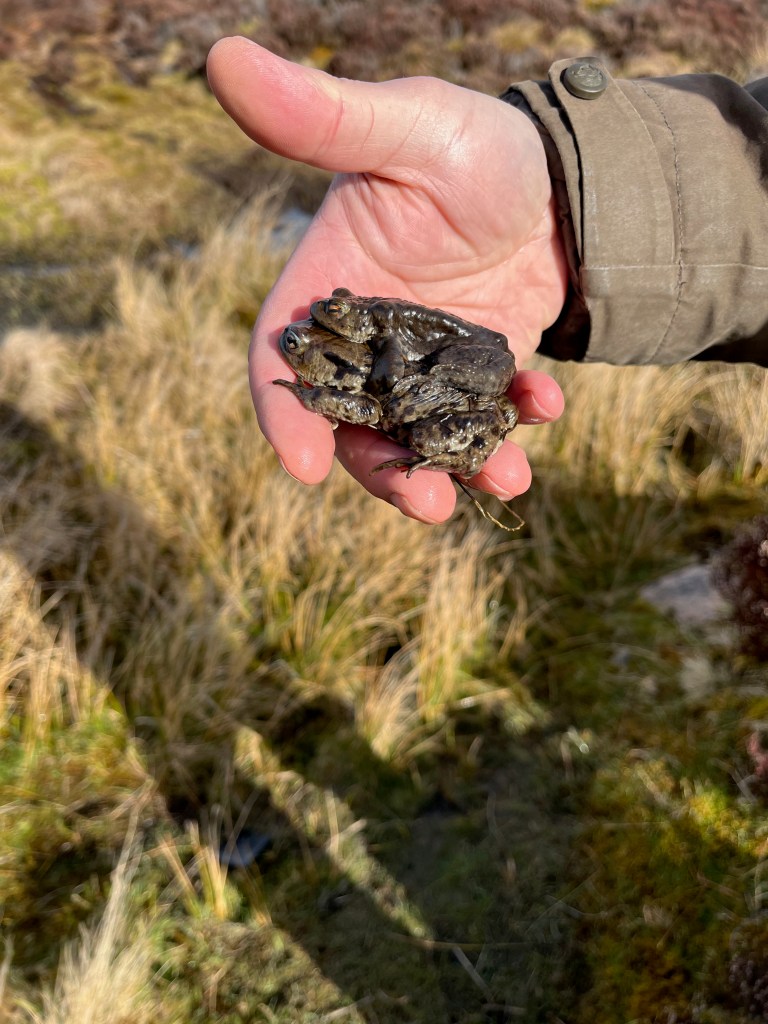
We left the loch and continued further into the moorland, but pulled over at a junction. We got out and strolled to the roadside (me still buzzing with excitement) and Nick reached into a pond and produced a mating pair of Common Toads. Their eyes bulged as they clung tightly onto each other, in a sort of piggyback position. And there were many more lining the shallows of this tiny, unsuspecting body of water. People drive past every day, and scarcely notice this natural wonder, the cycle of life.
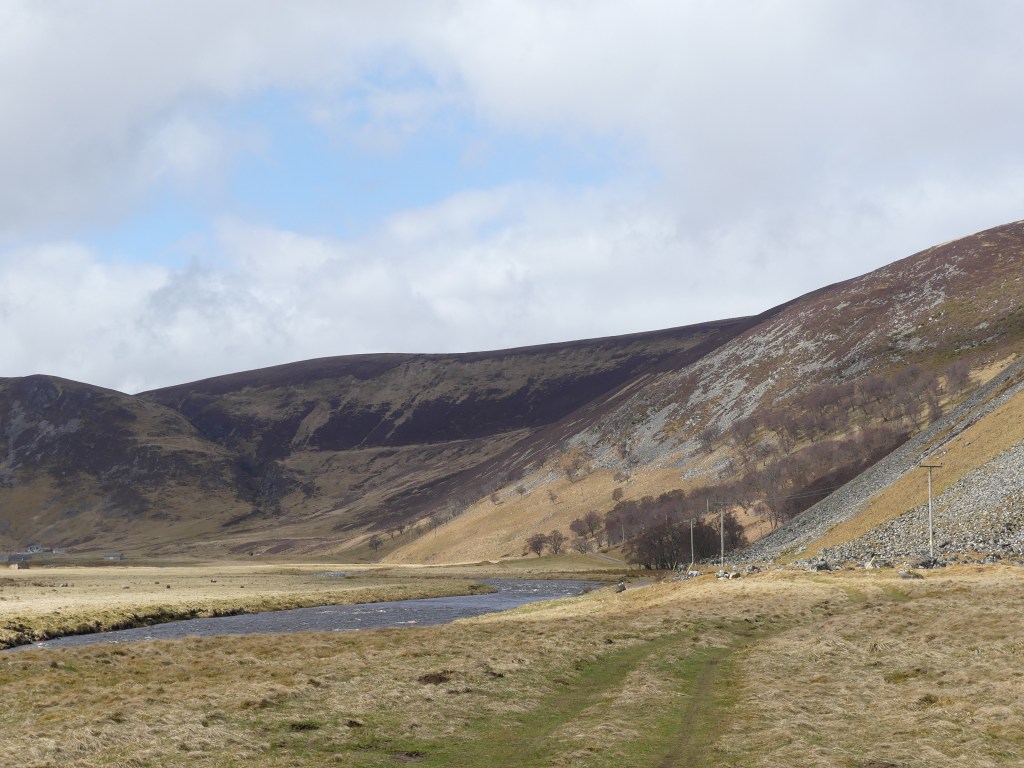
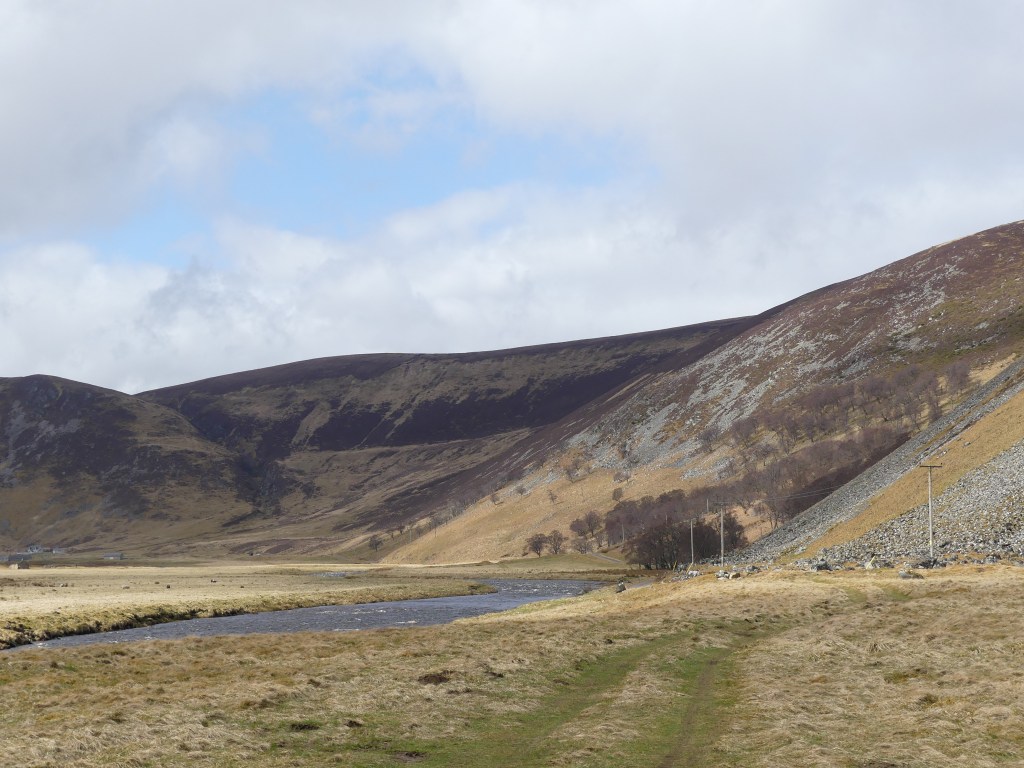
The next stretch of the journey was a slightly longer one, but definitely rewarding. After a quick stop at some services (the farm shop was closed sadly) in Tomatin, we set out into Strathdearn, AKA the Findhorn Valley, famous for some of the best raptor spotting in the area. Various car parks and lay-bys were scattered along the narrow road, and the River Findhorn lay azure in the centre of the Strath. It was so wide and wild that it looked like an American River, one that should contain salmon-fishing Brown Bears (I’ve noticed this a lot about Scottish Rivers, it just makes sense).
But why is this place so good for raptors? It’s all to do with the geography. Strathdearn is one of the foothills of the Monadliath Mountains, which is where many raptors are to begin with. The sheer ridges and hills of the Strath form a corridor to the Cairngorms, a route which raptors can take that still provides the right food and habitat. And if you actually nest somewhere hidden in the Strath, I guess you get the best of both!
The first two spots we scanned were our first chances to try out the Zeiss ‘toys’ that Nick had with him. A thermal imaging camera proved a game-changer in scanning the hillsides, with it pinpointing the position of a huge herd of Red Deer, sheltering on the sheer, rocky ridge. I felt really privileged to be able to use this top of the range equipment, it was a real thrill to be able to use such amazing tech, so much so that I felt a little bit like I was filming a nature documentary! But yet, the best sightings were yet to come, and a flyover Kestrel could surely be only a good omen?
Well, it certainly looked that way, for at the third lay-by we faced the Findhorn head-on with the sheep fields on its far bank full of life. Lapwings screamed, and dive-bombed each other in a continuous aerial dogfight, while the haughtier Golden Plovers remained on the ground, handsome and dignified. Their golden backs glinted in the sun, and their jet-black breasts provided a suit and tie to contrast. They would likely breed in these fields, due to their adaptations as visual-hunters; with the sheep keeping the grass brutally short, it was easy for them to spot their insect spray and sprint after it.
But then it all kicked off. We were just packing up to continue on when a raptor stooped in and enclosed an enraged Lapwing in its unperturbed talons. The Peregrine flashed off upriver, laden with its prize, and pursued by virtually each and every Lapwing that had been in that field, around a dozen at least. Yet, just when it seemed to be getting away, it dropped its prey and vanished away. Hearts pounding in excitement, I continued to watch the rather ruffled Lapwing whose pride had been severely hit by such an encounter. However, he seemed unharmed and continued with his frolicking antics.
But the commotion had certainly attracted a few onlookers, and two falcons had appeared behind us and were warily surveying each other. One was quite clearly a Kestrel, but the other was identified by Nick as our smallest falcon, the magical Merlin. One of our upland loving raptors, the Merlin just doesn’t seem powerful enough to be a specialised predator to the naked eye, but they break through this stereotypical barrier every day of their life. Also, there were two lifers in that lot (Merlin and Golden Plover)!
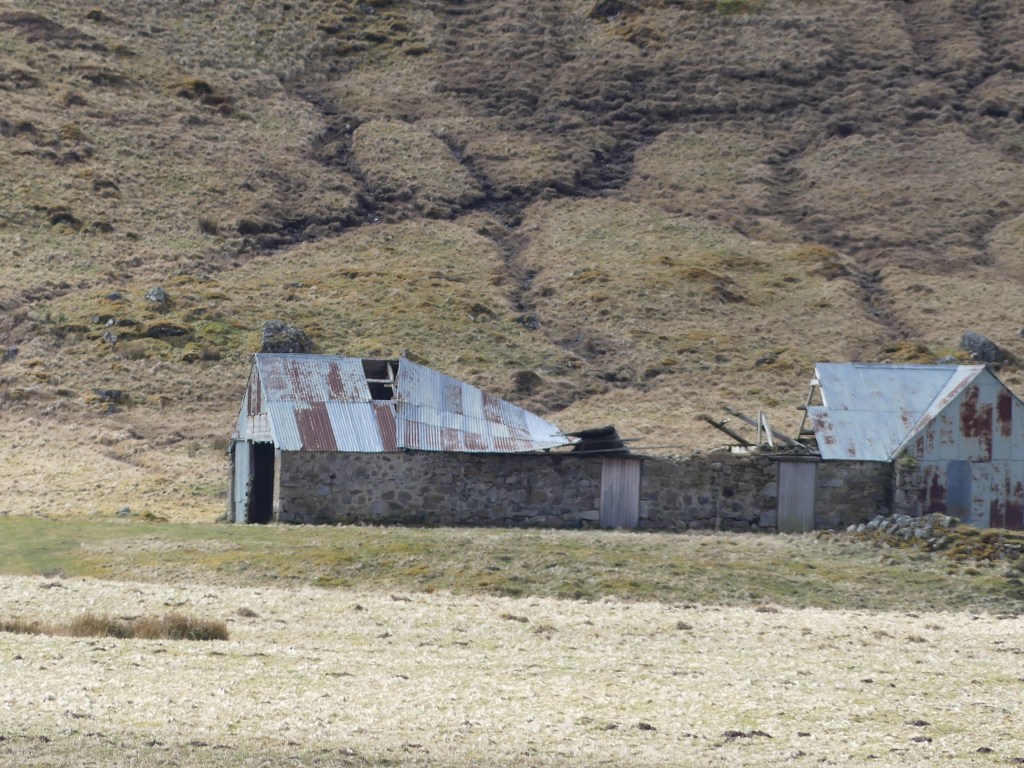
By now the heavy showers were on our tails, and we quickly leapt in the truck to flee it and head further into Strathdearn. The final car park had another mammal surprise, a group of Neolithic feral goats, living on the flat ground by the river, right next to the ruins of an old barn. But this was where the thermal imaging camera really came into its own, with the search for Mountain Hares. The camera used contrast to its advantage, turning the landscape grey with heat signatures coming up as white shapes.
And after just a few minutes, we spotted our first hare and Nick set up the scope to give us all good views of it. It was ‘one of the most obvious hares’ he had ever seen, so our luck had not given up on us. The Mountain Hares were beginning to turn from pure white to their summer fur-job, and this individual was slightly speckled-brown. A brilliant spot to end our Strathdearn endeavour, but the day was not over yet.
After a 30 minute car journey, out and away from Strathdearn (I was glad to finally stretch my legs), we were perched in a churchyard overlooking Loch Insh, with a male Osprey perched on the boughs of an island tree. He was incredible, stark black and white, returning to guard the site until the arrival of his mate. It felt surreal to be watching a bird that just decades ago was on the brink of extinction in Britain. They’re spreading rapidly now, and almost every Loch on Scotland has at least one pair of Ospreys.
A cafe up the road meant we could still see the island distantly (knowing the Osprey was there in the minds-eye) and enjoyed the warm, clattering atmosphere. But we were soon off again, to the renowned RSPB Insh Marshes. Frustratingly, by now the rain had caught up with us, and was thumping down on us in droplets the size of bullets. Racing inside of the Lookout Hide, we stared out at the vast expanse of wetland that stretched way downriver. Wooded islands dotted the banks, and meandering channels criss-crossed the marsh. Huge numbers of Pink-Footed Geese lay to our right, in a slightly flooded field.
When the weather decided to calm down, we climbed the staircase to the open-top roof viewing point. With the wind tousling hair and splintering bare-skin, we scanned with the scope without the nuisance of glass hindering our efforts. But we didn’t see much else here, and we decided to head back towards Grantown.
Our next location was something not bird related but very special and important to the UK’s biodiversity, Nick showed us a place where Beavers were present on one of the waterways -though we didn’t see any actual beavers, as primarily nocturnal animals, it was wonderful to see how they have engineered this landscape, I picked up a couple of souvenirs – sticks worked by the beavers! An unexpected bonus to the day.
Before we bid each other farewell, Nick had one more surprise up his sleeve for us, and he took us through a suburban town and behind a good few gardens. But this was in fact Dell Woods, part of the Abernethy Forest. Nick had told us what we had a chance of seeing, and I was buzzing with anticipation as we strolled with purpose to the feeding station. When we got there the Coal Tits were surprisingly abundant. This was another thing about Scotland; they seemed to have more Coal Tits than Robins, whereas it was a bit of a treat for us to see this many Coal Tits down south.
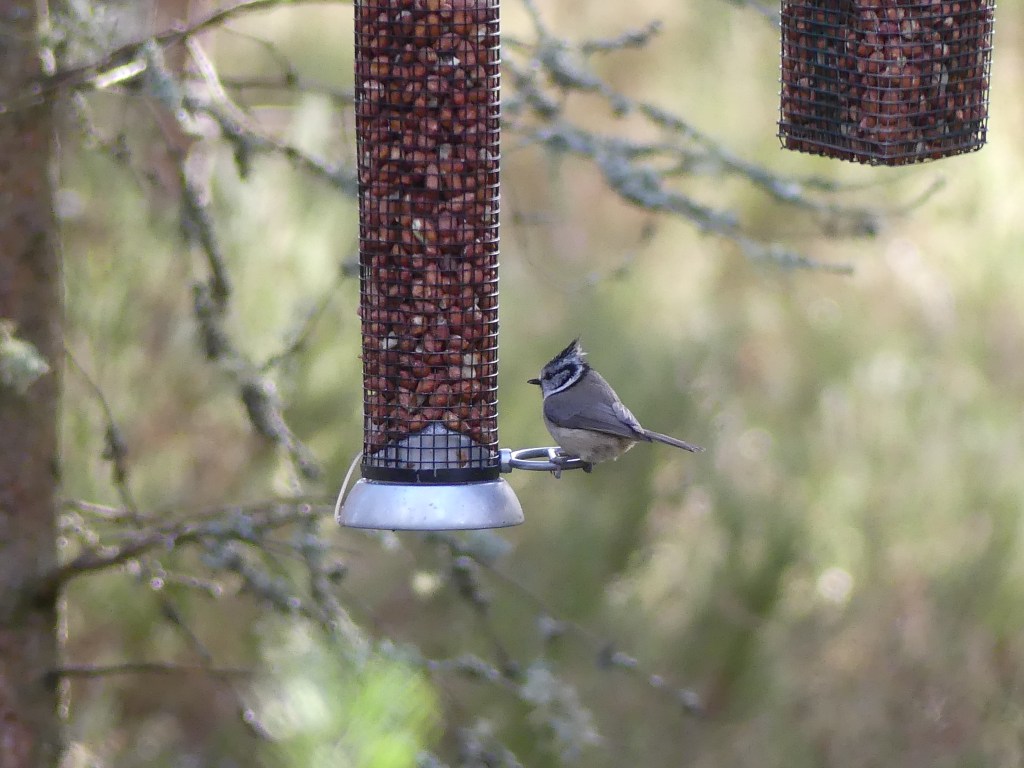
We did see Blue and Great Tits though, as well as a bristling Great Spotted Woodpecker savaging the suet squares. We waited for about a quarter of an hour, and were preparing to head back to the hotel when the pair appeared. Two of a species that you will not find anywhere else in Britain. Crested Tits, with their lichen-like quiffs stuck on their heads. They didn’t stay for long, but every moment was precious, and when they fluttered off with an electrical trill, we realised we had rounded off the wet, windy day perfectly.
We returned just in time for dinner, we snuck in through the door of the Capercaillie Bar and found none other than Iolo Williams sat writing up field notes with his guided group. Immediately Sue rushed over to us, and explained that dinner tonight was at the Speyside Hotel instead, due to a problem in the kitchens. And the bus left in two minutes! But Nick, who had been talking to Iolo, walked up to us and said that he could drop us off instead. An extra 10 minutes with Nick Baker was not something I could turn down, so we took the stairs two at a time and ran down changed and no longer laden with optics. The Hotel staff looked after us superbly, and they made sure the dilemma did not largely impact on anybody’s evening. The next day, all the meals went on without fail.
Dinner went on so late that Iolo’s quiz could not go on. Sue, however, came into the bar after everybody had returned and asked if I still wanted to do the quiz. So the quiz was back on, albeit on a smaller scale. Many of the people in the bar joined in, and soon we had a contest between two teams. Eventually, our team came out on top (yay!) but after Sue introduced us to two of the people who had been on our team.
Dawn and Pete were their names. Dawn had a bit of a dream job, being Head of Surveys at the BTO and Chair of the Rare Breeding Birds Committee. And both of their knowledge was second to none! We would spend more time with them during our stay…
After that, it was way past 10:00PM and almost certainly time to head back up the grand old staircase for some well-earned sleep. What a brilliant day it had been! Seven lifers added to the list! It was an experience (or many experiences) that I will never forget, and I felt really lucky to be able to spend this time with Nick.
As we left the warmth of the airport, the wind hit us with a freezing flurry. It desperately attempted to wrench bags and papers from our hands as we walked through the car park. My first impressions of Inverness were slightly biased, given the chill and blustery air, but I’m sure it would have been better if the sun would rear its head for just a few minutes! But I could see snow-topped mountains from where we stood, and this could only be a good omen!
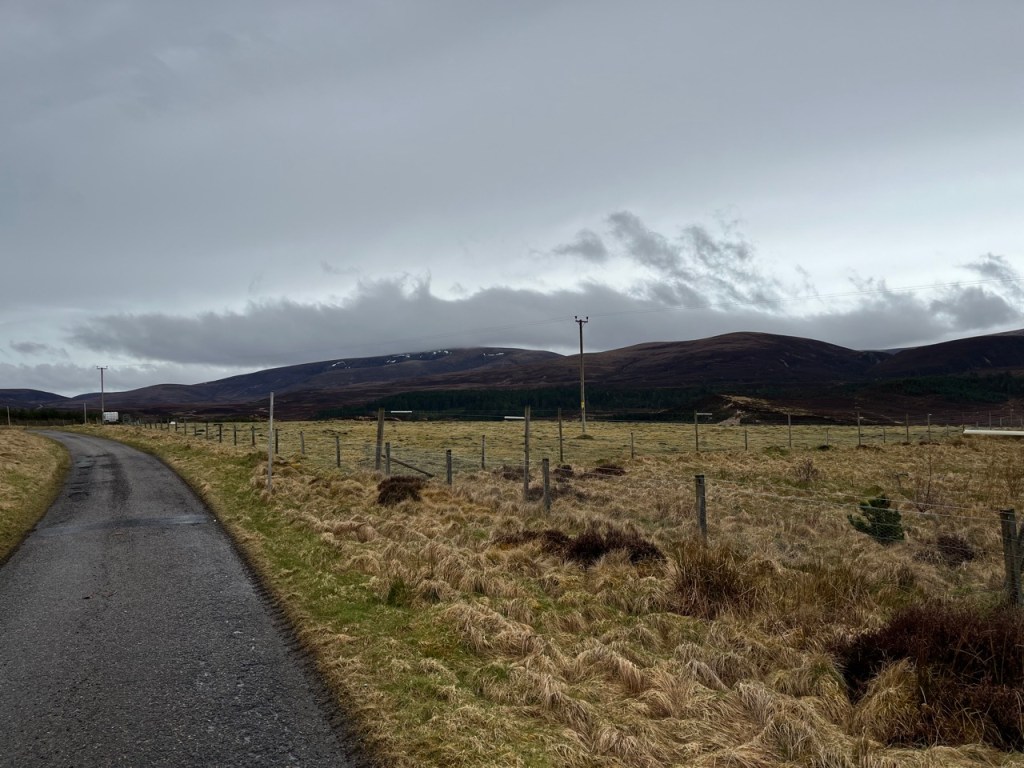
Outside of the city, the countryside stretched before us, in the shadow of the mountains which loomed distantly. Many fields and farmland stretched before us, interspersed with pockets of watchful woodland. The lane had little in the way of hedges and the views this afforded were very much appreciated. The recent heavy rainfall had left the land dotted with azure puddles and ponds, adorned with Common and Herring Gulls.
We soon left the large chunks of farmland behind, but the spruce plantation that replaced them seemed dark and forbidding, tall and vain. As spruce only took around 50 years to grow, it was a favourite of the logging industry and planted across the Highlands. It was as if they had eyes that followed you, invisible yet staring.
And then suddenly we were meandering over the banks of a cerulean river, wider than anything we usually see back home. It gushed over rocks, distinctly looking as if it should be inhabited by salmon-fishing Brown Bears. But this was not America, and the River Spey flowed beneath the ageing stone bridge. It was idyllic, this living water enclosed by the Scots Pine woodlands, which let more light in than their spruce counterparts, as their branches tend to be higher up the trunks. Completely picturesque.
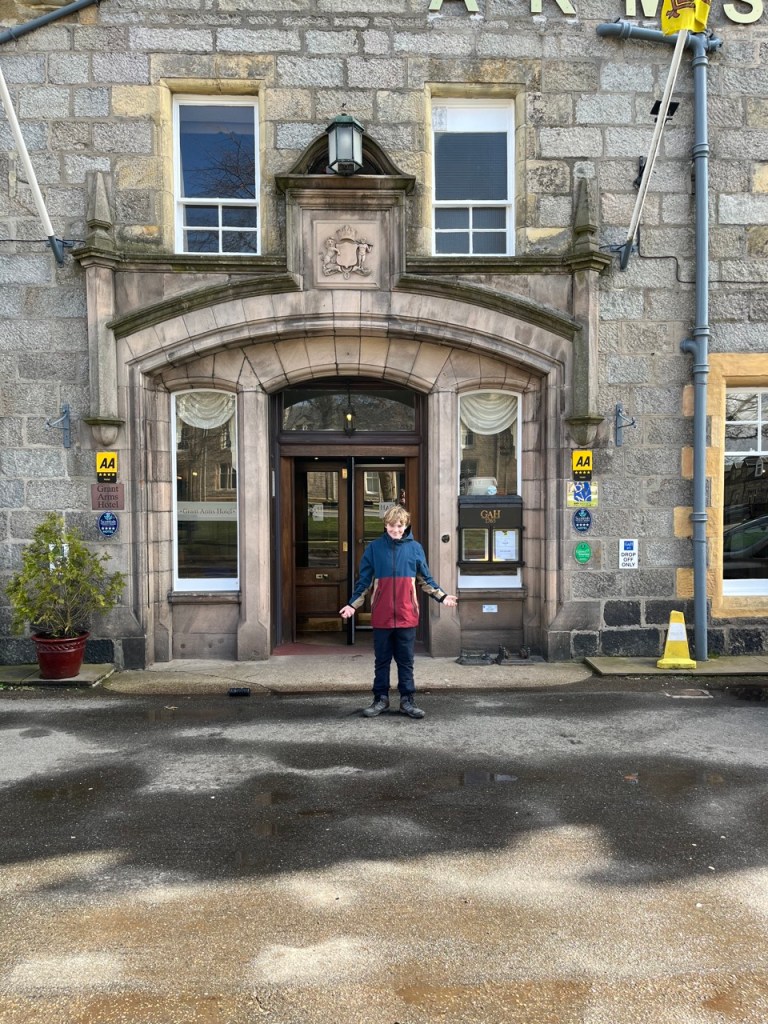
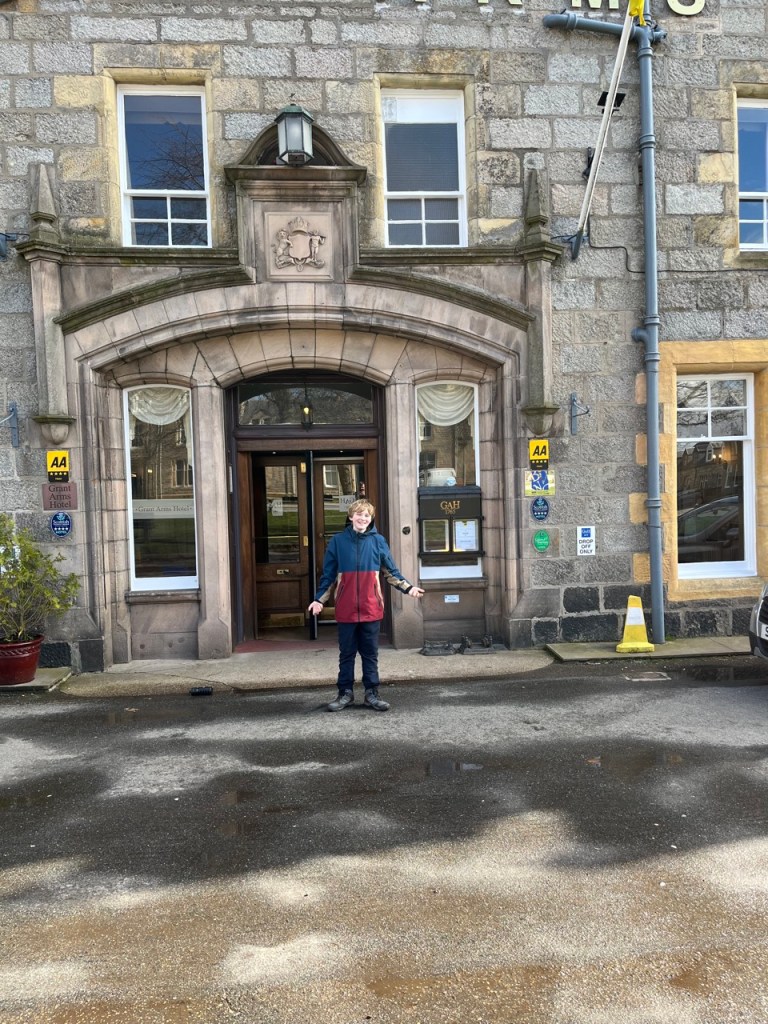
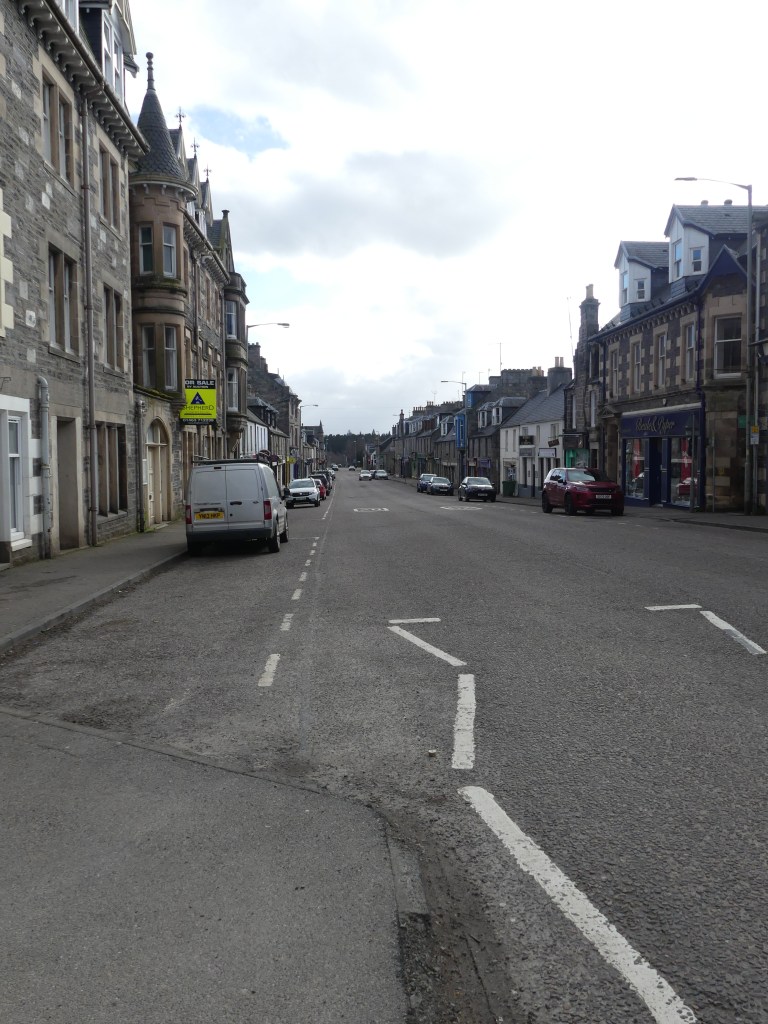
And then came Grantown-on-Spey. Historic buildings, long high street and good-looking cake shops. The Grant Arms hotel itself was tall and photogenic in its age and beauty, with its dark wood rotating door, which you pushed manually by use of golden bars at waist height. Despite us being more than early, reception was an easy affair. The people there were great, and got us checked in after a few minutes. But then out from the office came Marion Muller, hotel manager, smiling and waving at us.
The conversation that ensued was incredible and inviting, with everybody cheerful. There were so many great ideas and facilities implemented here, and when Marion talked of it she seemed so encouraging about it, and proud of what the hotel has become. She does a great job here and it was incredible to be welcomed by the manager as well! But then she asked Reception to ring Sue (head of BWWC) and minutes later she emerged from her office as well! The enthusiastic talk continued with the greetings and it was brilliant to meet both of them, who do amazing work to keep the Grant Arms running. Sue was phenomenal (as she would always be during our stay) and so heartening, immediately making me feel comfortable. All just as we walked in the door as well! Quite the welcome!
So we arranged to meet Sue again at 6PM (in the Capercaillie Bar, best name I’ve heard in a long time) and went off to our room. The staircases were wide and grand, with red carpets and walls adorned with wildlife photography. All the windows seemed to have some view of the mountains, including ours! The lift was a few doors down from us, and it was of an older make, taken from a warship to be introduced here (as Marion had told us). Its amazing how history and birding can just overlap like that.
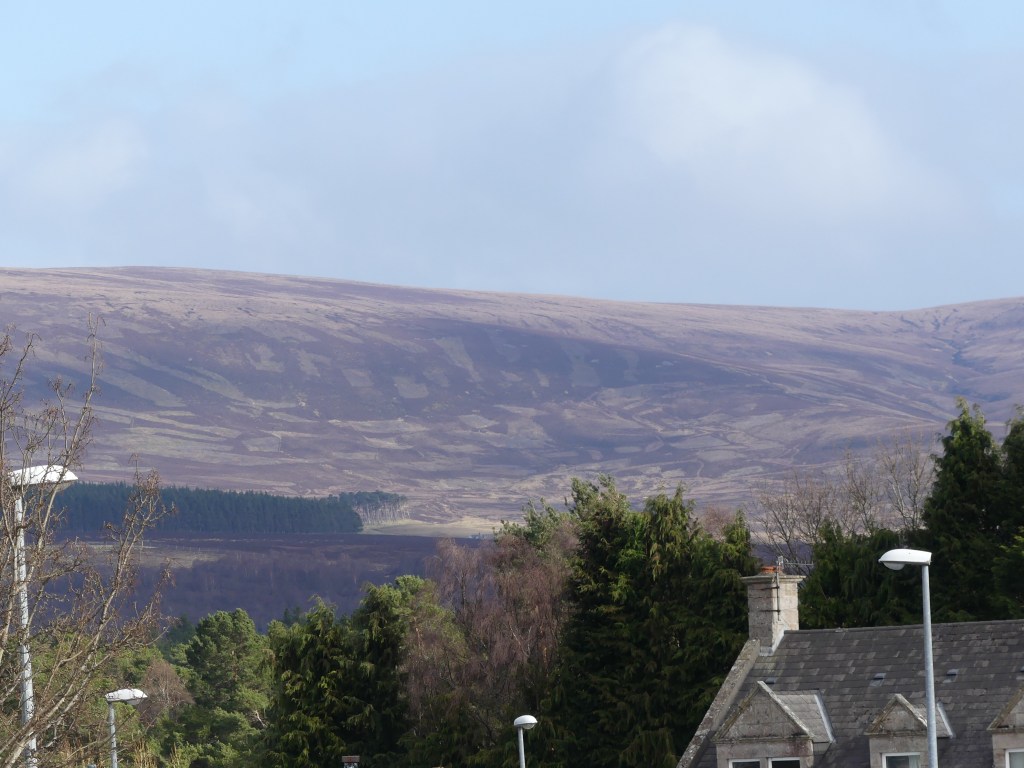
The proximity of the mountains to Grantown is amazing.
And so, after a rapid-fire photography session on the streets of Grantown-on-Spey, we made our way through the door with the golden plaque above it. The room was L-shaped, and the bar was just around the corner. We found Sue waiting for us while stroking a dog. Thats another great thing about the hotel; the team really want to engage with the guests and get to know them. But crucially, it welcomes dogs with open arms! She led us out of the bar and around the staircase, and the conversation was light and cheerful.
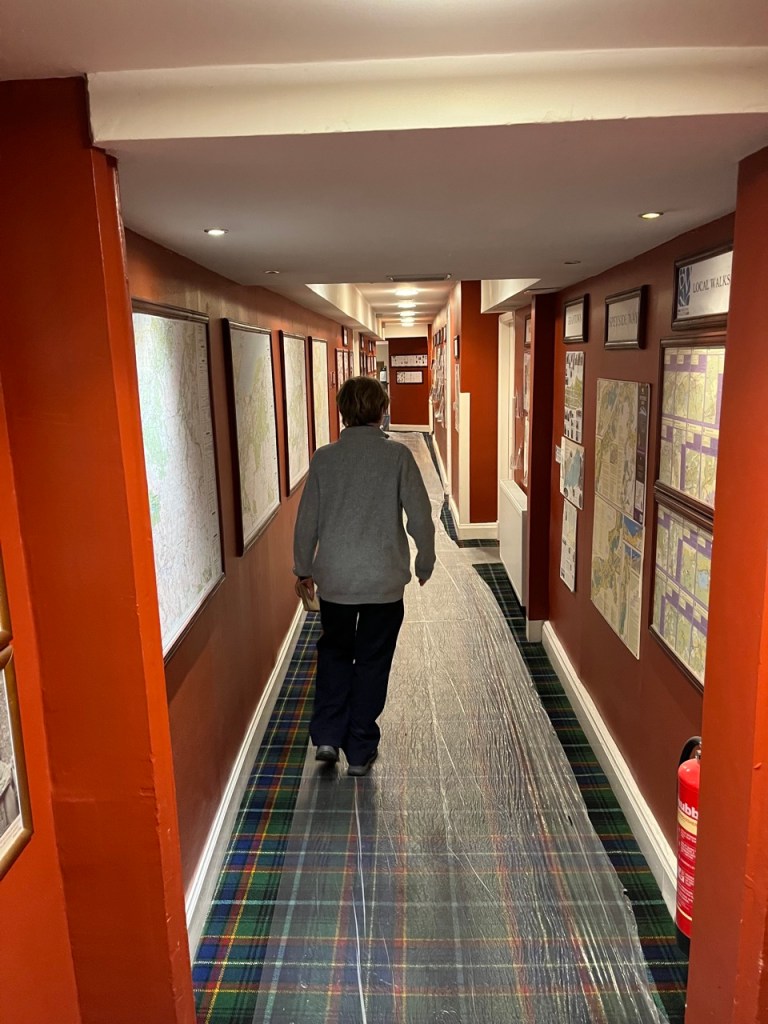
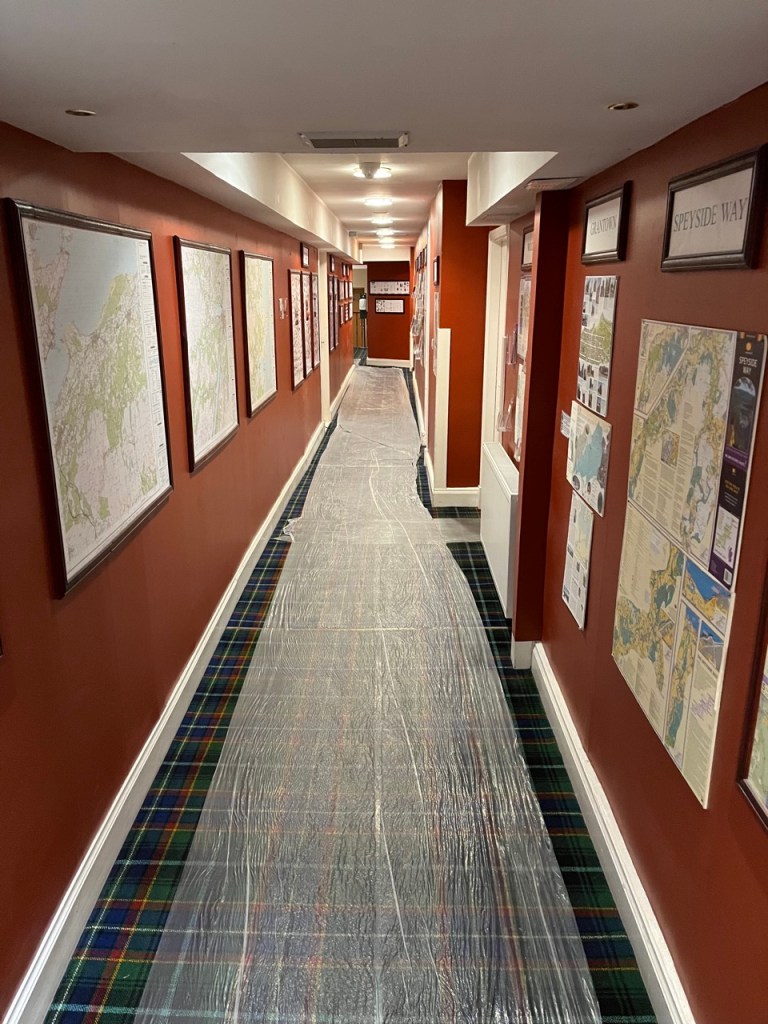
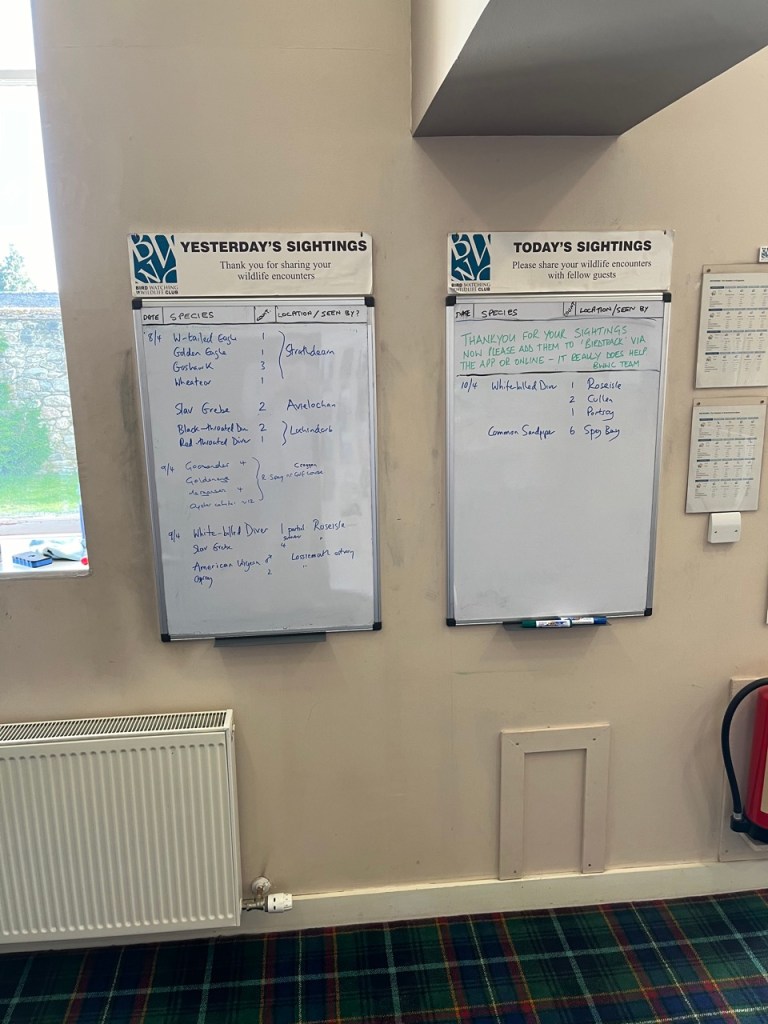
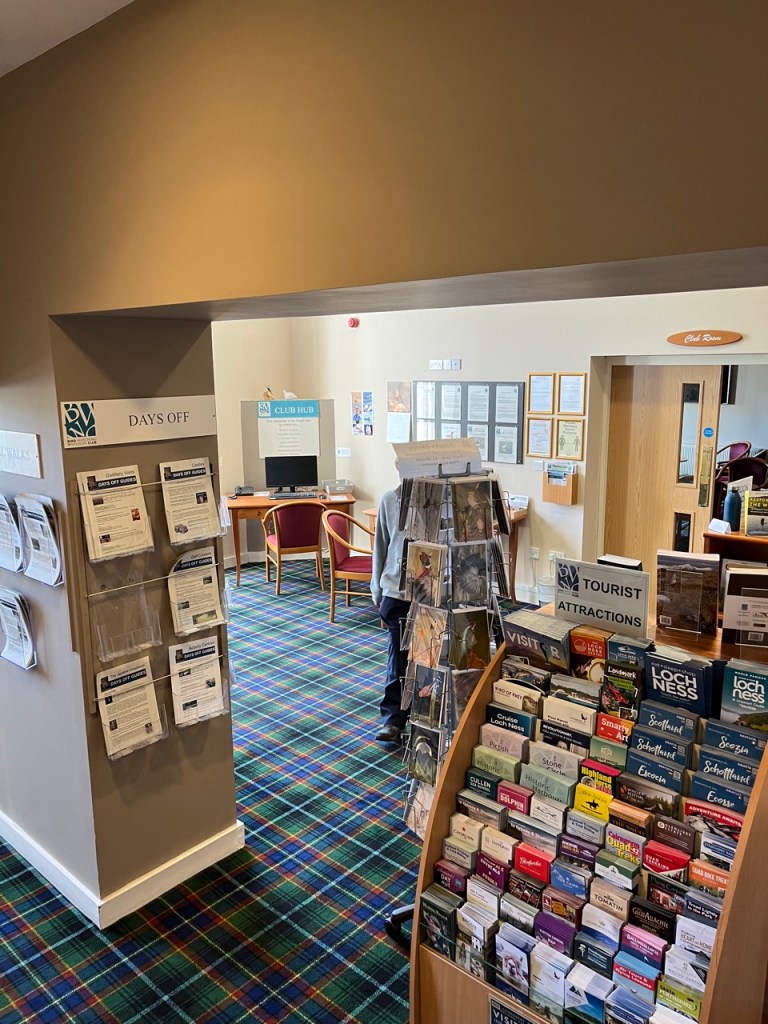
We found ourselves in a long narrow corridor, red-walled and welcoming. Sue’s ‘domain’, as she called it. The half-hour corridor was named as it was thanks to the many maps, ID guides and information that filled the walls of this place; you could easily spend 30 minutes reading through it all! We (sadly) did not have the time to spend 30 minutes in there, so we walked to the end and down a ramp, bang into a pair of sighting boards. This was the official Club Room of the BWWC, and featured a bookshop, drying room and planned days out positioned on the walls.
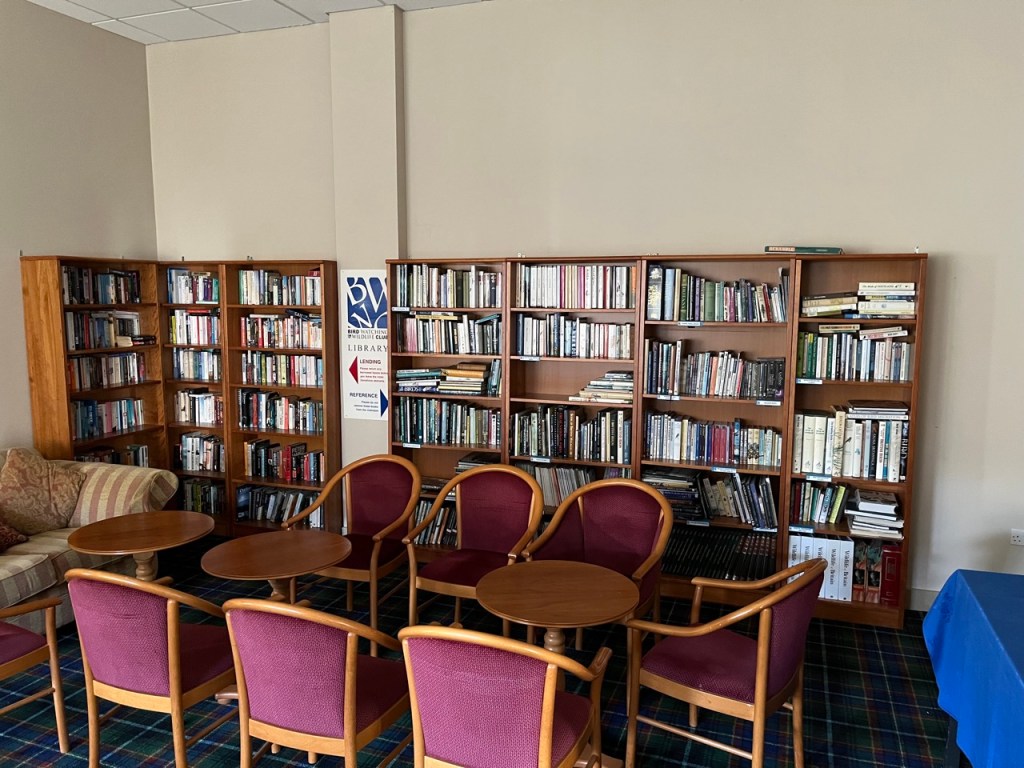
But the true jewel of the crown is through the double doors on the back wall. The library. Shelves and shelves of just birding books. Bird atlases, bird photography and bird fantasies. You name it, I bet you can find it in this hallowed chamber.
Sue had arranged for us to meet Nick Baker here, and he was waiting for us as we walked into the library to discuss the next day’s birding day trip. We greeted each other, and set out a relative, flexible plan for tomorrow. Where we’d go, how we’d get there, what kit we would take and all the other essentials such as food stops. We also mentioned some target species that we were likely to see at certain sites, but no spoilers!
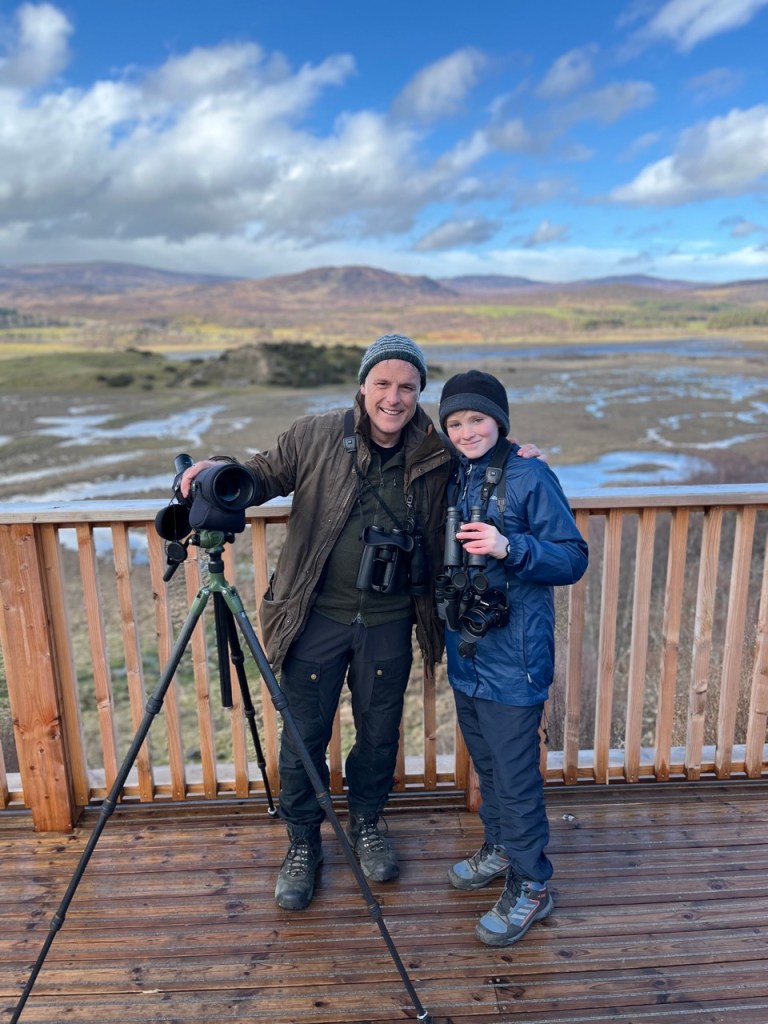
I have followed Nick Baker’s adventures and journeys for a long time now, and he is certainly an inspiring example to many young people out there. Nick has vast amounts of natural knowledge, but he’s also somebody who makes you feel comfortable immediately. He really is a phenomenal naturalist, and his knowhow spans most of the natural orders, not just birds. I was fortunate enough to meet him at the Global Birdfair, where he presented the Zeiss Young Birders Award ceremony and we had a quick chat after I received my award. Even that brief five minute chat at Birdfair was tremendous so I was filled with excitement for the following day and I went to bed fizzing with anticipation for what lay ahead!
The Cairngorms National Park is about as picturesque as you can find in the UK, with some of the landscape almost untouched (emphasis on almost) by human hands. Many birds and wildlife that cannot be found anywhere else in the UK is found here, such as Capercaillie and Crested Tit (to name a few). And with it being one of the most enriched habitats left in Britain, it goes without saying that it deserves its own Wildlife Hotel! And that’s where the Grant Arms comes in.
Strathdearn
The Grant Arms Hotel is tall and historical, featuring a clock-tower and a lift removed from a warship! Even its manually rotated revolving doors leave an impressive touch, panelled with dark wood. Everything you need is off one door or another from Reception. The people who operate reception seem to be a lot more nice and helpful than any other hotel that I have ever been to, because they don’t just check you in, they offer advice, packed lunches and even permits for certain birding sites!
Grantown-on-Spey
Opposite reception is the weekly noticeboard, displaying all the guided tours and walks available to guests on each day, and there’s no hassle in signing up. All you have to do is put your name down on the signup sheet, and there you have it! The aptly named Capercaillie Bar is where we spent a fair few of our evenings, and the food is just brilliant! But the real treasure lies in behind the foot of the grand old staircase. As Sue Williams described it, it is ‘the domain’ of her and the BWWC (birdwatching and wildlife club).
There was some slight building work, so don’t mind the plastic sheet!
The half-hour corridor. What’s the first thing that makes you think of? Well at the Grant Arms it is the name given to the main corridor into the club rooms. Packed with maps and information, ID guides and posters, you could easily spend over 30 minutes learning all the knowledge revealed here. And then there’s the Club Room, down the ramp and bang into a sightings board (try not to hit your head). But I guess you wouldn’t mind if you did (well, I wouldn’t anyway) simply because you’ve been hurt by the many birds seen by guests, such as Eagles and Slavonian Grebes! The power of nature, eh?
And you don’t even have to do any planning (unless you like that sort of thing, I’m not stopping you)! There are suggested days out adorning the walls, featuring two or three locations in the same area to make birding so much easier (though, I must admit, I do enjoy planning and we didn’t use these. I’ll leave it up to you)! The bookshop is a great addition, and featuring titles by Mark Avery, Nick Baker and many more! But the true jewel of the crown lies behind some pale wooded double doors…
The library. Yes, a library completely devoted to birds and wildlife. Multiple shelves stacked with bird atlases, concise reference guides and even portfolios of wildlife photography collections (warning: reading may result in speechlessness)! I personally spent a large proportion of my stay sat in there, flicking through pages. And through the next wall lies a theatre (yes you heard that right. But its not an expensive posh one like they have in London). The Osprey Suite (honestly, everything is named after birds in here! Great idea in my opinion) is where guest speakers and guides give talks and presentations on anything nature!
The Grant Arms is kept running by a team of amazing people, each a specialist in their own right. Hotel Manager Marion Muller always made a point of coming to talk to us, from when we arrived and right through our stay. Sue Williams (Head of the BWWC) was brilliant with us and introduced us to many incredible people (herself included). Special mentions have to go out to Nick Baker, Will Hall and Simon Pawsey; thank you for all the memories of mornings, evenings and days out. You shared so much of your vast knowledge of me and for that I am incredibly grateful. Big thanks to Dawn, Pete and Iolo for being so encouraging and kind, and for sharing tips and skills that will prove valuable for me.
I have deliberately not mentioned any of my sightings or trips out here (at least, I hope I have) in order to attempt to make you want to read the rest of this saga (did it work?). I’m going to have my hands full with all the content from my Scottish journey, so watch this space!
Saturday will bring the trip of a lifetime for me, as me and my Dad set out for Scotland, namely Grantown on Spey, deep in the Cairngorms National Park. The Land of Red Squirrels, Capercaillies and huge Scots Pine trees. Four days of absolute brilliant birding and wildlife watching.
Last year, having been told that I had won the Zeiss Young Birder Award, we travelled to Global Birdfair for the award-giving. While there, we spoke to Simon Pawsey on the Grant Arms Hotel stand (link here if you want to book a stay – they run amazing birding tours throughout the year with loads of incredible people! http://www.grantarmshotel.com). I felt comfortable around him, and gave him my card, asking him if he would like to read my blog. We had an animated chat and really enjoyed it, and then throughout the weekend when we passed his stand he would call me over to introduce me to somebody, like Mike Dilger for instance, it was so great to meet all these experts! We returned home, happy as Larry after such a great weekend! To my surprise, when we returned home, there was an email waiting for us to invite us for a stay at the Grant Arms Hotel, where Simon was guiding. Gobsmacked was the word – I couldn’t believe my eyes when I read and re-read the email! With much to-ing and fro-ing we finally settled on a date, and here we are about to head north to Scotland!
So many great birding sites surround our base for the time we are away, AKA the Grant Arms Hotel, a renowned wildlife hotel with a rich history. Just a stones throw away lie Scots Pine Woodland, heather moorland, and a large selection of Lochs to choose from. When I first saw the images, it felt reminiscent of a castle to me!
I have to say, really looking forward to this one! On two of the days we are there, me and my Dad are actually going to be taken out with guides, which is probably better than us bouncing around with little local knowledge! Nick Baker and Will Hall will show us around a few sites on two out of the four days during our visit, people I have heard of and am very excited to meet. I hope to learn a lot from their huge amounts of knowledge, and enjoy birding with them!
Nick Baker is a naturalist and TV presenter, and he is based in Scotland. Bug and wildlife extraordinaire, he does many things from Instagram Lives to BBC TV programmes and documentaries, on top of being a published author. He is a nature inspiration and I cannot wait to meet him!
Will Hall is a brilliant presenter and photographer, and he is known nationally as an incredibly knowledgeable zoologist. He’s been everywhere, from jungle to mountain, and lets few things stop him from witnessing and working with nature! Like Nick Baker, he is guiding up at the hotel at the moment and really looking forward to meeting him!
As I said above, I met Simon Pawsey at Global Birdfair, on the hotel’s stand. He was great to talk to, and has a real wealth of knowledge. He introduced me to Mike Dilger and helped to set this whole plan into motion. Special thanks to Simon, and hope I bump into you at the hotel!
Moving slightly off topic, Simon Pawsey and Mark Pearson, two great naturalists and birders, ran an inaugural School of Birding at the hotel, supported by Zeiss. It sounds like a truly great experience, so if you’re looking for some expert guidance with your birding, maybe this is the course for you!. My own binoculars, won in the Zeiss Young Birders Awards, are Zeiss Terra, and I really rate them, they have been a real asset in my birding.
Anyway, there are so many things I would love to see, but one of the main ones is Crested Tit. A tiny, regal bird that reminds me of a Snow Queen. They are quite abundant across the pine forests in the Cairngorms, but Scotland is the only place in the UK where you can hope to find them, so I would really love to find one.
Secondly is a bigger ask. Capercaillie is another bird that you would be unable to find anywhere else in the UK, and this huge, proud grouse would be great to find. With the males able to weigh 2-4 kg, they truly are huge birds and their call is a mournful, clicking song, with gobbles and gurgles in between. It sounds eerie, but if you get close to one it really is beautiful.
Thirdly and finally, it has to be the Black Grouse lek, one of UK nature’s greatest spectacles. The males spread their tails and make themselves look big and formidable, and they circle each other, in a threatening dance. At this time of year, females are visiting these leks and the males know how important a first impression is. However, this is usually an early morning spectacle, so an early start would be needed!
This is truly the trip of a lifetime birding wise, and I simply cannot wait for Saturday to come! My thanks to Marion Muller, Sue Williams and Simon Pawsey, as well as the whole Grant Arms team for organising and putting it together, and for continuing to stay in contact with me during the build up to our visit!
On our final morning, we were (thankfully) able to sleep for slightly longer, and woke up for breakfast at the Countryside Education Trust for the last time. After preparing lunch, the beds were stripped and the rooms were emptied. As we sat outside waiting for the last person to emerge, the Starlings flew over as if in farewell. A Green Woodpecker yaffled (this is what their call is known as) from behind the hedge.
The minibus rumbled out onto the lane and towards the coast, eventually parking up in a lay-by. The cacophony of noise emanating from the Normandy Lagoon was easily heard. We were at Keyhaven Marshes, a 500 acre site along looking over the English Channel. We were met by the Reserve Warden, who handed out leaflets about the site’s history and what we could expect to see. As a tiny sneak peek, I’ll tell you now that we saw around 45 species here!
We walked up the lane towards the sound, and in a field nearby a group of Fallow Deer congregated by the hedge. There were five, some with their antlers fully grown and looking sharp. In the same field four Mallards moved or sat in a ring around two Canada geese, as if worshipping the pair. A Blue Tit sung above me in the boughs of a beech tree, and that made almost everything seem at peace in the chilly dawn air.
And then we saw the Normandy Lagoon; islands of shingle and marshy grass, so many spread unevenly across the wind-churned water. Each was painted in a thick coating of avian life. The one nearest us, stood on the sea wall, played host to Black Headed and Mediterranean Gulls, as well as Shelduck and Wigeon. Tommy sent up a shout of Red Breasted Merganser, and everybody flocked to the scope. Its a scarce bird, but you see it more often this time of year and its always a treat to come across one! It looked ruffled, but oddly proud and regal.
Black-Tailed Godwits, about a dozen of them, sat on a bar of shingle, crowded with Dunlin, Redshank and a lone Ringed Plover. A Little Egret crouched on the bank, moody with its head tucked beneath its wing. Mallards, Shoveler, Wigeon, Teal and Tufted Duck swam in the channels and the open water. Brent Geese flew in with a clatter of wings, landing with a delicate splash in the water. A Water Rail squealed in the reeds, and Turnstone sprinted over land.
We walked up before the lapping waves that lay adjacent, sea to lagoon. A pair of Great Crested Grebes in glorious breeding plumage bobbed in the inlet, and two Eider Ducks stood proud on the strips of rock that lay ahead of us, with a group of starkly pied Oystercatcher in their foreground. Curlew flew in behind us, along with something else special. Everybody noticed at similar times. A Spoonbill followed the Curlew, and rushed into the green banks at the back, among three more Little Egrets which had just arrived since we last checked. Eight Pochard rocked in the waves to our left.
We decided to head further down, in order to get better views of the Avocets and the nesting Lapwings, in the muddy banks of the far corner of the lagoon. But when we got there, a shout went up from those who had gone ahead. A Spotted Redshank, taller and paler than its Common counterparts, was moving about in one of the closer channels, nearby to the two Lapwing nests. It’s known as Spotted because in its breeding plumage, its pitch black with white spots on its underside. This one was in its winter plumage, however, and was likely passing through Hampshire on its way to its breeding grounds in Northern Scandinavia. Another lifer, and a very scarce passage migrant here in England.
The Avocets were out in force, many of the black and white pied birds running fast across the brown, silty mud. In complete contrast to their rapid neighbours, the Lapwings on the nest were docile and still, as if they were sleeping. However, above them, two males scrapped and clawed at each other in mid-air, clearly ticked off at each other.
Eventually, we decided to move on back into the New Forest for our final afternoon. We were going raptor spotting at Pig Bush (I don’t actually know what the reasoning behind it being called Pig Bush is), a place with a great mix of heathland and woodland, and that was good for certain birds of prey. So we bid farewell to the Lapwings and set off in the minibus back into the trees.
We ate lunch on arrival, and set off with binoculars primed and ready. A pale Buzzard circled above us, and Stonechats constantly appeared and called from all directions, us being surrounded by heathland. Eventually, we came to a hill where again we set up a temporary base and went off to explore for a while. There was a boardwalk at the foot of the hill, which led the way over an expanse of treacherous boggy land. While exploring this, a shout went up to signify something had been spotted.
A Goshawk flew just above the treeline, barely a speck on the horizon. Binoculars and scopes made it clearer, however, and in comparison to some nearby Buzzards, it definitely looked smaller and hawk-like. That proved to be my final lifer of the trip, and as we took a group photo back on the hill, I knew that I would remember this experience, the entire weekend, vividly, forever.
As we strolled back to the minibus, the sun beat down on us kindly, drying out wet trousers and damp bags. Back at the CET, I said goodbye to everything for the final time, and we set off back to the South-West.
When I woke at 4:30 that morning, I was surprised to find that it was slightly light outside. Barely anybody was up yet, but a few of us went outside to check the moth traps that had been set the night before. There was a good range of species among the egg-boxes, from Hebrew Character to Oak Beauty, and a few were potted and taken inside.
Breakfast was in full swing when we reappeared, and after a couple of rounds of toast lunch was prepared and bags were packed. We were to be away from Home Farm at around 6:30, and heading towards the bird ringing site for the morning session. With camera and binoculars swung around my neck, and boots tightly laced up, we set off on the minibus into the woodland and heathland habitats.
The journey took us through a local village, and lasted about 10 minutes, but when we arrived a Robin proved to be our dawn choir. Shortly after, a red car pulled up with a precious cargo. White drawstring bags, each with a wriggling resident. The bags were hung from a pole, and all the ringing equipment was laid out on the parcel shelf. Bird ringing out of a car boot, could it be any more perfect?
To kick things off, Tommy (the resident ringer) brought out a wonderful female Kingfisher, dazzling green-blue plumage glinting in the dawn light. The orange beneath the knife of a bill betrayed its sex, and the process began. The bird’s wing was measured and aged, and then she was placed head-first into a pot which was placed on a scale. All the data was recorded in the logbook, and eventually she was ringed with the corresponding size and released down by the river.
The rest of the morning passed by in a blur. Two Grey Wagtail were next up, a bird which I had never seen so close up before, their yellow undersides stark against the hand. Third was a female Brambling, a lifer for me and a popular winter visitor. The males were incredibly beautiful, but these birds can occasionally be quite erratic in their movements to Britain, depending often on the crop of beechmast, a crucial food source for them.
The final bird of this first set was quite possibly the best. Powerful, wedge like bill, rusty orange plumage and rather nippy. A female Hawfinch was clutched in the hand of Tommy, an increasingly scarce and shy bird. Its main food being cherry seeds, it used its huge bill (about as big as my finger) to split them and get inside. This was probably the bird you least wanted to have any attitude while in the hand.
Over the course of the morning, regular trips to the net turned up another THREE KINGFISHERS (four in total), as well as regulars such as Dunnock, Chaffinches and Blue and Great Tits. After exploring the boggy ground surrounding the river, we ate lunch before clambering back into the minibus and driving off to Eyeworth Ponds, where the Camp’s Bioblitz challenge would take place. A bioblitz, if you didn’t know, is where you take an area of land and record as many species inside of it as you can, from fungi to mammals. Anything goes really. Sometimes it can be used for conservation, other times just as a contest, or even both.
As the group ambled into the woods, a large group of Fallow Deer began to half-retreat, but remained there watching us as the rules and teams were sorted. My team ended up with 84 species, but we still didn’t win! Hats off to the winning team, with 117! Avian highlights of this one included Marsh Tit, Goldcrest and Coal Tit, as well as a distant Red Kite.
The trees seemed watchful here, and were older and gave homes to all around it. A fallen one of these was where we pitched our base, and read out the three scores. At about 3:30PM, we set off back towards the CET (Countryside Education Trust, where we were staying).
After some time to relax and unwind slightly, the hour before dinner held a Careers Talk from Katiana Saleiko, a Species Reintroduction Officer at Forestry England. She was incredibly knowledgeable, and had experienced many different projects, from volunteering to species release. The props she handed around after were particularly impressive, including beaver sticks and a ring for a White-Tailed Eagle. It was really great, and quite informative about the future careers I could go into, and what qualifications and work I would need to do. It really was quite brilliant, and I enjoyed every minute of it. It, in a way, made me feel motivated and want to push on even more than I already did.
To round off the evening, we went on a walk around some marshland (again in pitch black), and Tommy did a bit of lamping on top of this. We’d got halfway up the path when he rung Marcus and we turned back rapidly to find a Jack Snipe clutched in his hand, his ringing equipment neatly placed on the parcel shelf. It was essentially the same setup as this morning. And this was another lifer as well! It was truly incredible, with rich colouring and a striped crown. And it looked smaller than a Blackbird! When it was released, it remained where it had been placed carefully down, thinking that we could not see it. And it was hard to, as it blended in so well with the ground in the darkness.
To finish the walk, the bat detector was brought out by Marcus and we listened as it picked up what we struggled to hear and see. Bats have never been my area of expertise, but it picked up quite a few! And then it was back to the minibus and then to the CET, for another late night. It had been an absolutely fantastic day, completely surpassing my expectations (which were very high to begin with!). It had been so enjoyable, and made me look forward to the next day so much more. It was truly valuable to begin to get to know like-minded people who love nature just as much as me and who are around my age, so that I feel a lot more comfortable. I am not much of an expert in fields other than birds, such as bugs and plants, and it was really great to learn from other people who were experts in these, and grow my knowledge further.
Last weekend I embarked on a brilliant trip to the New Forest on the Wild New Forest Wildlife Camp, sponsored by the Cameron Bespolka Trust. It was truly incredible, spread from Friday evening to Sunday afternoon, and featured bird-ringing, visits to the coast and nocturnal walks. It is usually held at Cameron’s Cottage, another residential area in the New Forest, in Spring, Autumn and Winter. For the 2024 Spring camp however, it was held at the CET (Countryside Education Trust).
The Countryside Education Trust (photo from CET)
The Countryside Education Trust was adjacent to a farm, separated by very little. In fact, it was basically on the farm, with all its buildings and accommodation on the same ground. Home Farm was the residential building, a one-storey stout house that would be our home for the weekend. In the evening light (or what was left of it), the lights inside were bright and welcoming, and with the fading sun, we went inside.
A kitchen/lounge area was in front of us, and two corridors with bedrooms went off the far walls. Immediately, I felt comfortable thanks to Marcus, Emily and their team of mentors. I ended up reading a few of the posters and books scattered around the room until everybody arrived.
Over the next few hours, I met some amazing people who love wildlife and nature like me, and it felt great to be among like-minded people, as this is not often something I experience. I truly hope to stay in contact with some of those people and know them better in future!
Following an icebreaker in the form of a quiz, we set out on a walk to Hatchett Pond, supposedly haunted following the failed testing of floating tanks there in preparation for the D-Day landings.
There were no vehicles resting in the car park when we arrived in the minibus, and torches shining on the lake revealed two silent Canada geese, otherwise invisible in the pitch black darkness (it was around 9:00PM at this time). As we trudged through the bog, everybody kept an eye out for anything or find of interest and after around half an hour we scattered into small groups to search the heather and trees by torchlight. Following the discovery of a collection of orb-weaver spiders and some caterpillars in the gorse, we headed back the way we came, in order to head back and prepare for a 5AM start the next day.
The weekend would prove to be truly incredible, with so many great experiences and wildlife firsts! Stay tuned to hear about them over the coming weeks.