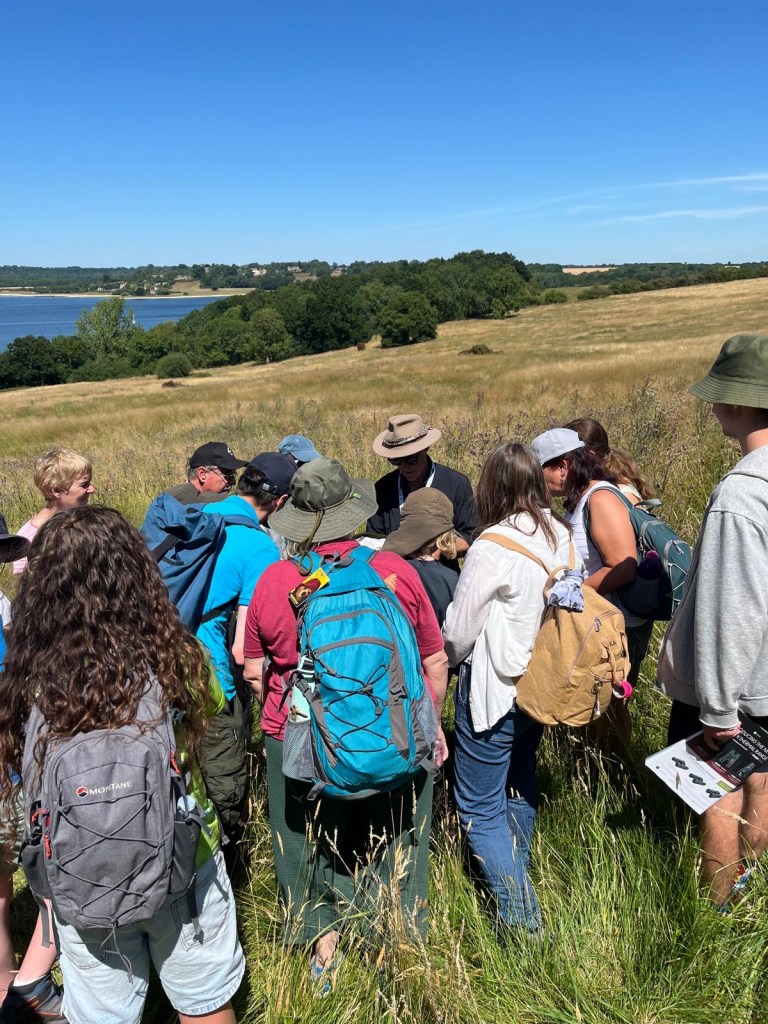
Nature Writing Retreat

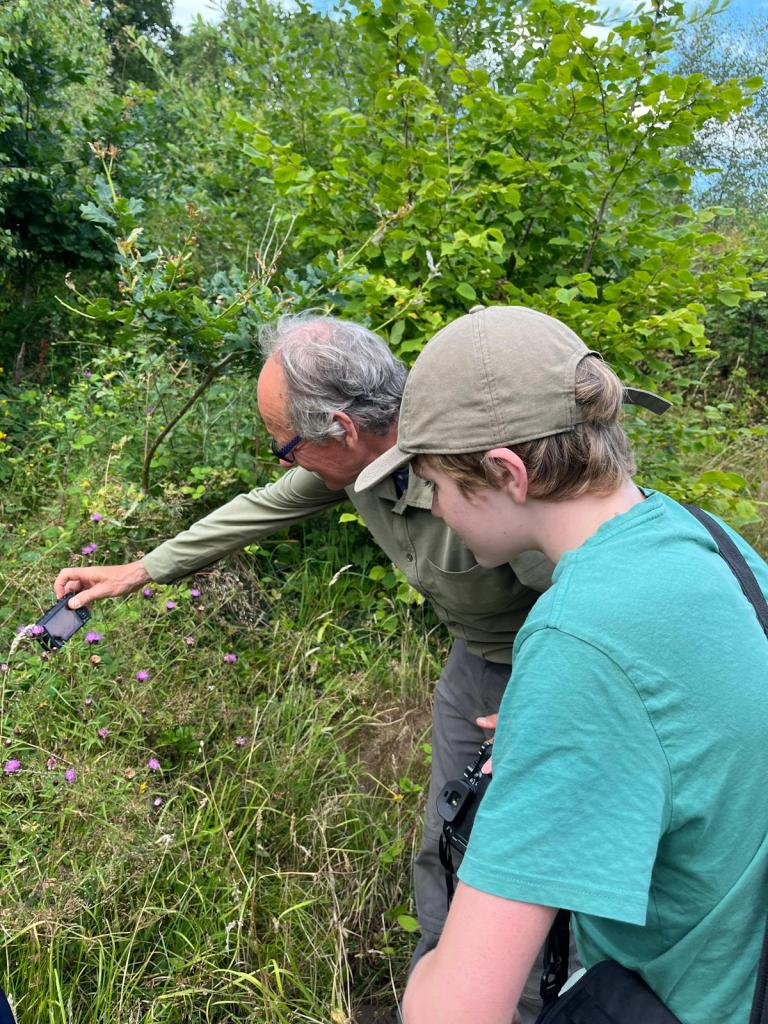
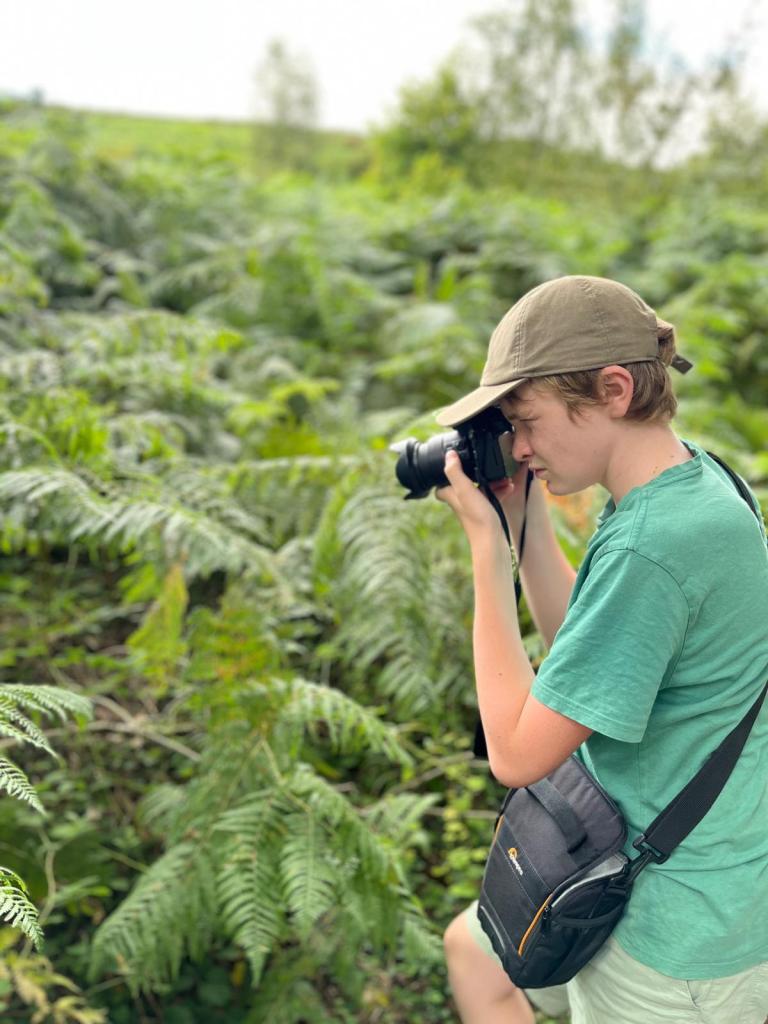
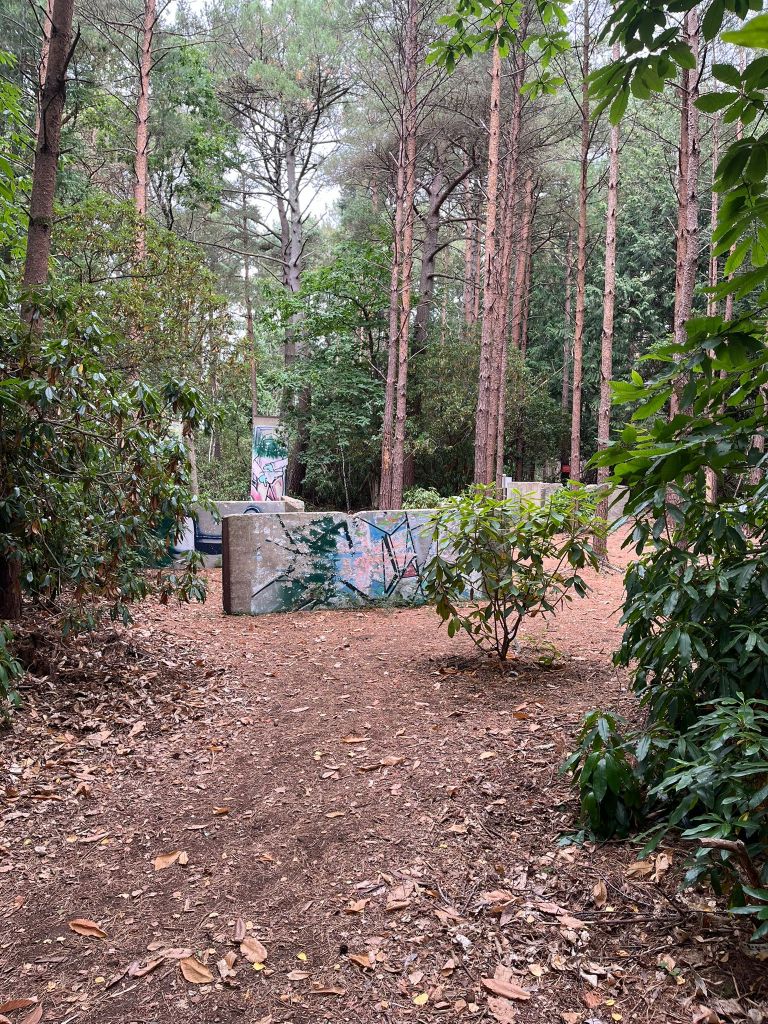
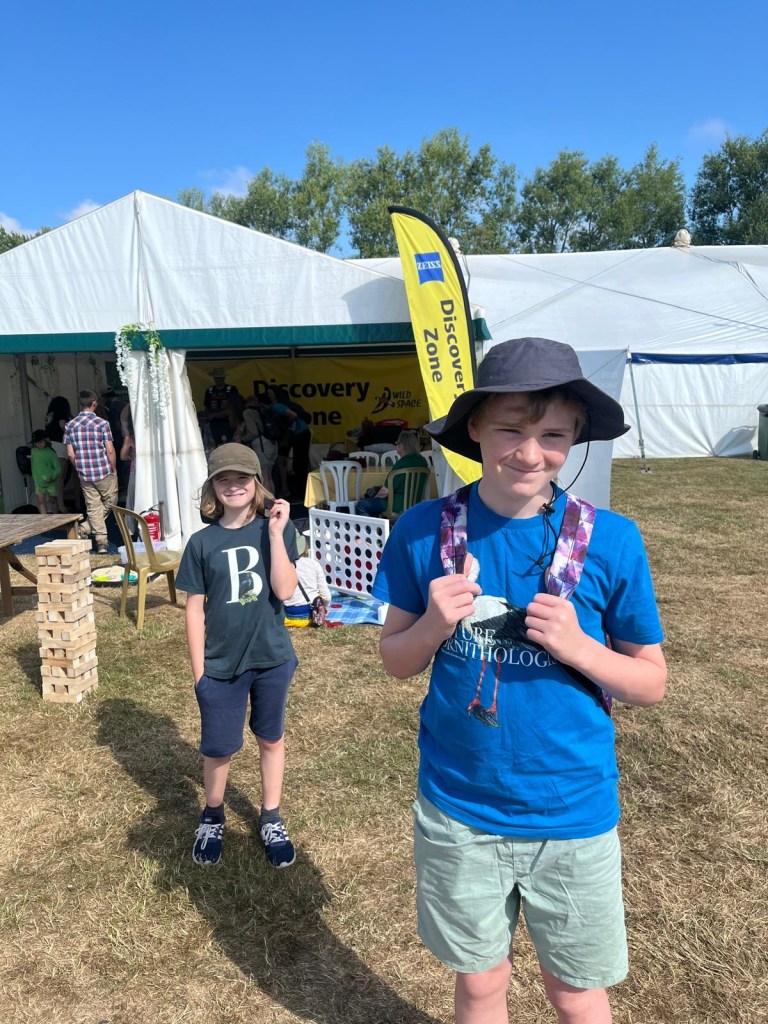
A couple of weeks ago, I headed off to a secluded spot in the New Forest, concealed behind a gate, a long gravel track and huge amounts of healthy trees. Organised by the dynamic duo of Emily Hunt and Andrew Millham, with support from the incredible Cameron Bespolka Trust and an all-star panel of esteemed guests including nature writing stalwarts Stephen Moss and Roger Morgan-Grenville, this was the Young Writer’s Nature Retreat. Despite being aimed at 16 – 21 year olds, this 13 year old aspiring writer managed to bag himself a place on a weekend to remember.
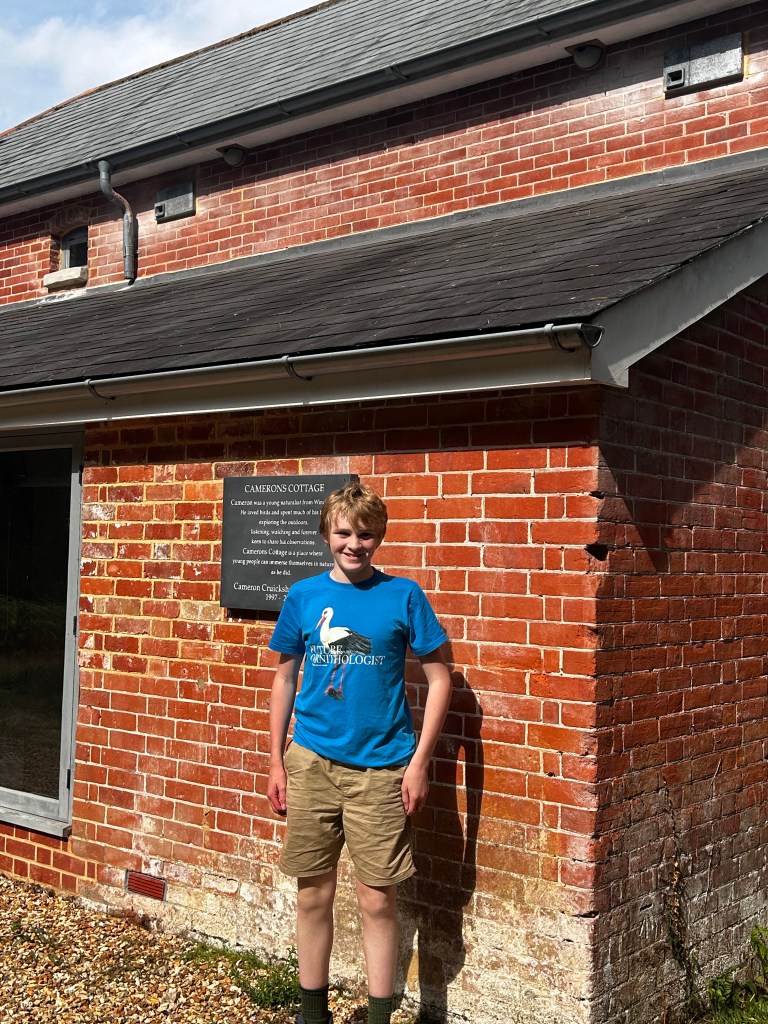
It’s time!

So, here are your hosts! Emily Hunt is a multi-award winning poet and nature writer, who was a youth voice in the creation of the new Natural History GCSE. She was named Warwickshire Young Poet Laureate for 2022, and is an incredible writer, naturalist and person. Andrew Millham is a 20-year-old writer, naturalist and nature writer from Essex, who received the Sean Corr Prize for Fieldwork Excellence. I’m very jealous of his broken down boat adventure (if you’re confused, check out this link), but he is a brilliant person and writer. They have both been involved with Reserva: The Youth Land Trust, who are fundraising to create the world’s first entirely youth funded nature reserve in the Ecuadorian Rainforest and they both put together a hugely inspiring weekend!

It was also amazing to meet so many young writers with a passion for the natural world. It felt like I was finally among my own kind! Nobody at school has the same interest, and in the past it has been a struggle to find people my age who share my obsession and awe for nature. This search has led me to find some brilliant young people, including those I was lucky enough to meet at the Camp! In Devon, there is sadly a lack of youth engagement schemes – however things are changing with the excellent work of the Dartmoor Youth Rangers and now, the creation of the Pebblebed Youth Rangers Scheme! While these are the only conservation groups for young people I could find near me, they are both fantastic examples of what can be done for the next generation of conservationists. So it was amazing to have so many young people for me to meet and get to know all under one roof, or tree canopy (of course, we spent a lot of time outside; who wouldn’t?).

As soon as we arrived at Cameron’s Cottage, a brilliant spot specifically designed for young people coming to stay in the woods at RSPB Franchise’s Lodge, we set up and the fun began! We started with icebreaker games, which provided a fun platform for everybody to get comfortable with each other (I’d met very few of them before, but came away having made new connections and friendships!). Soon it was time for our first workshop of the weekend from one of the esteemed guests, who had all planned activities to share their expertise on improving our nature writing. Taking the floor was Roger Morgan Grenville…

Roger is a writer, speaker and campaigner on conservation and biodiversity loss, and as a story teller, he believes strongly that the power of persuasion and entertainment is, and should continue to be a huge tool in halting the mass extinction crisis currently facing the world. He delivered the 2023 Cameron Bespolka Memorial Lecture at Winchester College, and has authored several books including his new one, The Restless Coast (available from all good bookshops). He even founded Curlew Action alongside the brilliant Mary Colwell. I’ve just finished reading Return of the Grey Partridge by Roger – I thoroughly recommend this insightful, inspiring tale of nature restoration. Read more about him here.

His workshop sought to teach us how to introduce campaigning and activism into our writing, something I have previously approached cautiously, and probably not done justice to. However his passion for having the nerve to be challenging in subject matter or viewpoint was infectious and I hope to incorporate more of this in future pieces. My top takeaways from Roger’s workshop for introducing activism into your writing are:

1. Don’t be boring (people won’t read if its boring, its as simple as that!),

2. Prepare to be unpopular (you’ll always have those opposed to your views, even if it’s the truth!), and it’s not a bad thing to make people reassess their beliefs.

3. My personal favourite, ‘Twitter/X is a snakepit’. Make of that what you will.
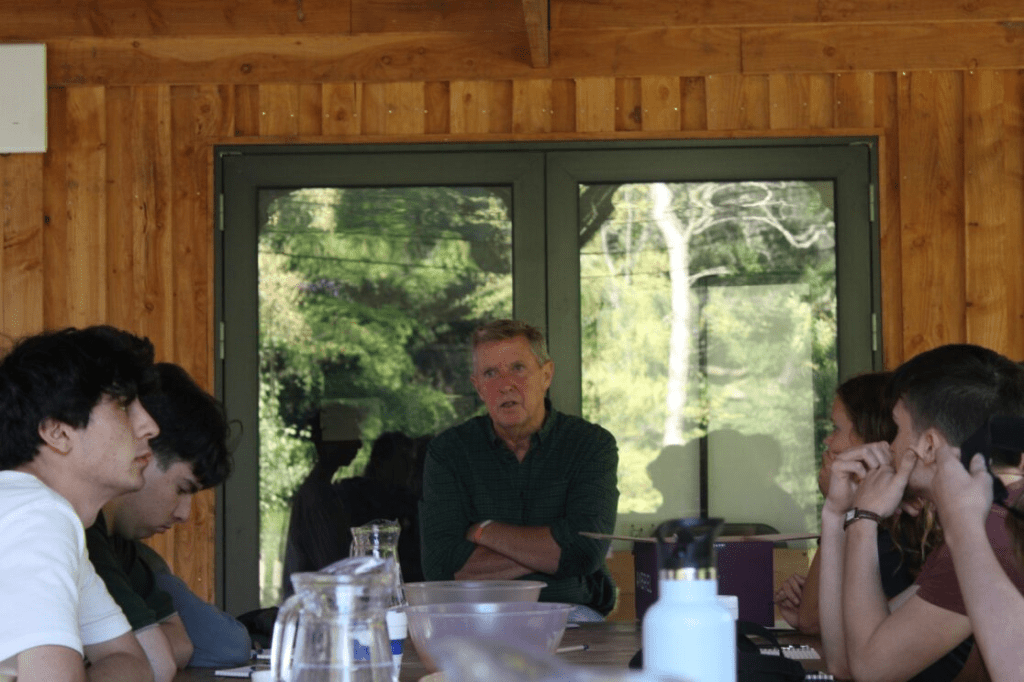
Roger’s Talk (Photo Credit: Emily Hunt)

Later that evening, we headed out on a walk into the woods surrounding Cameron’s Cottage which are part of the RSPB Franchises Lodge reserve, a unique place where where the public aren’t allowed! Only those staying at Cameron’s Cottage, or with special permission from the RSPB, may enter and explore these beautiful, untouched and unspoiled woodlands. The absence of human activity was clear as the woods were abundant in birdlife. The undergrowth hummed while the tree tops thrummed with everything from Blackbirds to Crossbills.

Upon our return was the Open Mic Night, sat out around the campfire, with thought provoking readings from books such as Curlew Moon by Mary Colwell, and some award winning poems. Important words, carefully spoken and carried on the wood smoke and out into nature where they belong. I felt privileged to be able to watch on as some of the best nature writers in the business and the talented young people around me read both their work and that of others.

As darkness fell, and with moth traps set, we retreated back to the warmth of the cottage. For those who have not yet come across the work of the Cameron Bespolka Trust and Cameron’s Cottage, let me enlighten you about their important work and message. Created in memory of Cameron Bespolka, a young naturalist who sadly died at the age of sixteen, the Cameron Bespolka Trust works tirelessly to inspire and encourage young people to love and appreciate wildlife and our environment and the Cottage provides a dedicated space for young people to immerse themselves in nature, away from the bustle of every day life. It was once a derelict building, but after a huge amount of fundraising, the Cameron Bespolka Trust teamed up with the RSPB to renovate it. I have been lucky enough to visit three times now with various groups and it is such a special place. You can read more about their wonderful work here: The Cameron Bespolka Trust Website
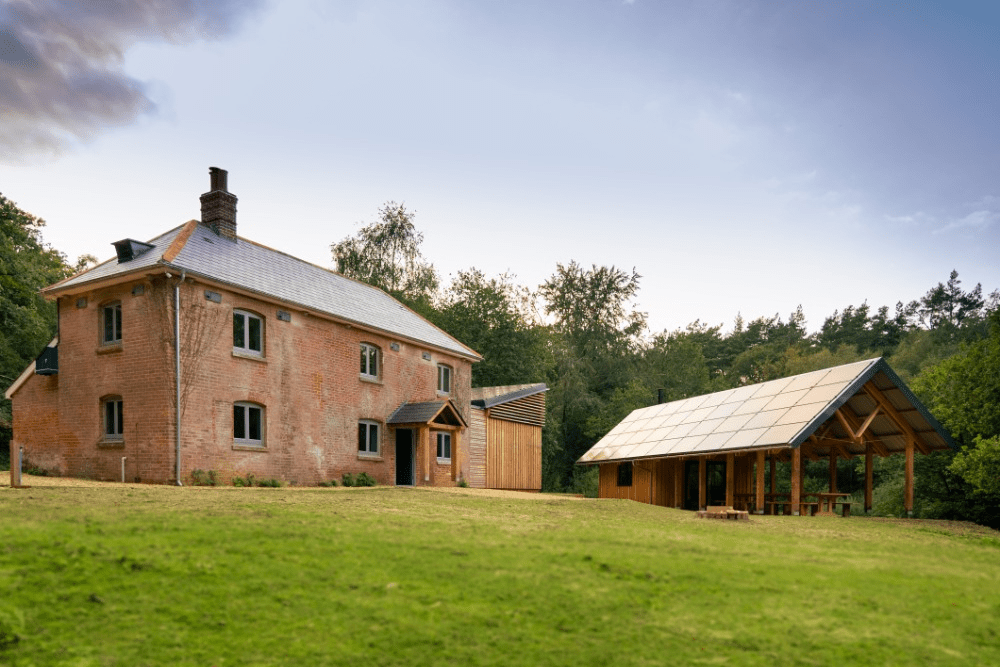
Camerons Cottage!

I had thoroughly enjoyed that first afternoon, and I think my peers agreed! So, waking up Saturday morning after a much-needed nights sleep I was naturally quite excited and eager to get going again. We kicked things off by opening up the moth traps that had been set the night before…

Moth trapping is a method of surveying and enjoying the beauty of moths, and I feel that I must stress that it does not hurt the moths! While I am no expert on moth trapping, in essence, the bright light in the trap attracts the moths, and they then fall into the bucket. Unable to get out again, they rest and recuperate on the warm, comfortable egg boxes, until they are released in the morning, often to marvel at or study. Moths are incredible, with a far greater variety of stunning species than you might think. From the huge Privet Hawk Moth, to the many tiny micromoths, there’s a moth for everyone!

We found a nice variety of moths, including several I had never seen before. Hiding in the egg boxes were, to start off with a surprise, two hornets. The actual moth roster (don’t be surprised by any strange names, moths are renowned for it) included both Black and Dark Arches (so named for the barring across their wings), a beautiful yellow Brimstone moth, a subtly but brilliantly patterned Mocha moth, and many micromoths that even a seasoned expert would have struggled to confidently identify. Much of the knowledge in this session was provided by Max Cantrell, another young person on the camp who is one of the best entomologists I’ve ever met. We had a special guest of the non-moth variety join us too, ahead of his workshop later on – none other than author Stephen Moss.

Stephen Moss is a leading nature writer, broadcaster and wildlife television producer. He won a BAFTA Special Award in 2011 for his work on Springwatch, and he’s written well-known books such as A Bird in the Bush and Ten Birds that Changed the World, and is, at his core, a passionate naturalist. Of his books, I have particularly enjoyed the Robin, A Bird in the Bush, and his collection of articles published in the Guardian – This Birding Life. I was lucky enough to take part in his quiz at Global Birdfair – he is a true font of knowledge on the natural world.

Stephen led us in a workshop based around memory writing with a focus on childhood memories and ahead of the weekend, he had even set us a little homework task: to read, with several questions in mind, five extracts from books of memoir, and with aspects of memoir. We went through extracts from the five books: The Butterfly Isles by Patrick Barkham, On Gallows Down by Nicola Chester, This Birding Life by Stephen Moss (had to be included), Clay by Melissa Harrison and Waterland by Graham Swift. The last two are both novels, but still contain aspects of both memoir and memory writing, so are very relevant, even if the techniques used are somewhat different to the first three books which are memoirs.

So, we had a discussion over these books and what prominent techniques were used in the memory writing, which led nicely in to a little childhood memory writing exercise. The exciting aspect of this was that we were given license to roam around the woods surrounding the cottage, which encouraged a quietness of mind not always easy to attain amongst a room full of people, and an important technique to remember to draw upon when life is busy but work needs to be done! Check out more about Stephen here.

By then it was lunch time, and time for a well earned break. After some food we headed into the woods again as part of the action-packed schedule put together by Andrew and Emily. As I mentioned earlier, RSPB Franchises Lodge isn’t open to the public, and so there was a little firepit area with log seating arrangements just for the youth groups that are lucky enough to stay at Cameron’s Cottage. Just a short walk into the trees, it takes up its position in a beautiful clearing, ringed with bracken and home to a Sloe Worm, which was found under a stone and much admired by the group. Sloe Worms, despite the name, are actually legless lizards, a fact that became quite obvious when the reptile flicked it’s lizard tongue out.

After several writing exercises, facilitated by Emily and Andrew, we continued on the path until the watchful trees became a brilliantly biodiverse, slightly marshy grassland habitat. The place was crawling with Wasp Spiders (this is a good thing), who were feasting on the copious amounts of Leafhoppers leaping from stem to stem. Another special arachnid find was a striking Raft Spider, reddish brown with two bordering yellow stripes. Swallows were constants, diving low over the grass and our heads, gorging themselves on the plentiful insects. Sadly, they’ll soon be gone on their migration back to Africa for the winter, so it’s important to enjoy them while they’re still here.
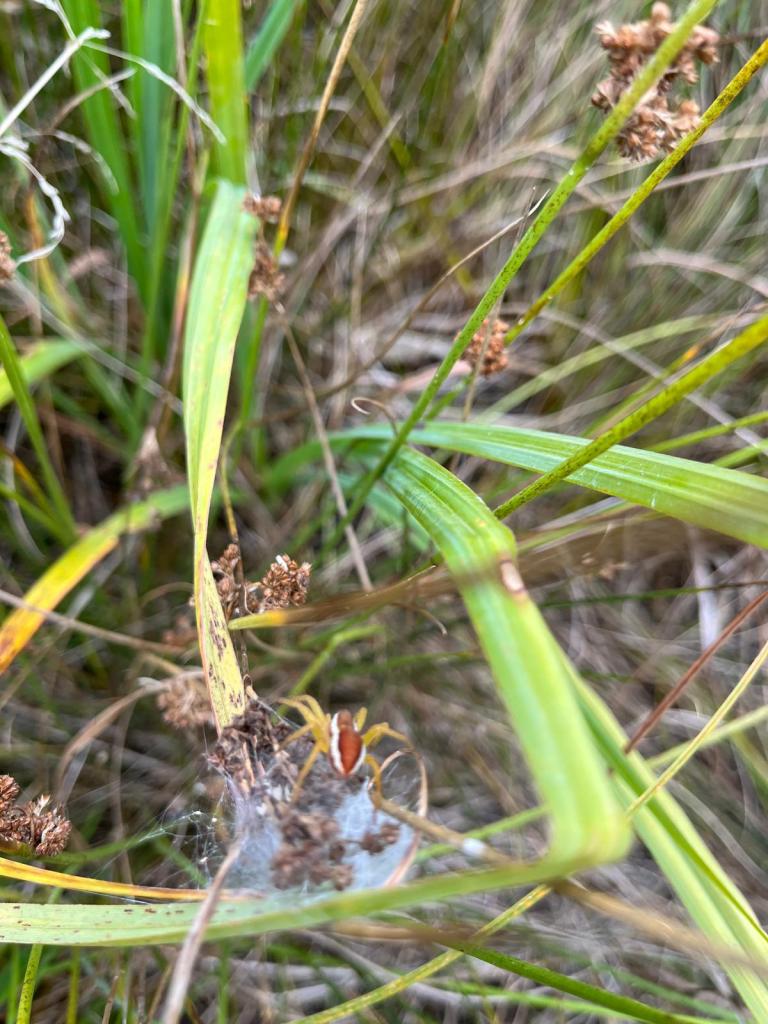
Raft Spider

On our return to the cottage, it was high time for a talk by one Kabir Kaul, a brilliant naturalist and campaigner who has already done so many good things for nature by the young age of 20, such as his tireless work in promoting London’s varied green spaces and the wildlife within them. Looking at his journey, I cannot fail to be inspired and amazed by his prowess, and hope that I too can follow a similar path in the not too distant future. With the world becoming more and more digitised, and things like email and social media playing a huge role in our lives, his tips and tricks for things like writing an email to ask for an opportunity and how to showcase your writing skills in a short and snappy Instagram post were incredibly valuable, and I know they work because he’s tried and tested them all! Read more about Kabir’s journey here.

Dinner and an outing over the road to Telegraph Hill followed, on the hunt for bats and Nightjars. We managed to spot one of these cryptically camouflaged birds, albeit a very distant one, spotted flying over the treeline in the last light of the evening and identified by its slender shape and pointed wings. Armed with bat detectors, we did manage to pick up two of the more common species, in the Common Pipistrelle and the Noctule Bat. The bat detectors work by picking up a bat’s echolocation calls, which can’t be heard by the human ear, and converting it into an audible sound we can easily identify, clicks and chirps. Each bat species has a different frequency, and that’s how you identify what you’re hearing.
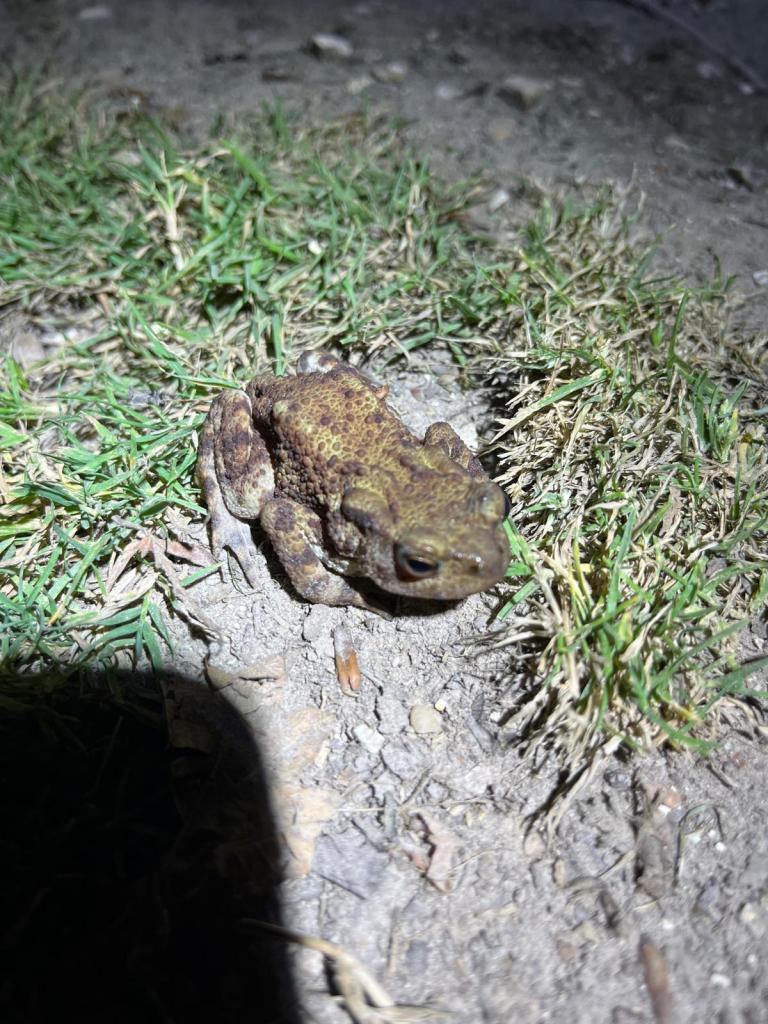
We also found this Toad!

I slept like a log that night, happily exhausted by the day’s endeavours. There wasn’t an early wake-up call for moth trapping the next day, but instead a hearty breakfast to provide consolation. A morning bioblitz was the first order of business for the day, heading out into the marshy field from yesterday to conduct it. A bioblitz is a simple concept, but easier said than done in real life! The aim of the game (not that its a game, its often used for collecting scientific data) is to find, identify and record as many species as possible in one given area, whether that be insects or trees or fungi.

Some highlights of the morning’s survey included at least one more Common Raft Spider (if you’ll recall, one of these beauties was found yesterday as well), lots of Wasp Spiders and a Common Toad, among many other species. I think the highest amount of species found that morning was around 90, and it just goes to show how biodiverse a small area can be when allowed to flourish.

On our return, everybody was delighted to find that our next speaker had arrived. Jeni Bell is a talented writer and photographer, as well as an engaging, lighthearted individual and this comes across in her writing. Her workshop was titled ‘Confidence’, this was particularly pertinent to me as confidence is something I really struggle with, both in writing and in person and something I want to continue to work on, as I know how much self belief is required to succeed in this field, and in pushing myself forwards for opportunities. Check out more about Jeni here.
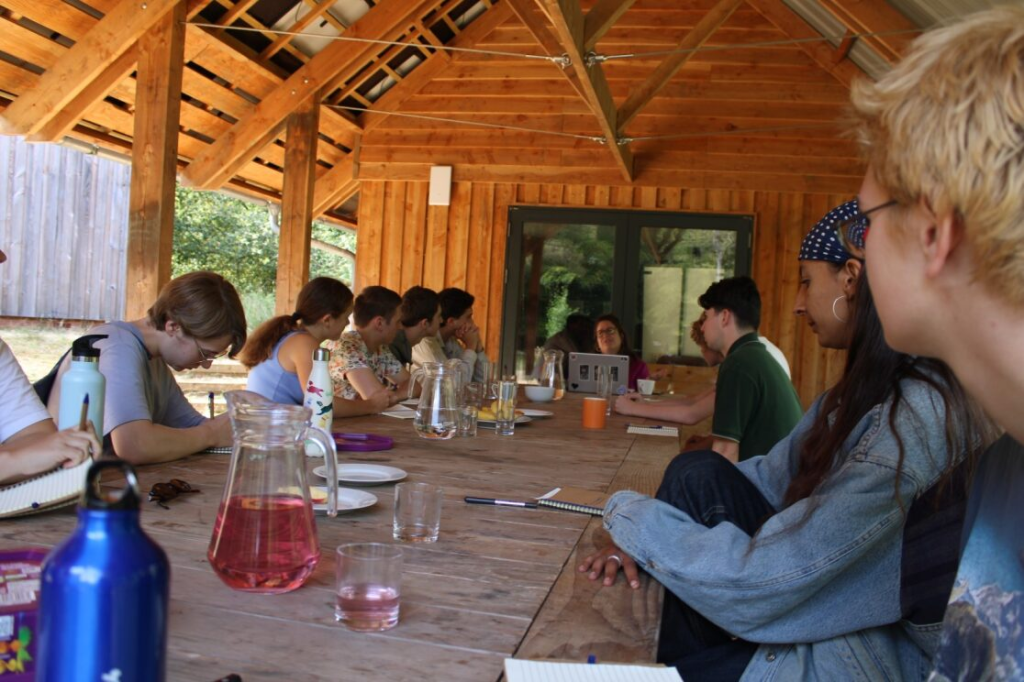
Jeni’s talk (Photo by Emily Hunt)

Post lunch, we gathered again to learn from Alicia Hayden and her workshop on Wildlife Artivism in Writing. Alicia is a committed wildlife artivist and conservationist. Artivism is probably a term you’ve not encountered before, but put simply its a way of promoting conservation and raising awareness of environmental issues through creative avenues. Writing is a form of art and expression and so it easily comes under the umbrella of artivism. We looked at several pieces of writing conveying environmental issues through fictional stories, including the script of a Studio Ghibli film, Princess Mononoke, and discussed the nature themes and how they were portrayed. It was fascinating to explore how serious issues were translated in a film aimed at a younger audience – the film covers the topic of deforestation and the conflict it brings into play between humans and animals. On another note, read more about Alicia here.
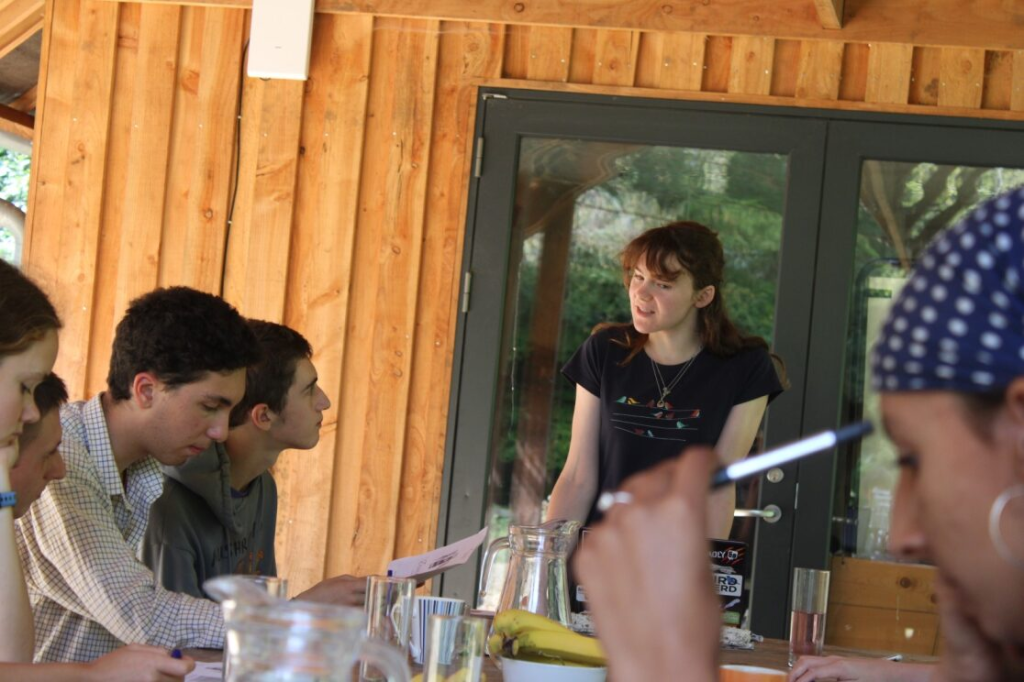
Alicia’s Workshop (photo by Emily Hunt)

At this point, the whirlwind weekend drew to a close, and as I packed my bags and said my thanks and goodbyes, I was so honoured to have been able to witness and be a part of such a special gathering of important players in the world of nature writing, alongside the next generation of writers, activists and creatives. I am so grateful for Emily and Andrew taking a chance in letting me attend, I have learned so much from the experience, and have already begun to weave those lessons into my own writing. As we left our weekend woodland home to begin the long drive back to Devon, my head was filled with ideas and plans, and our retreat whatsapp group began to ping with notifications! I had taken so much value from the retreat, so much inspiration from both writers and fellow attendees and I am so grateful for the magic that Emily and Andrew have created. I must thank everybody who made it possible, Emily, Andrew, all the authors, the Cameron Bespolka Trust and the RSPB, I hope I can return again next year!
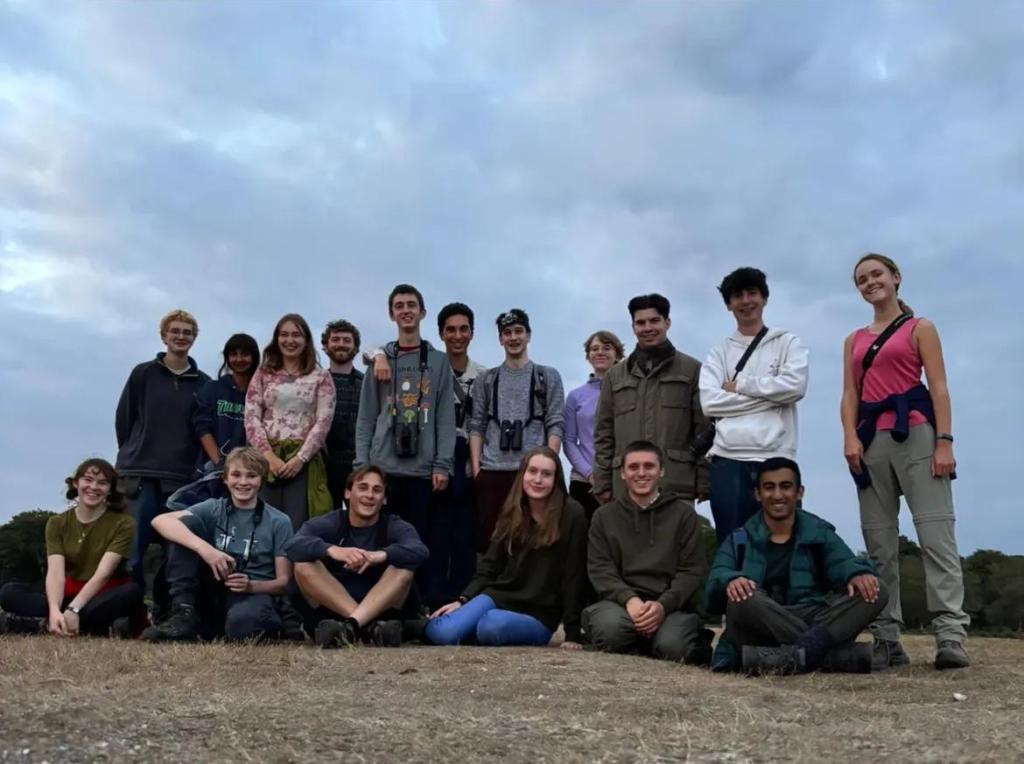
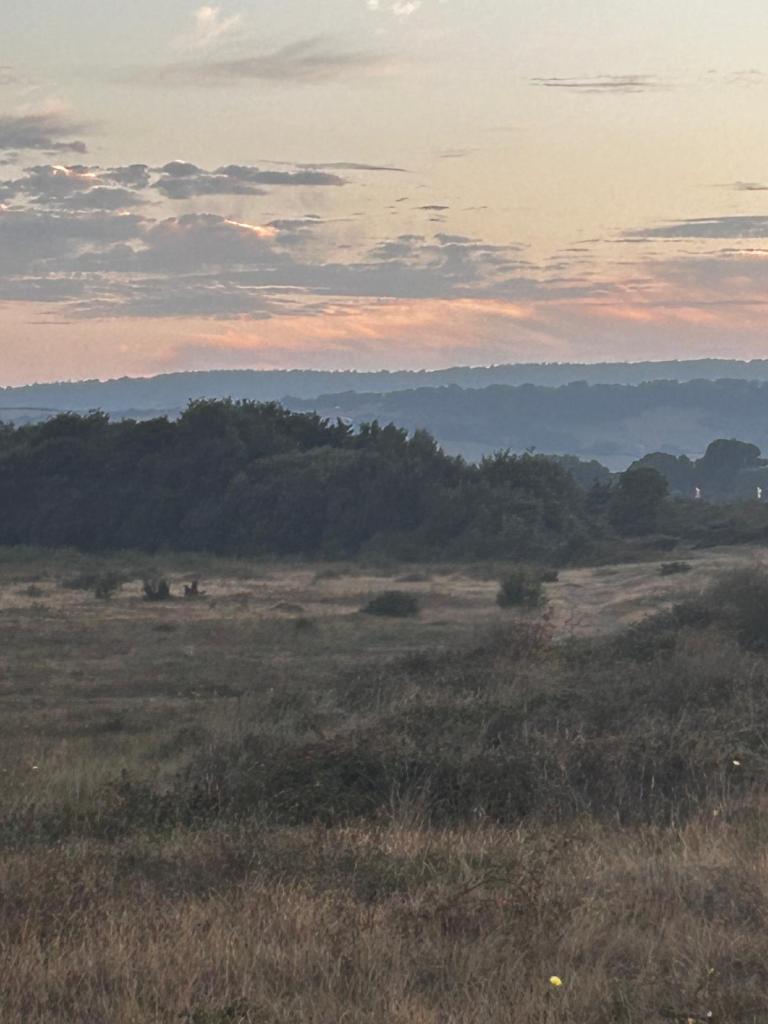
Bird Beach

I can’t think of a better way to spend a Monday evening than on a beach, crouching metres away from a sizeable mixed flock of just about every wader species you would expect to find on a sandy shore, and then some. An evening walk through Dawlish Warren Nature Reserve had ended up with an unforeseen detour onto the beach, an area that I’d normally avoid when visiting here due to its tendency to be packed with people. However, when I was forced towards the other side of the dunes thanks to a path closure, I was met with an incredible sight. More on that later.

Dawlish Warren National Nature Reserve is an internationally important coastal habitat at the mouth of the Exe Estuary, and a key part of the Exe Estuary Special Protection Area. It’s the main roosting site on the Exe Estuary for thousands of wading birds, and hence is a crucial site for wintering bird populations, especially species like the Avocet. The mix of habitat within the reserve is another reason it has been designated as so many things; dunes, grassland, scrub, meadows, copses, reedbeds, ponds, saltmarsh all feature, and this array makes Dawlish Warren a unique site.

Sorry about blur, only due to low light levels

However, despite this jewel lying in apparent secrecy behind the dunes, the beach itself is one of the most popular tourist spots in the south-west. With its Blue Flag award, gently sloping sands and clean water perfect for paddling, you can see why its popular among holidaymakers and locals alike. We always make sure to visit outside of peak times as it can get very busy, and what birds decide to brave the beach are often scattered by dogs, toddlers and the like.

And so we arrived in the evening. The sun was low in the sky, and the beaches were gradually getting closer to becoming deserted for the night. But to start with, I had no intention of heading onto the beach. I was to spend the evening exploring the National Nature Reserve behind it. And it was brilliant. Crickets and grasshoppers were enjoying the evening sun, chirping like there was no tomorrow. Charms of Goldfinches roved through the scrub and the grassland, while Stonechats perched on prominent twigs and branches, affording good, if silhouetted, photo opportunities. But after a while I was met with a problem.

The path towards the bird hide on the point, where huge numbers of birds would be coming in to roost right about now, was closed due to erosion. Annoyed but understanding, I hesitantly stepped out onto the beach. The prospect of a visit to the hide had excited me, but I guess it wasn’t to be. It was still possible to access the hide from the beach, but there was a risk of getting cut-off by high tide, which was just under an hour away.

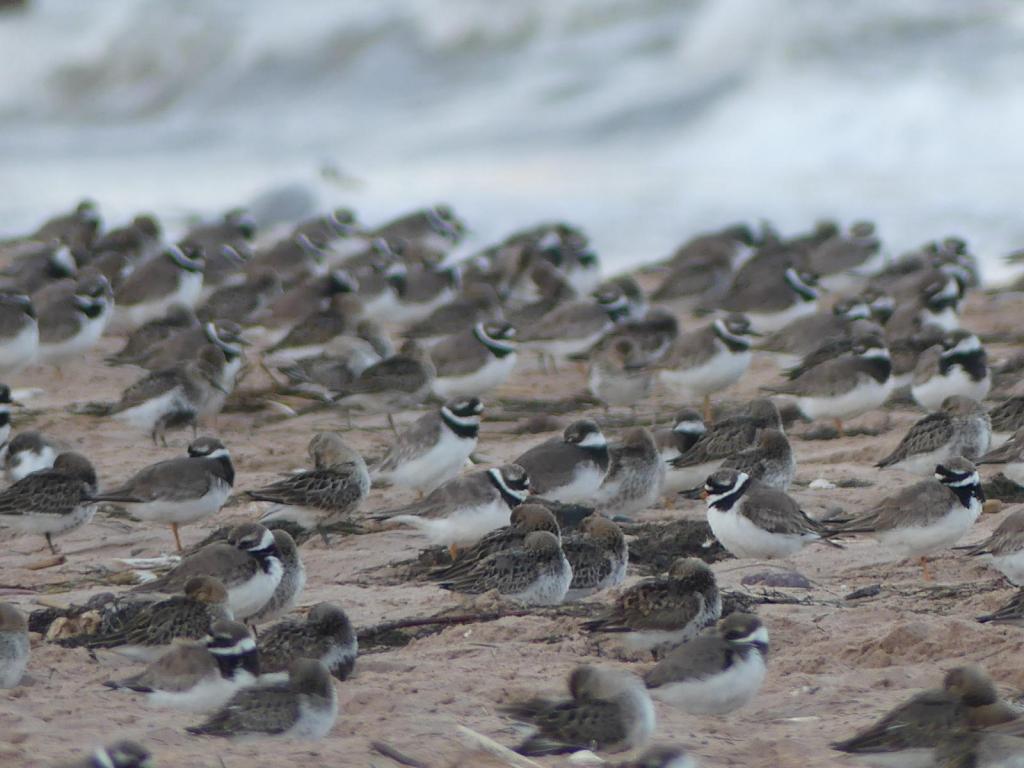
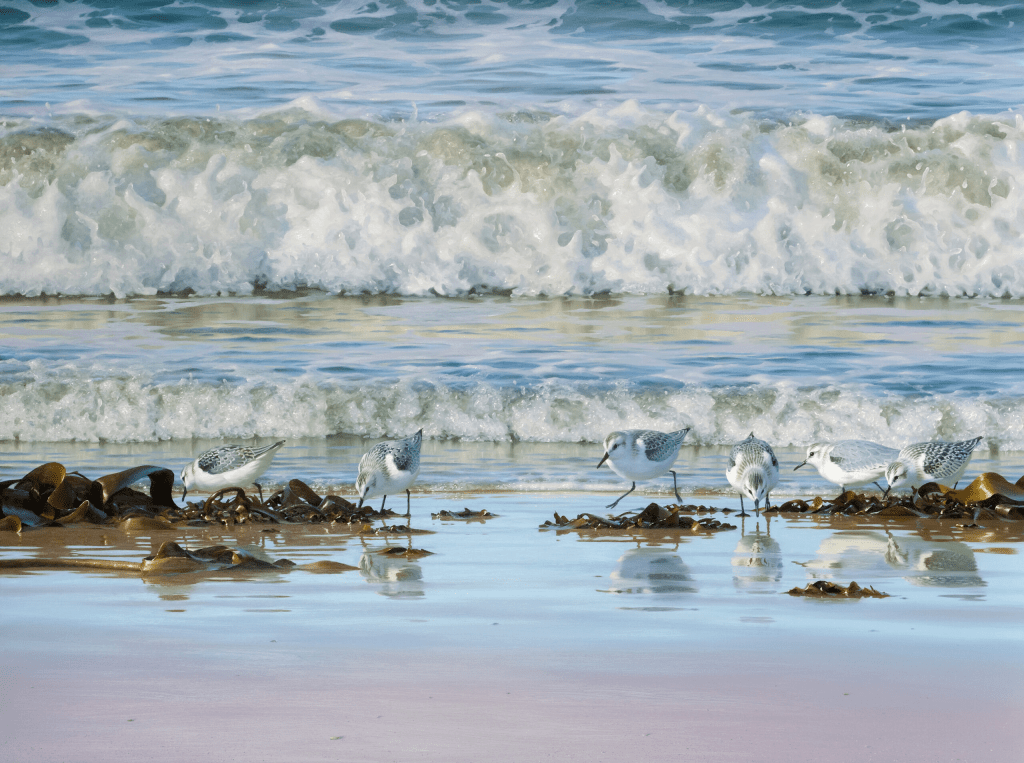
But it turns out I didn’t need to go anywhere near the hide. The beach was empty, except for the largest flock of beachgoing waders I had ever seen in my years of birding. Before me sat at least 100 Ringed Plover, another 100 Dunlin, dozens of Knot and scores of Sanderling. There were even two Grey Plovers in there, along with the jewel of the crown which I had in no way expected to see tonight, an early Purple Sandpiper. Both of these species were lifers, and because I had given up on any of those tonight when the prospects of the hide were dashed, I was understandably ecstatic. So much so that I started silently jumping around on the beach, although I was careful to remain a good distance away from the birds. I didn’t want to spook them when I had just stumbled across them.

So many birds!

Lots of the birds were roosting, however some were still up and about, feeding and racing along the tideline, retreating from the waves like little clockwork toys. I was impressed; the only was I can possibly be this active past 8PM is if I am out birding, which I was now (hence the celebratory dancing a moment ago). I had never seen anything like this in all my birding years, and it genuinely had my heart pounding faster with excitement. Only birders will know this feeling, just saying (no offence)!

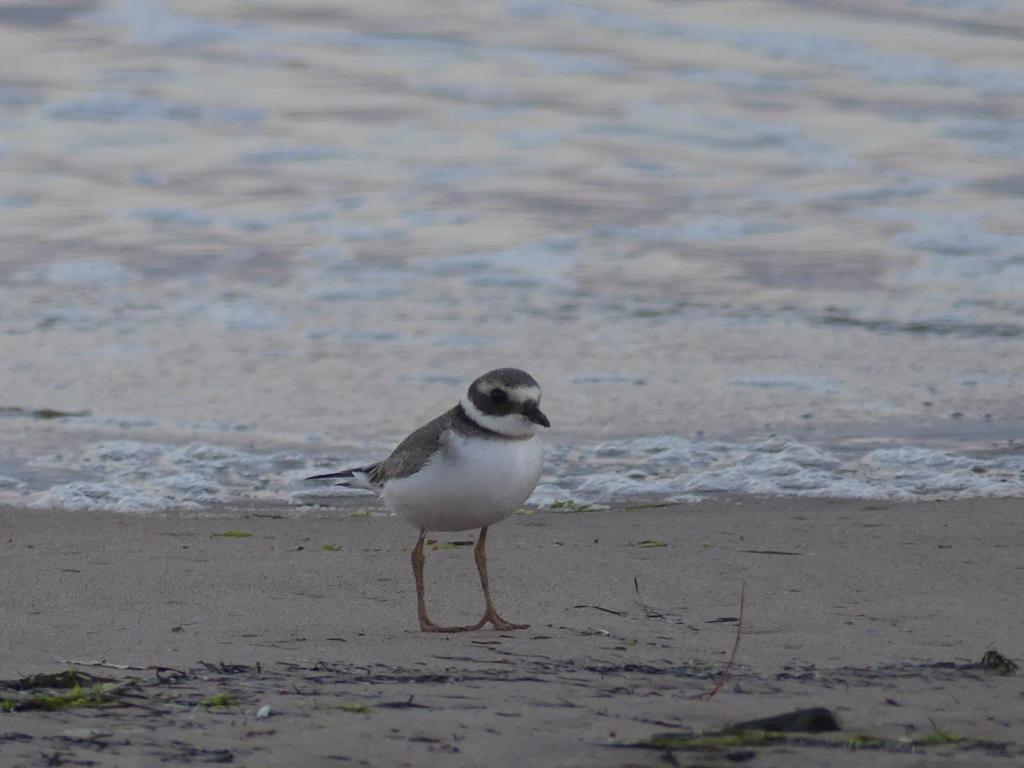
Don’t tell me that this Ringed Plover is not beautiful

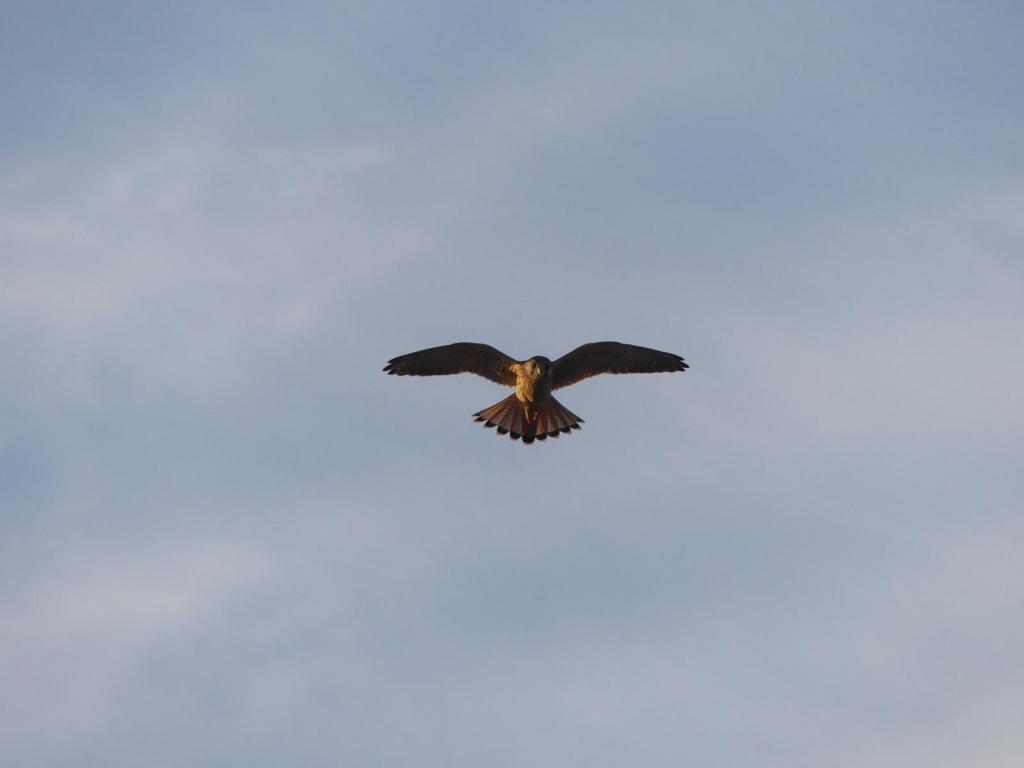
As I crouched there for about an hour, just metres away from all of these incredible birds, I was astounded as I contemplated the transformation of the beach from tourist-filled and almost bird-empty to completely void of tourists and full of birds! The abruptness almost disturbed me; the conversion had happened over such a short amount of time and yet hear I was, enjoying more Ringed Plovers than I had ever seen in a single place before, along with a small group of Ruff which had just flown in and all the other birds I mentioned above. On top of this, almost directly above me hovered a Kestrel, intent on prey in the dunes. I’d almost missed it being so engrossed in the beachgoing waders.

Kestrel

Alas, the constraints of darkness soon crossed my mind, and before I lost all light completely, as well as my footing because the tide was fast coming in, I was forced to head off back into human civilisation. I couldn’t wipe the smile off my face though. I’d just spent a whole hour with birds, and nothing else. No humans, no dogs, no nothing. Just me and the birds. It was incredible therapeutic. After all, there’s no better way to cheer yourself up than watching birds. Coincidentally, there’s also no better way to frustrate yourself either, but we’ll save that for another post.

I trudged up the steep path that traverses the dunes, and went for a quick scan of the adjacent golf course before I headed back to the car park. It was slightly more fruitful than I was expecting, heralding two Mistle Thrush, a Robin and even two male Cirl Buntings! I was pleasantly surprised to find them here, in such good habitat as well (not the golf course, but Dawlish Warren NNR). There was a fear that they wouldn’t spread from Labrador Bay after their numbers grew nicely following the RSPB’s purchase of the land and subsequent management of it specifically for the Cirls. But this sighting has put me at ease, as well as hearing reports of them being spotted elsewhere in the South West as well, often even further afield.

Before I leave you then, a word on the Exe Wildlife Refuge Scheme. Launched in 2017, it created two wildlife refuges on the Exe Estuary: The Exmouth Wildlife Refuge, which protects a large bed of eelgrass, the main foodplant for the internationally important wintering population of Brent Geese (they like it partially submerged in the water, with a little gravy if you will) and the Dawlish Warren Wildlife Refuge, which unlike the Exmouth Refuge (which is closed off for all humans from September 15th to December 31st every year) is closed to people all year round.

It protects an area of saltmarsh, inter-tidal mudflats and the most important high tide roost on the whole estuary. At high tide, wading birds congregate in areas such as Hide Island and Finger Point. The refuge is crucial for wintering bird populations, as the closer the food source is to the roost, the less energy birds have to spend on travelling between the two, and the higher the survival rate is in the colder months. SED (South East Devon) Wildlife even have a patrol boat that guards the boundaries of both refuges, so don’t even think about trying to gain access (I don’t think you anybody reading this will though, at least I hope not).

Dawlish Warren National Nature Reserve is a special place, and clearly so is Dawlish Warren beach, at least when all the people are gone. I learnt something new on this visit, and I hope you did too, whether that be about the importance of the Wildlife Refuges or that Brent Geese are stubborn, fussy things. But nobody mentions that because they’re smartly-dressed birds.

Bashing for Butterflies!

DISCLAIMER: You’re probably wondering about the origins of the title of this one. I won’t give too much away, but I will say that no butterflies, or any creatures for that matter, were harmed in the making of this blog.

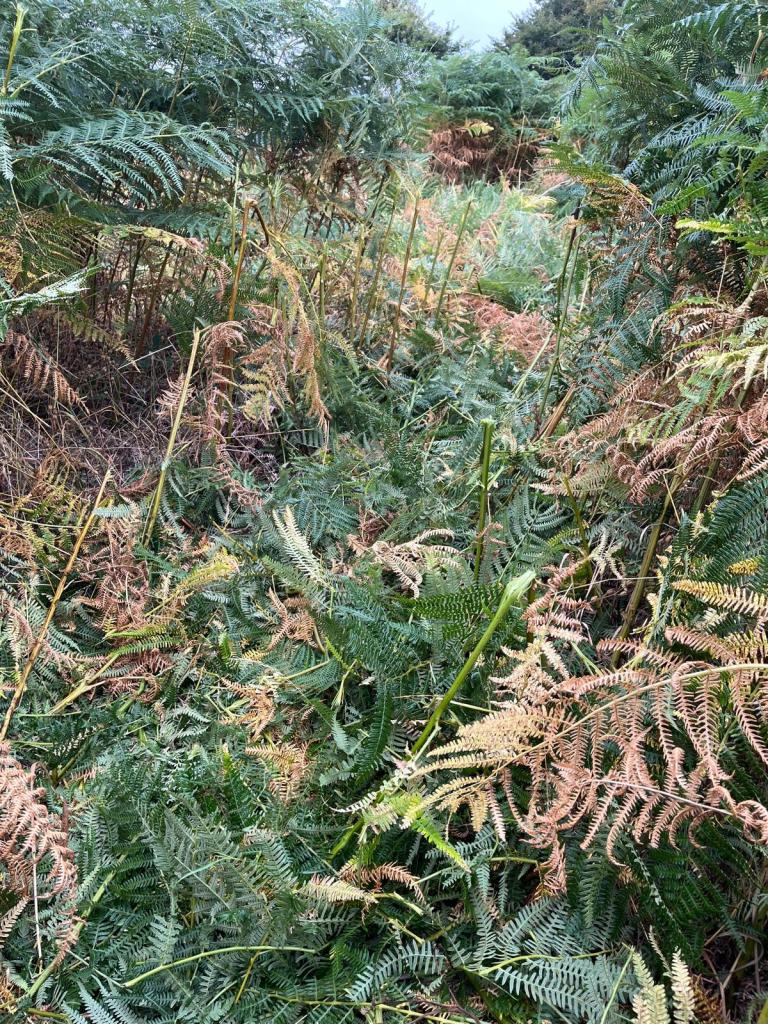
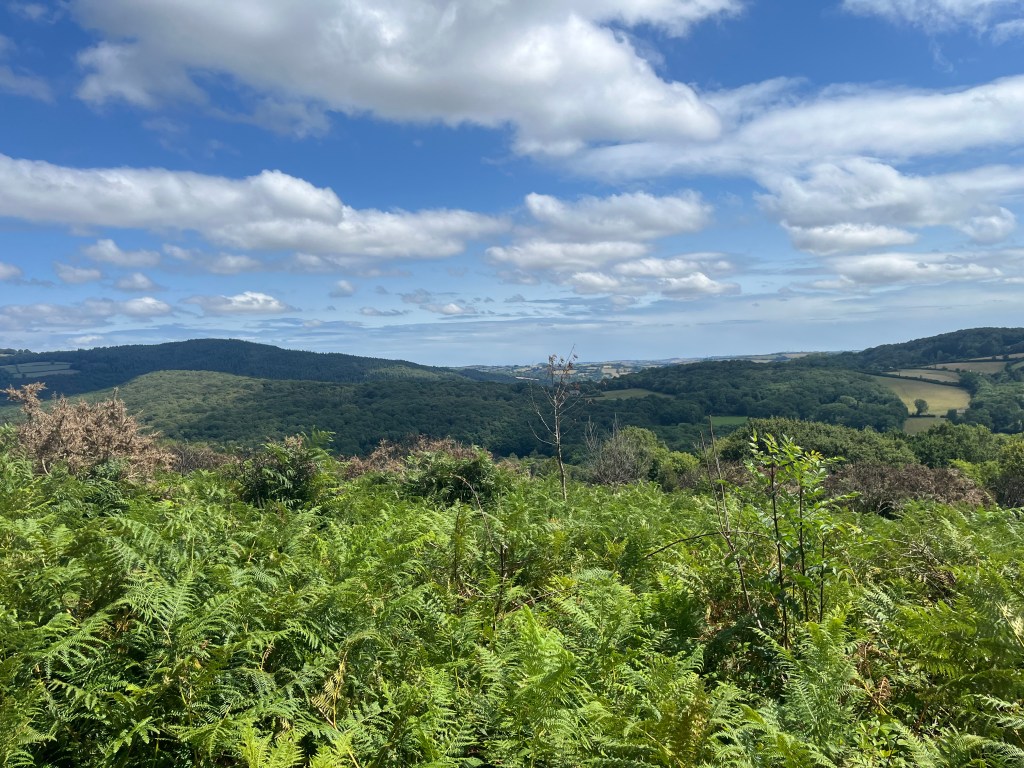
Bracken. That was the reason I stood upon the crest of the hill at Pepperdon Down (an area of access land, meaning that the public can go there and stray off paths) at 9:23AM, looking down the slope at a whole field of the stuff, packed close together and at head height. Apparently, the view from here is meant to be outstanding, but all I could see was green fronds, and after that white. The mist didn’t bode well, but it was still early doors. Afterall, a little mist had no chance in stopping the Dartmoor Youth Rangers doing what they did best. Brutally massacring bracken.

Location, location, location

Well, it wasn’t that simple. The aim of the day was to channel our inner bovine, and to become cows. Graze like cows, move like cows, sound like cows. Well, maybe not that last one, but we did have to mimic cows in our approach. That meant that we had to try and carve wide paths and channels through the bracken, that twisted and met up with one another. Essentially, we were looking to build a maze for flying insect customers, with one species forming our target market.

But first, in case you didn’t know, what is bracken? Bracken is the UK’s most common fern, and is found in every continent except Antarctica. It’s fronds appear all over the UK, and unlike many other ferns, it dies off in winter, leaving crunchy brown bracken everywhere. It’s success is owed to its sometimes annoying ability to completely dominate a landscape, growing in such densities that is blocks out the light and prevents any other plants, the bracken’s competition for sunlight, from growing, which isn’t very good for biodiversity.

The Pearl Bordered Fritillary is one of the earliest Fritillary species to emerge, with them often being found as early as April in woodland clearings and hillsides complete with some bracken. Emphasis on ‘some’ bracken. Well, as I stood on the road, I quickly noticed that we had both of those: a woodland clearing on my left, and a hillside with bracken on the other. Just too much bracken. And too high as well, because Pearl Bordered Fritillaries generally like to fly close to the ground.

It is a bit of a looker, with two large silver pearls and a row of seven small pearls along its underwing (not actual pearls, this is Dartmoor not Monaco), but they are one of Britain’s fastest declining butterfly species. Once widespread across Britain, they’re now only commonly found in northern Scotland, south Cumbria, Devon and Cornwall. Thanks to habitat fragmentation and a loss of woodland clearings, such as those left by coppicing, have contributed to a huge drop in numbers.

So, this was a habitat restoration project. Pearl Bordered Fritillaries lay their eggs on dead bracken in late summer, which thanks to its fronds, create air pockets and therefore warmth. They’re usually laid near to violet flowers, the Fritillary’s main food plant, but by the time the caterpillars are ready to eat, sometimes the violets are nowhere to be seen. You see, the eggs usually hatch after 10-14 days of being laid. After that, the caterpillars eat very little, if anything at all, and enter a period of dormancy, essentially hibernation, during the winter months. They awake from their slumber during March and early April, but soon after they awake the bracken can become dominant, blocking out the light and preventing other plants from growing, including the violets.

So our aim was to bash the bracken. By hitting it near to the base of the stem and bruising it there, the bracken will continue pumping nutrients straight out of the hole, eventually self destructing. By carving a network of around three foot wide channels ( the wider the channels, the less likely the bracken was to become dominant again) and forming isolated pockets of bracken, we could make sure that the butterflies can have both their nesting sites and their violets, hopefully for years to come. And now, you see the meaning of the title!

Bracken!

And so we began bashing for butterflies. Armed with logs, branches and bamboo canes, we set to work, creating a surprisingly intricate and complex network of channels and paths, relishing bashing the bracken. To be honest, a lot of conservation work is destruction. Trapping, removing, bashing. It’s important work! But don’t go getting the wrong idea. There’s also restoration, reintroducing, planting and lots more nicer stuff. It’s not all damaging plants!

But even from the destruction, an immediate positive impact was made. At around lunchtime, the mist was banished by the suddenly blazing sun, and everyone who was anybody (in the insect world) came out to play, exploring our maze and whizzing through it. Bumblebees, moths, butterflies and hoverflies all returned to the jungle of the bracken, free to fly at their preferred low altitudes. It was incredible in its instantaneousness, and despite the fact that we didn’t see any Pearl Bordered Fritillaries, I’m sure that they can’t have been far away and are right now, as I write this, enjoying the corridors we built for them. As soon as the flowers start coming up, which will be hopefully be sooner rather than later and probably begin with some dandelions, I’m sure Pepperdon Down will become an insects’ Ibiza.

And I really hope it does, because more than half of UK butterfly species have been shown to be in long-term decline since 1976 by the UK Butterfly Monitoring Scheme. 2024 was the fifth worst year on record for butterflies on our shores, resulting in all but 8 of 59 species showing a decline from the previous year; and nine suffered their worst year on record. But one of the most shocking figures was that common butterflies, the ones that everybody sees in urban parks and gardens, suffered their second worst year on record. Peacock, Red Admiral, even the Large White are all in trouble. The Small Tortoiseshell, an instantly recognisable species once common across the UK, has declined by 89%. That’ll be why I don’t see them anymore.

I know that this makes for bleak reading. But all of these figures are true, and it’s largely thanks to us. The merciless destruction of crucial habitats rich in food and nesting sites, the use of pesticides and the acceleration of climate change have all played a role in these depressing numbers you have read in the above paragraph. And if the planet keeps going the way it’s going, with weather becoming more extreme and unpredictable, its not going to stop. 2024’s wet spring and cool summer had a big negative impact on butterfly populations. But unless climate change is slowed down enough for the natural world to adapt, that’s going to keep happening. And it’s only going to get worse.

On a more positive note, incredible people are working their socks off every day to save Britain’s butterflies. Charities like Butterfly Conservation and the Wildlife Trusts, are working on projects to restore habitat, conserving the species most in need, conducting citizen science projects like the Big Butterfly Count, which you can do annually (find out more here), to monitor declines and raising awareness wherever they go. You can help easily, simply by planting a few nectar rich flowers in your garden, for the adult butterflies to feed on. I hope that we managed to make a difference today, but so much more work needs to be done to reverse these declines. But the work being done is having a positive effect, and given time, should make a big difference.

Bug Hunt!

Last week I was lucky enough to head out on a bug hunt alongside a small group, landowner Fiona and renowned entomologist John Walters. We were nearby to Newbridge on Dartmoor, where the River Dart tumbles towards Dartmeet in a spray of white and grey. It was a brilliant afternoon, where we used several different methods to search for and survey the insects hiding in the field. The field in question, by the way, was an absolute nature haven. It was messy and unruly, with narrow paths weaving through the wonderland. I loved it, as did the insects. Hard to believe this place was once a Christmas tree farm!

What a view!

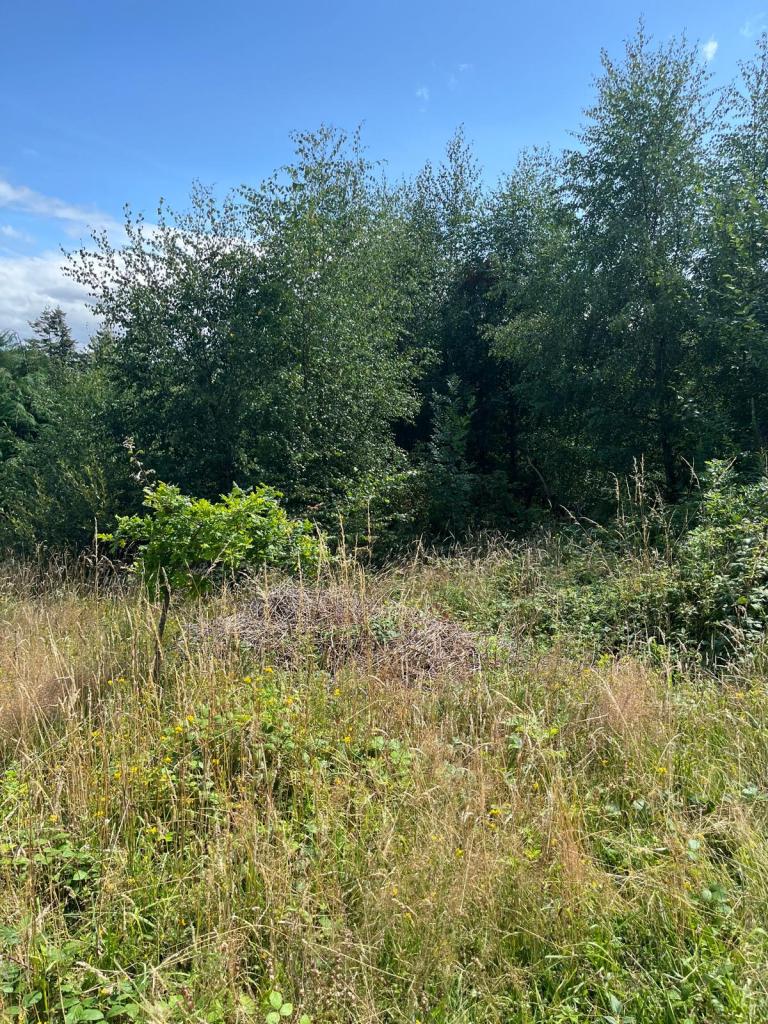
But what’s the story of this little piece of rewilding? Well, to start with it was bought so that a phone mast wouldn’t be built upon the land. Now this was about seven years ago, and back then it was full of young coniferous trees. In fact, there are still remnants of this as you walk along the paths. A suspicious looking Christmas tree here and there. But they are largely gone, and thankfully they don’t seem to have harmed the soil quality with their acidity either, as many deciduous trees have cropped up, such as silver birch. Silver Birch is often the first kind of tree to crop up in an open area, a pioneer of sorts, and these slim trees can be home to around 300 insect species. But don’t worry, there are still lots of areas that have been kept open, so as to create a mixture of habitats and promote biodiversity.

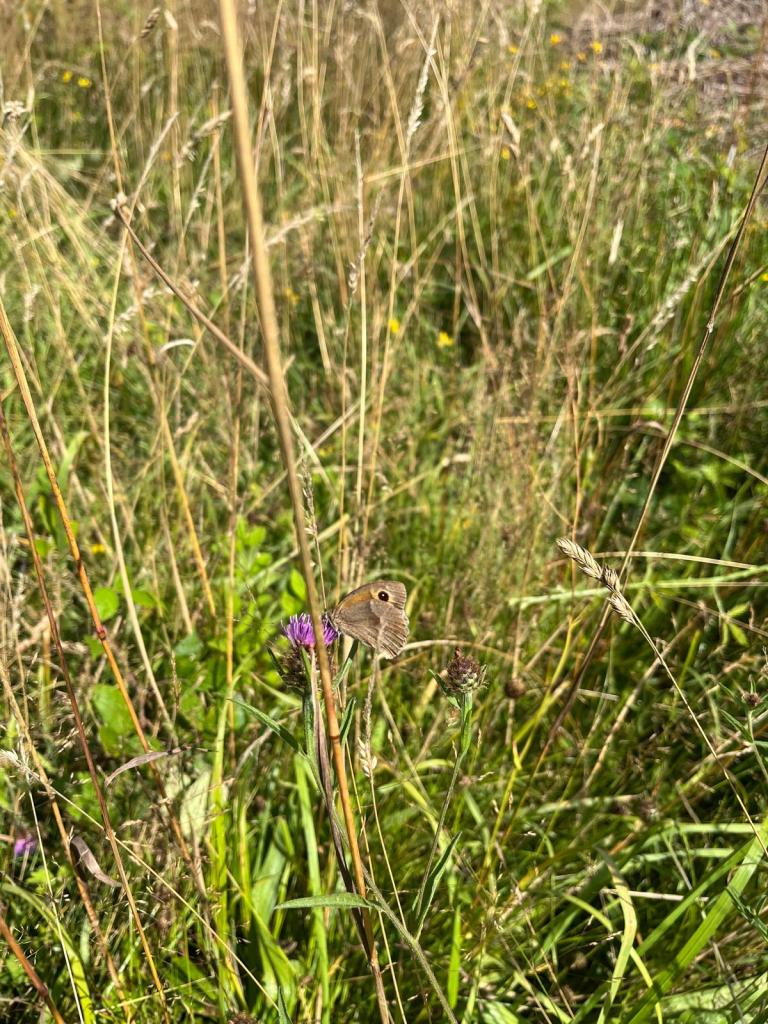
These open areas were full of long grass, short patches of grass and bramble patches, which is many an insect’s perfect idea of an idyllic paradise. Tall vegetation, whether that be lofty meadow grass or knee high brambles, is home to everything from tiny aphids to butterflies such as the Meadow Brown. And for good reason too, as it provides very good shelter from the elements and predators such as birds, food sources such as nectar and pollen from flowers like Cornflower, and places for insects to lay their eggs and overwinter, like in bracken. However, longer grass can make it harder for insects to navigate, especially flying ones, and this can potentially hinder their search for a mate.

Gatekeeper

Others, such as ants and mining bees, are attracted to shorter grass. It provides easier foraging opportunities, such as seeds that are more evident than in taller vegetation. The mining bees use the short turf and exposed soil for nesting and digging their burrows into the ground. The exposed soil is easily warmed by the sun which penetrates the surface, warming the bee’s larvae. Additionally, flowers like clover thrive in short grass, and this can in turn provide food for lots of pollinators. However, the problem with short grass is that it doesn’t provide any shelter from the elements unless you burrow down, so many species can’t live there long term.

And finally, there’s the insects that like wooded areas, whether they be wood-boring insects such as the Deathwatch Beetle, or ground dwellers such as centipedes, or even flying insects like the Lobster Moth. Trees provide food, shelter and places to breed thanks to the availability of dead wood, leaf litter and diverse vegetation. The only downside with a woodland is that the kind of vegetation that creates so much biodiversity, like long grass, is unable to grow to a decent height due to the shade created by the trees.

The whole field is managed diligently, but also left to go wild a bit. It’s lightly grazed which stops the growth of scrub, there are log piles and sheets of metal left around for insects, reptiles and amphibians to bask under and feed on. The paths were kept clear so that humans could observe and enjoy the natural bounty, as well as for the use of ants, and therefore Green Woodpeckers too (favourite food: ants). Striking the right balance between management and allowing nature freedom is crucial for biodiversity.

Such a wild place!

Overmanaging an area can hinder the natural processes that would be carried out without human interference, and this can potentially lead to a loss of habitat and biodiversity. Overgrazing is probably the most common example of this in the UK, and it just ends up creating a monoculture where little can thrive. You may think that the rolling green hills of England are full of nature, but really they’re anything but thanks to decades of intensive agriculture.

Whereas undermanaging the land can have a completely different effect. Letting nature go completely would cause this mosaic of habitats to degrade, and eventually become scrub, and if left unchecked even woodland, neither of which are as good for biodiversity, especially the insects enjoying the field.

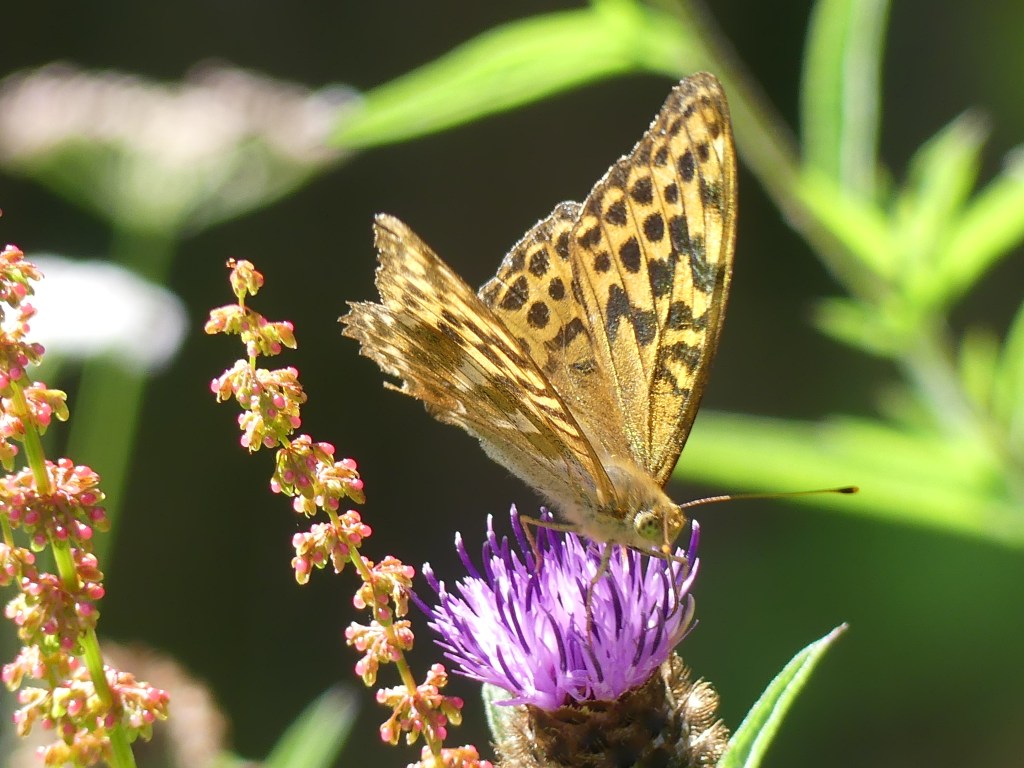
The mosaic of habitats seemed to be working perfectly, as the whole place was buzzing when we arrived. Butterflies, bees and hoverflies were the most obvious residents, fluttering, buzzing and whizzing from bramble to thistle flower. The diversity was incredible. I saw at least three species of bumblebee and five species of butterfly before I even walked through the gate. One of these was a particularly engaging Silver Washed Fritillary, who landed on a flower adjacent to the path and allowed me to take in its beauty. The first impression I’d had of it was as a big orange flying thing as it dashed past my ear. They are the UK’s largest fritillary species, and are recognised by the silver streaks on its underside.

Silver Washed Fritillary

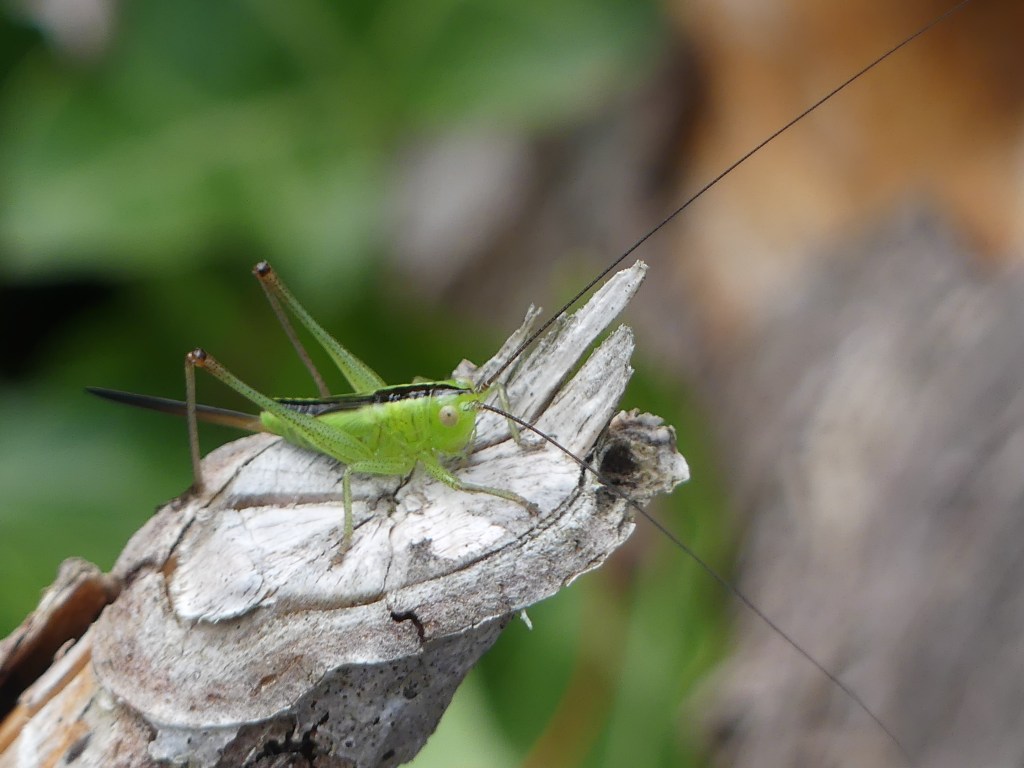
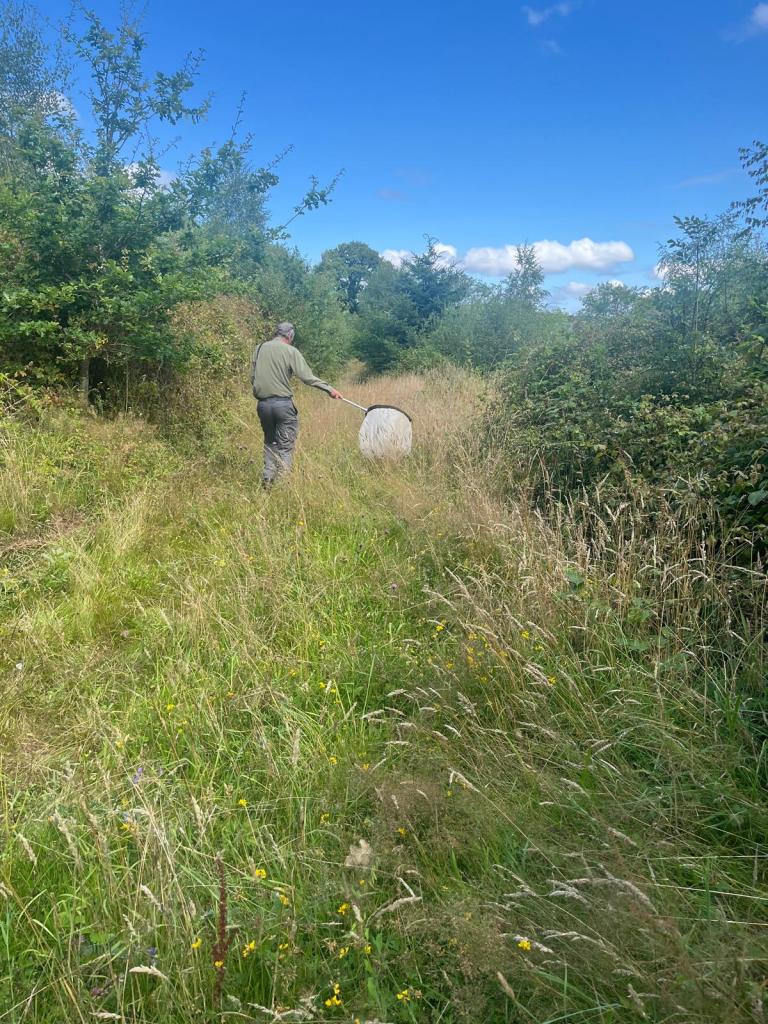
But now, let’s crouch down and look along the ground. Even just sitting there, the grass was crawling with life, from shieldbugs to caterpillars. We used sweeper nets, which you swish back and forth close to the ground so it picks up all the insects hidden in the grass, and an upturned umbrella as a substitute for a beat sheet, which you hold underneath a tree while you shake it so you can observe the insects that fall from the tree. We found some beautiful insects, my favourite of which was a Tortoise Bug, a kind of shieldbug so named for its back being patterned similarly to a tortoise’s shell! Another species which I enjoyed close up views of was the Long Winged Conehead, a type of Cricket so named for the angled shape of its head. There were several individuals enjoying the sun, which by now was getting really quite warm!

Long Winged Conehead
Sweeper Net in action!

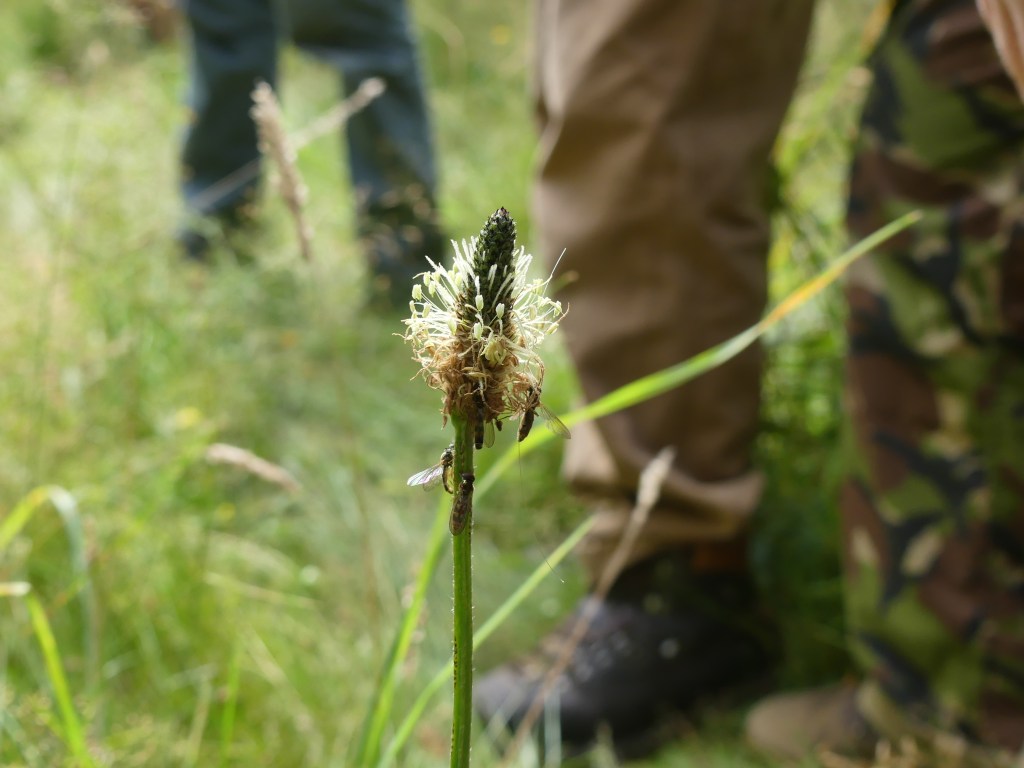
We even found a plant with several dead flies at the top. This was when John gave us a lesson on a fungus that infects these creatures, and takes over their nervous system, forcing them to climb to the top of a plant against the fly’s will. When the fly reaches its final destination, it assumes a position in which it’s abdomen faces upwards; ideal for spore dispersal and the targeting of the fungus’s next victims. The motive was revealed. You know, a zombie apocalypse might not be so far fetched if such shocking yet fascinating things are happening in the natural world, right under our noses. But, to be honest, I wouldn’t have even noticed if it wasn’t for John and his generosity in sharing his expansive knowledge!

Zombies!

It was an incredible session, which despite only being a couple of hours long, afforded incredible views of just a fraction of the UK’s 24,000 (and then some) insect species, as well as being a brilliant learning opportunity for somebody who is primarily a young birder! Huge thanks to John there. Some people have their misgivings with these creatures, but they really are phenomenal when you get to know them, or see them up-close for the first time. But whether you like it or not, we need them, and they (to a lesser extent) need us. However, they’re in trouble.
Me and John

The results of the Bugs Matter citizen science survey, where volunteers are asked to count the number of insect splats on a car’s number plate after a journey revealed a 63% decrease between 2021 and 2024, which is quite alarming. Let’s not forget that if we lose our insects, we lose the lifestyle that we have built across centuries, that is all centred around pollination. Without bees, hoverflies, butterflies, moths, beetles, wasps and others, how would we produce food? And without insects, the entire food chain could collapse, resulting in mass extinction and a planet full of problems for humanity. So please, don’t say they’re disgusting. Don’t kill them without a second thought. Lot’s of common human practises, like pesticides, are doing that well enough already. Spare them a thought, and also a thought for what could happen to humanity if they were finally wiped out.

On a more positive note, there are many organisations, charities and volunteers working to save the UK’s insects. Whether that’s habitat restoration, which I have had a hand in when out maintaining habitat for Marsh Fritillaries with the Dartmoor Youth Rangers, reducing the use of pesticides, conducting citizen science projects like the Big Butterfly Count or even just raising awareness, organisations such as Buglife, Butterfly Conservation, the Wildlife Trusts and others too are all making progress in pushing for an insect-filled tomorrow. After all, who wouldn’t want that?

Let’s hope they’ll still be here to photograph for many years to come

Osprey Exhilaration!
Last week, I was lucky enough to head out with the Birds of Poole Harbour Young Birders Group, on a trip in search of birds of prey. The main target species? It was, of course, the Osprey. Poole Harbour is at the forefront of Osprey reintroduction to the south of England, and here at Carey’s Secret Garden was one of two pairs currently nesting, following their extinction in the country in 1847. I was bubbling with anticipation to see these incredible fish-eating raptors, but also to learn more about their story here in the area.

Birds of Poole Harbour is a charity whose main aim is to raise the profile of and increase accessibility to conservation, preservation and observation of birds in the Poole Harbour area. The Harbour itself is a RAMSAR site (a wetland area of international importance designated under the RAMSAR Convention on Wetlands) and hosts internationally important numbers of many bird species such as Black Tailed Godwits and Avocets, so the study and monitoring of it’s avian residents is crucial to conservation efforts. And by connecting the surrounding locals and tourists with the harbour’s special qualities, they are ensuring a bright future for the site.

The Harbour is now famous for it’s Osprey reintroduction efforts, 109 years on from the last original breeding pair in the UK nesting at Loch Lyne, Scotland, in 1916. Despite being the second most widespread bird of prey in the world after the peregrine falcon, they were persecuted by farmers, egg collectors and gamekeepers, leading to their extinction. Fortunately, a pair of Ospreys of Scandinavian origin set up camp at Loch Garten in 1954. Thanks to nest protection and public engagement by projects like Operation Osprey, led by George Waterson, then Director of RSPB Scotland, the population began to slowly increase.

By the 1990s, there were over 60 pairs in Scotland, with the population having overcome barriers such as egg-collecting and DDT (a widely-used chemical banned in 1972), as well as young ospreys having a tendency to return to the same place where they fledged year upon year. This is known as nest site fidelity, and it also hampered the spread of the birds. Frustratingly, this meant there were still no Ospreys in England, 40 years on from that first pair nesting at Loch Garten. And so began a huge translocation project at Rutland Water in the East Midlands. With the support of Roy Dennis, the project began in 1996, and 5 years later, breeding Osprey returned to England, with a pair at Rutland and another in the Lake District. As of 2023. 250 chicks had fledged from Rutland Water, making this a true conservation success story.

But what of Poole Harbour? Well, in 2017 Birds of Poole Harbour joined forces with the Roy Dennis Wildlife Foundation to translocate up to 60 Scottish chicks to the area. Since 2017, the flagship Osprey individual has been CJ7, who was hatched at Rutland Water in 2015. She was attracted to the site by the young birds released through the project, and in 2019 bonded well with young male LS7. Breeding looked almost certain for the next Spring, but LS7 didn’t return to the Harbour the following year. Step up 022, another young male from the translocation project who arrived back in the Harbour in 2021. Him and CJ7 bonded, and in Spring 2022 they fledged two young, one of whom was predated by a Goshawk. The other, however, safely left on migration, and since then the pair has bred every year, rearing three young in 2023, four in 2024 and another four this year, in 2025. Just to put into perspective how rare it is to rear four chicks two years in a row, there is around a 1% chance of an Osprey having one brood of four!

Anyway, back to the trip! We arrived at Carey’s Secret Garden, a beautiful spot complete with a walled garden, a disused Goshawk nest and several large chunks of the Berlin Wall purchased at an auction. The seven full sized fragments make up an exhibit designed to highlight the contrast between itself and the peace inside the walled garden. Essentially, it highlights the contrast between walls that divide and walls that unite. Anyway, there was also a viewing platform looking out over an active Osprey nest! The Young Birders Group met in the walled garden, under the expert leadership of Mya Bambrick, an events assistant for Birds of Poole Harbour, and a young naturalist that I had admired and been inspired by for several years via social media. After a quick introduction, we headed off through the woods towards the Osprey Viewpoint.

What a juxtaposition against the natural world

I could hardly contain my awe as I spotted the Osprey nesting platform, around half a kilometre (by my likely incorrect estimate) from where we stood upon the viewing platform. Between us lay a meadow teeming with butterflies and a woodland edge teeming with Spotted Flycatchers. It was an incredible view, and I thoroughly enjoyed watching the small flycatchers flit from branch to branch. But absolutely nothing could have prepared me for the jaw-dropping performance the Ospreys put on for us.

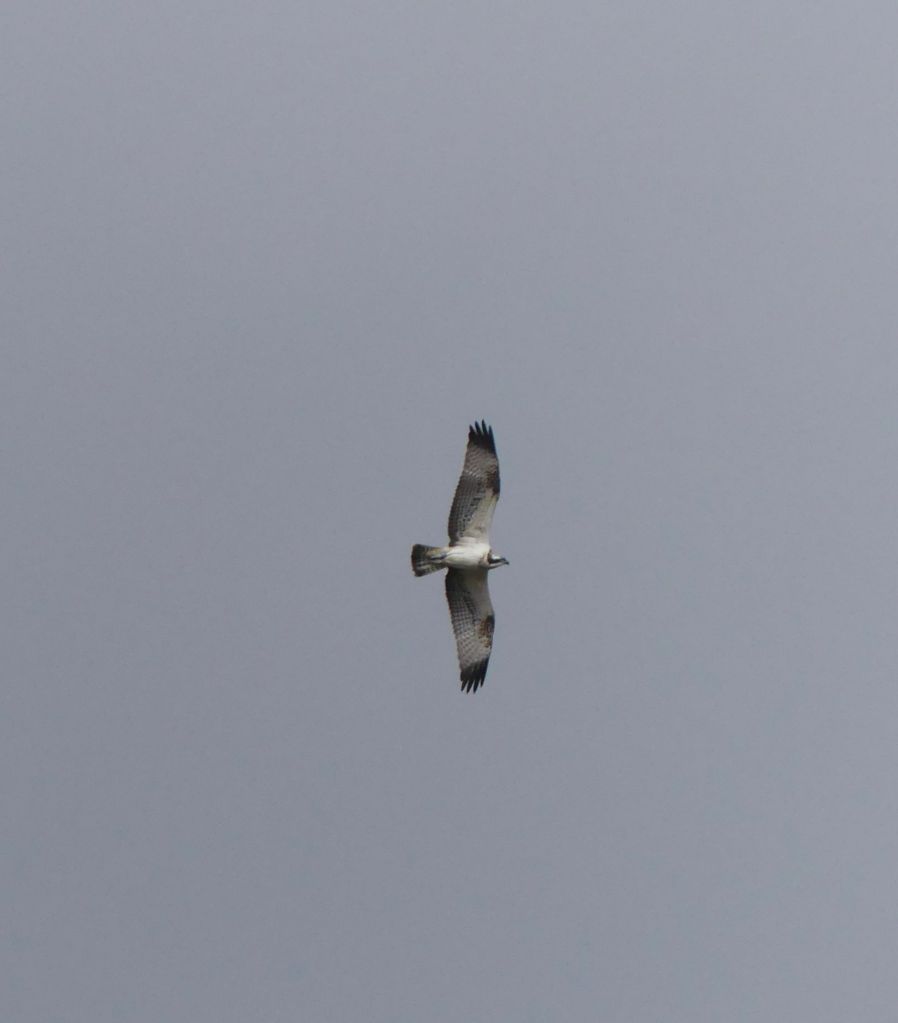
It began with this year’s recently fledged young flying right over the viewpoint, soaring against the pale grey cloud. They had browner backs compared to their parents, and were practising spreading their wings in flight before their looming migration. Then, in swooped CJ7, carrying a decapitated fish in her talons and depositing it on the nest. The four youngsters, 5R5, 5R3. 5R4 and 5R6 all immediately went crazy, and streaked towards the nest, hoping for a fishy prize. And when all the commotion finally calmed down, 022, hidden beneath the canopy, began alarm calling, clearly agitated by something. Could it have been a menacing Goshawk? Sadly, we never got to find out thanks to our session ending far too early for my liking. I would have stayed there all day if I could have! If you want to see these majestic birds for yourself, check out the Osprey webcam here. Highly recommended!

It took me a while to catch my breath on the way back, still replaying the aerial acrobatics of the young Ospreys in my mind. I worried for them as well, and hoped that 022’s sudden alarm wasn’t for something too serious. But no matter what, nothing will ever take away the exhilaration and sheer joy I felt at seeing these majestic, piebald birds alive and kicking once again in the South of England.

This Osprey project is a great example of an ongoing success story, but there are pros and cons to reintroductions. For example, the ongoing Capercaillie reintroduction project in France has met lots of challenges from even conservation groups and organisations, because the issues that led to their disappearance have not been solved. Problems such as high levels of predation, rising temperatures, altered weather patterns and increased tourist activity have even led to a court case against the project. So reintroduction, to work properly, has to be in the perfect habitat, with measures in place to control predators and human disturbance. However, the Poole Harbour Osprey Project is an example of a perfect reintroduction, as is being shown with the success of it so far, in only a few years. I just hope that the Osprey recolonises Devon fairly sharpish!

Otter Estuary Nature Reserve

Last week our family met up with some friends at the River Otter Estuary Nature Reserve, in Budleigh Salterton, a town on the coast in South East Devon. The reserve was at the mouth of the river, and the plan was to walk around the reserve and then onto the beach, but I of course had other plans. Birding plans. Even from the viewpoint at the car park, I could tell this morning had a lot of avian potential. Who knew what lay waiting for us on the mudflats? So despite the heat and the muggy air, I was enthused.

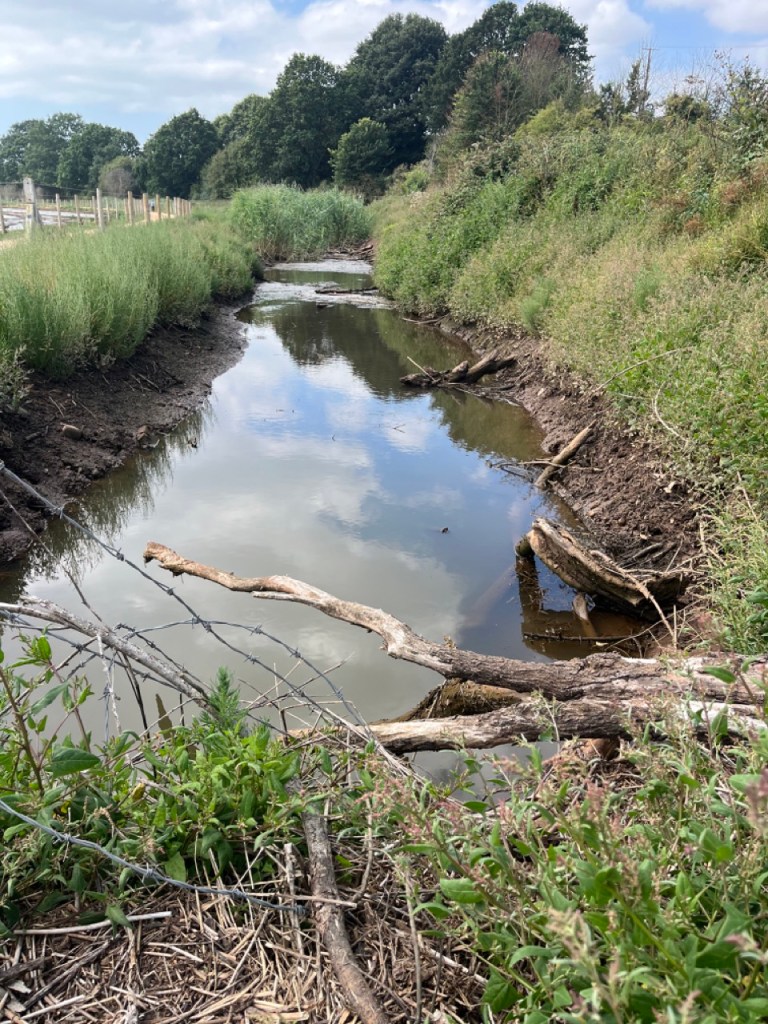
One of the channels along the path

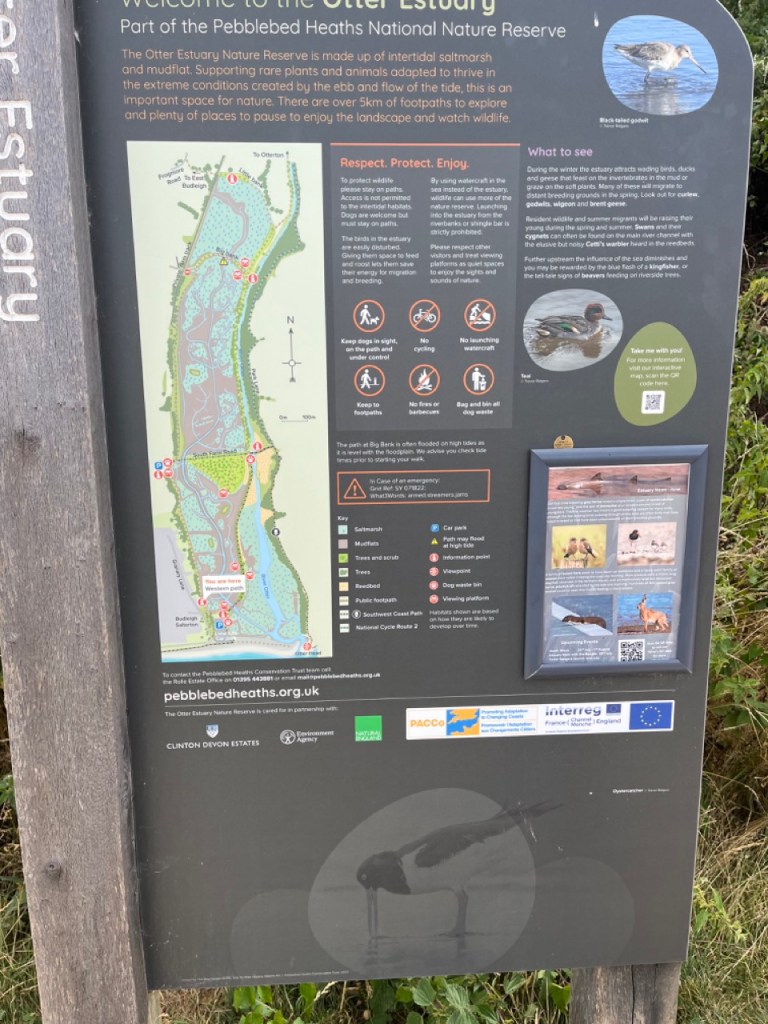
The Otter Estuary is managed by the Pebblebed Heaths Conservation Trust, with its diverse saltmarsh and intertidal mudflats well looked after within the Special Site of Scientific Interest (SSSI). With 120 (and counting) bird species having been spotted here, its a birding haven. But the River Otter is also home to England’s only wild breeding population of Beavers, with signs of them all over the River Otter Estuary Nature Reserve. But the site wasn’t always as perfect as it is now…

The Lower Otter Restoration Project began in 2021, aiming to restore the crucial habitat of the estuary and increase it’s adaptability in the face of Climate Change by breaching 70m of tidal embankment and reconnecting the estuary to its floodplain. It was highly successful, and ended up restoring 55 hectares of wetland habitat. The project also built a flood resistant raised road and bridge, all part of a collaborative effort led by Clinton Devon Estates and the Environment Agency. It was completed in 2023, with the opening of the River Otter Nature Reserve and the 70m Elizabeth footbridge to go with it.

The Otter Estuary Nature Reserve

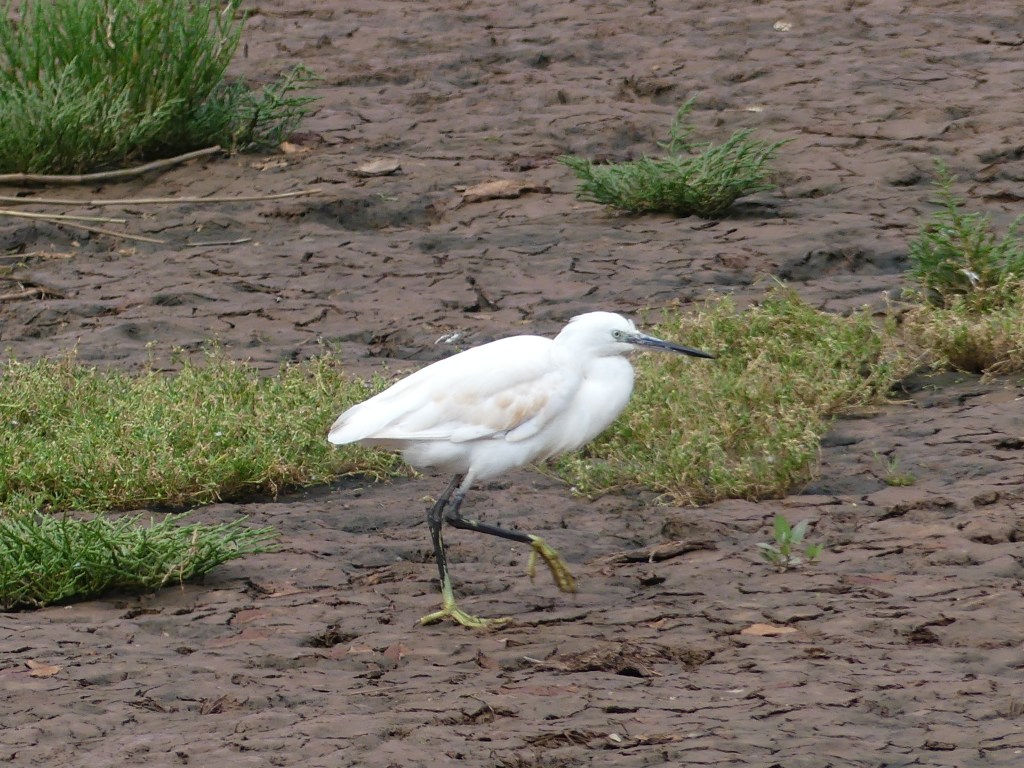
While you’ve been learning about the history of the site, I’ve been off birding. That day, we managed a highly respectable tally of 44 bird species, including some memorable encounters. These included the first pair of Egyptian Geese I have ever seen in my home county, Devon. Despite their name, they are not actually geese, but rather a type of Shelduck. And speaking of Shelducks, there were plenty of the Common sort around, including several pairs with young juvenile birds following them around. There were several Herring and Lesser Black Backed Gulls feasting on crabs, and one adventurous Little Egret flew off with a frog in its bill. But within one particular group of Dunlin there was a rather special wader… and it was quite little.

Little Egret

It was around 2/3 of the length of its Dunlin counterparts, with a shorter bill. It had a white underside, but unlike the Dunlin its head, breast and upperparts all carried a faded, rufous-red colour. My heart leapt inside of me, as I glimpsed the Little Stint once more before it flew off in rapid flight with the Dunlins. I couldn’t believe it. Little Stints are a scarce passage migrant, stopping off in Britain during Autumn on their way towards their overwintering grounds in Africa and Southern Europe, following their spending the breeding season in the Arctic. They’re more often seen on Autumn passage than in Spring, but nevertheless you still have to get lucky to find one. I speculate whether or not it might have been a failed breeder, having left the Arctic early. But no matter what its origins, it had been a dream of mine to find such a bird for so long.

While I attempt to relocate the Stint, let me tell you about the Beavers I mentioned earlier. The River Otter is currently the only River in England with a breeding population of beavers, thanks to the River Otter Beaver Trial. It ran from 2015 to 2020, culminating in the Government announcing they could stay, breed and spread. Now there are over 25 beaver territories along the river, creating diverse wetland habitats, reducing flood risk and improving water quality. Oh, and I didn’t manage to find the Stint again.

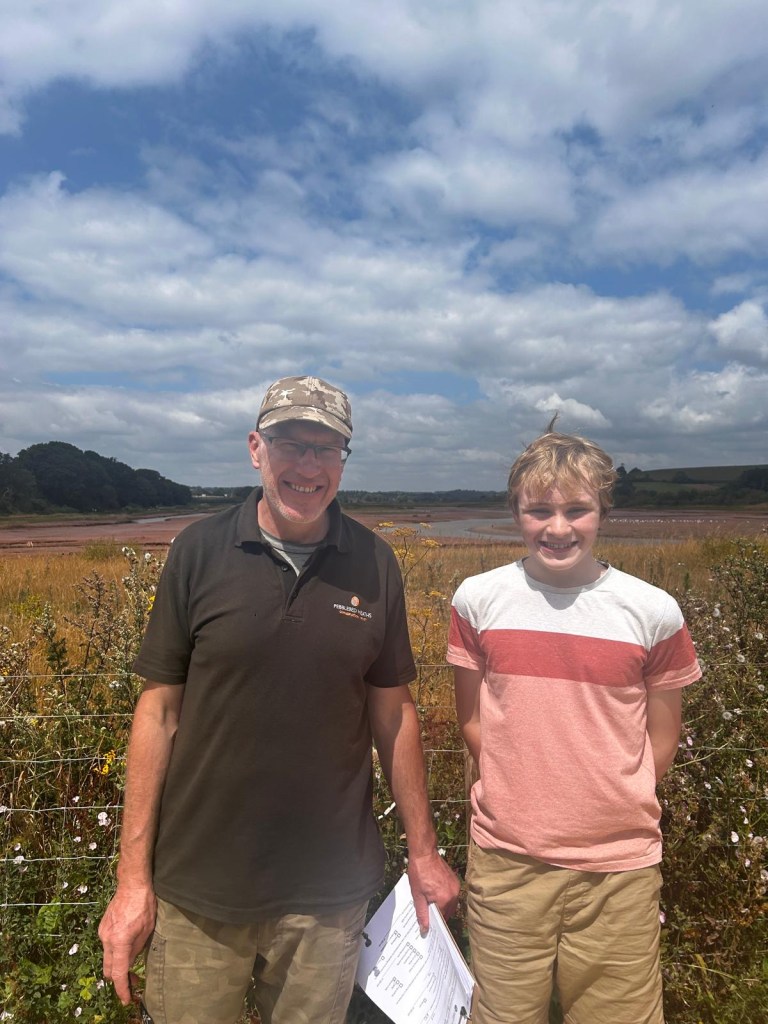
On our way around, we were also lucky enough to meet Otter Estuary Ranger Rick Lockwood, who was conducting a visitor survey with Pebblebed Heaths Conservation Trust, Clinton Devon Estates and the Environment Agency. Of course, we ended up talking about birds, and it turned out Rick was a keen birder too. After the survey, I told him about the Little Stint, and naturally, he was quite excited. And as soon as he finished up, he told us that he would be off to go and see if he could find it. It was great to talk to him about birds, his career path and the Trust. His first ever job was safeguarding a Little Tern colony in Northumberland! How amazing is that?

Me and Rick

it was an enjoyable morning, and I learnt even more than I already knew about the Lower Otter Restoration Project and its background, from both Rick and the informative, interactive signage around the reserve. And, come on. 44 species at one site within two and a half hours is pretty good. It just goes to show the amazing range of biodiversity at the estuary, and highlights the incredible work of everybody who was involved in the Lower Otter Restoration Project.

The Barn Owl Trust

The Dartmoor Youth Rangers is a scheme run by the National Park that aims to engage young people, and get them actively involved in conservation activity. I have been lucky enough to be part of the group for over a year now, and we have worked on various tasks and projects across the moor, from peat bog restoration to invasive species control. However, we went on a bit of a different trip on Sunday, and paid a visit to the Barn Owl Trust, a conservation organisation and charity based near Ashburton, on the southern edge of Dartmoor.

The Barn Owl Trust is, as you can probably guess from the name, a charity dedicated to the conservation of Barn Owls, their prey and their habitats. They do this in various ways, such as managing land specifically for them (open fields, with a lot of tall grass), educating people and raising awareness, rehabilitating and releasing injured birds back into the wild and putting up nestboxes for the birds to use. They also play a major part in educating the construction industry in nature friendly practices, and train people in surveying sites for the presence of Barn Owls. The Trust was founded in 1988, and has come a long way since then, now running their own small sanctuary for owls that cannot be released back into the wild and their own reserve, known as the Lennon Legacy Project.

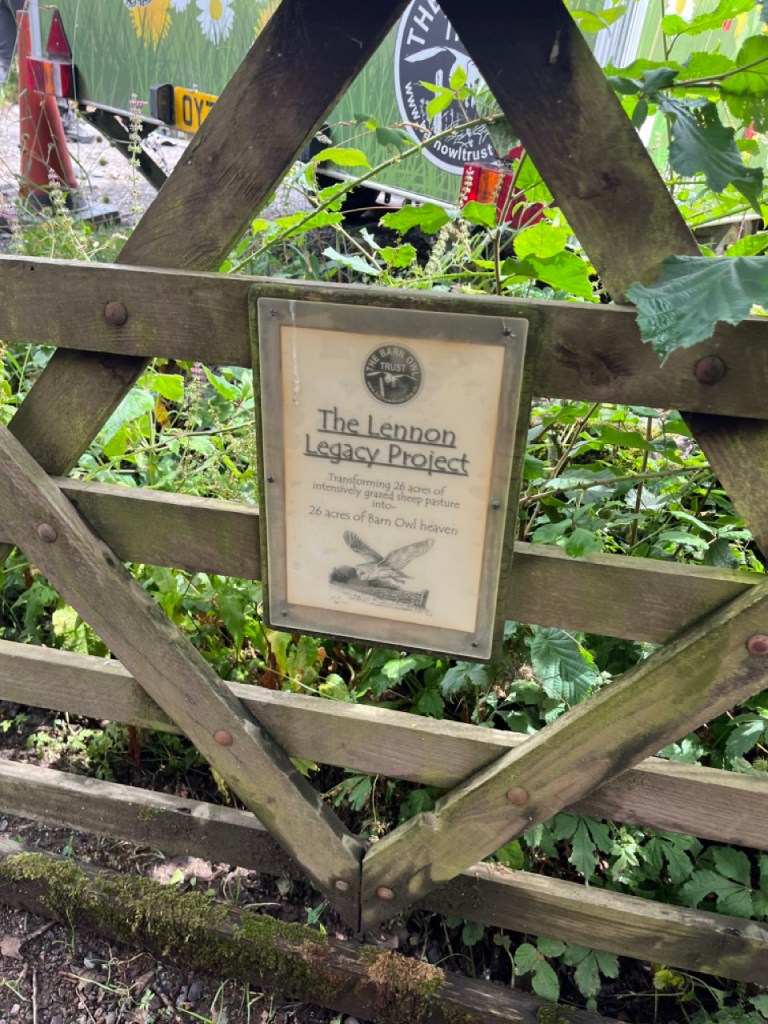
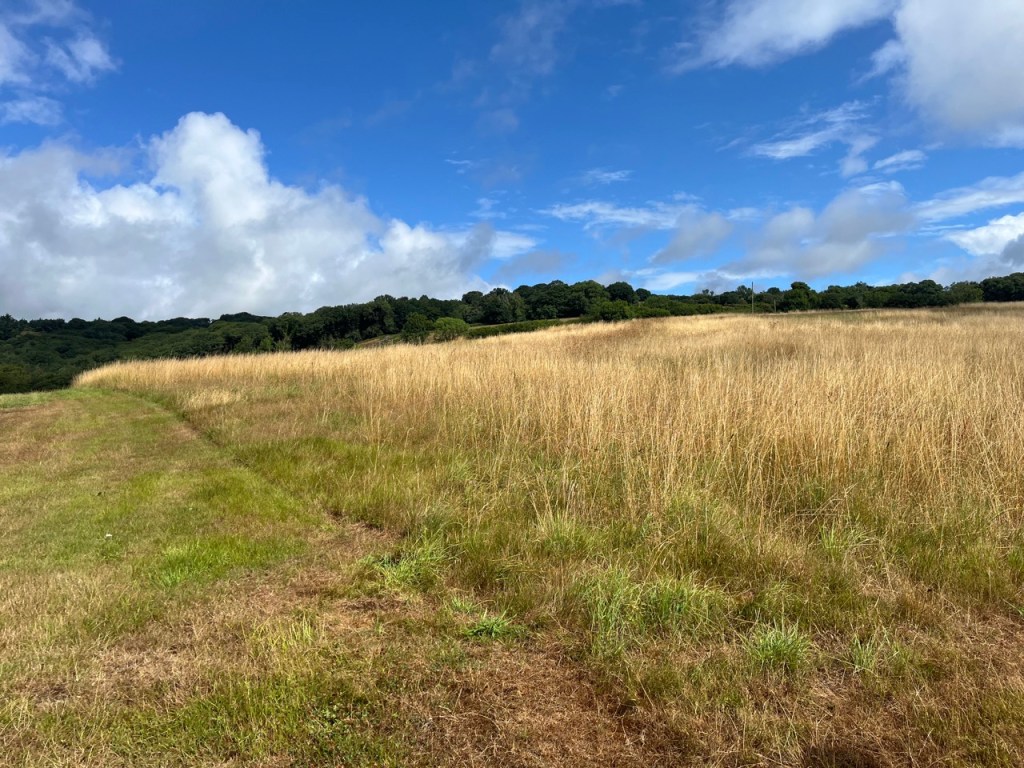
The Lennon Legacy Project is a reserve managed by the Barn Owl Trust that covers 26 acres, with large parts of it managed specifically for the Barn Owl. In order to increase Barn Owl numbers, you need field voles. And a lot of them. So by managing land for field voles, you are also managing it for the owls. But by managing land for the field voles, you are also managing land for so many other species, from insects to the flock of Linnets that was enjoying the seed crop from that year. But its not just grassland. They have wildflower meadows, an orchard, several ponds and even a strip of woodland. The Barn Owl Trust’s reserve is one of the most biodiverse places I have ever had the pleasure to visit, and on such a small site as well. Also, it’s not generally open to the public, so we were very lucky to be able to experience it!

The Lennon Legacy Project

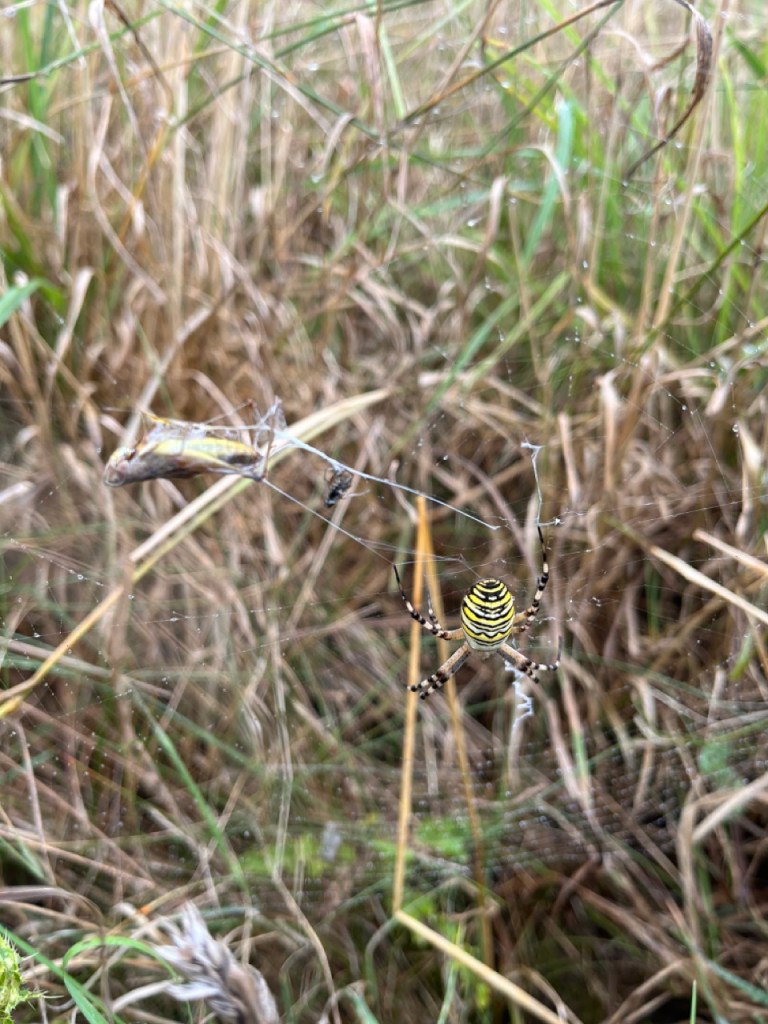
But we weren’t just there for fun. As the Youth Rangers, we were also there to work. Luckily, part of that work was surveying one of their fields for insects, plants, birds and any other species we could find. Armed with sweeper nests and bug pots, we set to work trawling through the long grass, as the plentiful grasshoppers and crickets hopped out ahead of us. It proved to be an amazing half hour, with some of the best finds including a stunning Six Spot Burnet Moth, a Cabbage Bug and lots of Wasp Spiders. But one of these striking arachnids treated us to a special bit of cinema.

We watched as a grasshopper, caught completely unawares, leapt straight into the orb shaped web. The spider, sensing the vibrations in her silk, immediately began to move towards its struggling victim. Taking the grasshopper, who was kicking out wildly with its hind legs, the spider spun him around, enwrapping him in inescapably strong web. The spider, grimly sated with her work, took a step back and became motionless in the centre of the web once more. She had given the grasshopper her dreaded bite, one in which a paralysing agent and a protein dissolving enzyme is injected into the insect and she seemed to have decided to save her snack for later.

Wasp Spider

I was snapped back to reality as the spider became motionless once more, and I realised that we were now off bracken bashing around the edges of the field. Bracken is a dominant species, one that is fast-growing and blocks light to the ground underneath it, preventing biodiversity and forming a monoculture when allowed to grow without restriction. Of course, one of the main aims of the reserve was to increase biodiversity, so the bracken was a problem. And to prevent the use of pesticides, the Barn Owl Trust regularly hosts bracken-bashing volunteer days. Today, we were the volunteers, and were tasked with clearing the bracken around the edges of the field. To prevent the bracken from growing anymore, we were given broom handles to hit the plants with. The aim was to bruise them low down on the stem, so that the plants flopped and hung limply on their side. This weakens the rhizomes, the creeping underground stems that store nutrients and allow the plant to regenerate after damage. Destroy these, and the plant can’t repair itself.

While I take out some frustration on the bracken, why don’t I tell you a little bit about Barn Owls? They are one of 5 British species of Owl, and were once very common on farmland and open countryside across the country. But they have declined significantly since the 20th century, and their population is at a vulnerable stage. Their decline was due to a number of factors, one of the main ones being the use of rodenticide left in bait for rats on farms. Funnily enough, if there is food left on the ground, the rats aren’t going to be the only ones gunning for it. The Barn Owl’s main source of prey, Field Voles, along with other small mammals, are also going to go for it. Small mammals make up 90-95% of a Barn Owl’s diet, and when an Owl ingests a creature packed to the skin with poison potentially potent enough to kill a human, what chance are they going to have? This is known as secondary poisoning, and it’s still a significant factor in UK raptor declines today.

On a more positive note, Barn Owls are an evolutionary marvel thanks to their adaptations for silent flight. There are several reasons they are able to do this, and most of them lie in the design of their feathers. The leading edges of the Barn Owl’s wings are lined with special feathers that have a serrated, comb-like structure. The serrations break up airflow into smaller, more stable streams, creating what are known as micro-turbulences, which are less disruptive and quieter than normal air flow. The trailing edges of the wings are fringed, which further reduces noise as air flows off the wing. And then there are the owl’s velvety down, covering their wings and legs and acting as an absorber of high frequency sounds and friction between feathers. These three adaptations are all immensely important to the Barn Owl’s silent flight, but it also does a much simpler thing. It flaps its wings less, and when it does the wingbeats are slow and measured.

Now I’m back from bashing bracken, let’s talk about the rough grasslands maintained around the reserve that are perfect for the Barn Owls. They have the landscape regularly grazed by cattle, in order to promote biodiversity and prevent the field from becoming scrub. The grazing is done at a low density, meaning that only a small amount of cattle are allowed onto the reserve, but recently an interesting trend has appeared that means there might need to be a slight tweak to the strategy. Even standing at the gate, you can see that there is a lot of False Oat Grass in the field, more of it than any other type of grass. And this is because of its higher silica content than other species. It grinds the cattle’s teeth down quicker, so they tend to leave it until last when grazing. And if they don’t get around to it, it stays there. So the Trust is currently working on a strategy to control the high amount of False Oat Grass, as since the reserve’s main aim is to increase biodiversity across that 26 acres, a single species of grass dominating a field is not really helping towards that goal. The perfect mix is, according to Defra, over 15 plant species per square meter, which seems reasonable to achieve a lot of biodiversity goals.

Rough grassland

Moving away from the grassland, the reserve also contains an orchard. In the orchard, the Trust have been experimenting with two methods of laying hedges, to see which supports a greater number of species. The traditional Devon way of laying a hedge is to do it on top of a bank, made of earth. The trees are generally planted in rows of two along the bank, and eventually they entwine thanks to their close proximity. But they’ve also tried the South of England way, where the hedge is cut and laid over to create a ‘double brush’ on both sides, which is then intertwined with hazel. I can’t wait to see the results in the future as the hedges mature, and I’d love to go back and survey them in a few years to find the differences between the two types of hedge. Hedges are such an overlooked part of the British landscape, but they are actually vibrant ecosystems in themselves. However, I never knew that there were different types of hedge, and this knowledge adds to my perspective as a young conservationist and naturalist.

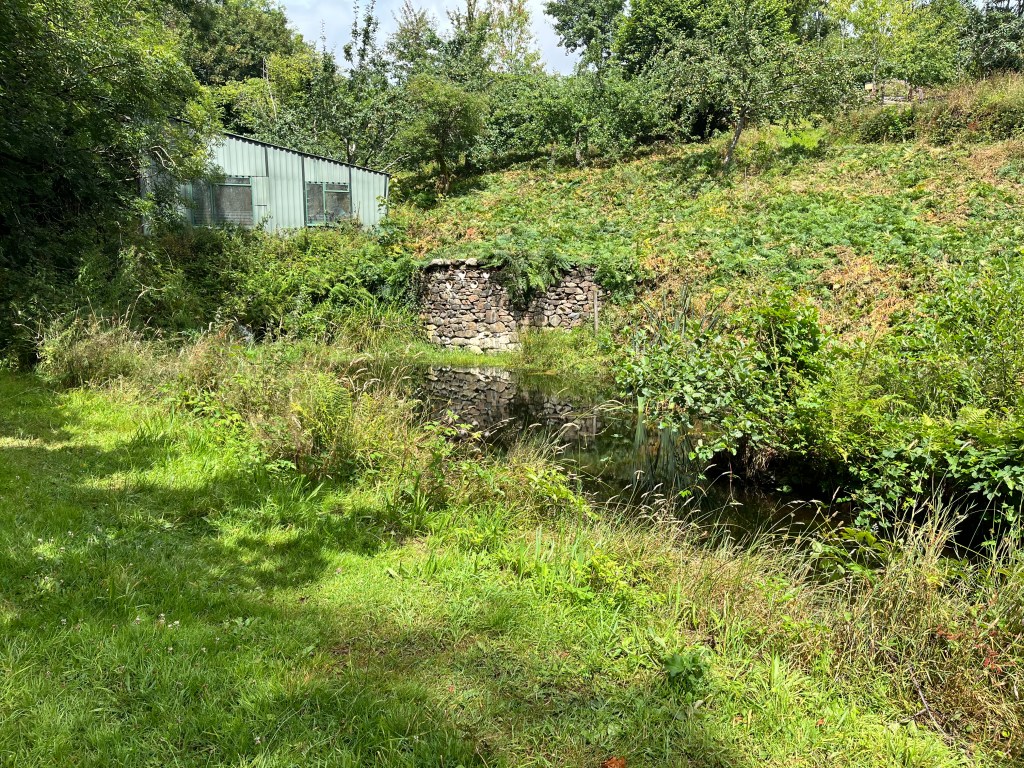
Further down from the fruit trees of the orchard lie the ponds, full of everything from frogs and newts to the occasional group of minnow. These fish attract Otters, which are regularly sighted visiting the pond and preying on the fish. There are also regular Kingfishers and Grey Herons, and even Roe Deer popping down for a drink. The ponds are fed by abstraction pipes leading from the River Ashburn, which keeps the water levels right for the wide variety of species using the ponds.

Ponds

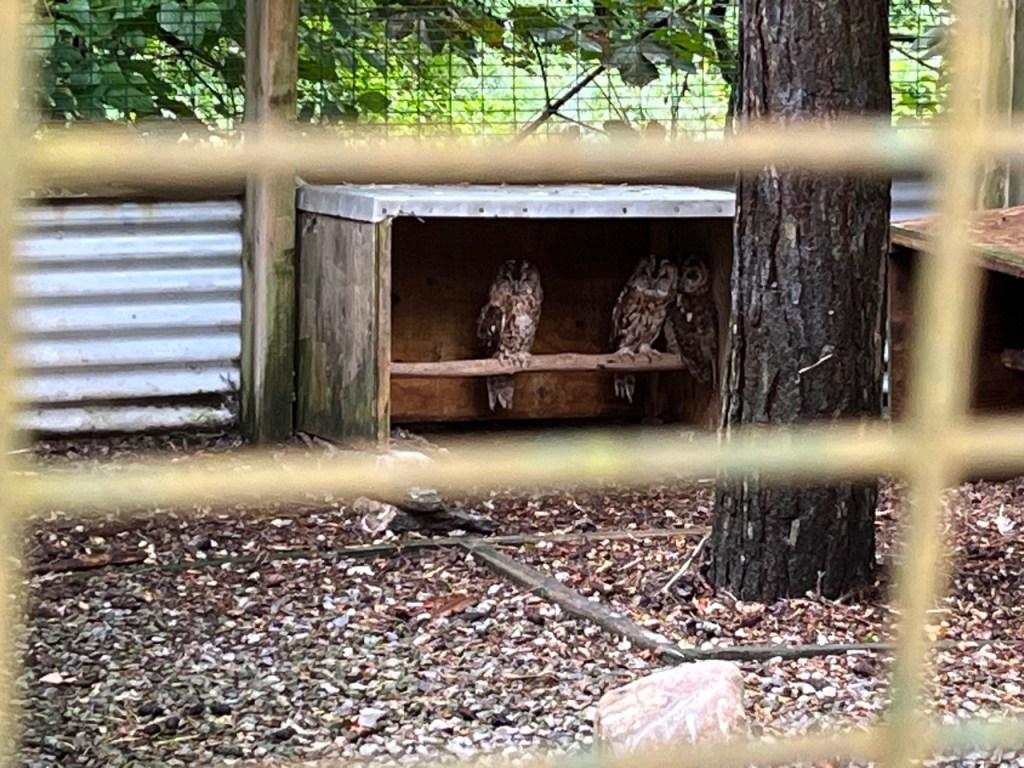
And I can’t write a blog about the Barn Owl Trust without talking about their owl sanctuary, in which they keep the owls who can’t be released back into the wild. There are not only Barn Owls in here, but also several Tawny Owls, who all enjoy a quiet life and a diet of freshly killed chicken chicks. It was amazing to see these birds up close, when normally I’d be lucky just to catch a glimpse of one. They are truly majestic, whether cryptic, brown and wise like the Tawny Owl, or pale, powerful and endearing like the Barn Owl. Huge thanks to Harry and the Barn Owl Trust for such a great day!

Tawny Owls in the Sanctuary

The Barn Owl Trust do incredible important work, whether that be campaigning for raised awareness about the birds or rehabilitating injured birds and releasing them back into the wild. It was really interesting to get an insight into their behind the scenes work, and I learned a lot from the wealth of knowledge possessed by Harry, who led the bug survey and took us on a tour of the Lennon Legacy Project reserve. As I said earlier, its not usually open to the public, so it was a privilege to be able to experience the place!

A Sunny Sunday at Birdfair

On Sunday, about two weeks ago, we returned to Global Birdfair, following an action-packed Saturday. We were in the heart of England’s smallest county, Rutland, on the south shore of the aptly named Rutland Water. The Global Birdfair is a celebration of all things nature, from birds to bugs and everything in between, but it also actively supports and fundraises for conservation efforts around these species. It’s a three day festival, with a packed schedule of walks, talks, workshops and entertainment, as well as hundreds of exhibitors. It’s a must-visit for any wildlife enthusiast, not just birders!

And, on the way to Lyndon Top Caravan Park (where Birdfair has been held since 2022), it must be said that I was really feeling the anticipation. I was excited for a day that could potentially top its predecessor, but there was also that ever-present sense of bittersweet, that all good things come to an end far too soon. Of course, this would be the last day of Birdfair, and despite looking forward to going home as well as the day ahead, there was definitely a twinge of sadness.

We spent the first part of the morning dashing from stand to stand, on a mission to complete the challenge devised by the Birdlife International team. We had been given a ‘Flyways Passport’, and we had to answer a question at the stand of each of Birdlife’s partners (those at the Birdfair), in order to collect a stamp. If you collected all the stamps, you were entitled to a free pin badge. The stands we had to visit were spread across three marquees, and we had to get around all of them fairly quickly. See if you can answer one of the questions we were asked; several birds migrate from England through to Spain in autumn, but there is one bird that migrates from Spain to England. What is it? I’ll post the answer at the end of the blog! Anyway, after cashing in our passports to collect our pin badges, we had to quickly run off for a walk with Luke Massey, Leica ambassador and one half of the incredible team running Wild Finca.

Luke Massey is a wildlife photographer and filmmaker, who recently embarked on the brilliant rewilding project known as Wild Finca alongside his wife, Katie and their two children out in Asturias, Spain. He and his family, since 2018, have been managing 10 hectares of pastureland, wildflower meadows, scrub, woodland and ancient orchard for both nature and the family’s self-sufficiency. But the site wasn’t always like this. It began as a dairy farm, nothing but overgrazed, monocultural pastureland. But now it’s a vibrant mosaic of biodiversity, home to hundreds of species. It just goes to show that both humans and nature can thrive easily alongside each other, if we allow nature the space to do so.

The walk through the grassland along the south shore of Rutland Water was fruitful, despite the unimaginable heat, with species such as Little Egret, Common Tern and Cormorant featuring prominently. The Whitethroats were also out in force, flitting between the sturdier stems and their highly concealed nests with insects to feed their young. A Green Woodpecker’s call betrayed its presence immediately, and we watched as it flew, undulating, over our heads. But the biggest surprise by far came as we were headed back, in the form of a Golden-Bloomed Longhorn Beetle hitching a ride on my back! These species, unlike most other Longhorn Beetles, lay their eggs in herbaceous plants such as hogweed.

We had another nature walk to look forward to later on, but for now we had a window of time to further explore the many stands exhibiting at the fair this year. We began by popping back to the Grant Arms stand, where we met Simon and Marion again and learned more about the recent fires that engulfed Dava Moor. According to landowners, the fires were the biggest Scotland has seen in its history, and with Simon and Marion both based in Grantown, a stone’s throw away from the moor, the effects were felt. The town was full of smoke, and anybody with an ATV was asked to help fight the fire. Though the full extent of the damage to local bird populations is not yet known, accurate guesses can be made. The fire hit at the exact time when birds were on the nest, eggs were being laid, chicks were being fed and fledglings were starting to come out. It’s heavy and saddening to think about, especially having been to Dava Moor when the breeding season was in full swing. But the quick reaction from everybody involved, whether that be the fire service or somebody living in Grantown with an ATV, was truly inspiring, and without that response, I dread to think about how much worse it could have been.

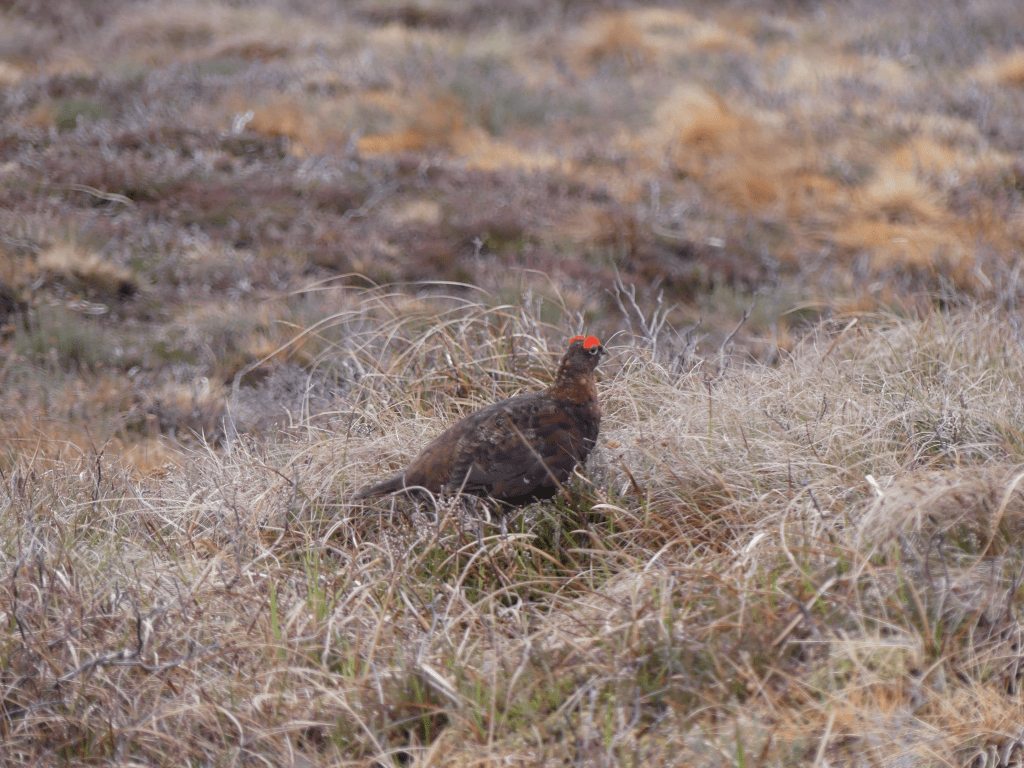
A Red Grouse on Dava Moor (from last year)

Marion told us to visit Chris Rose, an artist in the Puffin Marquee who was also based in Grantown. His paintings are absolutely incredible, probably the most realistic and stunning I’ve ever seen. And they’re all of birds, so that ticks another box in my book. Chris and his wife, Dogna, also told us about their experience of the fires, and how there was a wall of smoke that descended on Grantown. On a lighter note, he also told us about the process behind his paintings and about how many less people you see when out birding or even driving in Scotland.

We also paid a visit to the Curlew Action stand, where we met Mary Colwell, the director of the organisation, who is also a TV and radio presenter and a published author (Curlew Moon. Highly recommend a read). Curlew populations in the UK have experienced around a 50% decline since 1995. I should know better than most, as this enigmatic wader and its bubbling call were once common on Dartmoor. Now there are, at most, two pairs left, and I was lucky enough to see one of them at Emsworthy Mire last year. Curlew Action was founded in 2019, and aims to reverse this decline before its too late by raising awareness and coordinating conservation efforts such as headstarting. But the challenge remains a big one. If you want to read more into Curlew conservation on Dartmoor, check out my blog on it here.

One of Chris’s paintings

And now it was time for our fourth and final guided walk of the weekend, alongside two Leica ambassadors that we had met last year. Harry Read is a wildlife photographer, ecologist and tour guide who is currently based in Norfolk. He is an incredibly experienced birdwatcher despite still being in his 20s, and is always willing to share his wealth of knowledge.

Elle Kaye is an award-winning bird taxidermist, who was selected as the taxidermist for the Natural History Museum’s recent exhibition ‘Birds: Brilliant and Bizarre’ (read my blog on that one here). She is also a TV and radio presenter, as well as the co-leader of the Feminist Bird Club. She can also identify many feathers at a glance, as I learned last year when we found a Kestrel feather on a walk.

By the time we set off, it was starting to cool off a bit, and there were high expectations for species to emerge, looking to enjoy the break in the heat. Again, out on the water it was largely Little Egrets, Cormorants, Common Terns and Gulls, with the occasional Oystercatcher. The Whitethroats from earlier had been joined by a group of Linnets, and both were taking advantage of the insect buffet on offer. But the big difference here was a special butterfly. The Gatekeepers and Meadow Browns were still around, just like earlier. But on the head of one plant, basking in the sun, sat a beautifully monochrome butterfly, striking against the background of green. A Marbled White, one of Britain’s most striking butterflies. They are an incredible species to see, and they were actually a lot bigger in person than I had expected!

But sadly, soon after the sighting of that butterfly, the walk ended, and that was our last hurrah at Global Birdfair 2025. I just managed to catch Henry, who I’d met yesterday, on our way back towards the car, and we had a quick chat. He’s been in Wales, so do go and check out his Instagram, @naturetasticwh. Of course, I’m going to miss spending a whole days surrounded by those who share the same passion as me, many of them my age as well. I’m also going to miss the learning experiences that I had from all the talks, walks, quizzes and shows I went to across the weekend. But I’m also going to remember it all, and use it in my journey to becoming a conservationist and an ornithologist. Watch this space.

Answer: Balearic Shearwater

Global Birdfair Returns!

Last week, we travelled to Rutland, the smallest historic county in England, to visit Global Birdfair, the brilliant festival celebrating and raising money for birds, nature and conservation efforts across the globe. It has been held at Lyndon Top, on the south shore of Rutland Water since 2022. The large annual event brings together birders, wildlife enthusiasts and conservationists from around the world, culminating in an event that aims to raise awareness about conservation and climate change, and to raise money to aid these efforts. It is an experience in itself, and just being surrounded by people with that same passion for nature feels incredible.

Birdfair!

So, to give you a brief history of the fair, it was founded in 1989 by Tim Appleton MBE (who I was lucky enough to meet this year, more on that later), and it was run by the Leicestershire and Rutland Wildlife Trust on the Rutland Water Reserve for 30 years. Birdfair was known as a force for good by wildlife enthusiasts across the globe, thanks to its tireless fundraising efforts. From 1989 to 2018, it had raised over 5 million pounds. Indeed, in 2018 alone the fair raised £322,000 to support the creation of a flamingo haven on Mar Chiquita in Argentina. Birdfair continued to climb and reach new heights until the Covid-19 pandemic, when disaster struck.

In 2021, the Leicestershire and Rutland Wildlife Trust made the decision to end their association with the fair, citing the worsening climate crisis and the event’s carbon footprint as their reasons. But in 2022, Tim Appleton and Penny Robinson founded the Global Birdfair, moving from the actual Rutland Water reserve to a campsite on its south shore, called Lyndon Top. And since then the show has continued to evolve, reaching the prominent stage it is at today.

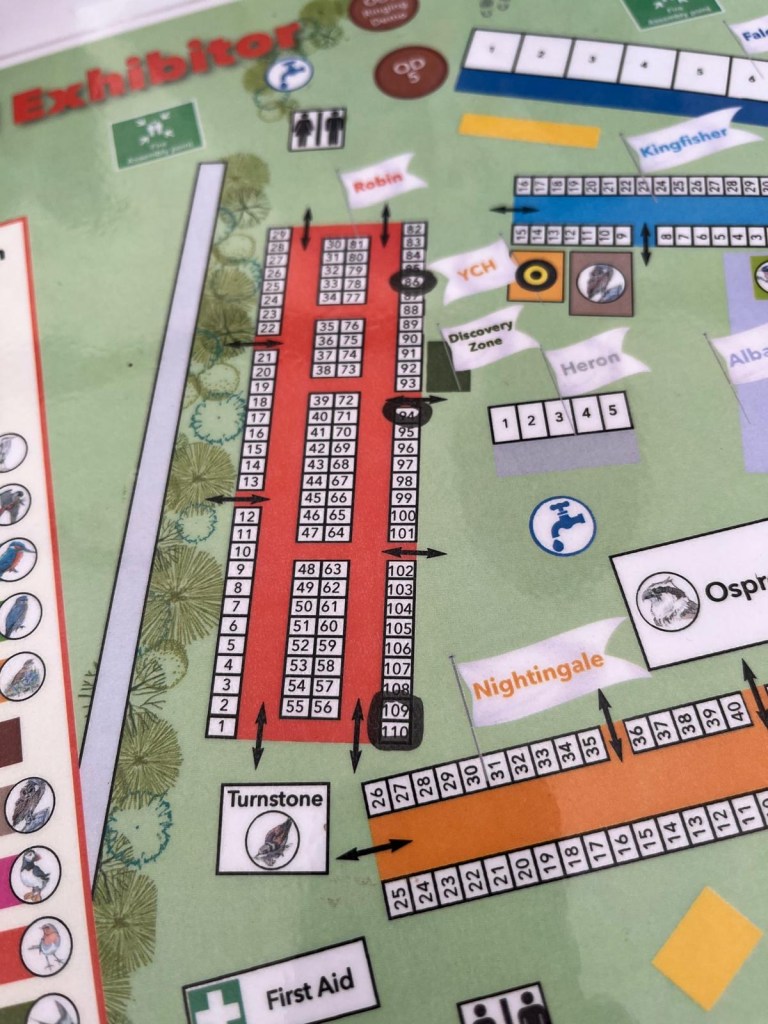
A map of the show

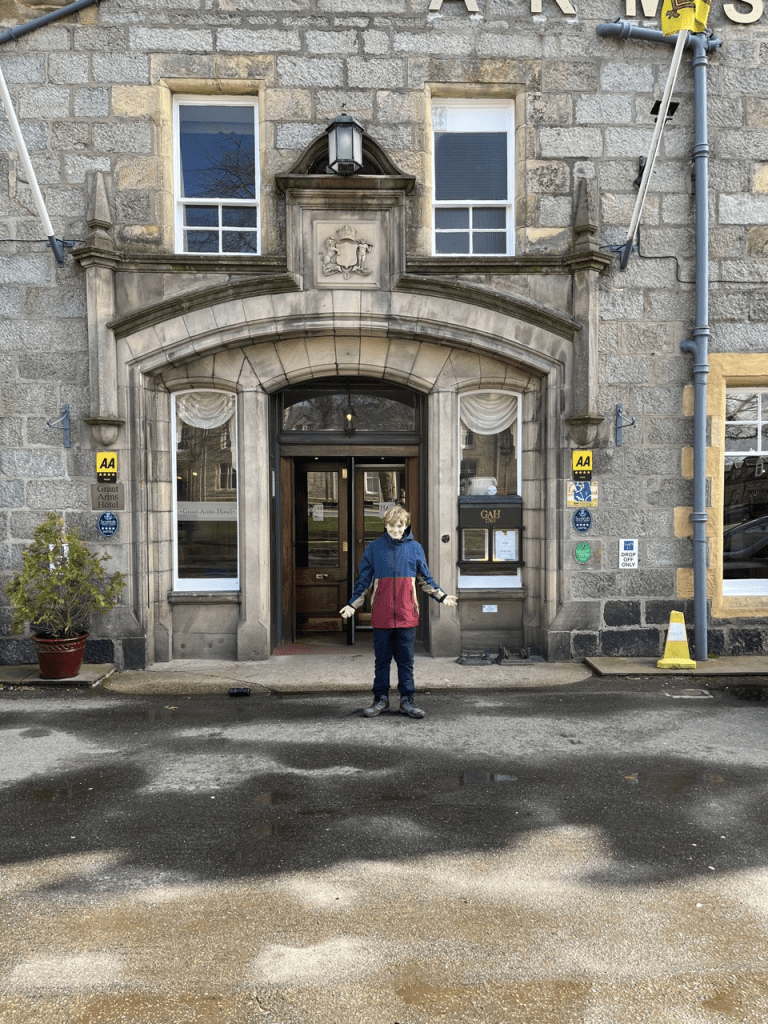
I’ve been at Birdfair for the last three years now, and since 2023 it has received glowing reports from me, my family and everybody I have spoke to there, which is a lot of people! The first time I visited was due to my winning the Zeiss Young Birders Award, which was presented to me at the Global Birdfair. That was a day that I still remember fondly, and shall for years to come. In fact, I still use my prize, a pair of Zeiss Terra binoculars, every time I go out birding. It was also thanks to Birdfair that I was fortunate enough to go birding in the Scottish Highlands, while based at the incredible birding hotel, the Grant Arms. If I hadn’t met Simon Pawsey at Birdfair 2023, I would never have had such a memorable, life changing trip alongside himself, Nick Baker, Will Hall, Iolo Williams and Dawn Balmer, to name a few. So I think its fair to say that Birdfair has played a big part in my life since that fateful 2023.

Me outside the Grant Arms Hotel

But thats enough about 2023, this blog is about 2025! We arrived at Lyndon Top at 9:23AM, strolling into the show-ground (after we’d had our tickets checked, of course) and taking it all in. The field we stood in heralded several Marquees, stages and smaller gazebos and tents, each named after a different bird species, from the Puffin Marquee to the Whinchat Podcasting Station. We began at the Nightingale Marquee, and literally as we walked in, we found the Grant Arms Hotel stand to our left. There were Simon and Marion, greeting us warmly and shaking hands.

Of course, I had met them for the first time at Birdfair 2023, and then again on my trip to Scotland. Simon, whom I hadn’t seen since Birdfair last year, immediately struck up a conversation and started telling me about the tale of a Nightjar he’d found. Nightjars are one of the Scottish Highlands’ rarest birds, with the last confirmed breeding record all the way back in the 1970s. Simon had been out driving in the night looking for the northern lights, when he saw a Nightjar literally just sat on the road in front of him. It quickly flew away, and a search ensued over the next few nights until two Nightjars, one of them likely the same bird Simon had originally reported, were found flying together, in good breeding habitat. Whether they bred remains to be seen, but it appears fairly likely that they might have done!

However, soon we had to say goodbye to Simon and Marion, and dash off towards the Zeiss stand, for a guided nature walk with the one and only Toby Carter. We had first met Toby last year, and as a Business Development Executive at Zeiss, he certainly knew what he was talking about. He regaled us with tales from his trip to Lesvos (now firmly at the top of my bucket list) as we walked along the south shore of Rutland Water, with Gatekeeper and Meadow Brown butterflies out in force around us. Whitethroats and Linnets flitted between the sturdier stems, carrying food back to their heavily concealed nests.

Due to the dry spring we’d had, there was a long, thin island visible out on the water, coated in Cormorants, gulls and Common Terns. According to Toby, who had grown up in the area and was an expert on the water, the island hadn’t been visible for ten years, and thanks to the very little rain we’d had this season, the water levels were at a record low. And it became obvious as you scanned the edges of the reservoir, the banks and beaches seemed surprisingly visible compared to the photos we’d taken last year and the year before.

Abruptly, deranged laughter blew in on the breeze, and the group turned to watch as a young Green Woodpecker, still with a speckled underside, flew along the hedgeline into the branches of a dead tree, posing at its crown. Toby quickly trained the scope upon it, and the whole group managed to admire it before it eventually dropped down and flew away, calling its ‘yaffle’ sound again as its undulating flight bobbed further away.

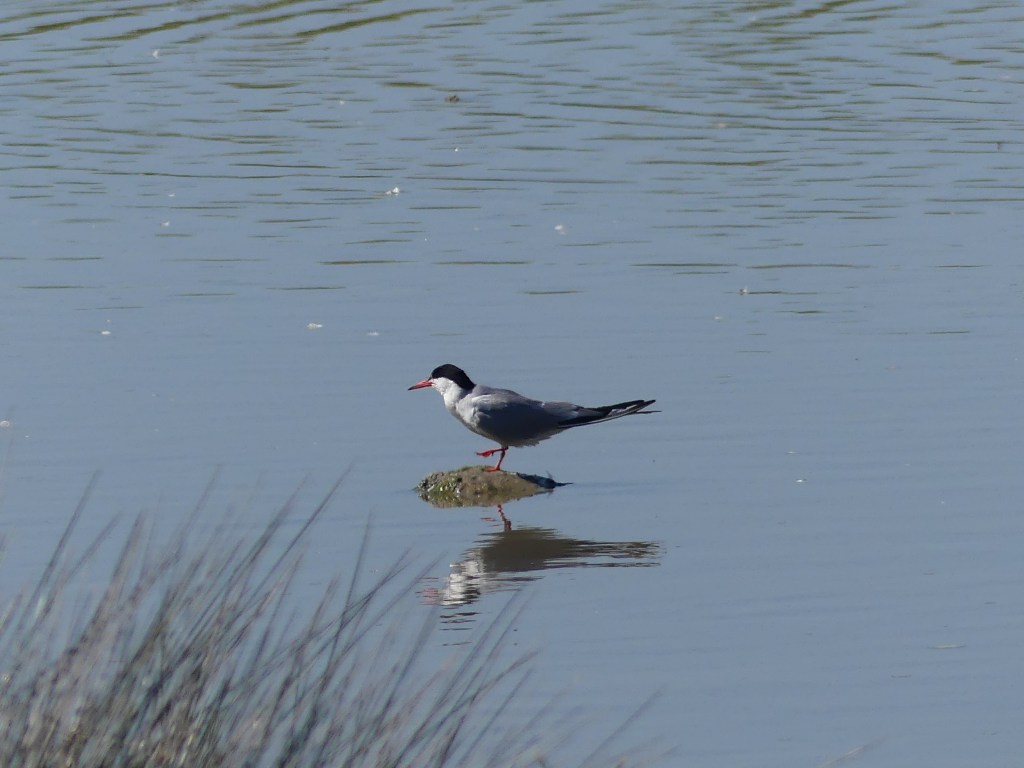
Common Tern

The heat that weekend was impenetrable, with highs of 33 degrees in Rutland. Thanks to this, there was little more about in the way of birdlife, except for several Little Egrets and distant swans. What was a surprise was a fly-by from the Red Arrows, zooming over Oakham with frightening speed and agility. And we were just on our way back, enjoying the numerous butterflies when we passed another group, just as a shout of ‘Osprey’ went through them.

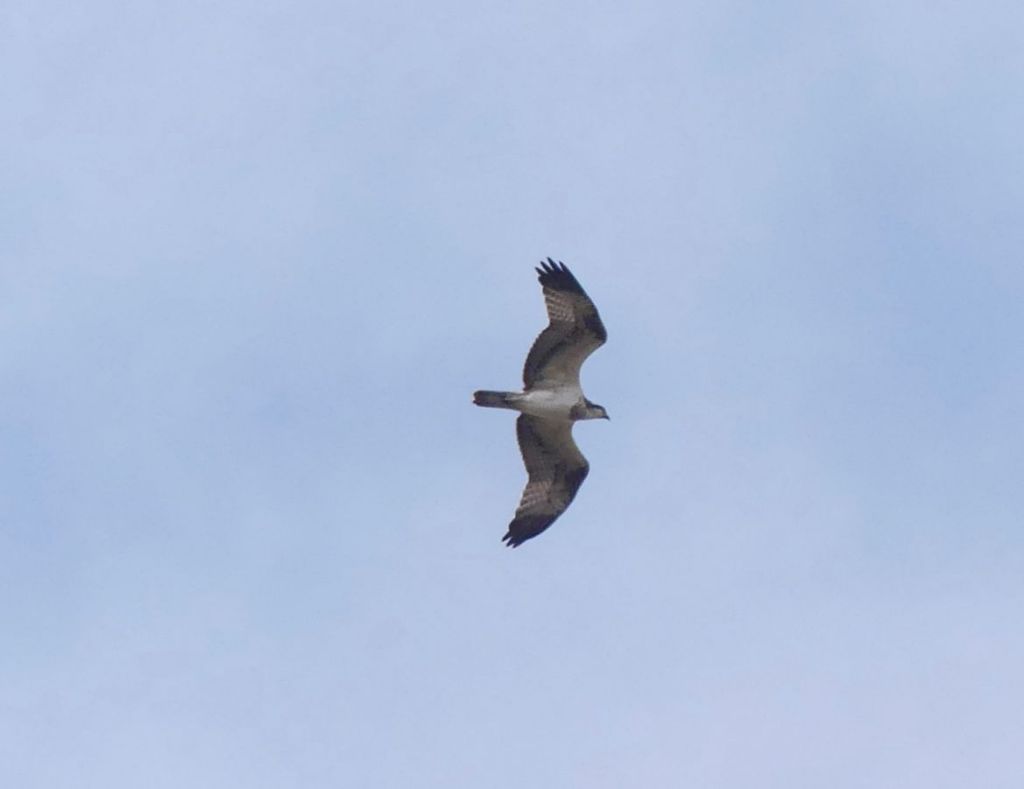
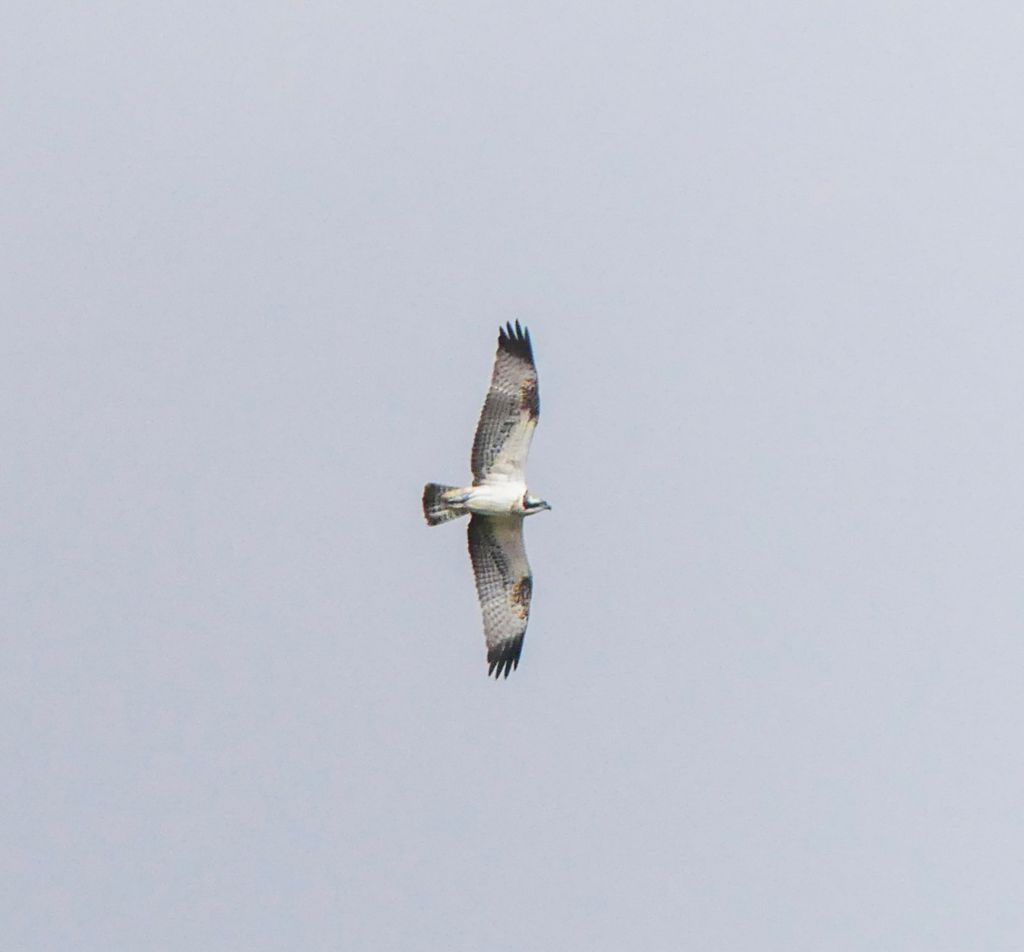
Ospreys are breathtaking raptors, specialised in hunting fish on the surface through their distinctive plunge-dive. Rutland Water is famous for these birds, having had a hugely successful reintroduction project beginning in 1996. Since 2001, over 250 chicks have fledged from the area, highlighting how well orchestrated the plan was. And now we were watching two Ospreys drift over Oakham, at quite a distance. But even here they were distinctive, with their m-shaped wings unlike any other UK raptors’.

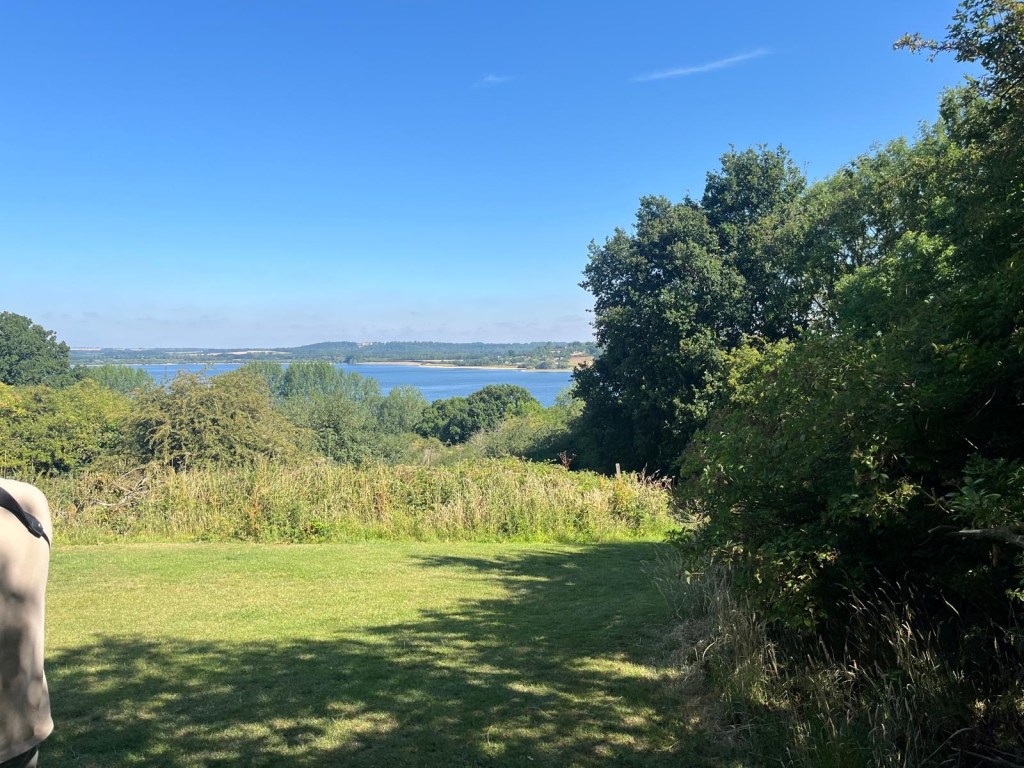
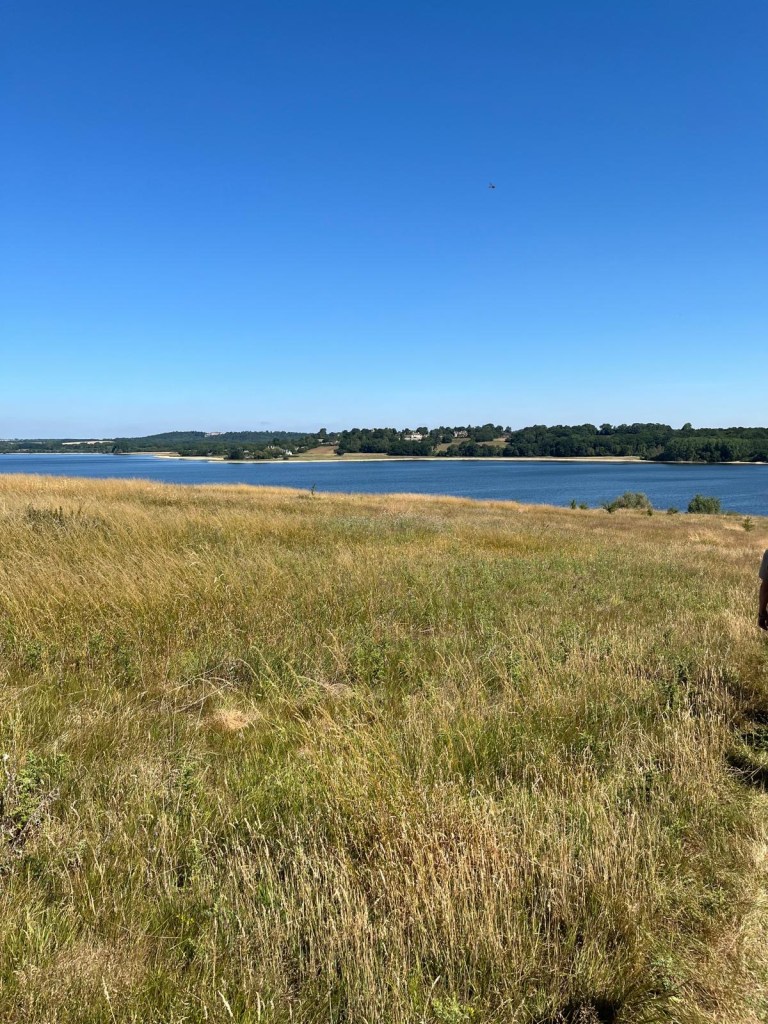
Rutland Water

Mind still reeling from the distant encounter, we headed back towards the Zeiss stand, where we received goody bags and said our farewells to Toby (to be fair though, we’d probably see him again before the fair was over). And at 12:00, I was lucky enough to meet up with three amazing young people before the other Zeiss nature walk we had planned that day with Nick Baker. One of them was Dexter, otherwise known as the Mustelid Man on Instagram, a mammal expert with deep knowledge and a friendly nature. Another was Henry, otherwise known as Naturetasticwh, also on Instagram. He was giving a talk on citizen science later on in the Osprey Leadership Foundation tent, and was also somebody I had been following on social media for a long time. And then there was Benji, a talented writer and artist who also knew a lot about nature. It was great to meet them, especially since I had been following their adventures on instagram for a long time!

It was a lot of fun exploring the Birdfair with them, as well as browsing the incredible array of RSPB pin badges on offer. But soon me and Dexter had to run off towards the Zeiss tent once again, gearing up for another nature walk, this time with famous naturalist, entomologist and TV presenter Nick Baker. I had met him for the first time when he presented my award in 2023, and it was great to be out with him again. It was a fairly sizeable group that would be heading out into the fields, but that would prove to be highly beneficial as we would be spreading out and searching for bugs and butterflies, and attempting to catch them in the insect pots we had brought with us.

The group examining the bugs that had been found.

The long grass was humming with Roesel’s Bush Crickets and grasshoppers. Trudging delicately through the grass, watching as the inhabitants of another world hopped, flew or crawled out in front of you was quite the experience, not dissimilar to immersing yourself in another dimension. Everywhere you looked, Meadow Brown and Gatekeeper butterflies fluttered around you, with almost every stem covered in Red Soldier Beetles. And then seeing species like lacewings close up, and really getting a sense of how beautiful and fragile they were was incredible.

Of course, such an incredible walk would be hard to beat, but up next at 2:30 was the next activity, which would be a young writers workshop led by award winning young writer Emily Hunt. The workshop went smoothly, with everybody in attendance creating both poetry and a piece of writing from the point of view of a species of bird. I also met Dexter, Henry and Benjamin here once again, and it was really interesting to hear their viewpoints on several different matters.

The Young Writer’s Workshop

We stuck around in the Osprey Leadership Tent after that for Henry’s talk on his experiences with citizen sciene, which I mentioned earlier in the blog. It was informative, well-delivered and passionate, and it made me want to get involved with more citizen science projects than I already am. I for one really enjoyed it, and I thought that Henry spoke confidently and clearly, captivating the gathering audience in the tent. Great work, Henry! Speaking of citizen science, I also highly recommend that you get involved do too, as it often takes little more than an hour with projects such as the Big Garden Birdwatch and the Big Butterfly Count. And yet, it provides incredibly valuable data in such a high sample size that would be unachievable for a small team of scientists. There was also another talk after that by Hubert Pollard, who shared with us his experiences of being a young birder, with his stories being informative, gripping and sometimes funny as well.

By now, the evening was beginning to roll in and as we settled down to eat dinner, we were approached, completely out of the blue, by Tim Appleton, who as i mentioned earlier is the founder of the Birdfair. He complimented my brother’s drawings, which he had been compiling in his sketchbook all day, and said he really liked my shirt, which that day featured a white stork. It turns out he had been really interested in the young people around the show all day, and just wanted to comen and say hello and see how we were all doing.

This was amazing. To start off with, Tim Appleton had founded not only the Birdfair, but the Rutland Water reserve as well, where he was the reserve manager for over 40 years. He also orchestrated the Rutland Osprey Project, alongside Roy Dennis. In 1995, they drew up the proposal to relocate young Scottish birds to the reservoir, which was seen as the perfect Osprey habitat. Large waterbody, full of fish and with enough space to cater for several pairs of birds. And he did a very good job, because just six years later, in 2001, the first pair bred. Since then, over 250 chicks have successfully fledged from the site! A conservation success story and a half!

And now, the finale of the day. What felt like everybody at the fair piled into the Osprey stage tent, ready for a pub-style quiz led by celebrated author Stephen Moss. The quiz was really enjoyable, with our team of me, Dexter, Henry and Benjamin managed a respectable 40/75, an even better score when you consider the average age of our team was 12. On top of this, many of the questions weren’t even nature related at all, and just about random songs and actors from the 1980s. So yes, we were very happy with 40!

The first day of Global Birdfair had been many things. Successful, enjoyable, informative, fun and full of surprises. I’d met several amazing people for the first time, met several amazing people for the second or third time, and bought a lot of pin-badges. There were talks, walks and activities galore, and we tried to take advantage of this packed schedule throughout the day. But could 2025 be the best Birdfair yet? Stay tuned for the second and final day.

Phantoms at Dusk: In search of Nightjars

On Saturday night, we went straight from a swimming gala to Brimpt Woods, managed by Forestry England. Brimpts Wood is very close to Dartmeet, where the two branches of the River Dart meet. The West branch flows alongside the Woods, increasing the diversity of species in the area. I would be doing a nightjar survey for Forestry England, with the Dartmoor Youth Rangers. From 8:30PM to 11:00PM, we would be out in the dim dusk light, listening and watching for these phantoms of the night. It was overcast, slightly drizzly and teeming with midges, but I was ready for it! By the way, this is not part of the ongoing Mallorca series, but the final instalment of that one will be out in due course!

But first, a little bit about Nightjars. Their defining trait is that they feed at dawn and dusk, coinciding with when their primary food source, insects, are most abundant. They migrate to our shores for the breeding season, and stay with us from late April to September in order to raise their young, taking advantage of our mild climate and the abundance of insects at this time of year. They’re ground nesters, camouflaging themselves against the undergrowth with their incredibly detailed, cryptic plumage, and on Dartmoor they typically nest on heathland, or in young pine woodland, with the trees around 5-7 years old. They have a clever way of catching their insect prey, in which they simply fly around with their mouth open. This creates some often erratic flight patterns, and if it was your first time watching them you’d probably wonder what on earth they were doing. This is why they only feed at dawn and dusk, because they needs to be an abundance of insects or else their hunting method is not as effective.

Such a secretive, mysterious species has naturally featured in folklore through the ages. The Celts viewed them with awe, but also superstition, believing them to be the spirits of unbaptised babies, doomed to wander the night forever more. In Medieval times, there was a belief, began by Aristotle, that Nightjars drunk the milk of goats, causing their udders to dry up and for the animals to go blind. This, of course, isn’t true. Nightjars are only attracted by livestock due to the abundance of insects around them. But during these times when science and knowledge was less advanced, people would have certainly been afraid of the birds and the damage they thought they might do to their livestock. Then again, Aristotle did also say that Swallows hibernated in hollow places during the winter, so despite him being a great philosopher, take his teachings with a pinch of salt.

And how to survey them? Well, the group of Youth Rangers and parents, who had to be there due to the fact that this session was outside of normal hours, split into four, and headed off in different directions via pathways throughout the woods. There were two ways that we could identify a Nightjar as being present; by their call, or actually seeing them fly past. If we heard them call, we had to note down where we’d heard them on the map, as well as the exact time to the minute. If we saw them flying, we also had to note down the time, but instead of the ‘x’ we’d put down for a call, we had to mark the map with an arrow pointing the general direction the bird had been heading. We were doing a dusk survey, but Forestry England also operated dawn surveys at Brimpts Wood, from around 3:30 to 4:30 in the morning. I must say, I’m very glad we were doing the former! But all of this research and monitoring pays off, as Nightjars on Dartmoor are currently considered to be steadily increasing. So hopefully, these magical birds will be around for a long time to come.

Nightjars, if you can spot them, are usually very easily identified by their mechanical ‘churrrrrrrrrr’ call, which is very distinctive of this species. And gone dusk, you are unlikely to see anything else flying. But just in case, look for pointed wings and a long tail, almost similar to a falcon. As I’ve mentioned, their flight pattern is also very erratic when feeding compared to other birds, so look out for birds changing direction quickly, and flying in strange routes through the air.

Our group, led by Forestry England representative and Brimpts Wood expert Shaun, took the right fork, heading up a slope until the path levelled out and we could see all the way to Bellever Woods from our vantage point. It was fairly exposed up there, and the wind was whistling through the gradually darkening air. The problem was, Nightjars are much less likely to fly in windy conditions such as the ones we were experiencing, simply because their prey won’t fly either. A gust of wind may not seem like a huge deal to us, but to a tiny moth it can be a considerable obstacle. Before us, the slope was a very open woodland of young conifers, with plenty of cover on the ground for the Nightjars to conceal themselves and their nests in. Quite the contrary to the patch of woodland behind us, which was so dense that even I probably would have struggled to walk through it.

The wind, after about 20 minutes, started to die down slightly, and the insects decided to come out from their hiding places. I was just starting to notice an abundance of moths around me when an electrical ‘churrrrrrrrrrrrrrr’ started up. It almost sounded mechanical, like a clockwork toy quickly unwinding. Nightjars can call at 30-40 notes per second, which was clearly evident in this masterpiece of music from one of Britain’s most mysterious birds. It was exhilarating to hear such a thing in the night, but it stopped as abruptly as it had come. Suddenly, a phantom glided silently from a tree behind us, performing an erratic flight full of agile turns and dives. The Nightjar went on feeding, its prey caught off guard by an avian ghost. I watched in admiration as the bird came and went, as quick to disappear as it had materialised.

Nightjars are a relatively understudied species of bird, compared to most species in Britain. This is, in part, due to their nocturnal habits, which make them trickier to survey than diurnal (awake during the day) birds. Another reason is their cryptic plumage, which provides excellent camouflage against the ground, in a bush or upon a tree branch. But there are also concerns about surveys becoming too intrusive, as with all ground nesting birds. Unlike garden birds, for example, there is a risk with getting the public too involved as they may not have the expertise to avoid the nests or the birds themselves. So Nightjars are very understudied, but from what we do know, they seem to be steadily increasing on Dartmoor.

It seemed that as soon as that bird dropped back into the undergrowth, the wind picked right up. A light, drizzly rain began to fall on us, and we made the decision to head down the hill in order to escape the elements and hopefully see some more Nightjars. As I said earlier, Nightjars will not fly in windy conditions, so finding a more sheltered spot flew to the top of our agenda. In order not to skew the data, we decided to pause the survey there, and in the hope of seeing some more Nightjars, we headed back down the track, and this time took a different path, which led along the bottom of the hill we had been stood upon before. There we met another group, headtorches illuminating the gravel track. It was getting a lot darker now, and I hadn’t noticed how little light was left now. Of course, in this more sheltered spot, the other group had seen around a dozen Nightjars, and even as we walked towards them another ‘churrrrrr’ started up.

Suddenly, the birds were everywhere, emerging soundlessly from the vegetation. They scythed through the air, feeding on the wing like Nightjars possessed. It was a true spectacle, with as many as seven birds being in the air at once, all gliding rapidly past our heads, pursuing the moths that were now out in force around us. Their flight patterns were completely random as well. They weaved through the nighttime, whether in a zigzag or a loop the loop. It was breathtaking, standing in the darkness watching ghost-birds zoom about the woods.

But soon there came a time when all the Nightjars just stopped. We turned back at that point after we’d caught our breath back, but why don’t Nightjars just fly all night if they roost for most of the day? Well, one of the main reasons is that the insects just aren’t anywhere as near abundant as they are at dawn and dusk, and as I’m sure I’ve mentioned somewhere in this blog, the Nightjar’s feeding method (flying around with its mouth open) is not as effective when there are fewer insects in the air. So when they become less abundant, so do the Nightjars. Also, flying takes a lot of energy, and even during hours when the birds are most active, they still need time to rest and digest their food.

So if they fly at dawn and dusk, what do Nightjars do during the day? Well, the obvious answer is that they just roost. But it’s not exactly as simple as this. They still have eggs to incubate, and their cryptic camouflage allows them to do this even in broad daylight. Typically, the female is in charge of incubation duties during daylight hours, and the male comes in to take over during the night. So, you may just be more likely to see male Nightjars at dawn, and females at dusk (according to my logic, which is not, by the way, solid fact). Of course, being strict ground nesters, these birds are highly susceptible to disturbance, which was a reason for their previous declines. So, at this time of year, please make sure to keep dogs on leads and stick to paths when walking through areas such as these.

I feel so privileged to have had such an experience, which is up there with some of my most memorable birding moments. To experience such a secretive bird opening the door into its life, calling, feeding and flying around us, could not compare to little else. Soon these birds will be off again, migrating back to Africa in a matter of months. So let’s enjoy them while they’re here. Huge thanks to Forestry England and Dartmoor National Park for organising this event!