
Here we go again! Another day at the Grant Arms began earlier than even the previous morning, with alarms set with one goal in mind; Black Grouse. And while the building still slept in the dawn air, we set off onto Dava Moor. The moor was huge, with heather and intermittent trees stunted with the wind as far as the eye could see, well at least until they found the various ridges and hills that enclosed this section of the Highlands.
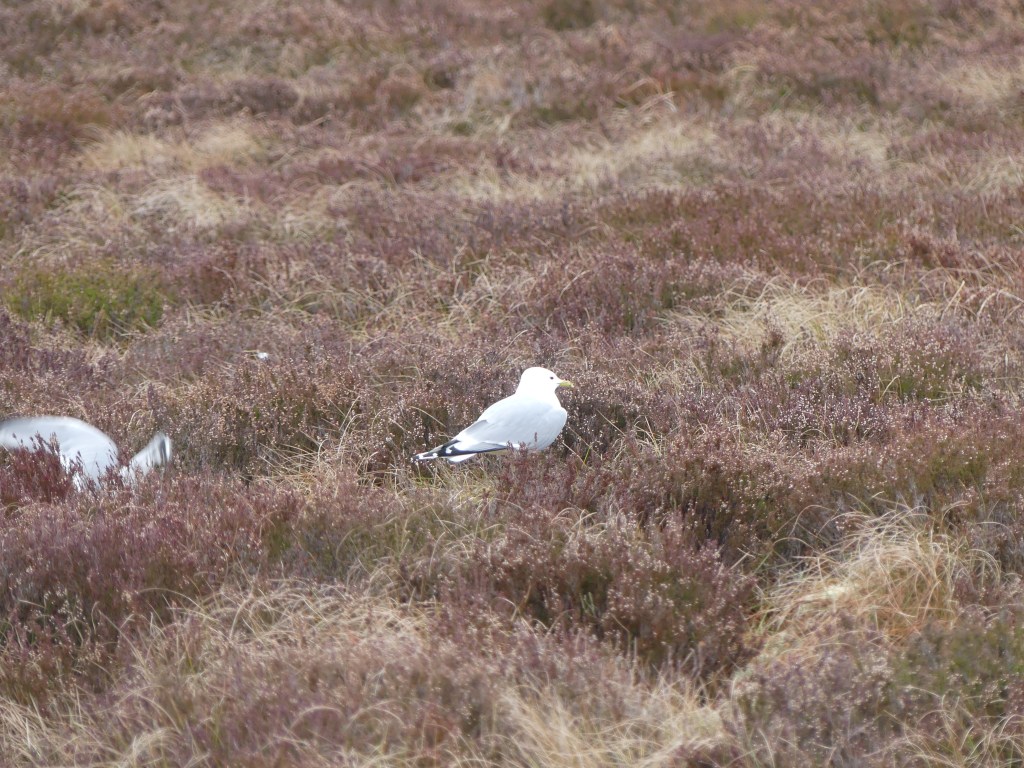
With the rain pelting down on us, we pulled into a lay-by that I will try not to give away too much, as the Black Grouse is one of Britain’s most sensitive species, and their leks are highly prone to disturbance. And what’s a lek you ask? Its essentially a battleground, which all the male ‘Blackcocks’ (no pun intended) in the local area descend on each morning during the courting season, and march against each other, circling warily before engaging in a war unlike any other in the human world. Their tails are fanned out, their scarlet brows raised with tension, and their snowy-white rumps flashing against the flat green grass. Later into the season, the greyhens (females) will arrive to scout out their future partners, and that’s when the competition really heats up.
From here, they were simply black specks with the occasional glimpse of white, but through the scope the tales of conflict became clear, and we could easily hear their bubbling and hissing from where we stood. The weather was miserably wet and attempting everything it could to hinder us. But our quest for this rare species didn’t end until exactly 6:53AM, when we quickly realised the time and raced back to the hotel.
Again, (I’m assuming you won’t be surprised) not long ago we would have been able to find these magnificent birds on certain sites across Dartmoor, but the most recent Black Grouse survey showed a 49% decline in the South West; and that was in 2005. By now, they have all but vanished from moorlands across England, with just under 1500 pairs left in England, but even this England-only survey is outdated, having been undertaken a decade ago. Reasons for their decline are disputed, but the main source of their demise has come from habitat loss, namely the removal of their favoured partly wooded moorland being cleared out to a large extent across the UK, to make way for the apparently ‘hugely beneficial’ sheep farming industry, with these creatures overgrazing and leaving a path of land useless to the birds.
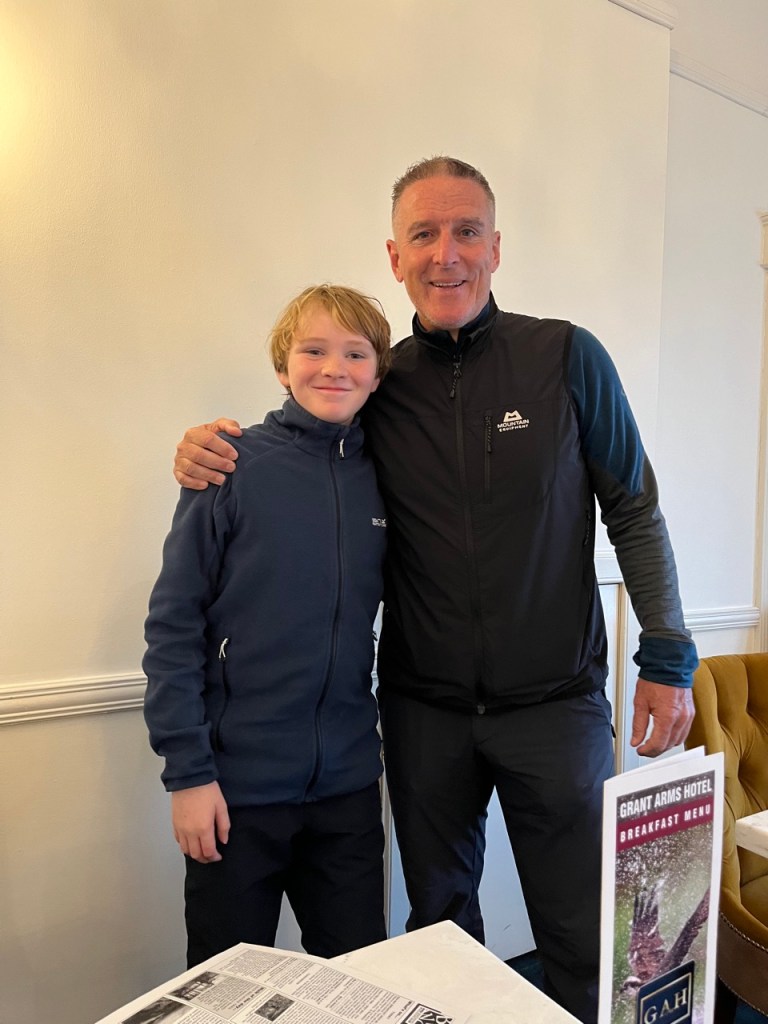
And now we cut back to the Grant Arms, where breakfast has just begun. And we were just flicking through April’s edition of The Watcher (the hotel’s very own publication) when a certain Iolo Williams walked up to our table to talk to us! It was just a general chat, but it was frankly incredible to be able to speak to somebody I had grown up watching on Springwatch, and he had grown to become a bit of an idol for me. The manner in which he talked immediately put me at ease, and he spoke to me as if I was on his level, which to be honest was brilliant! It was, to be quite blunt, a pretty good start to the day!
We also met Dawn at breakfast, somebody I mentioned in the Sunday post, and it turned out her and Pete had been at the same lek site as us that very morning. If you need a reminder, Dawn had quite the dream job, being Head of Surveys at the BTO and Chair of the Rare Breeding Birds Committee. To top this perfectly, both Dawn and Pete’s birding knowledge was completely second to none! We would meet them again later, but for now it was time to prepare for another day in the field. A quick foray up the grand old staircase, and we were back down once again by the reception noticeboard, hanging out with Nick Baker ready for a morning’s group walk out into Anagach Woods, an underrated gem just behind the Grant Arms.
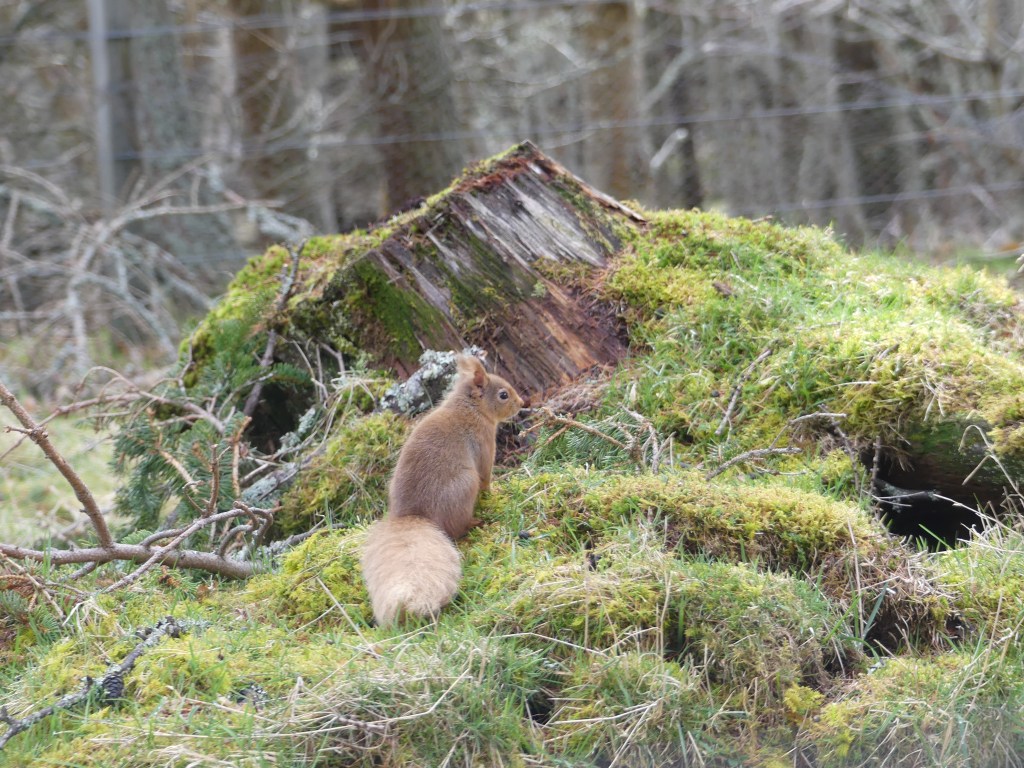
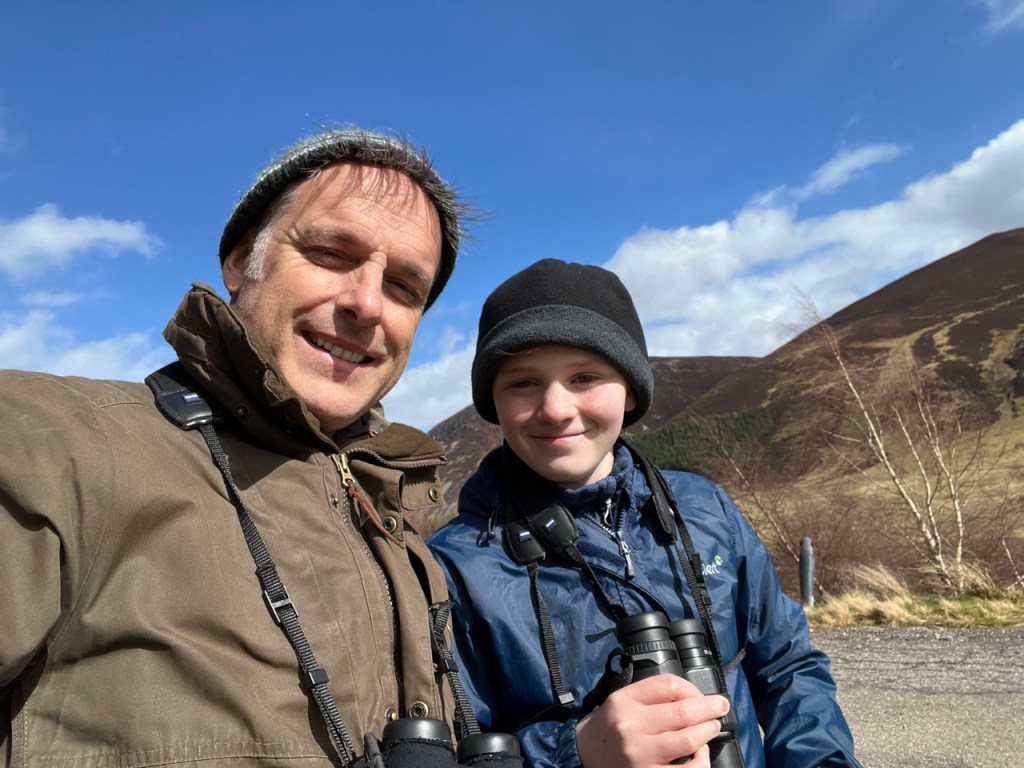
It was exciting to be out with Nick again, and talking to him seemed so simple and casual, featuring topics we both were interested in, and that he was so knowledgeable in. Our party of 5, armed with binoculars and a scope, set off via the golf course into the pine woodland. By the way, the weather since those drastically early hours had not changed in the slightest, so beneath the trees thudding drips on hoods were a constant sight and sound! Anagach was silently wonderful, with welcoming trees and gates, and an early finch flock as a good omen. At this time of year, large finch flocks are really quite common, with many birds coming together to roam the forests, searching for a sustainable food source. They are often inter-species, with Chaffinch, Goldfinch, Greenfinch, Siskin and Brambling (in winter only) all the norm up here.
These birds were targeting a feeder in an adjacent garden, and so we left them to it as we continued deeper into the trees. Nick and us had arranged a loose sort of target species, something to be on the lookout for as we trudged through the sodden leaf litter. And at our first stop for a bird feeder, we heard a certain distinctive call; ‘chirp chirp chirp chirp chirp’, in rapid succession, uttered by a deep-throated voice. We all immediately looked up in perfect synchronisation, and Nick rapidly released the legs of the scope to scan the tops of the trees, for not just a silhouetted bird, but for falling pinecones and rustling branches. We had, of course, just heard a Crossbill, and everybody had binoculars glued to faces, eagerly searching the pines around us.
But it seemed that the bird had eluded us, with not a single trace of it even when we fanned out into the undergrowth. It didn’t call again, and we continued on to higher ground, for there were many small hillocks and ridges in these woods. The path was narrower and wilder here, entangled with brambles and thorns, and dropping steeply away on either side. More finch flocks were ever-present, and they roved through the trees, searching for food.
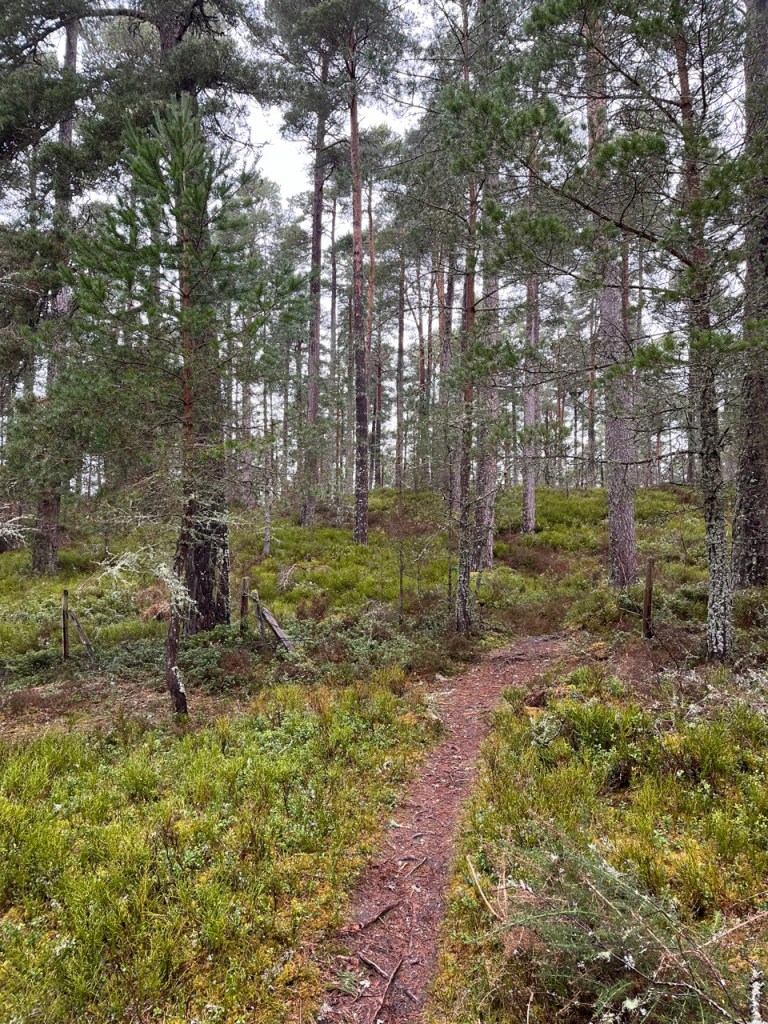
We came to a tree, however, which did seem to be different to the others. It stood in the centre of the path, and on closer inspection seemed to have been hacked at with a powerful axe, the bark stripped away around these slicing marks. And then Nick explained his thoughts, giving a new perspective on the woods as a place of historical and natural value. He described the tree as a pine-candle, as before electricity became readily available, people would brighten their homes by candle-light, and these homeowners chose candles of pine-sap, which burned for a prolonged amount of time. You could also see the faint evidence of scratch marks and engravings on the weathered trunk. If you looked hard enough, you could make out a name and initials. This further supported the theory, as people would come out into the woods before winter and mark the trees they would collect the sap from, so others knew not to lay hands on their ‘property’.
People would travel long journeys to collect these little slivers of pine bark, enriched with the sap, for in the depths of winter in the highlands, you would often be stuck in 17 hours of darkness out of 24. But why were these trees so good at this purpose? Well, that’s a long story of ecological evolution. Just like the famous Californian Redwoods, these pines have learnt to adapt to the occasional forest fire, and this provided a slow burning, long-lasting candle. The bark of a Granny Pine is tough and burns awfully slowly, and in this way the tree hopes to outlast the flames, with the bark taking such a long time to burn completely that the tree has a better chance of survival, simply because forest fires don’t burn forever.
Further on, to our left was a pine covered slope, layered with thorny tangled like landmines, laden with new growth. A Blackbird chattered its alarm, and emerged with tail erect, before undulating away into the trees. To our right was a boggy selection of pools, connected by channels of sphagnum moss and protected from the driving rains by watchful alders. The former was our next destination, heading down the slope and dodging the cascading mud, before coming through a stile and entering a… house estate? Well, Anagach Wood is a community woodland, run by and for the local community by the charity Anagach Community Trust, and this explained why the woodland was so well managed, by those who had its best interests at heart.
Fair enough I guess, and it delivered to begin with, as a singing Song Thrush presented itself for inspection, perched prominently on the top twig of a garden cyprus tree. But we soon left the red brick bungalows, and came to a long stone footbridge, arcing over the River Spey. To provide you with more Scottish historical knowledge, this bridge formed a crucial route over the Spey as part of the Old Military Road, which allowed soldiers to move rapidly in response to a threat over long distances. The road was essentially a dead straight line, reminiscent of the Roman roads which still exist in England. Of course, the Romans never managed to conquer Scotland, so this is probably the closest thing they have up here.
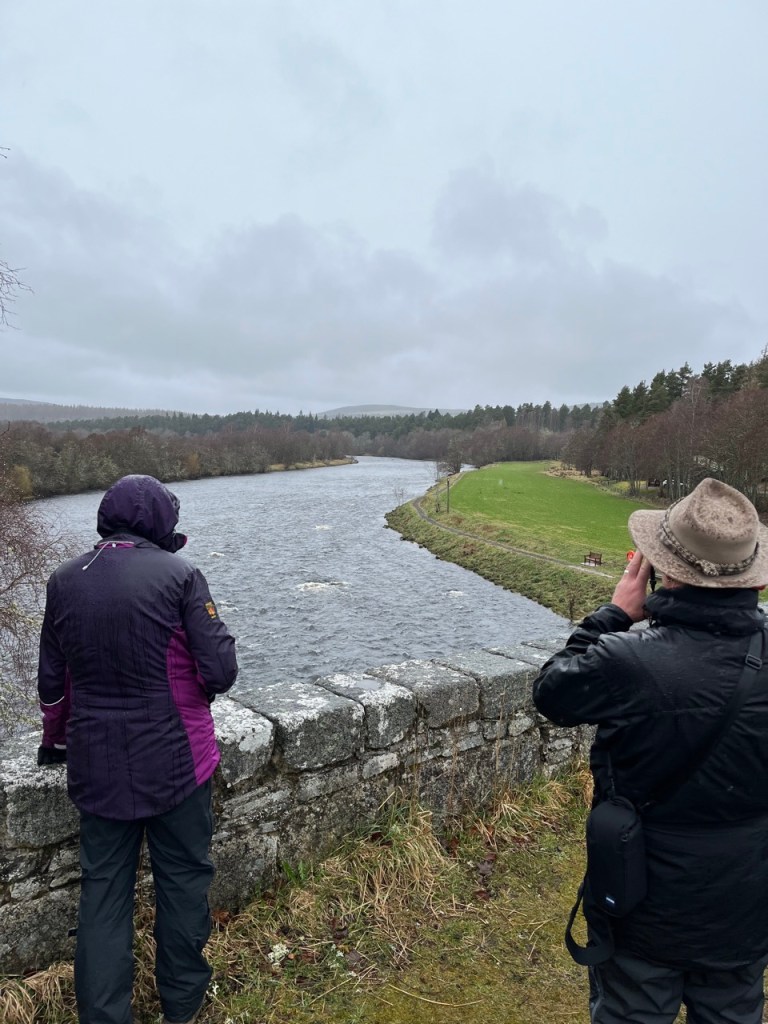
Immediately we saw a displaying Goldeneye male, throwing his head back a surreal distance onto his back and essentially harassing the chocolate brown female, chasing after her and throwing his head in her face. It seemed to work, and they flapped off downriver together, wings whistling in the morning air. This, like many of our Scottish encounters, was a courtship phenomenon I was unlikely to ever see further south, with the birds preferring to breed north of us, in Scandinavia, Iceland and of course Scotland. These birds are one of the few British ducks to actually nest in tree cavities along the Scottish rivers, and will even take to specialised, deeper nest boxes if provided! Even one of the local Scotch whisky distilleries had put up many of these nestboxes along the banks, in a bid to be more nature friendly!
We saw a few more pairs exacting the same ritualistic behaviour, with perfect nesting trees lining the riverbanks. But there was also something I hadn’t seen up here yet, in fact never in my life. Everybody was gathered on the corner of the bridge, and Nick was pointing and following a Dipper with his binoculars, directly below us. But what was special here was a certain mossy cup attached to the stone cracks of the sheer walls that made up the bridge. You’ve probably made this assumption, but this was in fact the bird’s nest, and most likely scenario a female was concealed inside.
A pair of Goosander flew at head height across the bridge, and that marked our continuation of the walk, along the riverside, with the path in some areas having become one with the river (flooded) and featuring the occasional staring Oystercatcher. A Grey Wagtail bobbed and wagged, following our progress and flashing its yellow underside in encouragement. It’s such a positive bird to find on a grey day (ironic, given its name), and we watched awhile as it leapt in and out of the shallows.
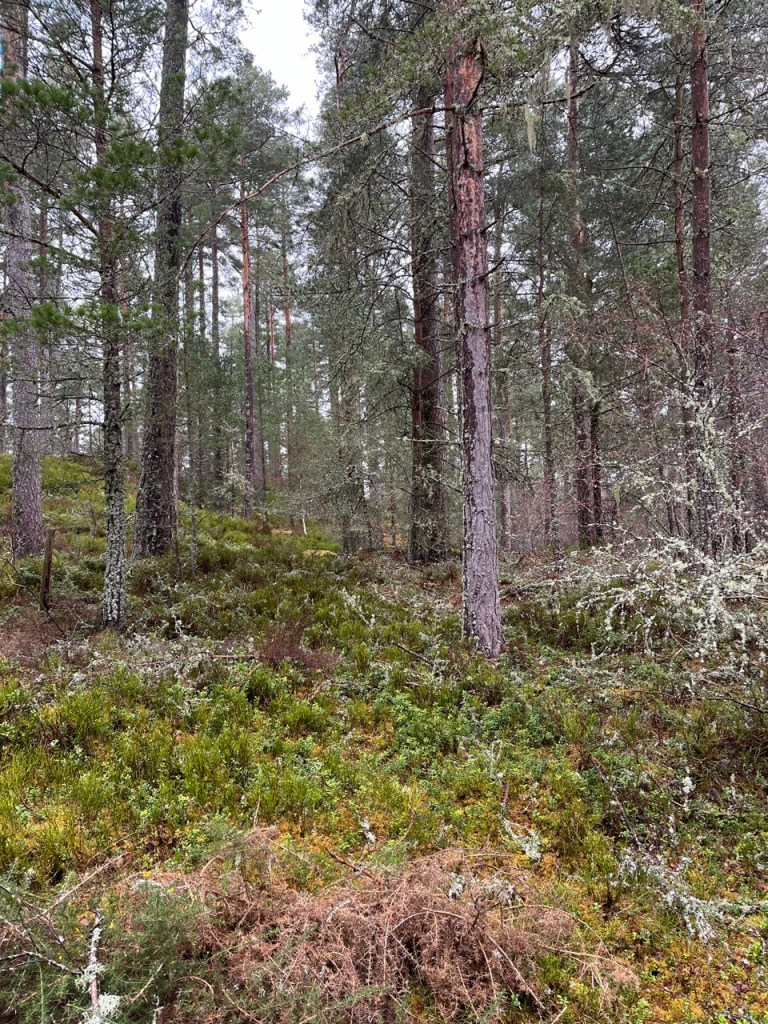
We reentered the woods at a second stile, slick with rainwater. This section levelled out, and the first spot was something I hadn’t really expected to see, due to their secrecy and general concealment. It camouflaged flawlessly against the pine trunks, bar an occasional flash of snowy white from its underside. It was, of course, a Treecreeper, and the positive mood climbed higher among our party as we walked out back into the grim skies of Grantown-on-Spey. The last few moments of that walk provided a friendly but provoking talk with Nick, on the issues that still surrounded nature even here in one of the wildest areas I had ever had the fortune to visit. It still felt incredible to discuss these matters with somebody who knew so much about them.
We would be out with Nick once again that afternoon, but for now we bid him farewell and hopped over the road for a rapid lunch, before a quick change of clothes and equipment and being picked up by Nick, bound once again for Strathdearn, where we had spent an afternoon one our first full day that weekend. One of the foothills of the Monadliath Mountains, it felt like a truly wild place (though its wasn’t completely), with one road heading through enclosed by plains, ridges and the Findhorn River. A more detailed description can be found in my previous post here, but for now we travelled up the Strath to meet with our guided group team for the afternoon.
After meeting in the very end car park, we traversed the Strath in convoy, searching for the golden target for that afternoon; an Eagle, of any shape or form. But over the first three car parks, despite the wind and rain we had many good Mountain Hare sightings, and many a Red Kite flew overhead. And even the Golden Plovers remained in the exact field where we had left them, two days on. But (to my deep sadness) our Merlin friend didn’t put in a second appearance.
This car park would provide something special, albeit distant. Our cold and wet group had gradually dispersed, bound for various locations, because the weather clearly had little sympathy left over for us today. And just as it began to clear, we were stood in the layby scanning the skies as a distant group of gulls swirled above a tractor. But Nick was sure something seemed odd about these birds, and after some verification taking 20 minutes, he was able to confirm that the the larger broad winged bird among them, with its feathered fingers just visible from here, was in fact a White Tailed Eagle. Immediately, I was giddy with excitement, for this was a species that really was once in a lifetime for many. Also known as the Sea Eagle, the majestic bird was simply a speck on the horizon, but the scope allowed a simplistic shape to be viewed, and it had to be. At the last minute, we had found our Eagle.
However, we had (again) overran our time quota, and had to race back to the hotel for the evening meal. There was, for the first time, nothing on in the hotel that night, so we caught our breath in the bar with Dawn and Pete, talking of subjects that varied as the night went on. It was the first time we had actually sat down with them since Sunday’s quiz, and it was one of those conversations that I didn’t really want to end, it just seemed so easy to talk and keep it going. And as soon as we left the bar, we signed up for their guided group meet at Spey Bay the next morning. What remained of our stay would fly by, however.


Wow,what an amazing account of your day spent exploring the woods and countryside of Scotland and experiencing the sights and sounds of such a variety of birds some of which are only found in this region of the UK.A great opportunity for you Henry,Happy Days (even though the weather was pretty awful)👏🦅🌨️
LikeLike