Hi, I apologise for this one being a little late out, and for not writing all week. Ive been away at Scout Camp since Saturday, and never fully dry until last night! It was fun, but I’m back now and working overtime on many more posts. Keep an eye out!
It was our last day at the Global Birdfair, and we intended to see most of it for one last time. This evening it would be packed up and prepared for next year. Because of this, todays outing was to be shorter, but still packed full of enjoyment. To start, we moved towards the RSPB discovery area, named as The Nest. It was quiet in here as the rain came down in torrents outside, and wooden chairs and tables were spread in a fun, disorderly pattern about the tent. Tables off to the left held a seedball making station and several boxes that you had to stick your hand in, and guess what was in there with just your sense of touch. It was tricky, and I only got one correct, but Daddy got all 3, so we soon knew what was inside. The volunteers were great to talk to, and we spent well over 20 minutes in there.
We were just leaving when we realised there was one thing that we had failed to check out on Saturday, and it was rather surprising that we never looked into it: the BTO Bird Ringing Demonstration. We turned up, and completely by chance, the demonstration started in about five minutes. One of the volunteers for the BTO showed us the different rings they used, each one suited to a different leg size. There were more than you would have realised, ranging from bands that fit the tiny Goldcrest, to the very much larger Mute Swan. We had a lot of fun trying to guess these combinations, ring and bird. And then the actual ringing began.
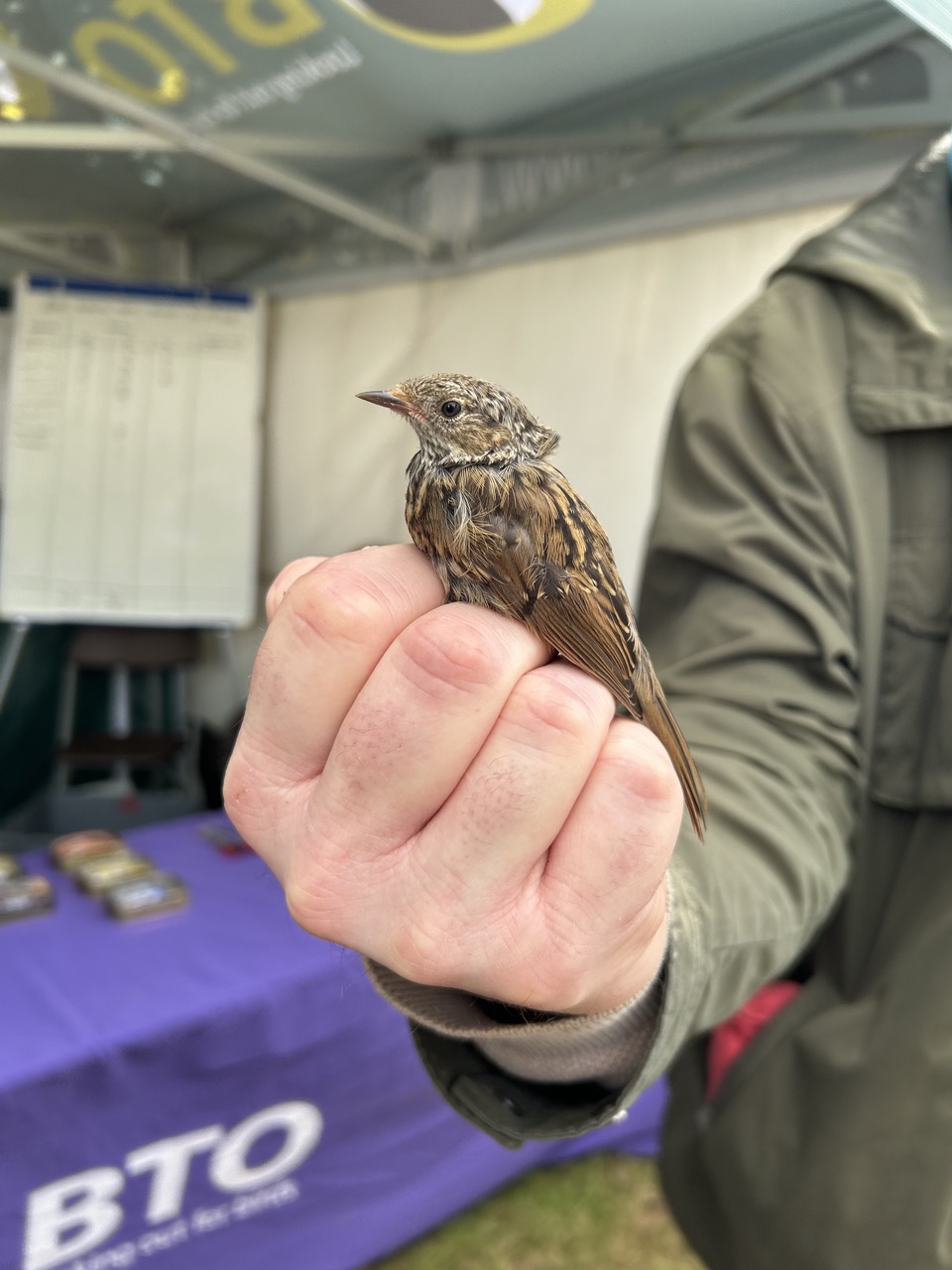
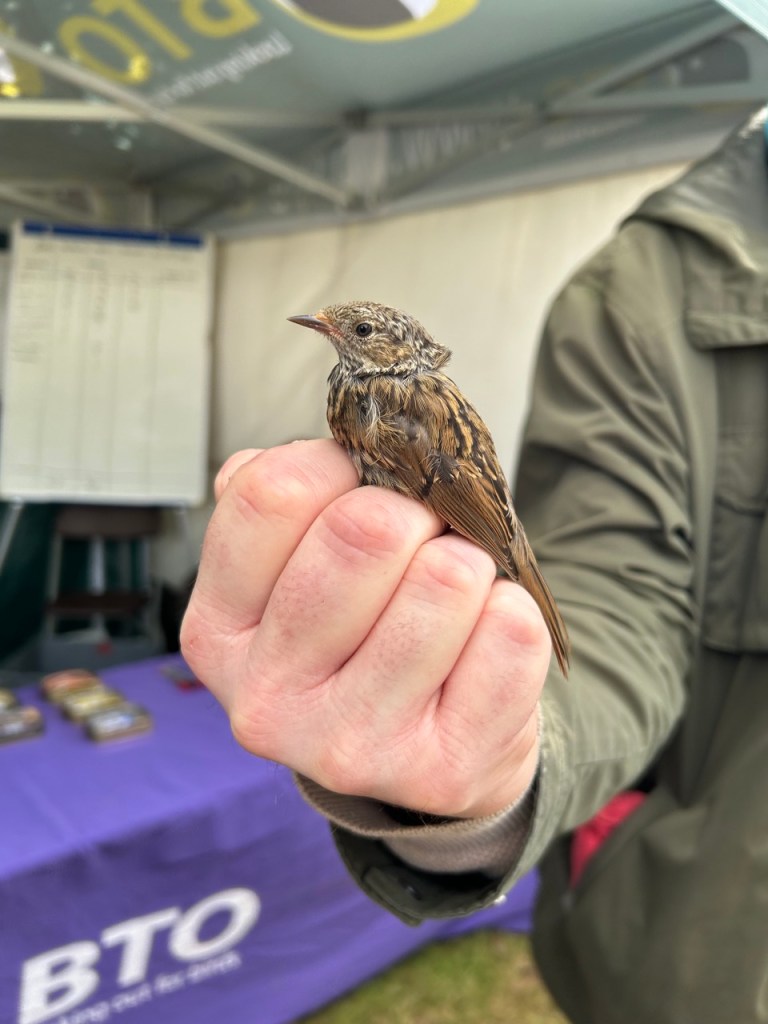
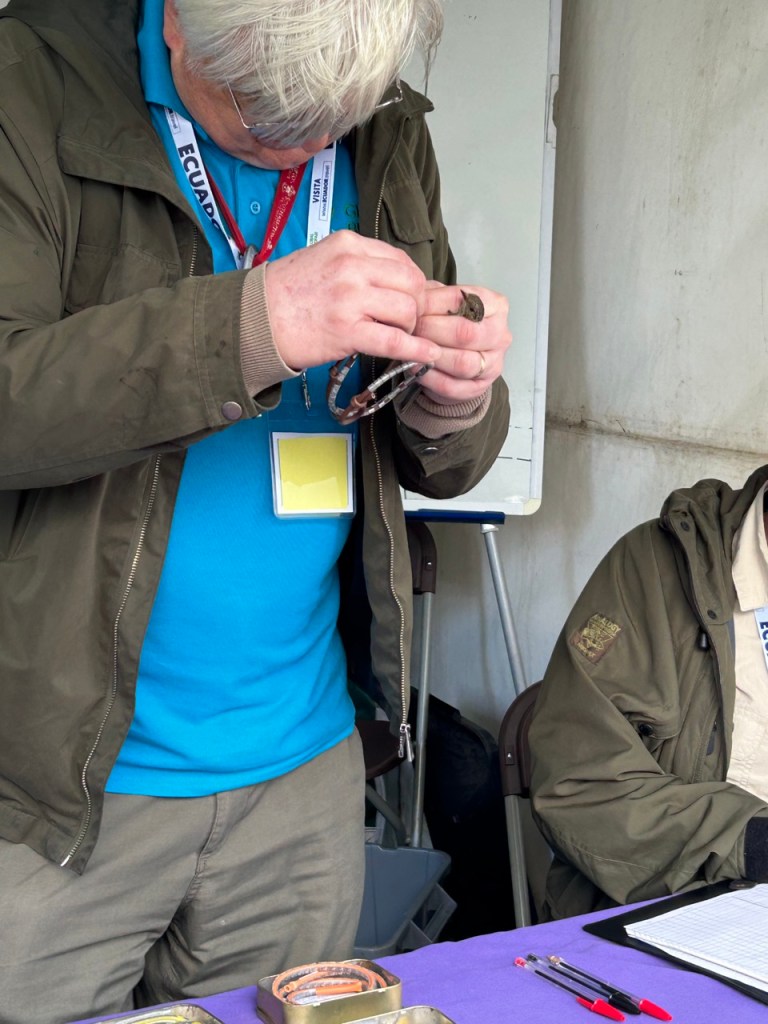
Two men sat at a table, and one took a small, drawstring bag from a box and produced a Dunnock, which he held between two fingers. The other man took out a leather-bound notebook and started to write as the first weighed and measured the bird. To weigh it, he had to place the bird headfirst into a black, plastic tube where it would be comfortable. He then took it out, and gently fanned out its wing to its full length. The measurements went into the notebook, and the man took a small pair of pliers, with about four or five different grooves for different sized rings. He placed a relatively small one in its corresponding slot, and applied it to the birds leg.
The ringed Dunnock.
The second man now carried the bird away towards the hedge, and there he let it sit flat on his palm, soon flying away. And at the end, we received coloured rubber bands that looked just like rings, and each one read as a different bird with its own unique ring number!
Ringing the Dunnock.
It was coming up to lunchtime, and we were wandering the Swallow Marquee, looking at the various art pieces for sale and available to view. Some of them were truly breathtaking, and all were bird-related. It was here that we met Darren Rees, a brilliant artist and a great person to talk to. But more on that will come in the next post.
Finally, following a quick lunch, we were beginning to contemplate leaving. We went around the Nightingale Marquee (my personal favourite) one last time, and Simon from the Grant Arms, remembering me, stopped me and introduced me to someone. I had seen him on Saturday during the Birds v Bugs quiz, him being ,of course, on the birdwatchers panel. His name was Mike Dilger, a well-known ecologist, presenter and writer. It was brilliant to meet him, and he explained that he would soon be down in Devon, on the hunt for Cirl Buntings (Devons speciality). He said he would be thinking of me, and that felt quite special. I shook hands, and even had a photograph taken in the cluster of people from the Grant Arms, and those who were with Mike. It was incredible.
And that was about the last thing we did. We walked out of Birdfair for the last time that weekend weighed down with things we were given or bought, but also lasting memories. We would be back next year.
The clouds spat slightly as we strolled through the car park of the Kettering hotel. The car rumbled out of its confining white lines, and turned onto the road. We were on our way to the greatest birding event on the planet. Global Birdfair…
The field (serving as a car park) was saturated with brown, murky, muddy water. It didn’t help that it was constantly getting churned up by passing vehicles. We ambled along until we reached the admissions tent, and entered through the large opening. Our tickets were checked briefly (they were completely free thanks to an award I won; see my previous post) and we were off, into the huge field that housed Birdfair. The scene was dominated by huge canvas tents, and food trucks lined up to our left.
We began by swerving off to our right, towards the nearest tent: the Robin Marquee. We stepped in, and were amazed by all the stalls packed into the space. This tent appeared to be for travel agencies and tours, and it went from exotic to more closer to home, such as Trinidad to Scotland, or Ghana to France. We ended up stopping and talking to many people, such as a stand representing Valencia, another for Ecuador, and another for the Falkland Islands. Throughout all this we were receiving a constant stream of freebies: pens, leaflets, rulers, bookmarks, maps, sunglasses, and even bags to put it all in!
Eventually, we moved on and started ambling through the Swallow Marquee just next door, full of art and incredible artists. There were sculptures, carvings, sketches, paintings, photographs, felt and even someone who painted stunning artworks onto feathers! Everything in there was breathtaking, and to create some of these things, such as weaving wire to make sculptures, or carving the tops of canes, must have taken a lot of time and effort. But we failed to spend a long time in there during that particular spell, as we had something marginally more important to do at that time. You see, we were off on a nature walk with Lucy Lapwing, a naturalist, conservationist and self described nature nerd!
We reached the Leica stand (the allotted meeting point) with plenty of time to spare, so we decided to explore the somewhat smaller Falcon Marquee it was housed in. Optics was this tents speciality, and all the companies that had spaces in here had binocular try-out stations as well! They had put up pictures of birds on fenceposts and trees, some close and some a fair distance, guaranteeing views and giving chances to try out some potential new binoculars! All the companies here had utilised this idea, including Viking, Swarovski, Zeiss, and of course, Leica. But what was really exciting was the fact that the Cornell Lab of Ornithology and ebird had both set up their stands here! The woman on the Ebird stand turned out to be part of the Young Birder Awards team, and we had a nice chat about Ebird and its app, and then more about the awards. We even received a small bundle of stickers!
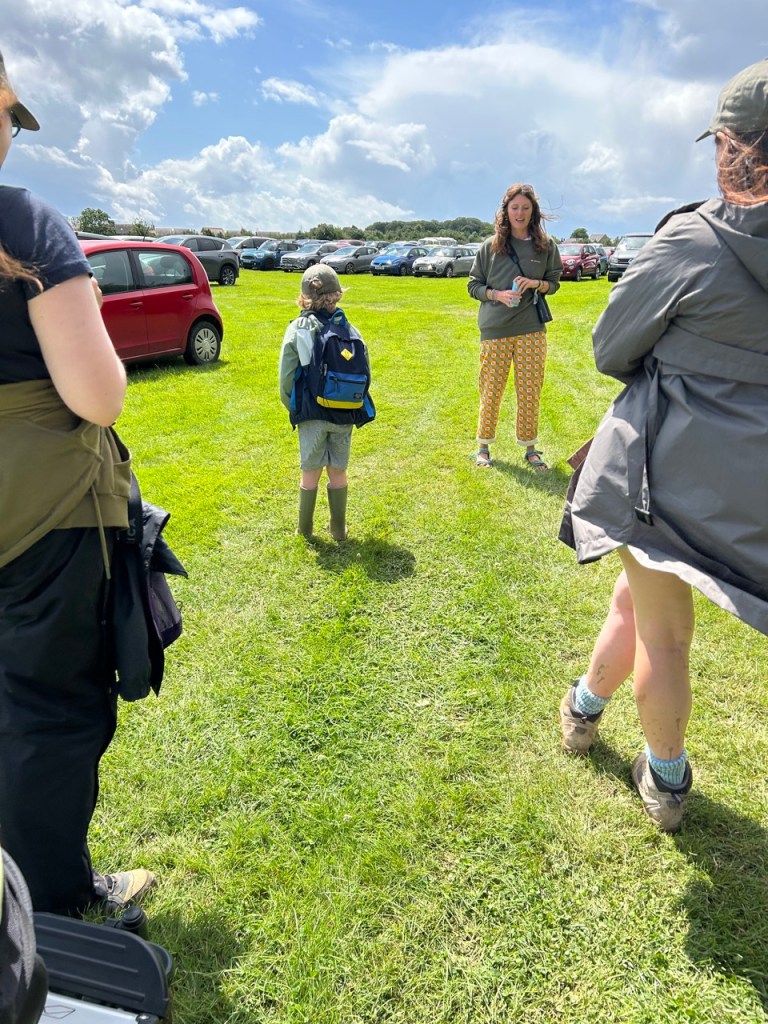
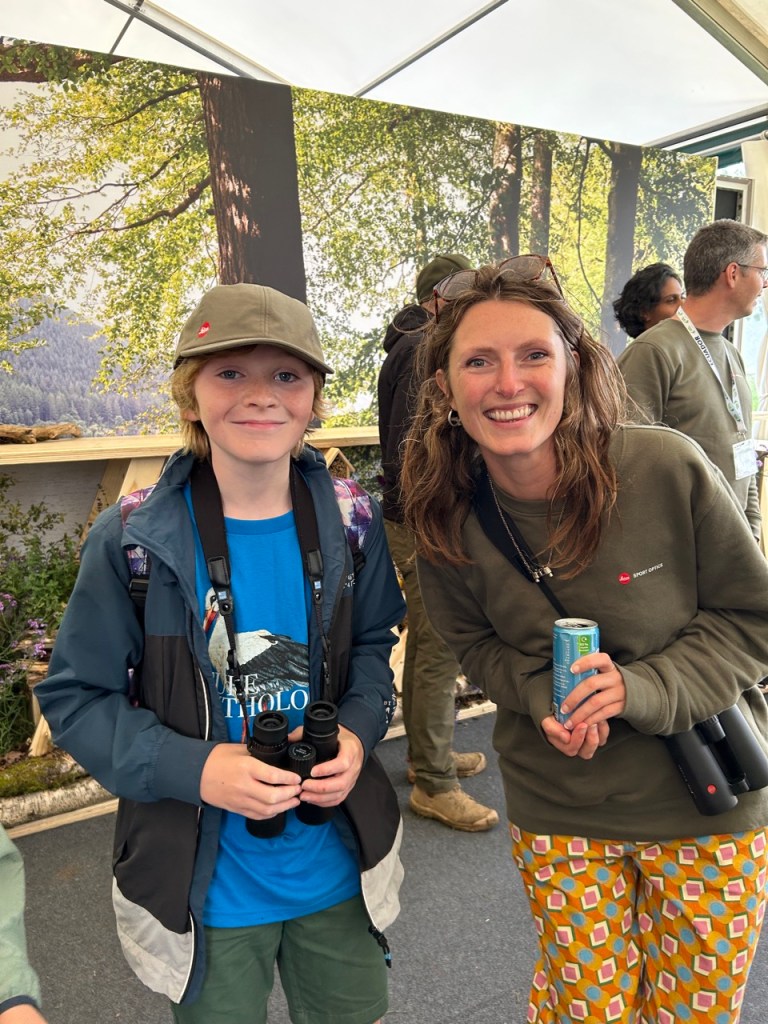
Time really flies when you are engrossed in something, and by the time we had left the Marquee, it was time to head straight back inside and prepare for our nature walk. A small group of about 10-15 had amassed there, all there for the same purpose as us. The Leica representative gathered us all outside, and alongside Lucy Lapwing, began to hand out Leica branded hats, and binoculars for those who had not brought their own. And so the leading of the group was handed over to Lucy, and we set off! First we ducked behind a tent and continued behind it until we came to a metal fence with a slight gap in it. So we slipped through that and found ourselves out in the saturated car park we had began our day in, with an overgrown hedgerow to our right, and many stationary vehicles to our left. We walked on, and somebody pointed out a bee. It seemed an ordinary bee. But this was no bee, but a Cuckoo Bee.
The walk before the thunderstorm.
These insects resembled bees in most ways, but were very different indeed. These bugs are similar to Cuckoos in their behaviour, laying their eggs in the nests of other bees. Telling them apart required close observation. This was a brilliant find, but grey and black clouds were mounting above us, preparing for an assault. So we turned on our heels and walked hurriedly back to the Falcon Marquee. Literally the second the last person stepped inside, the heavens opened and you would not believe it! Lightning bolts flashed regularly over the neighbouring field, and the rain was just beyond belief! The amount coming down was insane, and the thunder sounded awfully close. It really was quite the downpour!
Me with Lucy Lapwing!
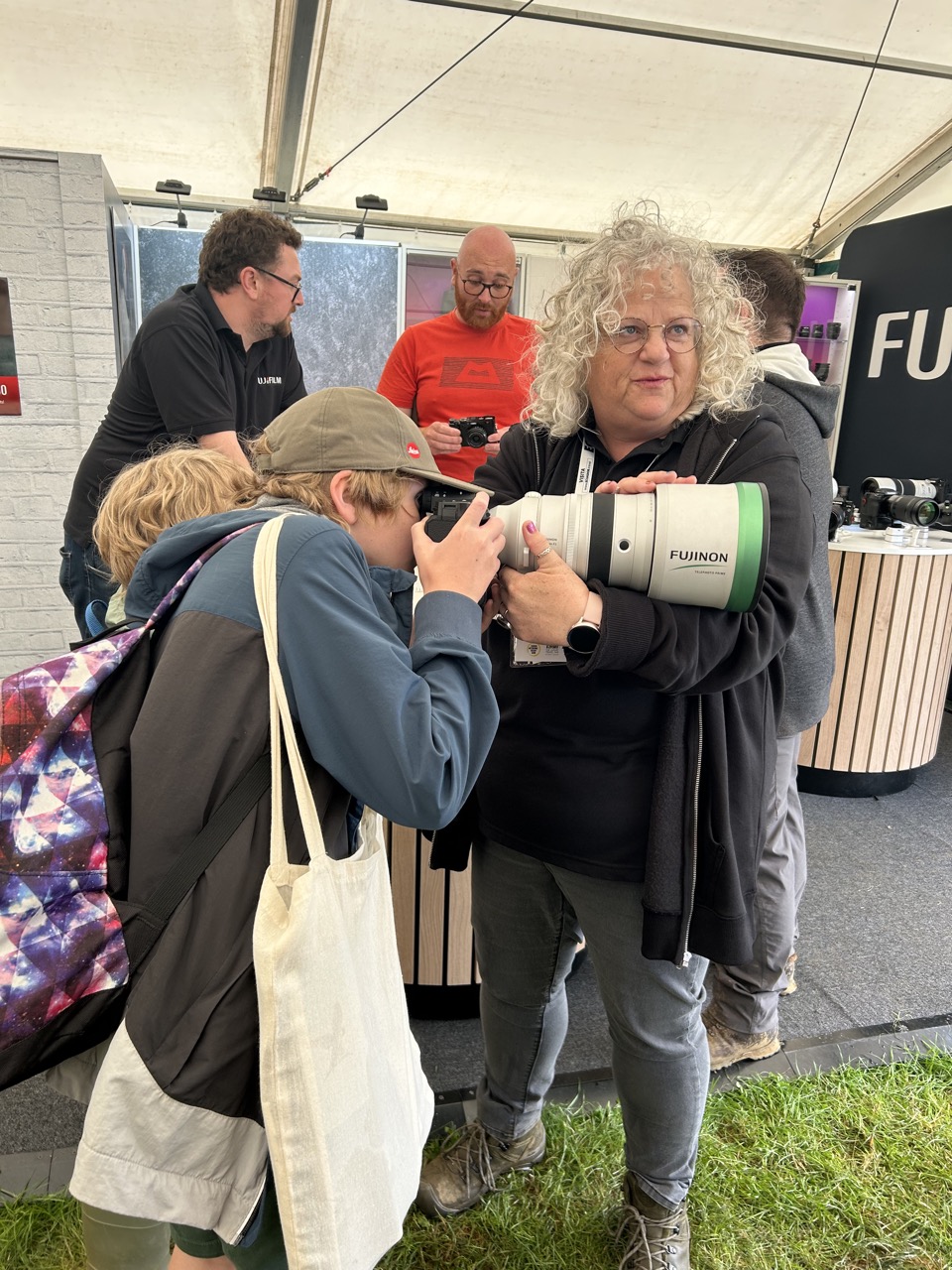
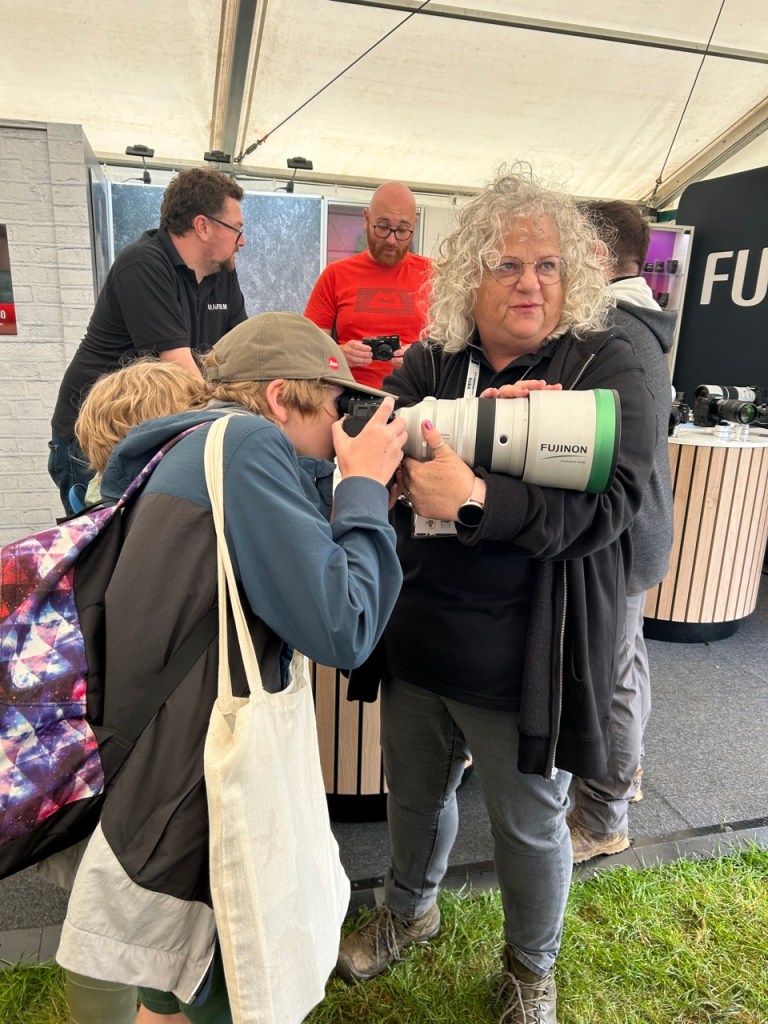
After around twenty minutes, the weather took mercy and slowed its onslaught. This happening outside, we took the opportunity to dash across to the next Marquee, named after the Nightingale. This one was shaped like a T, and we entered along the left of the top line. Bertie and Felix were immediately drawn to the huge display of soft toys on the first stand, Button and Squirt, and ended up rushing over there, while I checked out some of Fujifilms latest photography products. The cameras and lenses were huge, and some of the price-tags also. But for such a brilliant item, it looked to be worth it.
Me trying out one of Fujifilms latest cameras.
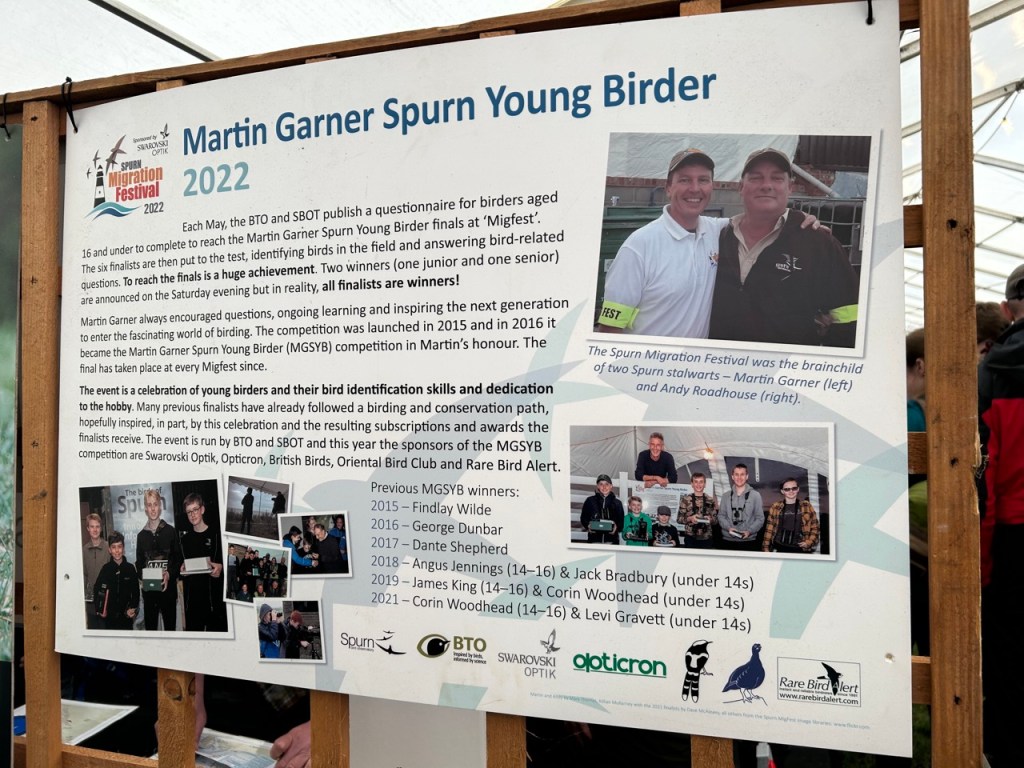
And we continued down the top of the T, until we reached the designated stand for one of the best bird migration spots in the country, maybe even Europe. Spurn Bird Observatory regularly received scarcities, rarities and megas! We paused for a look around, and ended up having a lengthy conversation with a man who worked up there. It was really insightful, and I feel like he really listened to me. He was brilliant, and hearing about what he did up there at Spurn was incredible. He explained that he also helped with the Martin Garner Spurn Young Birder event, which is a contest with the finals held at the Spurn Migfest, where the finalists are taken out onto the peninsular and tested on their knowledge. He told me that I should apply, and I said I would sometime. And in the end, he just took a book from the stall and gave it to me, just like that!
The Martin Garner Spurn Young Birder
After saying goodbye, we continued down the top of the T and came to a stand for the Grant Arms Hotel, a birders hotel in the Cairngorms (Scotland) where Nick Baker did some of his tours. We looked around for a bit, before a man came up to us and started yet another conversation. But this one felt a bit different. He introduced himself as Simon Pawsey, a birdwatcher and tour guide up at the hotel. He seemed really impressed with me, and we spent about 20 minutes just chatting about the Birdfair and just birding in general. But at the end, he said to me as he shook my hand that we need more people in the world like me. That felt really special. And Simon proved to be a fixture for the rest of the fair, meeting up with us multiple times. But that is for another blog.
And now, I fear we have reached the end of this Saturday Birdfair account. But stay tuned. More is to come.
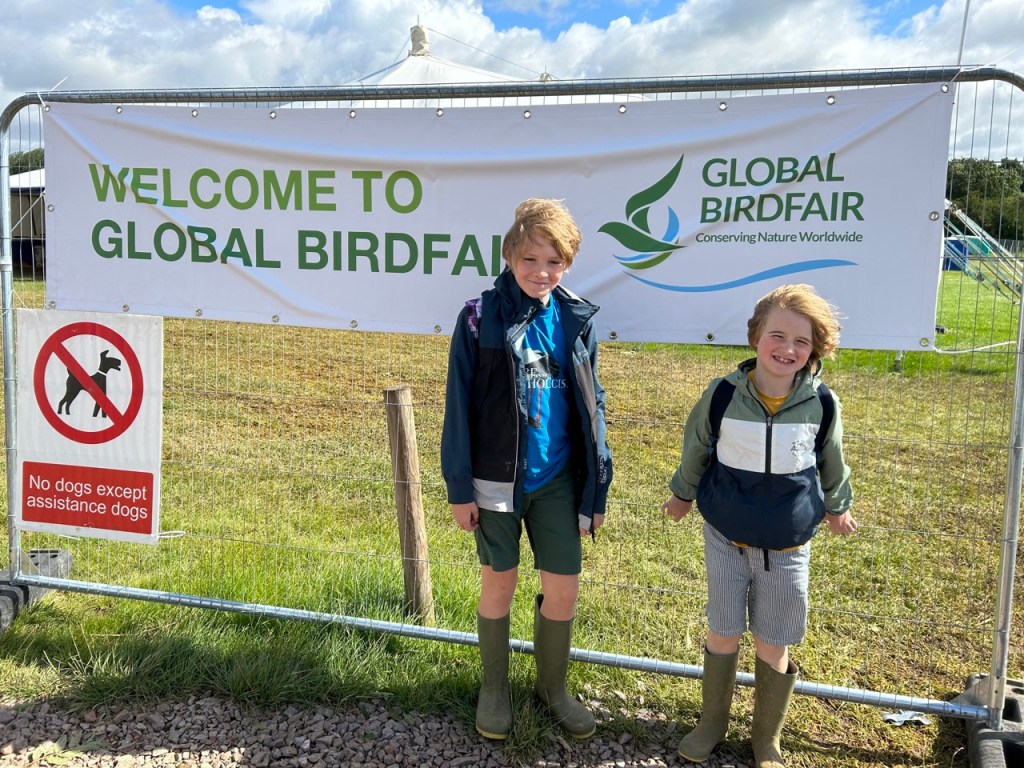
Last weekend, we took the trip of a lifetime to the UKs smallest county, Rutland to visit one of the greatest birding events in the world, the Global Birdfair. This whole field was filled with people and activities that all came together to celebrate one thing: the world of birds and nature. It was absolutely incredible, and the reason we were there was also pretty exciting. I had just won the under-11 category for the Zeiss Young Birder Awards (although, I bet you could have guessed that from the title)! And that was why we had travelled around 250 miles to be where we were! I had wanted to come for years, but it had never happened. But now we are already hoping to go next year! So please read on, and enjoy my account of the Zeiss Young Birder Awards…
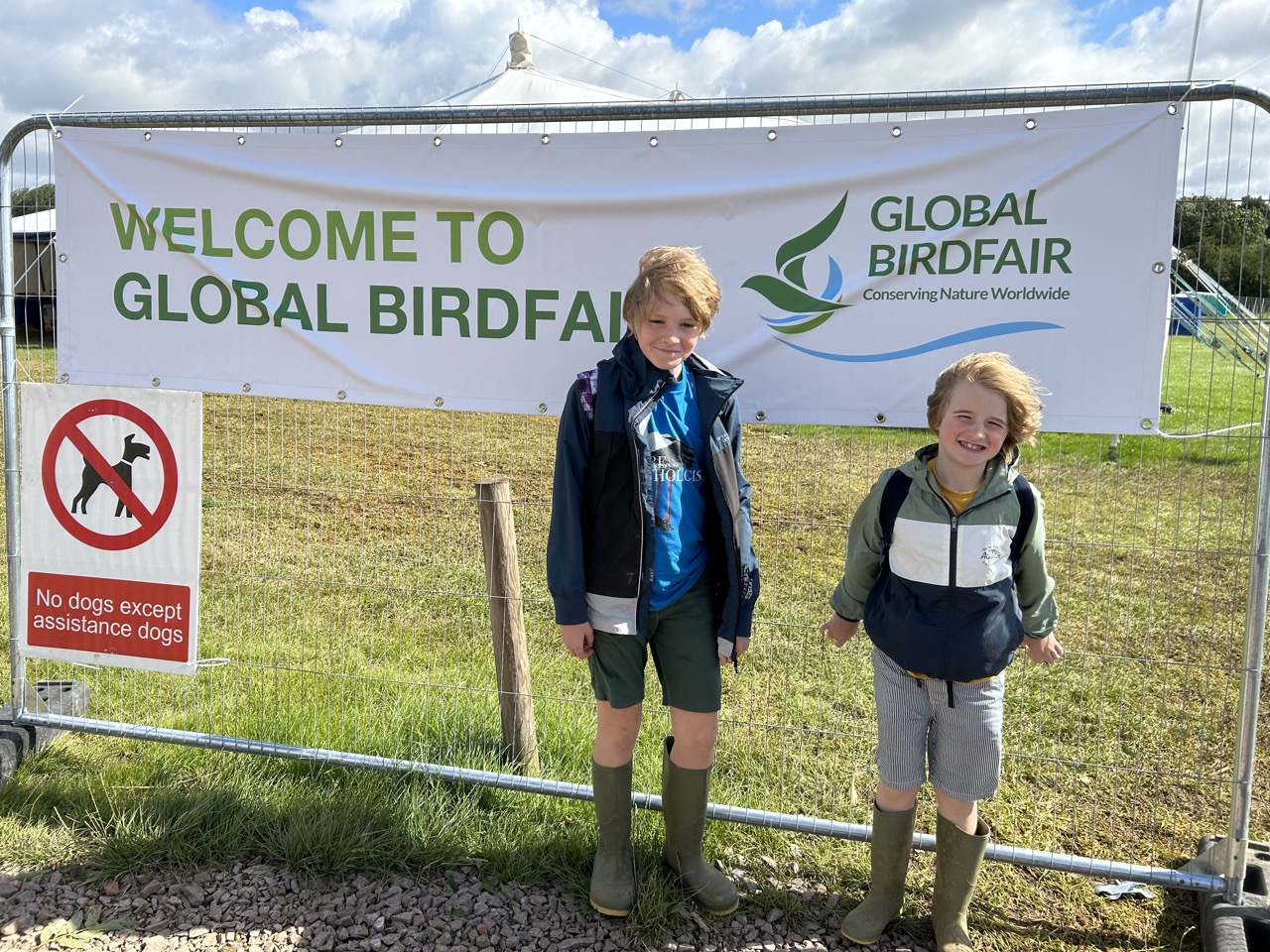
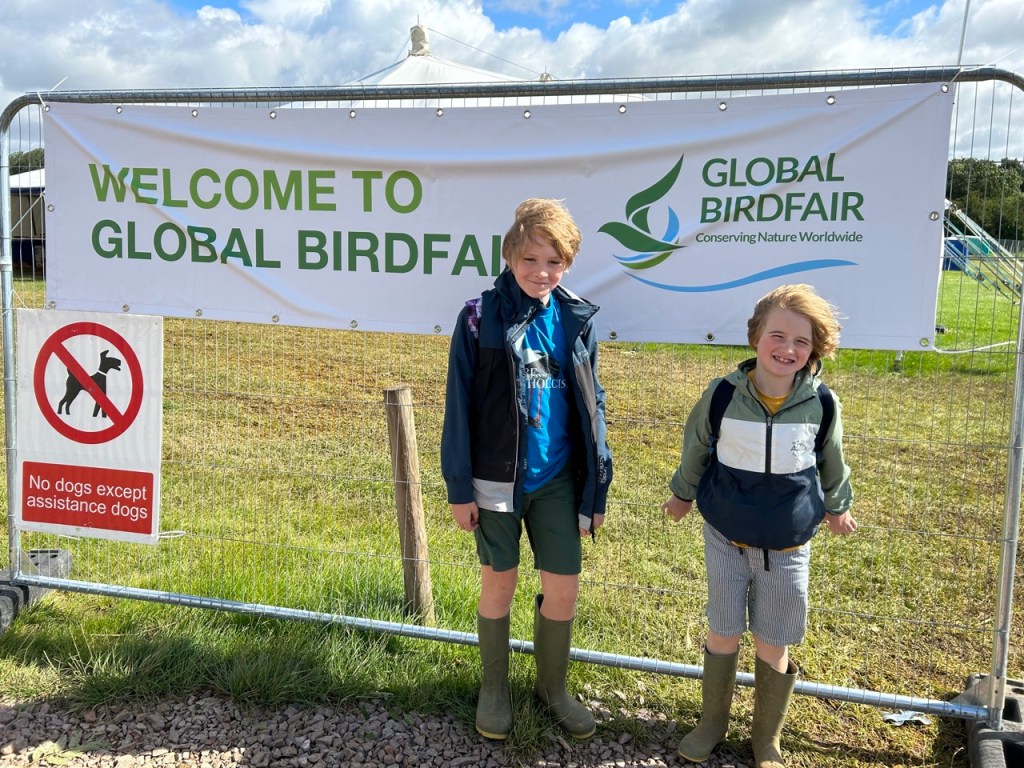
Me and Bertie outside the gates of Birdfair
We walked into the large, canvas tent that enclosed the Osprey Events Stage towards the end of a Birds V.S Bugs quiz game, with a panel of bug experts facing off against a panel of great birdwatchers. As we took our seats at the back, the presenter launched into the next round, a rather tough ID challenge. On the bug side, I recognised Nick Baker, a well-known naturalist who was, for a while, based down in Devon. And on the birdwatchers panel, Mike Dilger, who is a brilliant ecologist and TV presenter. The challenge was cruelly hard. Even the experts struggled. And it went on like this for another 15 minutes, pouring through three different rounds.
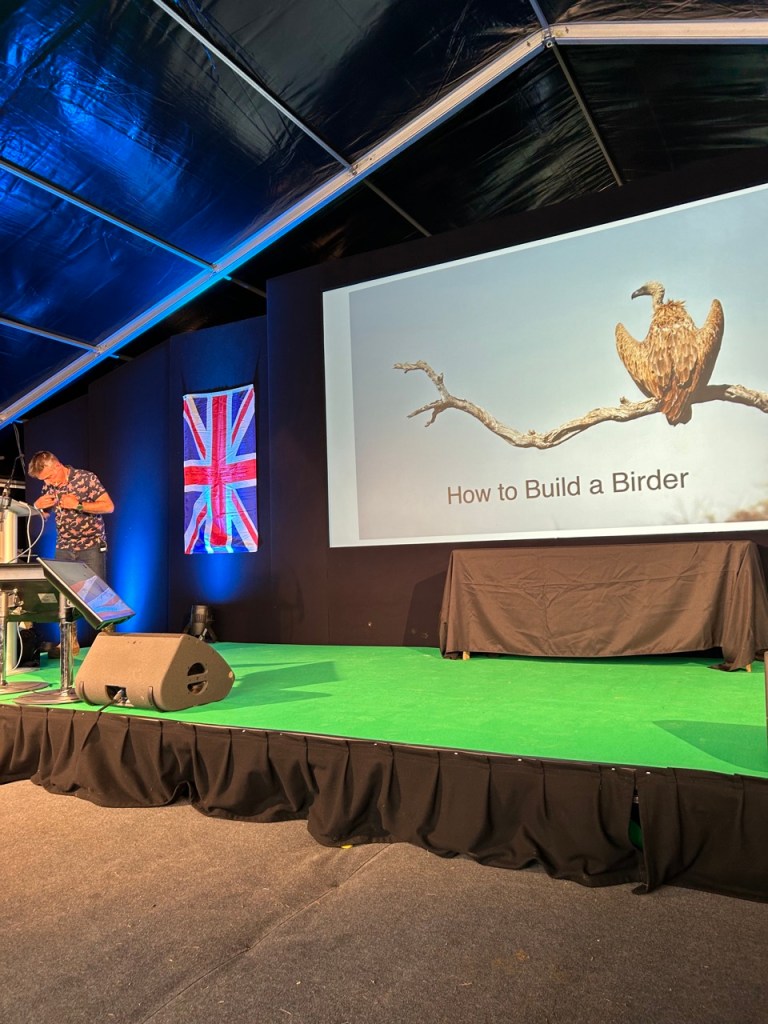
And then, just like that, the quiz ended. Upbeat, bubbly music played as people came on to set up for the next show: the presentation of the Zeiss Young Birder Awards. Under-16s were asked to seat themselves in the front two rows with their parents, as Nick Baker prepared to give a talk on how to build a birder. After a couple of technical difficulties with the latest Apple software, we were underway and the awards had began.
Nicks talk was both insightful and cheery, and you could tell he knew what he was doing. He spoke to the audience of his experiences of nature as a child, and how his parents had helped him develop his passion, although in an indirect way. He said his parents were never into nature as much as him, but that they would take him out to all these wonderful places, where they would fish, or walk about. And he continued on about how parents of children these days should do the same.
The opening slide of Nick Bakers talk
Soon enough, the opening show was over, and there was no delay in the schedule. Stephen Menzie, a birder who currently works in Sweden (and the editor of British Birds) took the stage to begin the presentation. At first, he congratulated everyone who entered, and added that they were all incredible, and full of effort and time. This year, there were too many entries to just pick one winner, so he explained that they had chosen two runners-up as well in each category. But when he read out the runners-up for the under-11s, nobody replied. They had not been able to make it, and would receive their prizes through another channel.
However, following this announcement, it was my turn. Stephen proceeded to express his opinion on my work, discussing his impressed reactions and its detailed drawing. He said that the annotations around it really showed an in-depth observation, and he thought the writing was excellent. And then my name in bold came up on the screen behind him, along with an enlarged image of my piece. I had chosen to describe one of my first (and best) birding encounters. During Lockdown, we found a drake Garganey on our local fishing ponds, likely stopping over on Spring migration.
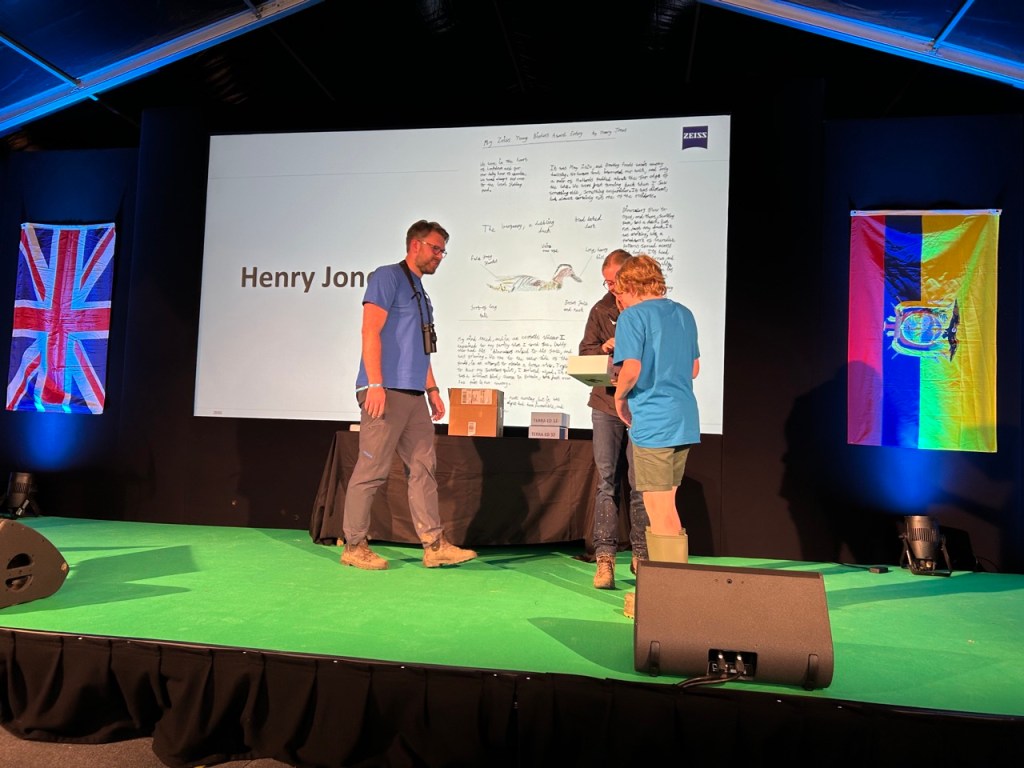
Then Stephen Menzie asked if I would come up and collect my prize, and the applause as I stepped onto the stage was immense. I collected my binoculars (8×32 Zeiss Terras; they’re really good) and book, and shook hands with Petra, a brilliant woman working for Zeiss. She congratulated me, and I walked back off the stage and back to my seat in the front row.
Me receiving my prize
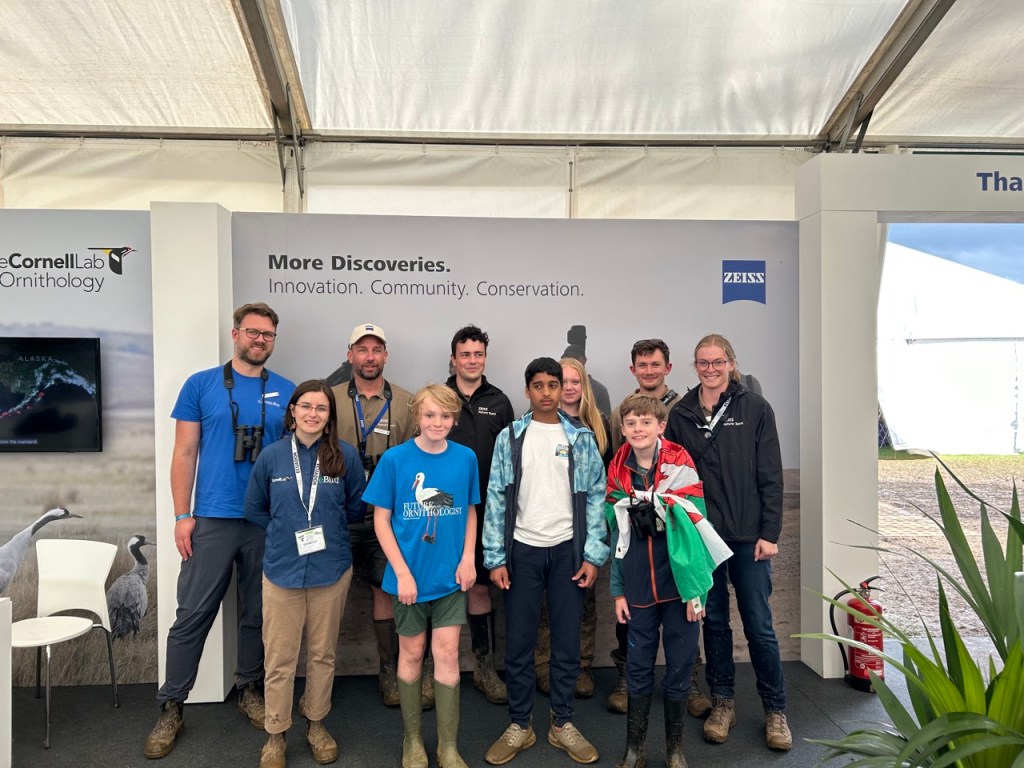
The presentation of the other two categories went by in a blur. 12-16 came next, and like before runners-up were announced and then the winner (although the winner wasn’t there either). They kept changing the presenter for each category as they went through. And the same passed for the 16-18s, and before I knew it everyone was leaving, and the winners and runners up were being asked to head to the Zeiss area in the Falcon Marquee for photographs. But the best thing came just after the show ended, and I actually got to meet Nick Baker! We shook hands and chatted a bit, before we took some photos of us together. Nick was brilliant, and I remember watching his lives during lockdown. He remembered all the instagram lives he had done, and was happy I had watched them. And then we said goodbye and we quickly began the two-minute walk across the field and entered into the blue and white of the Zeiss corner. The three younger ones (me and the two runners-up from the 12-16s) were ushered in front of the entire Zeiss team that had put together the award. Photos were taken, and then one of the runners-up from the 12-16 category came up to me and congratulated me. I said the same back, and suddenly a small and brief conversation was launched. His name was Levi Gravett, and he had already won the Martin Garner Spurn Young Birder award. He was brilliant, and really good to talk to.
The group photograph
And five minutes later, we were strolling across the saturated field that served as a car park, already looking to tomorrows visit with glee.
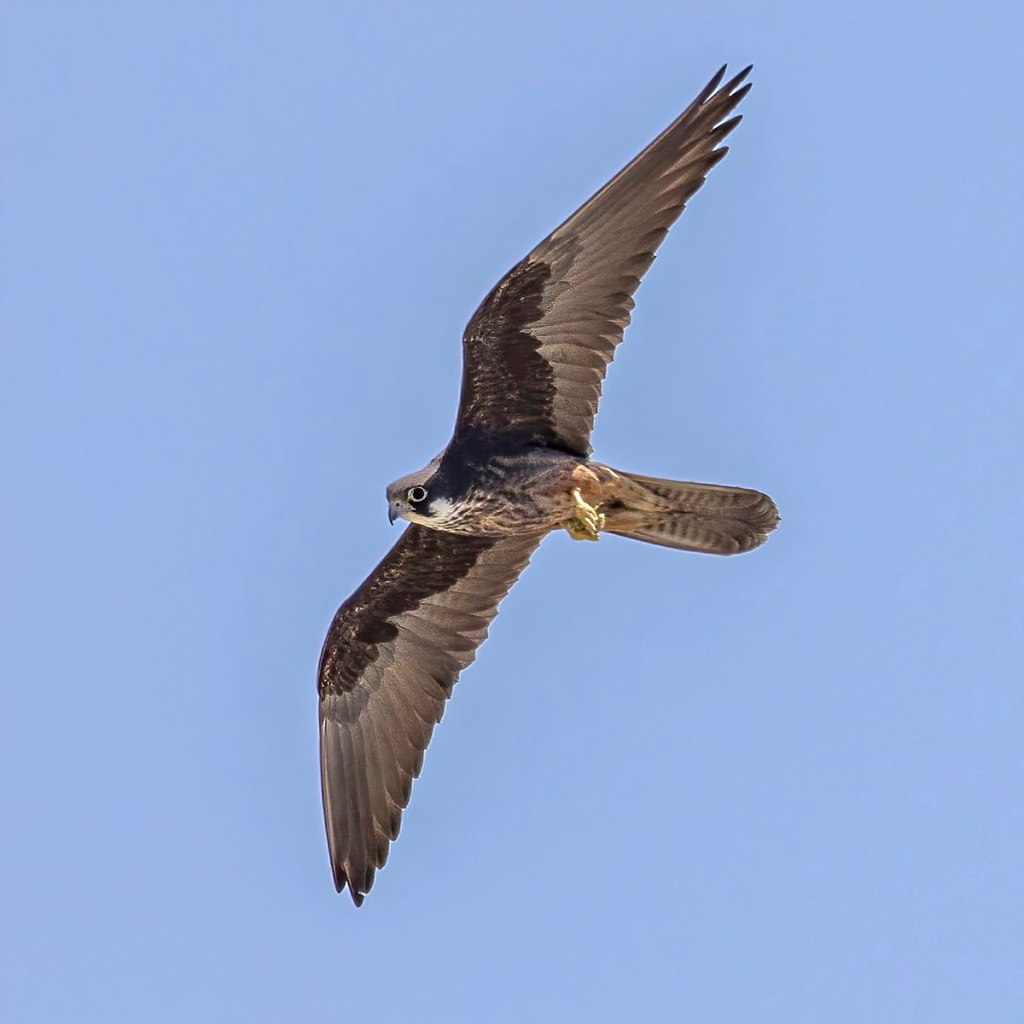
I first saw this particular bird when out birdwatching in the wild island of Mallorca, with one of the best local experts you could find, Pere Tomas. They were majestic, and for a bird of prey, surprisingly happy to be around each other, as they hunted the many insects flying about the air. I hope you learn more about them here.
Photo from Wikipedia
Plumage
There are two morphs (different plumages) of these birds: a light and a dark. The dark morph is a rich chocolate brown, and when seen well in flight the outer wings appear slightly paler than the stomach. The light morph, however, has a rusty-brown underside when seen in flight, with grey/black wings. It also has a rounded white cheek, a bit like a Hobby, a bird I am yet to see.
Diet
This bird has an incredible diet, adapting it to the time of year. When overwintering in Madagascar, its main food is insects, so locusts, beetles and butterflies and moths. And when it arrives on its Mediterranean home in summer, it begins gorging itself on similar foods, these being readily available. An interesting thing about this, however, is that they are willing to feed alongside much smaller birds, such as swifts and swallows. And once finished here, late in the season, it will move to its colonies on Formentor, a prominent headland in the north of the island. Here it will proceed to begin breeding, laying its eggs. By the time autumn migration begins, the chicks are hatched and begging for large amounts of food, and it is literally flying right towards its parents. Formentor is a headland jutting out for miles, and an important stopover point for many migrants. And the falcons take the more manageable ones to give to their young. Evolution is a truly awe-inspiring process.
Habitat
They prefer to breed in scrub and on cliffs, and the Mediterranean islands have plenty of this particular habitat. Islands such as Cyprus, Ibiza and Mallorca are perfect for them! They will overwinter in Africa, specifically Madagascar.
Migration.
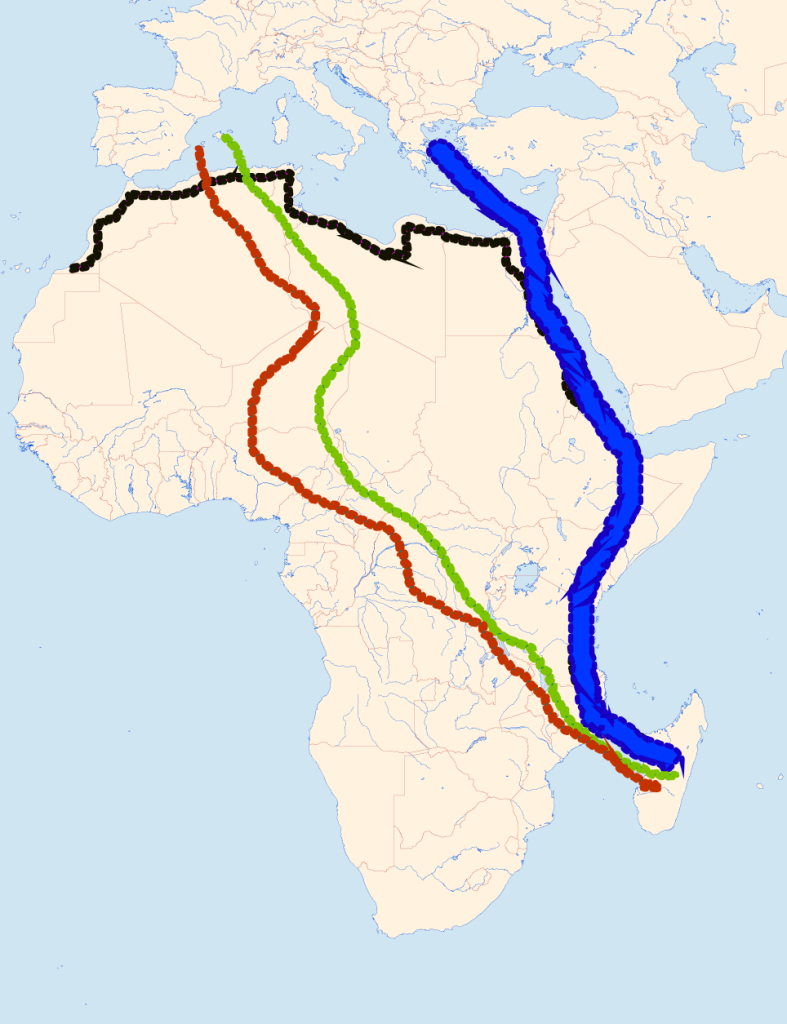
The Eleanoras Falcon is a long-distance migrant, which travels from Madagascar to the Mediterranean in the spring, and back in the autumn. This amounts to a distance of over 9,500km. And that’s just one way! It truly is incredible.
This map shows the migration route of the falcons. This photo is from Wikimedia Commons.
Range
We have mentioned this already, but their breeding range incorporates most of the Mediterranean islands, and parts of the North African coast. They overwinter in Madagascar, and then complete their migration all over again.
British Status
This falcon is an incredibly rare vagrant to Britain, a true MEGA if you were ever to find one here. Only clocked seven times since records began, the most recent record was actually only May last year, down in Kent. It sparked a huge twitch, with people coming from all over the country. To find this bird would be very lucky indeed.
And there you have it! We haven’t done a Bird Spotlight for absolutely AGES, but I hope this was useful and informative. And the possibility of any rarity on your local patch is one of the many excitements of birdwatching. Get out and just give it a go if you haven’t already. Trust me, its fun. And sometimes, its the more common birds that are nicer to see.
For the first time ever, me and my family are about to do something I have always wanted to do. We are going to the annual BIRDFAIR, one of the best bird-based fairs on the planet! Held in Rutland, where the Ospreys have only recently begun to breed, it is an incredible opportunity. And I have been given this opportunity thanks to one thing. The Zeiss Young Birder Awards…
The Zeiss Young Birder Awards are as follows: every year, they choose a winner from three age categories. This year, the task was to write, draw or interpret in any way your best birding memory, and a specially selected jury would be chosen to pick three winners, which would then be announced at BIRDFAIR by a guest presenter. This years is Nick Baker, a well-known naturalist, formerly based in Devon. And the reason that I am going to Birdfair is because I won this award.
Pere Tomas was actually the one to tell us about this award, and he said both me and my brother Bertie should try for the 11 and under category. Bertie chose to draw his experience of Albufereta in Mallorca, and I chose to write about one of my earliest birding memories. Finding a Garganey on my local fishing ponds completely accidentally, and drawing a picture, annotating it and writing a poem about it as well. It took a long time, but clearly it was worth it!
And so this is my pre-birdfair post.
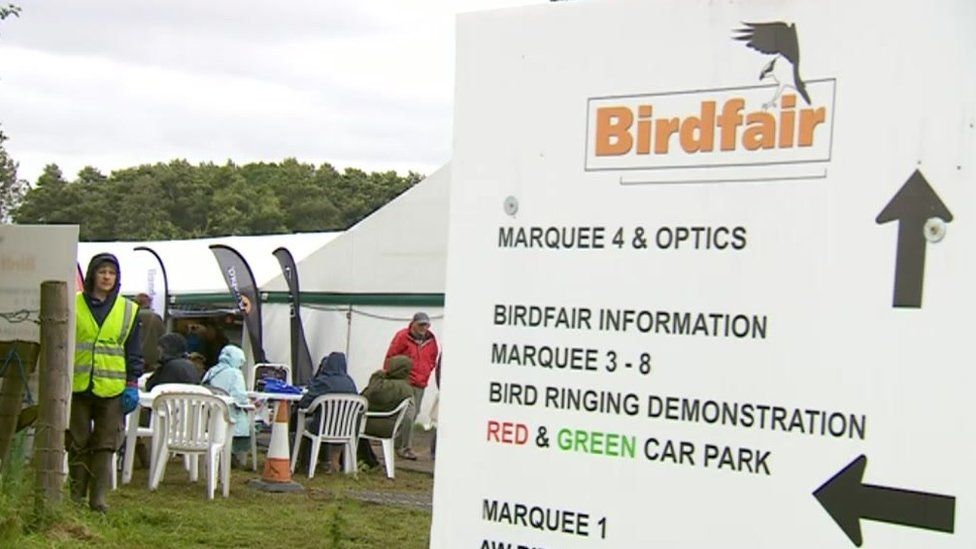
Photo from the BBC
Supposedly scrapped last year, due to the carbon footprint of travelling guests and visitors, it has been rejuvenated by groups of determined people across the world, and I am incredibly grateful for this. Starting out in 1989 as a few tents in a muddy field and a younger Bill Oddie as the main guest, it has come a long way from then. Charities, organisations and bird tourism companies all try to get in on the act, not to mention the birdwatching celebrities that visit every year, and take part in the festivities. Chris Packham, Jane Goodall and many others have all joined in there.
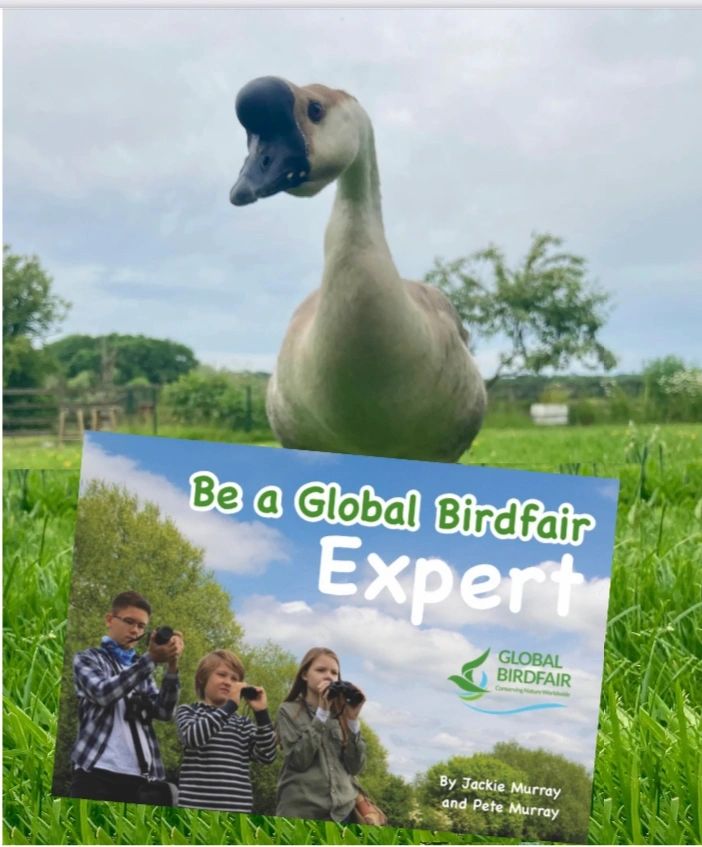
A free book is given to every child who takes part in Birdfair. This photo is from globalbirdfair.org
Charities such as Birdlife International, the RSPB and CABS all play their part, alongside various magazines such as the BBC Wildlife, Birdwatching and Birdwatch. Last year there was a total of 245 exhibitors, which I think shows just how much of a global thing it is. And on top of that, there are 5 stages all named after birds. Some are for lectures, some for authors and some for events such as the Zeiss Young Birders Award.
Another good idea of Global Birdfair is to have a podcasting station, where you can listen to a variety of bird-related podcasts live, and there’s a workshop station offering forty five minute workshops for anyone who wants to try, including owl pellet dissection, moth trapping and nature writing.
The RSPB are not just exhibitors, but they have their own entire area called The Nest, a special nature-discovery area for younger ones, as well as setting up an animal bone trail and a nest-box challenge!
Long story short, it is apparently BRILLIANT and I cannot wait to visit my first ever Birdfair!
And now, ladies and gentlemen, it is the end of our Mallorca series. This will be the last post of our time in Spain, but I hope to return someday, and write once again about this glorious island that holds a special place in my heart. We’ve had lifers, local experts, birdsong and long walks. But on that final day, a reminder of our holiday came to call…
It was time to go. The suitcases were zipped up and stood outside the front door, their yellow colours gleaming in the early morning sun. Everyone was busy, loading things into the car, chasing the baby, or locking the doors. But I stood in the garden, taking one last look at the place that had created so many lasting memories. The Red Kite circled above, putting on a show one last time. It had been incredible, but one week is never a long time. It flies by so quickly, and suddenly you’re facing saying goodbye as soon as you’ve said hello.
But some things can make goodbyes easier. Only slightly, but still, easier. Like the Nightingale singing its heart out, saying its farewells. Thats the main thing I will miss. Just being able to hear all these brilliant birds that you’d be lucky to see back home without even leaving the villa. Tree Sparrow, Serin, Honey-Buzzard, Scops Owl. All of them wonderful, all of them elusive in England. But I think I might be back one day. And until then, there’s a Mallorca shaped hole in my heart.
We had previously met Pere Tomas on a chance tour of Albufereta, back before the Pandemic. It had been 2019, and we had spent a memorable evening birding. He was absolutely brilliant, his knowledge perfect, and if there was anybody I would choose to go out birdwatching with, it would be him. And this time around, we met again on the penultimate day of our stay. The arrangements were made, and we were off! Please enjoy this account of our trip.
It was 7:00 when a black car pulled into the villa driveway. We stood waiting under the porch, rucksacks crammed with essentials. We greeted each other. We (somehow) remembered each other from four years ago, and knew we were in the hands of an incredible local expert. It was around a 20-30 minute drive to our destination, and Pere heartily quizzed us on where we were going, and talked with Daddy in the front of the car.
We were heading to Son Bosc, on the fringe of the great Reserva Natural de sAlbufera, one of the most prominent and crucial reserves on the island. You cannot access Albufera from Son Bosc, but this lesser known site is one of the best Bee-Eater hotspots in Mallorca. The land, close to a working quarry, was once a beautiful habitat, filled with sand and soil mounds for the Bee-Eaters to nest, and luscious green spread all around (Pere asked us whether we had ever seen the Bee-Eaters, and of course we replied no). However, this all changed once the land was bought by a local hotel. They hoped to receive planning permission to turn Son Bosc into a golf course. This sparked uproar among the islands nature communities, and they fought against it. However, before they achieved planning permission, and despite the outraged cries all around, the hotel came in and flattened the entire thing.
Luckily, the golf course was never began, thanks to the efforts of people including Pere. But the damage was done. The mounds were gone, and in many parts industrial debris was scattered among the habitat. But many birds still remain, and just then the car turned down a dusty track with overgrown fields on one side and the quarry on the other. The vehicle came to an abrupt stop, and Pere lowered all the windows. He explained that the surrounding fields were a good spot for species such as Theklas Lark, and Corn Bunting. However, our first spot of the day was a Stone Curlew as we trundled gradually down the lane. Against the rich brown of the ploughed field at the end, it was incredibly hard to spot, except for when it moved around the fringes. And, just as we watched this, a Woodchat Shrike flew in to land on a towering conifer tree adjacent to the track. A good start, but more to come.
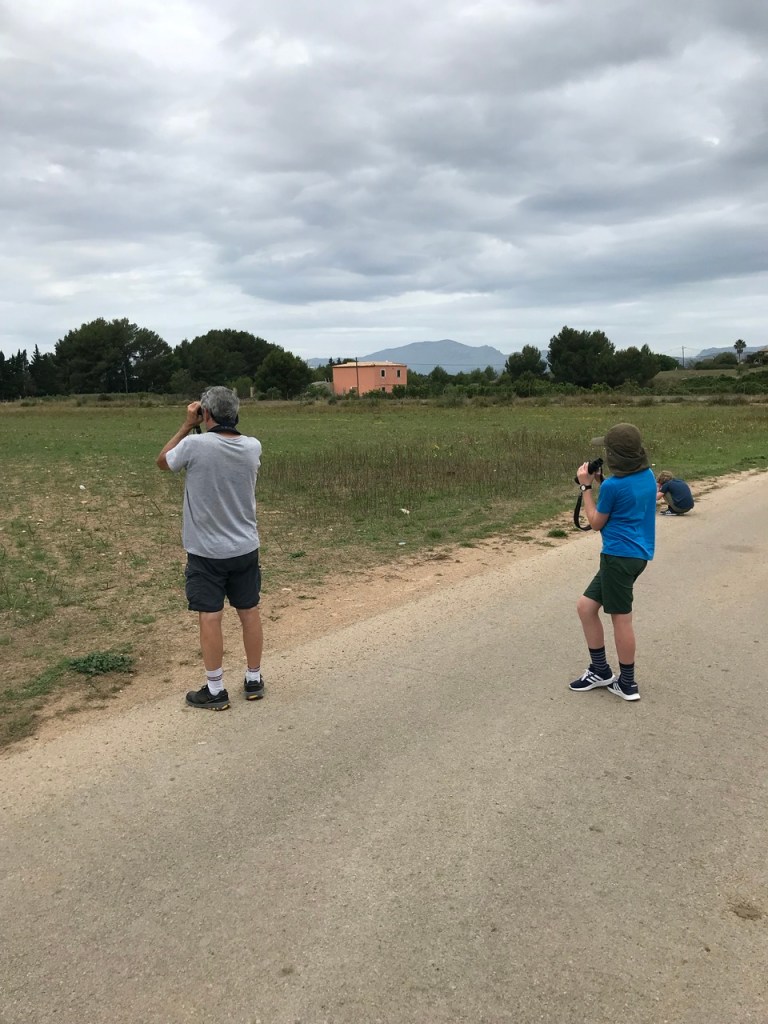
We began our walk down the track, leaving the car parked on the side of the road. Swallows flew low over our heads, and the swifts screamed. It was only around 8:00am by now, and the sun was low in the sky. A flock of finches squabbled over the grass they perched on, constantly flapping around and towards each other. There must have been about 30 of them, Goldfinches and Greenfinches, many young ones among them. It was odd seeing the Greenfinches out here, when we hardly ever saw them back home. This realisation showed the steep decline of English greenfinches even more obvious than ever.
The field where we saw the finches.
A sharp chirping call emanated from our left as we walked, in the densely vegetated ground on a slightly lower level than us ( clearly the hotel people hadn’t flattened the site very well). Nobody else seemed to notice, so I scanned the field of overgrown plants, and found a small brown bird precariously yet expertly perched on a swaying blade of grass. It was blasting its call out of its beak incredibly loudly. I pointed it out to Pere, identifying it as a possible Zitting Cisticola. It flitted away just as he got a brief glimpse, but it was enough for him to confirm my ID. In our previous trip to Albufereta, we had heard one of these special birds but not seen it. Now I had.
We had only taken another few paces down the track, when Pere pointed up and notified us of three bafflingly acrobatic birds, turning somersaults in the air on their quest to catch the abundant mosquitoes. On closer inspection, its plumage was glorious. Every bright colour you can think of, played a part in its grandeur. Blues, greens, yellows, reds, all blending together to create colours I can’t name when they mixed on their borders. This, of course, was the wonderful European Bee-Eater, which had recently nested for THE FIRST TIME in Norfolk, England. And this was my first time view of one as well! And the species this site is famous for. Me and Pere high-fived and we continued on.
We came to a small cluster of pine trees, tall and looming. And cradled in their boughs were about three or four of what seemed to be balls of messy, white hair. It looked to be some sort of nest, and Pere soon explained this. Pine Processionary Caterpillars had created these nests, a toxic species that can kill trees and cause severe allergic reactions in humans. People are encouraged to take them down before March, and burn the nests, but never make contact with the creatures. Sightings are on the rise back home, but they are a regular sight on the island.
But now onto a more positive note. A soothing, chirping tune played from these trees, one which I could not bring to mind, though it sounded familiar. Pere soon identified it though, but not before he checked if we recognised it. A Nightingale, singing its heart out for our audience of four. We attempted to find the bird, but it soon fell silent, and chances of seeing it were now slim. And just as we turned back, a flash of black, white and orange sped past, so close that if I had outstretched my hand, I could have touched it! Hoopoe! Happy, we pressed on down the lane. And just as we turned a corner, a Marsh Harrier drifted low above the tree-line. And, somehow, there was still more to come!
We came to a dead end, and turned back, heading towards the car, having just seen an elusive Cettis Warbler. This Warbler is a rich, rusty brown and really rather unremarkable, often going unnoticed; until you hear its song, of course. So loud and powerful, from such a small bird. Incredible stuff. And now we were back in the car, driving round to the quarry side. Pere told us to keep an eye out for Tree Sparrows in a large, metal, sort of barn, and the surrounding areas. But we didn’t see them, although we had heard them previously at the villa.
We continued to drive until the track got wider. A well-cultivated field was on our left, and, with quite the contrast, an overgrown one on the right. Pere had stopped the car with excitement, and directed us all to get out quickly. And I soon saw why. Two small birds of prey flew directly above us, so low we could see their plumage quite clearly. The body-shape suggested some sort of falcon, and both were a dark brown. Pere identified them at once as a pair of Eleanoras Falcons. But the strange thing was as they flew further away, they were joined by a third. And then a fourth. Then a fifth and a sixth. Rapidly, their numbers were increasing. They all seemed to be joining together, in a huge party. And then I saw why. The air was thick with insects, and they were all hunting them. And more birds were taking part. I think after about 20 minutes we were on 17, which was when we decided to move on. These falcons really were majestic, and this first sighting will remain etched in my memory for a long time. And to top it all off, Pere pointed out something else.
It was distant, and I will be honest, I had no clue whatsoever on its identity. But whatever it was, it was big. It almost seemed like an eagle, a creature I had only really ever seen on the television, or on the internet. But Pere pounced on the identification immediately. A juvenile Booted Eagle, circling the distant mountains. Wow.
Me and Pere watching the falcons.
We walked to the other side of the track, and stopped by the barbed-wire fence. We watched as a Kestrel floated lazily on the breeze, and a Marsh Harrier glided across the tops of the trees, intent on something below it. When it became clear not much was going to show here, we headed back out into the track where the car was waiting, and a Hoopoe flew up to perch on the fence near where we had just stood. Its plumage was a pink -orange, with a black and white tail. The contrast was just so stark and striking. A short-lived encounter however, as it dropped into the long grass moments later.
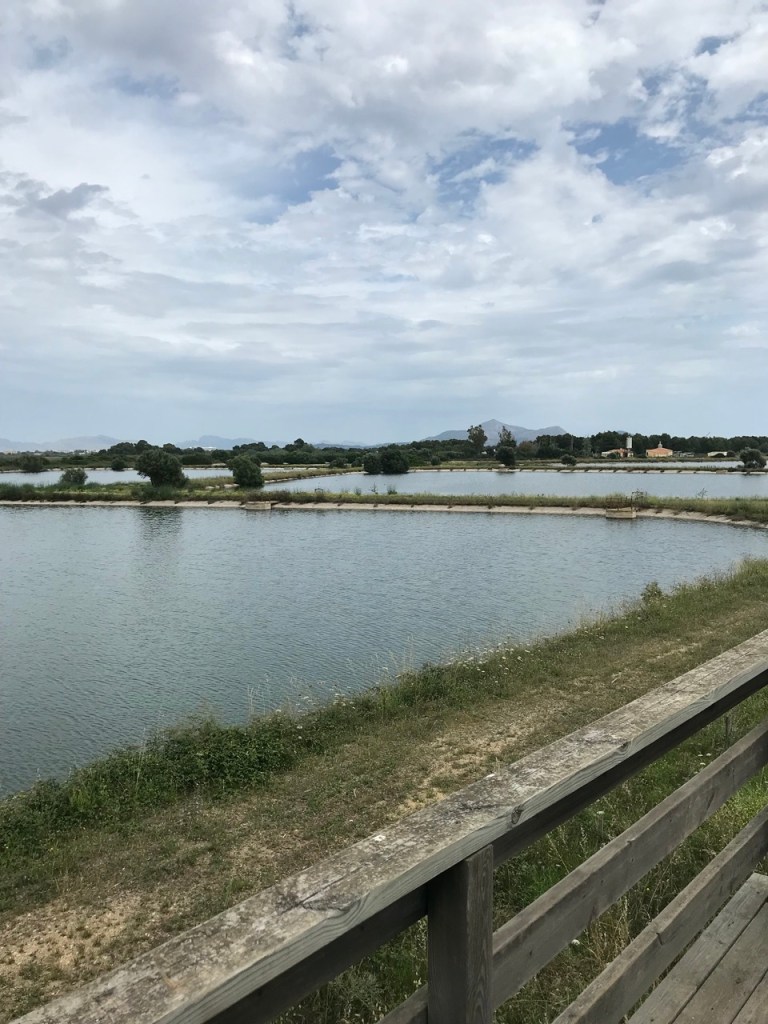
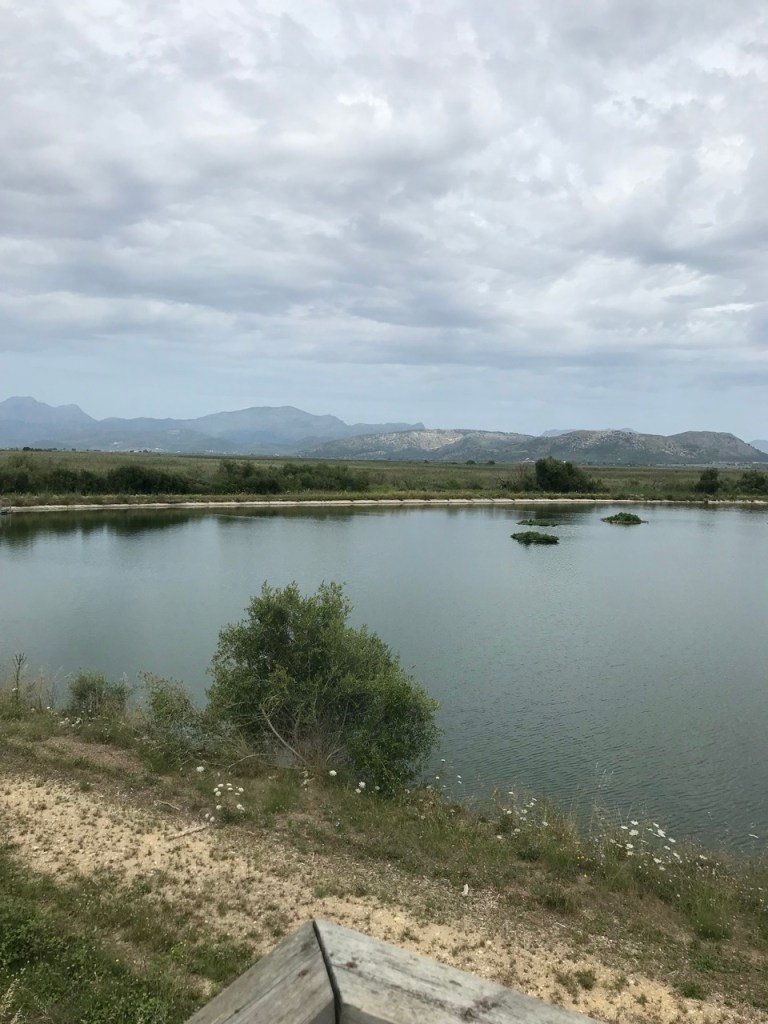
We parked the car by a gate, and strolled through on foot. It was a long, winding path, narrow right until the end. A large viewing platform, not unlike the one at Albufereta, loomed over a series of lakes, used by a sewage treatment plant. As we climbed the stairs, another song floated surprisingly close on the air. In a bare branched tree, at eye level with us, was a black-headed bird, with a blood-red eye-ring. A Sardinian Warbler, its operatic voice just for us. Beautiful.
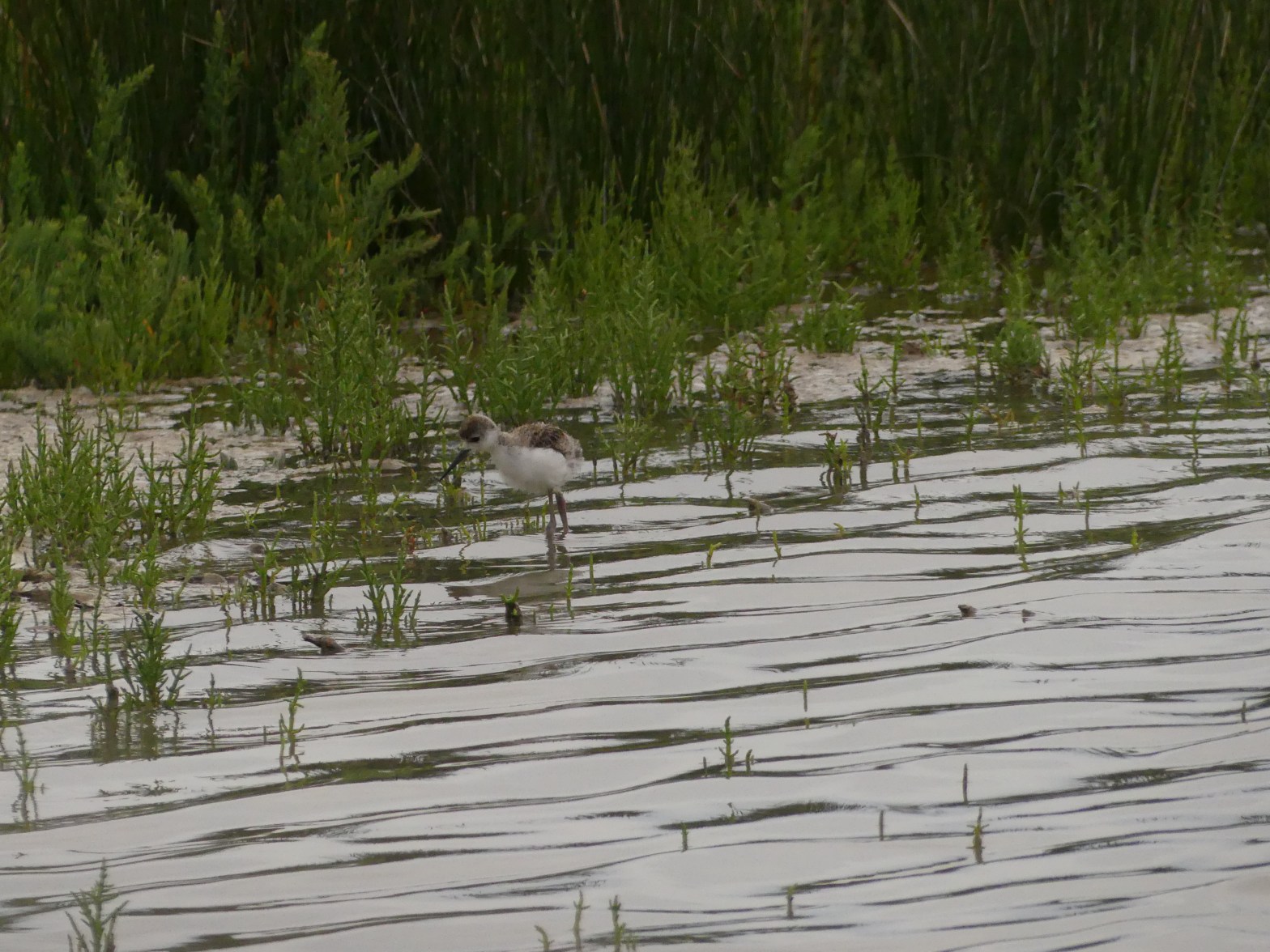
And the sight that met us at the top was twice as wonderful. I didn’t know where to start. It was a feast for the eyes, the amount of birds before us. Yellow Legged and Black Headed gulls lined the right bank, with around 30-35 Shelduck splashing about in the shallows. Mallards and Gadwall sculled across the centre of the water, and a Cattle Egret came in to land on one of the artificial islands. And on these precious few islands were Common Terns, about 10-20. And that was just on this lake. Pochard paddled about the next one, and Pere even found some Red Crested Pochards, yet another new species for me! A Marsh Harrier flew over, agitating the gulls and putting some to flight. Three Black-Winged Stilts took to the air, squawking raucously at the invader. But it soon passed, and calm was restored. A stonechat chattered next to us, perched on a reed. And that was when I noticed the expansive reedbeds on our right, stretching far into the distance right towards the edge of the mountains. It was such an extensive habitat, this whole island, which, despite SOME peoples efforts, like the hotel owners, still remained a natural paradise. Honestly, this whole outing was some sort of birdfest!
The lakes from the platform.The lakes again.
And as our trip neared its close, back at the car, the Booted Eagle put in another appearance. Except this time, it showed rather well. A brilliant way to round off our trip. But the end was not so quick in coming. As we drove home, Pere asked us if we had ever seen a Spotless Starling, and we, of course, replied no. So we went on a little detour round the back of Albufereta. And round there was a house. And on that house was the aforementioned starling. It was a smooth, glossy black, with no spots, unlike the ones back home. We got out of the car and watched this marvellous bird. We also saw Blackbirds here, and a Little Egret flew over our heads.
Back at the villa, farewells were said, and we promised to keep in touch. It had been one of the greatest birding experiences of my life, and as Pere pulled out of the driveway, waving cheerfully at us, I knew that I would never forget those goodbyes, and that I would be back someday. The island had me under its spell, and I happily jumped into its arms.
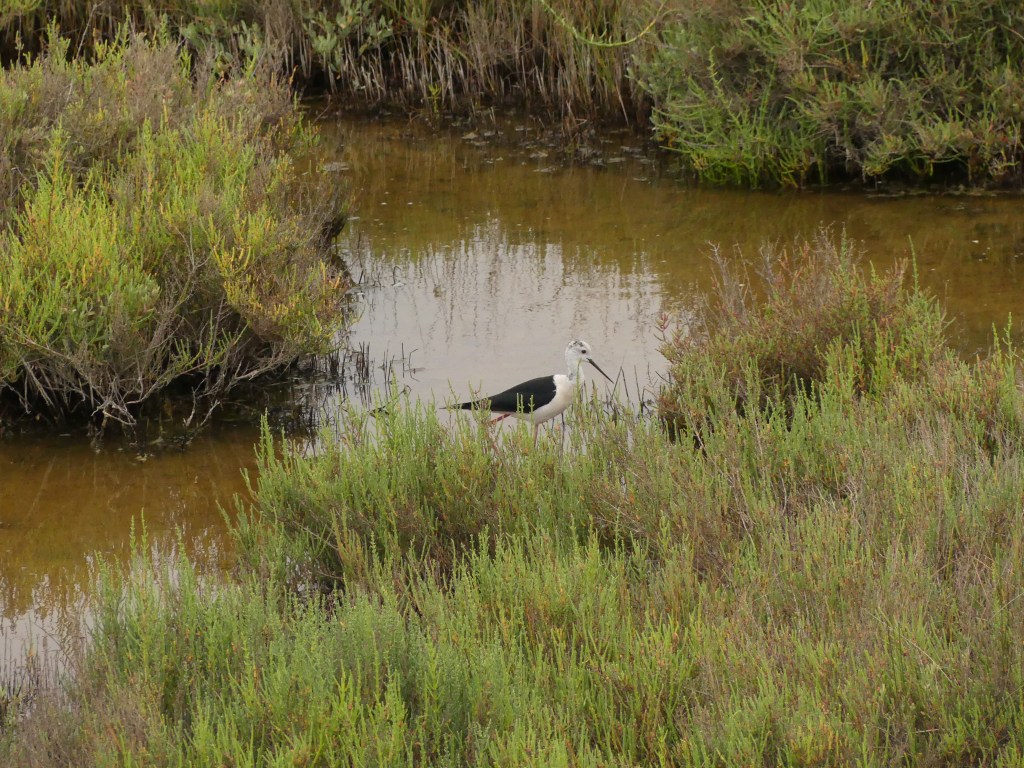
On the Thursday of our stay, me, Daddy and Bertie packed our bags and headed towards the site where I had my first proper birdwatching experience in Mallorca, around four years ago in 2019, before the pandemic. Reserva Natural de l Albufereta. It was here that I met Pere of Mallorca Nature Tours. He is a brilliant man, but more on him on the next post. If you would like to read about that first visit, there is a link here to one of my earlier posts. However, this time we were on our own with only memory to guide us, and we got off to a good start as we drove along the coast road-there was no wall, just open sea by the road- of the Bay of Alcudia. A bird with very distinctive wings flew over out to the bay to fish. A tern, although identification was tricky as I was leaning out a car window. However, it seemed a good omen, and this mood was improved as we parked, as a frustrated Black-Winged Stilt flew over, calling furiously. They’re smaller than you would realise, with long red legs and stark black and white plumage. It seems almost impossible for them to fly, with those huge legs dragging behind them. But they manage, and this one flew out to the extensive marshes, still rather grumpy.
A Black-Winged Stilt in the marshland fringes at Albufereta
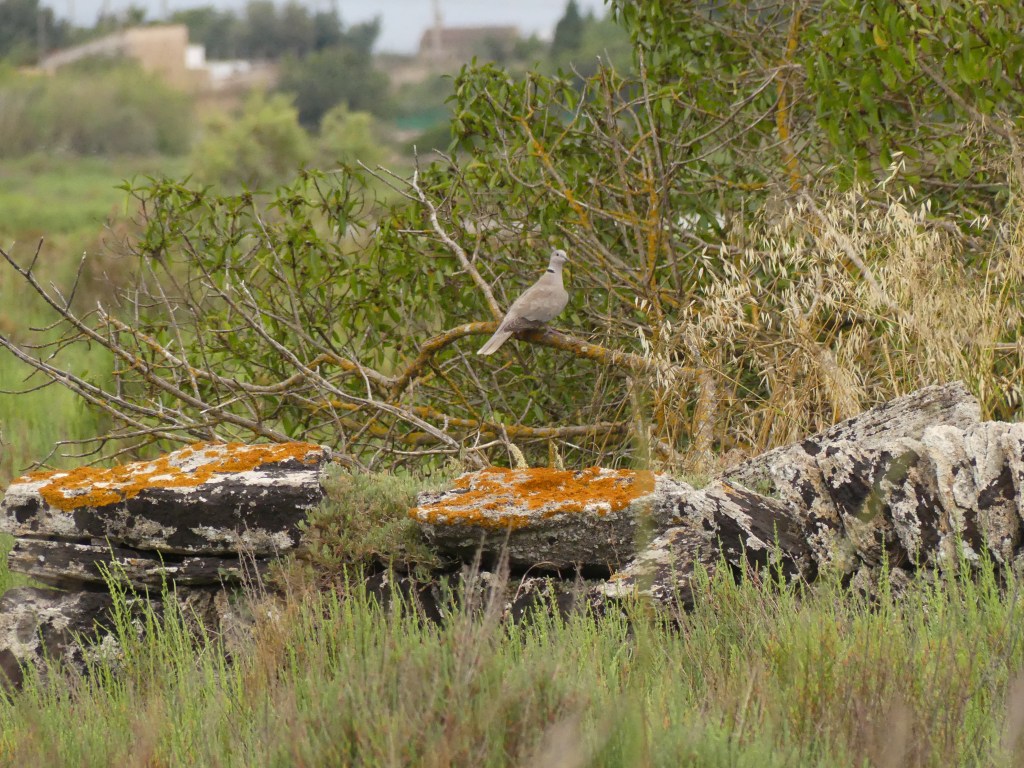
We began our walk down the dusty track, Swifts screaming overhead and Collared Doves calling monotonously. As we heard the sounds of many Terns, our pace quickened. We took a wrong turning towards a section of private land, but were rewarded with a pair of Blackbirds showing well.
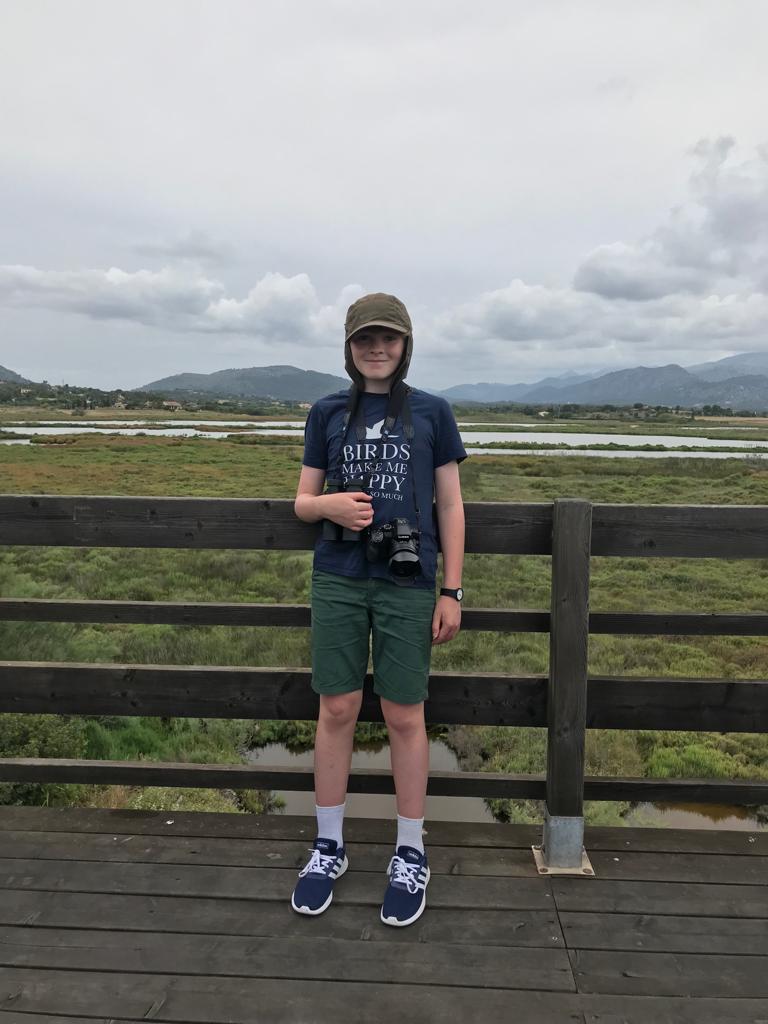
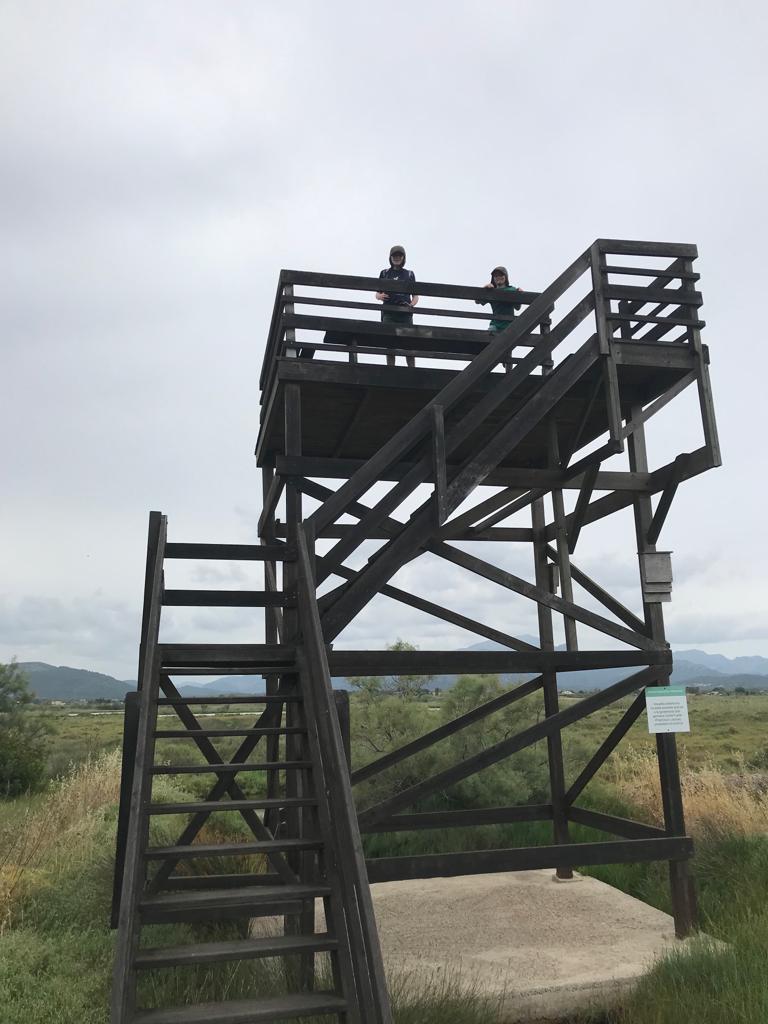
We continued up to our first stop, a towering viewpoint that loomed over the entire marshes. We climbed the stairs, and were met with the most breathtaking view. We could see for miles from up here, across the marshes, through the cluster of villas on the edge, and right up into the mountains. As we watched, a Kestrel glided past on the breeze, at eye level with us. It is such a special thing when you see these creatures at their level. Shelducks grouped in one channel, Mallards in another. Two Gadwalls came in to land on another patch of water. A Grey Heron wandered through the vegetation, its head swaying from side to side slowly in search of its next meal. The Swifts seemed much closer from up here, and you could appreciate their rich, chocolate brown plumage much more than you could have from ground level. Black Winged Stilts were everywhere you looked, and a Moorhens bubbly call sounded from the distance. Energised, we continued on into the woods towards the sounds of Terns.
We treaded quietly as we entered the woods, helped by the slight bed of pine-needles. What we had heard here last time was a Cetti’s Warbler. This time there was no Cetti’s, but a whole lot more. The first sound was the duel between two Greenfinches down in the undergrowth. The next was another finch, the Serin singing away from a prominent bough. The third came as a surprise to us. A Common Nightingale, an increasingly rare bird at home, trilled its beautiful song as loud as it could, just for us. A bird that had often appeared in the pages of folklore would now appear in the pages of The Bovey Birder. Just perfect.
A Collared Dove
Now the fourth… well its name was a bit of a tongue-twister. Try saying this three times fast: a Zitting Cisticola. Once known as the Fan-Tailed Warbler, it was moved to a different genus quite recently as it was more closely related to the Cisticola Family. It is the only Cisticola in Europe, and really is an incredible species. The way it squats between the flimsy reeds with one foot firmly fastened to each stem seems almost Physics-defying.
Anyway, as we came up to a stile on the edge of the woods, we heard another bird. But this one was especially special. A Eurasian Thick-Knee. Or, as I, and many others, know it, the Stone-Curlew. An oddity of the bird world if ever there was one, but a marvellous creature never the less. The cryptic plumage makes it almost impossible to see it against its preferred habitat. These birds are almost like a book that few have opened, it’s dusky brown feathers disguising its true behaviours, and meaning. For now, we rushed toward the hide with purpose in our strides, and closed the door silently behind us. I unloaded everything from my neck, and settled down to watch.
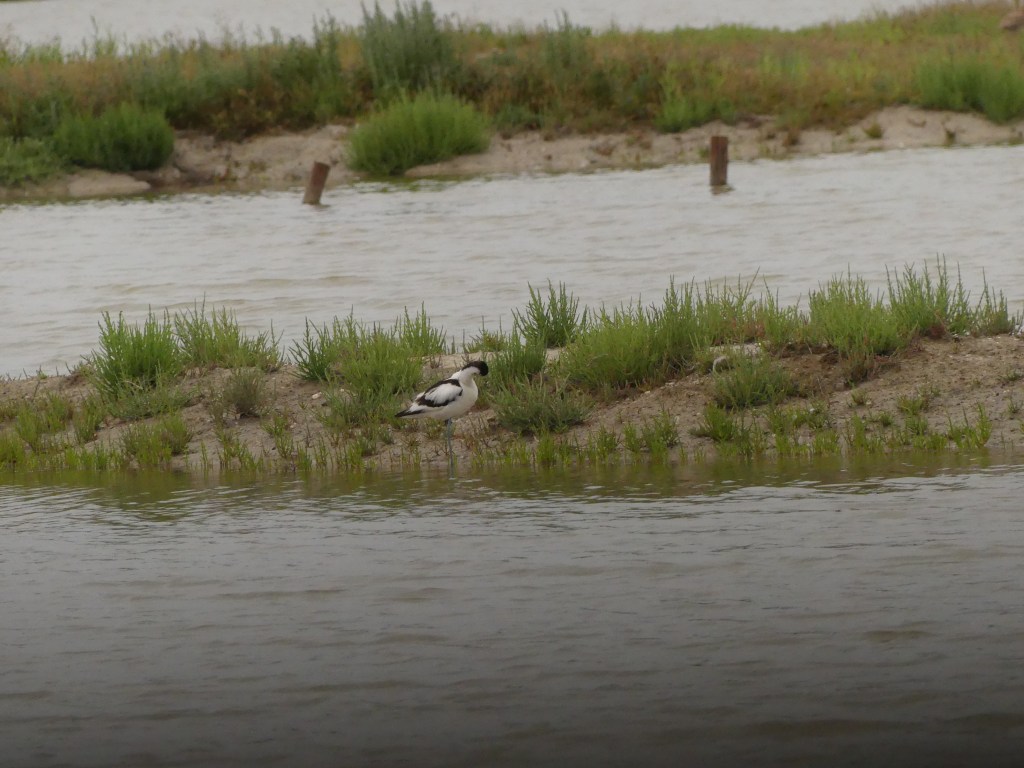
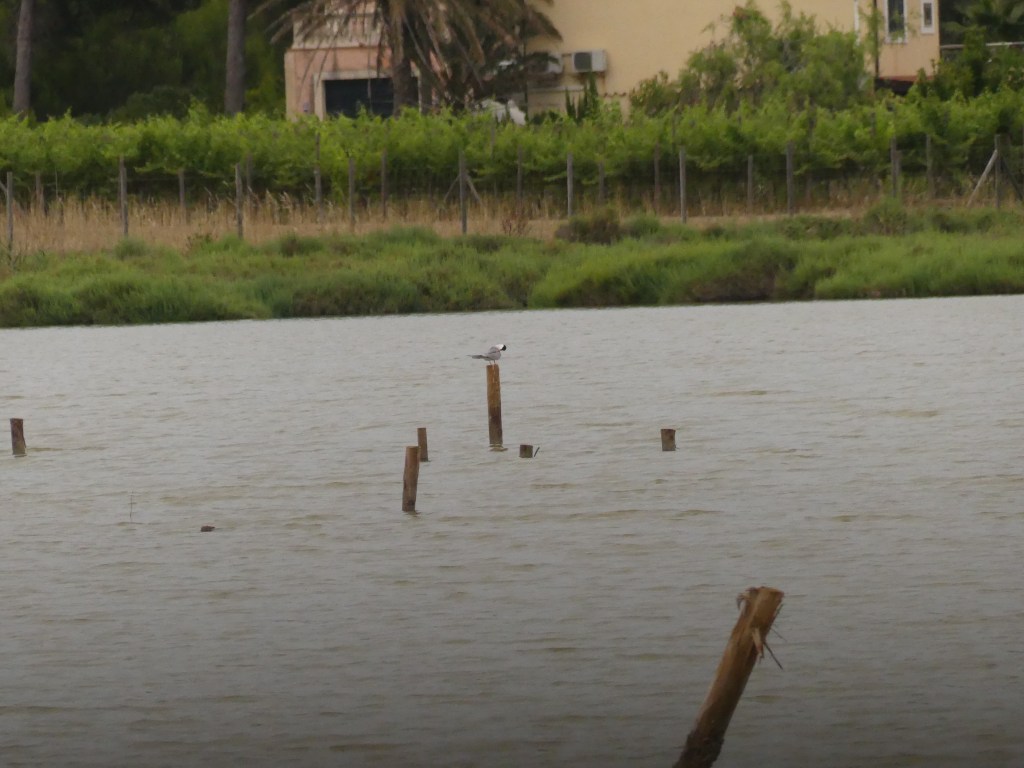
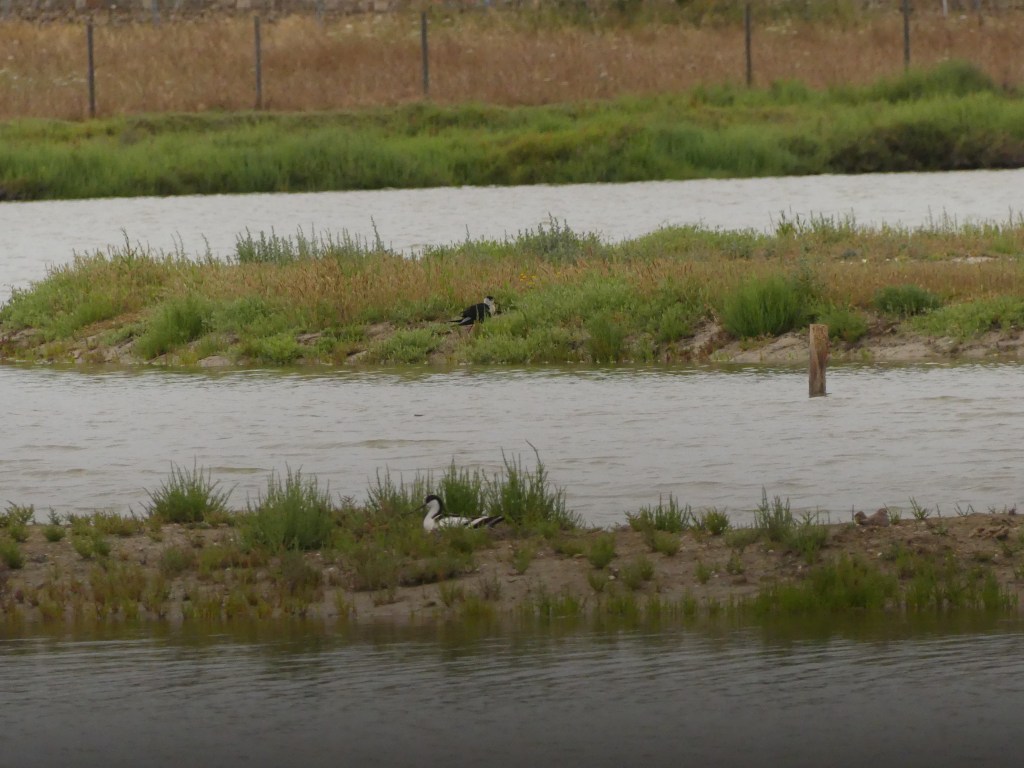
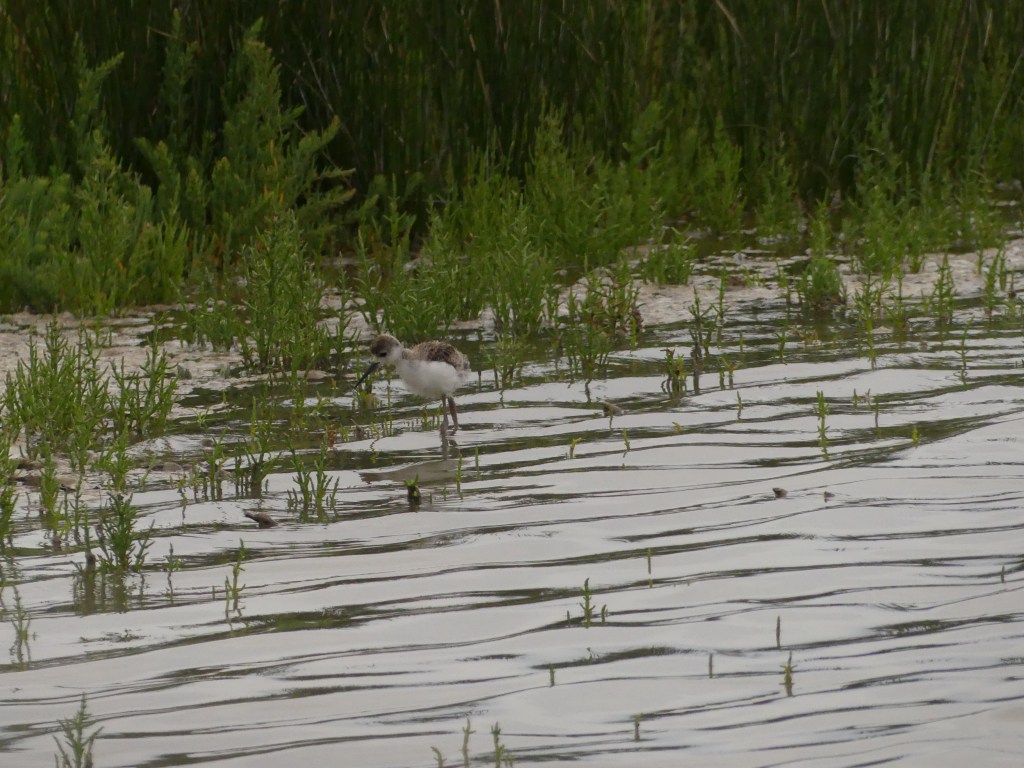
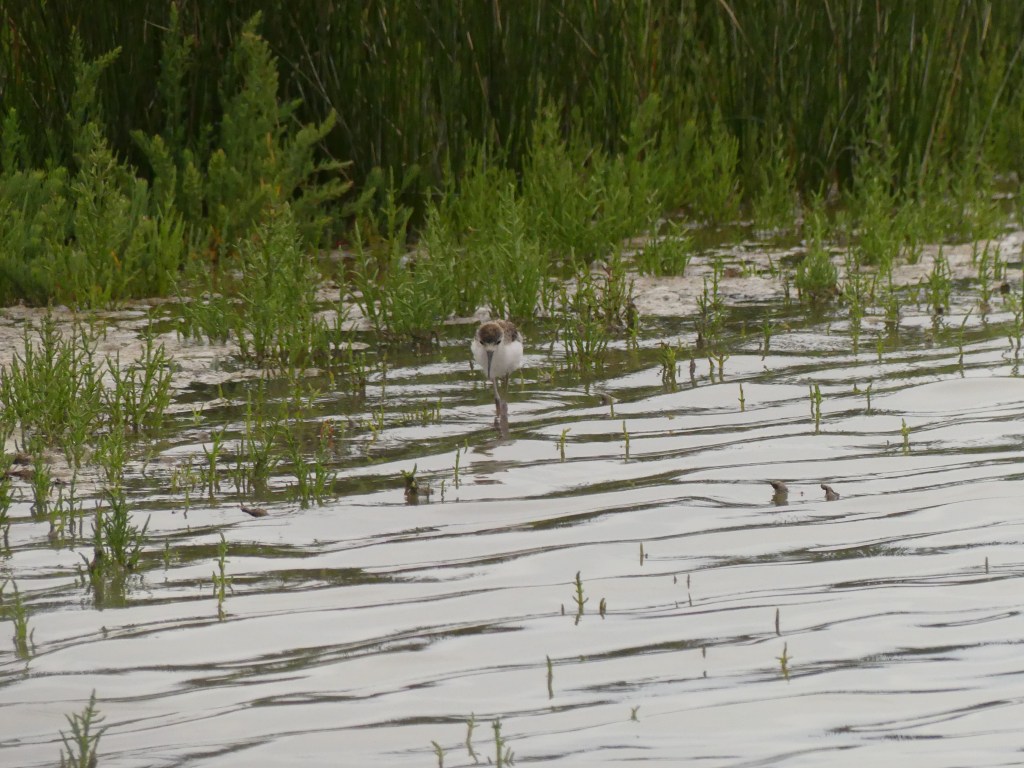
The first thing that struck me was three Avocets on the centre island out in the middle of the lake. This island was larger than many of its counterparts, and thinly vegetated. They all seemed calm, their upturned bills dipping lazily into the water. All calm, at least until the Common Terns began their ruckus. They were everywhere ,perched on wooden stakes jutting from the water, or harassing the now indignant looking Avocets. All of their blood-red bills were stuffed with fish. Their white and grey plumage and black caps all glistened with water droplets. Some even shook a little, in a vain attempt to dry themselves off. By now, the Black-Winged Stilts had arrived, and had joined forces with the Terns in their campaign to torment the Avocets, calling surprisingly loudly for a bird of their size, and the Avocets strutted around, clearly agitated.
A striking AvocetA distant Common TernAn Avocet with Black Winged Stilt behind
Suddenly, Berties voice cut through the sound of the birds. He pointed out a tiny Avocet chick stumbling about the shallows, with a watchful parent following it closely. It was really fluffy, with already rather long legs and a sandy beige back. Again, a voice pulled me out of my trance, but this time it was Daddy, and he had spotted three Stone-Curlews over on the far island! The binoculars swung round automatically. The birds cryptic camouflage came into play here, making it almost impossible to see them against the brown and green. But you could just make out the shape of the avian creatures. They seemed almost eery, the yellow eye ring almost glowing as the sun hung low in the sky.
The young Avocet
My eyes were drawn to movement directly in front of us on a sparsely vegetated sandy stretch. Two small birds hurried about, seeming busy about something I did not know. They looked like a pair of plovers, although not one I was familiar with. One of them was rather fetching, with a rufous coloured nape, and a black streak across its white face. Its crown was the same colour as its back, a sandy beige. Its underside was the same white as its face. The second was similar, but had a yellowish curve behind its eye, and that sandy beige colour also on part of its white face. The crown was beige again. These could be none other than a pair of Kentish Plovers, a male and a female in their Summer plumage. Back home, this was a rare passage migrant or a vagrant, and a brilliant sight to see. Here, in its breeding plumage, these birds were wonderful to watch. Their antics were almost comical, darting about, retreating from the waters edge, ducking behind short tufts of grass.
Another new species. And still more to come!
A Cattle Egret flew over, and on that note, we decided to move on. We continued our trek down the path and came to our final pitstop. A wooden platform rose above the fields and marshes, and this was the place last time we had seen the Stone-Curlews, along with 2 young Ringed Plovers. However, not much turned up this time as the rain began to pour. The Black-Winged Stilts were still out in force, piping their alarmed cries into the evening air. At this point, we met a man who was also out birdwatching, and also spoke our language. We said hello, and he explained how he had just flushed two Hoopoes up ahead behind the stone wall. We talked for a bit, and then continued on.
We turned into the hide one last time. Nothing much had changed, except the Avocets had moved about a bit. But just as I watched a Common Tern dive into the water and come out with a full beak, a brown blur flew in and out of my binoculars in a split second. I lifted them down from my face and watched as a Stone Curlew disappeared around the corner of the hide, now incredibly conspicuous. It came as quickly as it went. The moment had lasted about three seconds, but had felt incredible nonetheless.
On the walk back we failed to see the Hoopoes, but were serenaded by a Serin which gave fleeting views, but its song was always there. It had been a brilliant evening, and as we walked under the screaming Swifts, everything felt at peace.
We are back in (rural) Mallorca once again, and this time our accommodation played a much larger part in the birdwatching side of things. A lot of the birds that will be mentioned were heard from the villa, and then seen elsewhere such as the Sardinian Warbler. This is an account of all birding completed from our home away from home, covering the entire week of our stay.
The villa was an odd one, with chickens, cats and dogs regularly entering the garden from the lemon orchard behind. Because of this, there were lemons scattered along the ground. The place had a friendly, comfortable atmosphere, however, and proved to bring some of the best birdwatching opportunities I have had in a long while. The orchard was separated from us by a flimsy wall of tall grasses, easily bypassed by the various domestic animals that visited the garden.
Now, please enjoy this account of mornings, evenings and afternoons birding (incidentally) from the best rural comforts, with the best mountains providing the best backdrop.
Day 2
Our first full day in Mallorca was (arguably) one of the best, bringing a flood of brand new species. To start, we found a Serin in a tree growing right by the swimming pool, its melodious song floating on the warm breeze (37 degrees celsius warm breeze!). The Serin was once a popular cage-bird, and you can tell why. Not just from its song, but from its beautiful yellowish-green plumage as well. Thankfully, this practise is no longer legal. The raptors that flew over also gave relatively good views. We saw a lone Honey-Buzzard pass over that day, along with a Red Kite that would continue to return to this area reliably for the remainder of our stay. To top it all of, we heard a certain Eurasian Scops Owl that night. And yet, after I had gone up to bed, the adults reported actually seeing it flying low over the garden. Unlucky for me. But that was only the first night. Off to a BRILLIANT start, I would say.
Day 4
I had to wait TWO WHOLE DAYS to finally hear that Scops Owl again, and it came even later into the evening since last time. The thing is, I thought I saw it, but nobody else did. But I still believe my eyes, and what a way to top a great day off. Scores of Swifts had flown over that day, with a lone Pallid Swift heard among them. The screams were monotonous, but welcome in my eyes. We also had the luck to hear a Tree Sparrow that day, an increasingly rare species back home. Sardinian Warbler also featured, an absolutely incredible bird to hear. Striking to see, and we would go on to see it away from Villa Rico.
Day 5
An incredible day, possibly The Best of our villa birding. Serin, Kestrel, Scops Owl, Red Kite and Tree Sparrow all featuring once again. But something really special proved a highlight. A strange call for a strange bird was heard at around four o’clock that evening. A Stone-Curlew (or Eurasian Thick-Knee). Another very rare bird back home, but regular here. Almost impossible to see against its natural habitat, due to its nondescript plumage, a speckled, light brown. One of the oddities of the avian world that’s for sure, but also one of its beauties. This probably would have been the best of the night, if it wasn’t for the call of a VERY special raptor. An absolute gem back home, it was the Osprey. What a sound to hear from our villa. A mainly fish-eating bird, the black-and-white Osprey is beginning to make a comeback in England, having been almost hunted to extinction in earlier years. With the recent success of the Poole Harbour pair, hearing this bird seemed even better than it might have done.
Day 7
Our final day, we had to be out of Villa Rico by 10:00am. As I went out into the garden one last time, a Nightingale sung to see us off. It just seemed right to be leaving on this note, and I was sure we would be back once again.
So there you have it. The birding highlights of a brilliant stay in the wonderful Villa Rico. More posts are to come. Stay tuned.
We were back in Majorca once again, for the second time. We had visited 4 years earlier, just before the pandemic in 2019, and thoroughly enjoyed every moment. Well, except the mosquitoes. However, this time was a little different. Our Grandparents had arranged this one, and they flew out with us towards Palma Airport. That is how we found ourselves driving north in the rental cars (one for us, one for them) towards Pollenca. It took patience, a SAT NAV and many phone calls between the two vehicles to reach the long winding road towards our villa home for the next week. But as we rumbled down the lane in a two car procession, a small, striking bird hopped onto a wire fence beside us. A stark, rusty red head and nape, with contrasting black and white down its back, and a white breast and stomach.
A summer visitor to the Balearics, a male in full breeding plumage. This was a handsome Woodchat Shrike, a vagrant to Britain, a mainstay down here. And a new bird. It seemed a good omen as we pulled into the drive of Villa Rico. Of course, it was dusk at that time (10:30) and there wasn’t much else after. But the birds we would, in due course, hear from our home away from home, may come as a surprise. It did to me. In fact, I can actively be heard swearing (sort of) on a recording of a very special raptor. But that will all be available later on. For now, more posts are forming. Stay tuned.
 The Bovey Birder