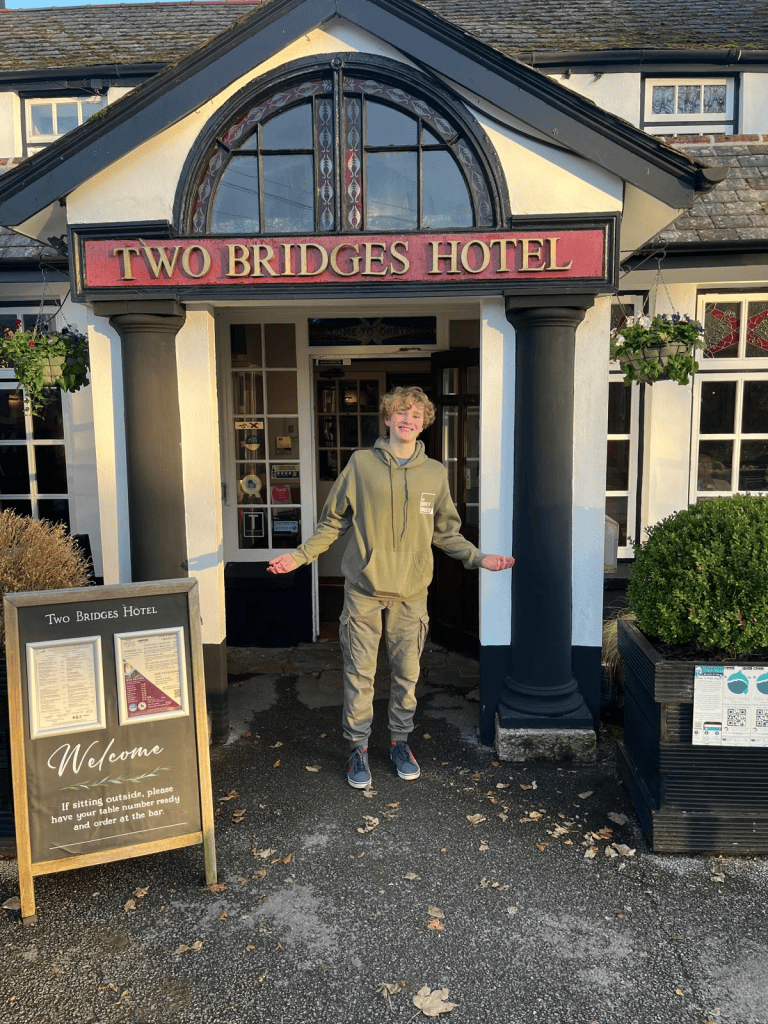
The Two Bridges Hotel is a stunning old building, set in a location that almost seems unreal in the Dartmoor sun. Surrounded by a sweeping landscape, grassland, heather and hills, snaked by the West River Dart, the latter of which is spanned by two bridges, one modern and one an old, disused clapper bridge. This is, of course, what gives the Hotel it’s name, and on Friday it hosted an incredible event to celebrate Dartmoor National Park’s 75th anniversary. I was lucky enough to be invited to speak at it, alongside several other Dartmoor Youth Rangers and a select few hugely inspiring orators. The array of amazing people in attendance, from rangers and executives to farmers and conservationists, was proof of an immensely strong community that calls the Moor home, one that I will admit I was positively terrified to talk in front of!
A wide range of topics was covered by those speaking to an enraptured and supportive audience, but they all boiled down to a love and raw passion for Dartmoor. Some had grown up alongside it, others had visited and fallen head over heels with it, but whatever the origin story, everybody in the room that day was committed to its longevity. History, conflict, folklore, forestry and opportunities were all touched on, but I spoke about hope, using tales of my birding, experience of management and other stories as a vessel. That makes me sound old, doesn’t it?
So without further ado, I’d like to introduce Kate Ashbrook, or Campaigner Kate. As well as being an incredible activist and a splendid human being, Kate finds time to be the General Secretary for the Open Spaces Society (England’s oldest conservation society) and to fulfil many other roles, one of which was to speak at Friday’s event about the history of the National Park, leading up to the present day. Of course, Dartmoor was formed when a massive molten bubble of magma pushed up through the Earth’s crust, before cooling gradually underground to form granite. I’m no geologist, so I’ll stick to that brief overview before going into what this section of the blog is actually all about, and what Kate spoke about.
Dartmoor was designated a National Park on the 30th October 1951, 75 years ago. It was one of the earliest National Parks to be created, the last of that distinguished first quartet – Peak District, the Lake District, Snowdonia and Dartmoor – after the 1949 National Parks and Access to the Countryside Act. To become a National Park, Dartmoor met the criteria of having natural beauty, extensive terrain for activities such as walking and riding, spanning a substantial area, and hosting rare plants and wildlife. The reaons for Dartmoor National Park are obvious to any visitor, and for those sorry fellows who haven’t had the opportunity, by the stories carried by word of mouth. It’s unique natural heritage; Dartmoor is one of England’s last true wildernesses, and yet it has been shaped dramatically by humans for generations.
And yet, it has had it’s ups and downs. Political conflicts have scarred the landscape, and industrial interests have left their imprint on the rock. Meldon Reservoir, a popular site with visitors and a place I have birded many a time, hides a fearful past. In 1962, the North Devon Water Board proposed to dam the West Okement River, flooding the natural beauty and habitat of Meldon Gorge, in order to secure water for the growing lowland populations. Other proposed sites in Gorhuish and Townleigh promoted by the Dartmoor Preservation Society (DPA) and National Parks Commission, were rejected.
Spearheaded by the legendary activist Sylvia Sayer, who also happened to be one of Kate’s dearest friends and mentors, the proposal was fiercely fought. After all, wouldn’t it show National Park status to mean nothing in the face of industrial interest, while losing an area of incredible natural beauty and importance? Regrettably, the battle was lost, and the dam was completed in 1972. After its completion, activists discovered the reservoir lay upon toxic 19th century mines and spoil heaps, running the risk of leaching lethal amounts of poisons such as arsenic into the water supply. The reservoir reqired extensive testing and work before it became operational, and justice was, in a way, served.
There were victories as well. Following the conclusion of World War Two, the military held 72,000 acres of Dartmoor land for exercises and training purposes. However, Sayer (here she is again!) argued their presence threatened archeology, wildlife and the public. Wasn’t this the reason Dartmoor had been declared a National Park in the first place? Sylvia Sayer was determined; in 1966, she and her husband walked onto firing ranges during exercises to collect evidence of damage to historic stone rows. The subsequent year, in 1967, she took a walk beneath low-flying military helicopters, putting herself at serious risk, in order to expose the danger of aircraft within the National Park to ponies and the public. In the end, her actions forced a public enquiry that cut military land within the National Park from 72000 to 33000 acres, a resounding victory for her, the DPA, the National Parks Commission and environmental activists globally.
There were many conflicts between the National Park and those who might do it harm and threaten its status. Come forwards to the present day, where arguments over wildcamping and land ownership continue as noise in the background of a strong, yet fragmented, Dartmoor. Its mosaic of habitats mirror the many people from different walks of life quarreling over it, and as such in areas, these habitats are damaged, not beyond repair, but damaged all the same. Species are declining and people aren’t all on the same page, holding views that are proving divisive in some ways. To mend the landscape, landowners, conservationists, farmers, the military, industrialists and the public all need to find some common ground, and to do that, some form of compromise is going to need to be reached sooner rather than later. Without it, progress simply can’t be made, and Dartmoor is going to become ever more vulnerable in the future.
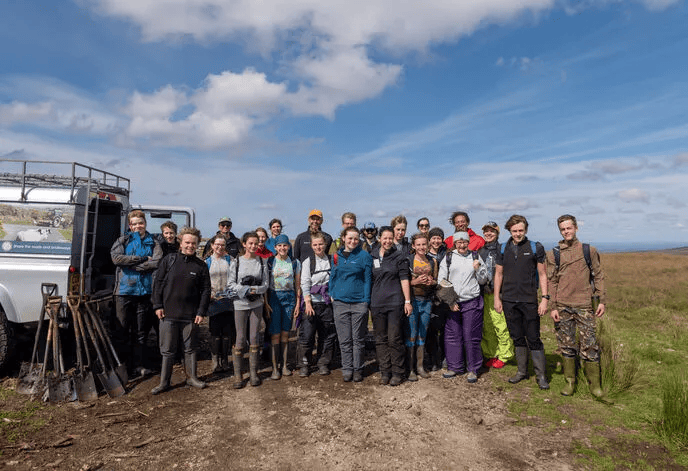
So what can we do? Well, I’m going to take you back to the anniversary event. It was telling that the youth rangers speaking, the future, were given such attention and time. Our quartet consisted of Tom, Iona, Lowena and me, and we discussed many a thing as to why Dartmoor is important, weaving a joint vision for the future. It was clear that all four of us had a strong personal connection to Dartmoor, its heritage and its wildlife, and we, like everyone, wish to see it thrive.
If it isn’t clear to you that some things must change, then now is the time to pay attention. Habitats and ecosystems are crying out for restoration; to give an example, take our peatlands. Dartmoor’s are globally important, both for their carbon storing capabilities and for their specialised plant and animal inhabitants. Yet, just 1% of Dartmoor’s peat bogs are considered healthy and functional according to the University of Exeter. The other 99% are dry, eroded and releasing their valuable stores of carbon dioxide into the atmosphere. On top of this, overgrazing by sheep and the subsequent dominance of Purple Moor Grass have reduced heather cover from 25% to just 1% according to Natural England, threatening biodiversity and particularly ground nesting birds that rely on this habitat.
And there’s more! Farmers need to be financially backed to produce food in a sustainable and green way, and there needs to be a shift in culture towards making the National Park more climate-change resistant, as extreme weather patterns and other effects of global warming are only going to become more regular from here. To do this, people are going to need to put aside their differences, whether farmers, archeologists or conservationists, who all carry valid views, in order to strengthen bonds between each other and move forward. The future is unknown, but the priority of the National Park has to now be to control the controllables, and make as much as we can secure.
Don’t fear, however. As I write this, plans are being carried out and more put in place. The Dartmoor Land Use Management Group consists of 22 representatives from all walks of life around Dartmoor, whose first official meeting came in January 2025. Of course, it’s still in its infancy, but the group provides a platform for liason between people, which will prove crucial as we move forward. The South West Peatland Partnership, who I’ve been lucky enough to work with on the ground alongside through the Dartmoor Youth Rangers, are doing incredible work to restore Dartmoor’s blanket bogs and valley mires. The Dartmoor Headwaters Programme is restoring natural flood management processes and implementing sustainable new ones to help habitats withstand dry and wet spells, and to protect over 21,000 properties downstream. So hope here has already been translated into action, and we are moving in the right direction. I finish by wishing Dartmoor National Park many happy returns for it’s 75th, and I hope that I will be writing about even more success storis by the time the next big milestone rolls around.