
The gravel crunched underfoot as we ambled across the car park towards the main track. A rustle, and then a burst of beating wings announced a Woodpigeon appearing ahead of us, and it quickly flew back into the undergrowth when it saw us. The sound of many raucous Mallards filled the air, drowning all else, except for a high pitched tsee from somewhere in the trees to our left, proving a Goldcrest inhabited these trees somewhere. A small group of Chaffinches and Sparrows moved as one across the path, and eventually all 12 of them darted up into the overhanging willows.
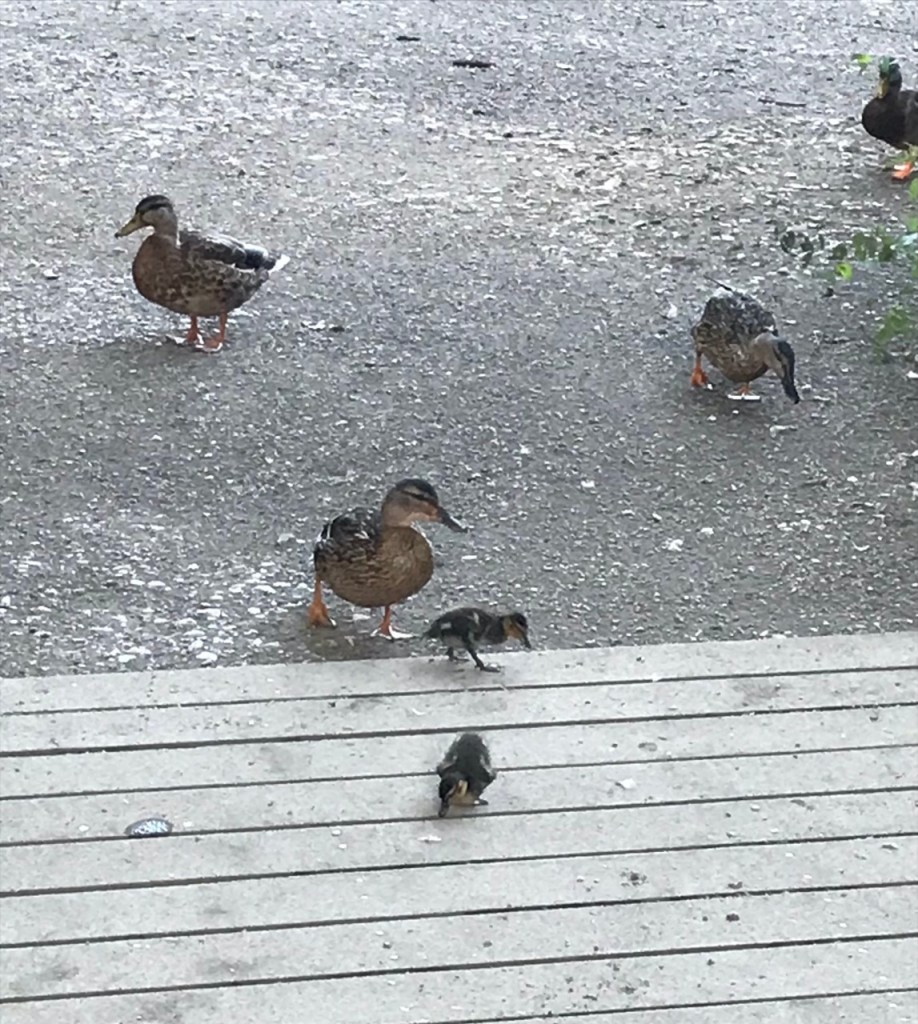
The drab grey female Mandarin Ducks struggled to blend in with the abundant Mallards, being very different in size, build and plumage. And the Mallards were everywhere, emerging from the shrubs about the lakes edge, swimming and tussling in the shallows, perching and overseeing from the branches stretching out into the water or just lazily strolling about around the bench. Ducklings, all yellow, brown and fluffy, followed their parents obediently. Coots, with their white-knobbed foreheads and jet black bodies, darted in between the ducks, and a Moorhens bubbling call declaring its arrival. And there must have been about 20 Coots just paddling about the central water, milling about while a pair of Great Crested Grebes fished in the deeper water, one adult and one younger bird, with the striped head that made it so appealing.
Just then, a flash of blue streaked through the view of my binoculars, and they flew from my eyes; just as a Kingfisher zoomed out of view behind the reeds, its blue plumage looking surprisingly like the House Martins backs thanks to the suns light. The binoculars I carried currently had no strap, owing to them only being unboxed a couple of days ago, my prize for the Zeiss Young Birder Awards. They were compact and light, with good grip, and the focusing wheel was slick and easy to rotate. The field of view was shockingly wide, making it a lot easier to scan the trees and the lake. Long story short, they were brilliant, a huge upgrade to what I had before. The Zeiss Terra EDs are a good all-round binocular , and highly recommended from me.

We continued down the path, attempting to keep footsteps quiet. But it wouldn’t have mattered, as the Drumbridges Roundabout was as busy as ever, just across the country park. But one bird managed to make itself heard over the racket, one so secretive it never revealed itself. But the harsh squawking was easily identified as Britains most cautious corvid, the Jay. And we immediately saw the reason for its alarming calls, as we were stopped in our tracks and stared at an adult Buzzard, just sat right in front of us, on a prominent tree stump that rose above the undergrowth. Now we understood why the Jay was calling, because of this monstrous yet elegant raptor that was now taking flight! It spread its rich brown wings and glided away over the trees. And finally, the Jay fell silent. Quite the encounter!
As we crossed the bridge over one of the many streams that fed the lake, a couple told us that they had sighted the Kingfisher once again, down on the far side of the lake, with two youngsters that were being taught how to fish! I went ahead, walking as quickly and quietly as I could but when I got there, the corner of the lake where a huge fallen tree dominated the shallows, they were nowhere to be seen. Oh, well. At least we had seen it briefly at the start.
We continued on, but failed to see much else of note, excepting the huge numbers of Coots out there. If I had stopped to count them all, I bet I would have gone past 40! The feeder was empty, so nothing much stirred up on the boardwalk except for a Magpie that hopped from branch to branch, squawking savagely. But something seemed a little off. We had gone through this whole trip without seeing a single Mute Swan, when at this time of year they should be out on the lake with their cygnets. But the riddle was soon solved as we watched a lone female Tufted Duck swagger amongst the Coots.
A huge white bird was squatting among the reeds, and soon put in an appearance, but with no others in sight. It was concerning, but in the end, everything turned out to be okay, as we rediscovered another adult with six cygnets paddling about a quiet corner of the lake, almost out of view to the naked eye. And we were put at ease as we walked to our final destination, the hide. The Kingfisher failed to put in another appearance, but just as we watched the distant Grebes, a large Grey Heron flew at eye level past the wooden room, before dropping into the reeds.
Rather a good way to round off such a productive trip, wouldn’t you say? Although, most of our trips to Stover have been productive. My life list for the place is now at 59 species, which is not bad for a lake and some woods, next to a main road and nearly always filled with busy people on trips and picnics. Hopefully I will be able to grow this list as we continue to go to Stover Country Park.

