
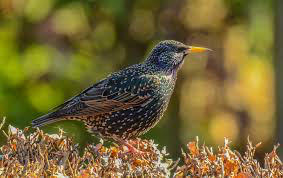
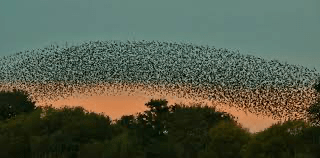
Many people regard the Common Starling as a rather common bird, swarming garden bird baths before anybody else can get a look-in, and crowding out electricity pylons on many an evening. But one thing they do sets them apart from all other birds and animals. They produce one of nature’s most awe-inspiring, beautiful, confusing phenomena. A murmuration.
A swirling, twirling, curling cloud of glossy black, interspersed with rays of evening sunlight shining through. Each Starling moving as if in unison, with the organisation of a military march, and the spectacle of a circus. A hypnotic dancing display, which we don’t really fully understand. It could be anything really, and we are yet to find a solid answer. But one is quite clearly for certain, and that is that this natural wonder of the world is truly breathtaking.
So, what do we know? Well, one thing that’s for definite is that these murmurations happen at a similar time every day, at dusk before the Starlings settle down to roost. They begin to happen from about November into early March, so that’s another piece of evidence. They only really happen in noticeable numbers during the colder months, and the best murmurations can usually be viewed during December and January. The latter is probably because of the fact that during the winter, our resident starlings are supplemented by thousands of others from the continent.
What is really surprising is that there is no leader for a flock of starlings in a murmuration. Unlike a migrating flock of geese, there is no bird to direct proceedings. And yet, they all stay in sync without fail. So what forces are at work there? Also, unlike a flock of geese, this offers no aerodynamic advantage. So why do they do it? These are just two of the questions that remain of our understanding of this natural phenomenon.
So, first of all, why do Starlings murmurate? Many scientists are of the opinion that it attracts other Starlings in the surrounding area, to add to the current flock’s numbers. There are several advantages to this; spending the night together increases body heat and keeps out the colder, for example. And it reduces the chance that an individual will be picked off overnight by a predator like an owl or a marten. Safety and warmth in numbers, after all.
Another theory is that their murmurating is an intimidation tactic, the starling’s way fo scaring away potential predators. After all, a massive flock of birds looming and forming into humongous different shapes is unsettling at best, if you don’t know what you’re looking at. Another, often separate part of this idea is that a murmuration is triggered by the approach of a predator such as a hawk or a falcon, and is a defensive mechanism.
These incredible happenings aren’t only beautiful to look at. In 2022, researchers and scientists in Italy undertook the most detailed analysis ever of these aerial acrobats. They came up with a mathematical model and cross referenced it with real-life birds, before simulating it artificially. The fact that these birds all imitate their neighbours within a murmuration could pave way for new science that has the potential to track space debris!
So yes, there is a lot of evidence that Starlings do this by mimicking the birds immediately around them. The lucky number appears to be seven, with any one individual following the seven Starlings closest to them. Sounds easy enough right? Well bear in mind the three principles a Starling must adhere to when partaking in a murmuration. The first, the attraction zone, means that in an area, you move towards the next bird. The second is the Repulsion Zone AKA don’t fly towards there, or you’ll go into another bird and you’ll both fall. The third and final rule is Angular Alignment, to follow your neighbour’s direction. And that, in a nutshell, is how they do it.
In my birding experience, I have had limited luck with Starling murmurations, although not for want of trying! We’ve gone all over Devon trying our luck, but we’ve just never been in the right place at the right time. It doesn’t discourage me though, and this winter I plan to go looking at every opportunity!
So, in the above blog post, I have tried my hand in explaining an almost unexplainable topic. Without all of the evidence that only evolution knows at this time and climate, we have no way of fully understanding the mythically tantalising Starling murmuration. Science is well on the way to understanding it however, and has formulated theories that definitely might be how it actually works.


2 thoughts on “Murmatory Mutterings: The Science Behind Murmurations”