
Up the hill in Hennock, the garden had us all in heavy coats and jumpers. But it was a still evening, and the sun was suspended low in the sky. It was cloudy. Very cloudy. We could barely see the sun. Yet that didn’t discourage some, and a recurring cascade of notes erupted from deep within the hedge to our left. To be honest, after a few moments, I just had to use the Merlin app on my phone, as I could not seem to recall the sound to memory. Then I was kicking myself. It was, in fact, a Song Thrush.
The snail butcher. The shell smasher. The positive plonker of Thrushes. It goes by many names, but Grandad then told us that it had been going for a few days up here. And he certainly seemed to admire it, along with me and Daddy. It was definitely comforting, if not slightly eerie in the darkening air.
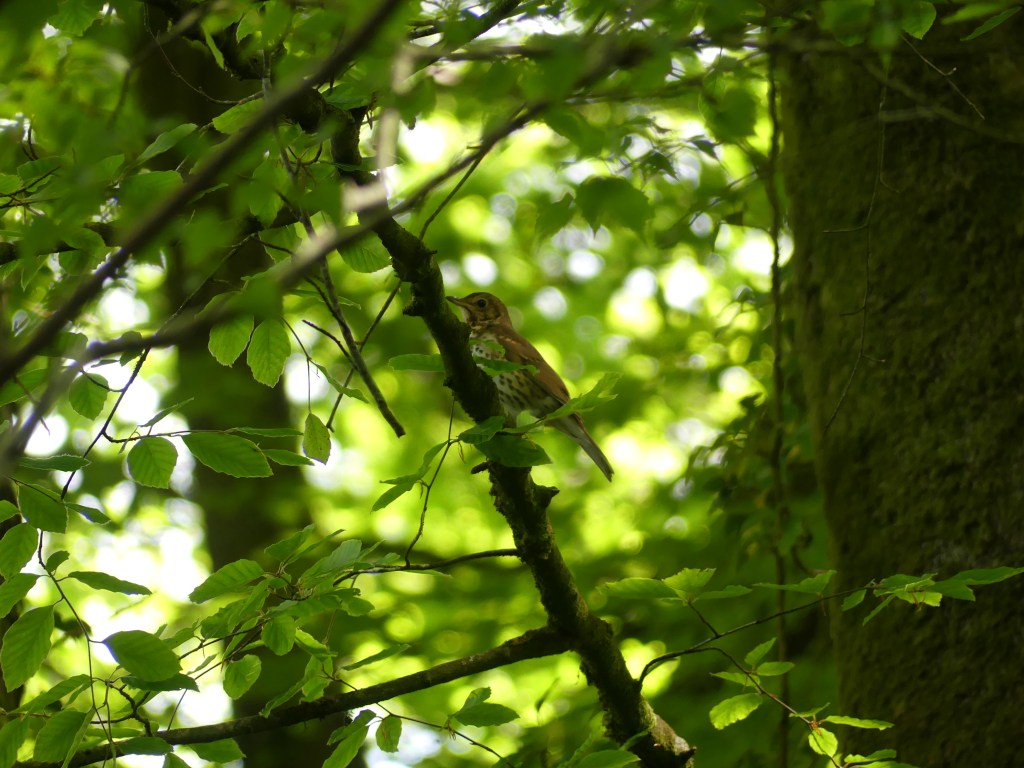
But it was also a huge relief to hear something else singing! Throughout winter, the only song I had heard was that of a Robin. Now don’t misunderstand me here; I love Robins! But after 5 months of hearing nothing but, I think many should be able to relate to my relief. The Robin is one of the few birds that sings throughout the year, due to it being so highly territorial. It chats, scraps and generally enjoys life on its patch. Bar the occasional freezing temperatures, it sounds pretty fun. And then once the warmer months arrive, its mating and breeding time!
And now, many of the other birds are beginning to sing. In fact, you can barely go anywhere without hearing something of a birdsong. From the dawn chorus to the dying evening notes, you can’t get away from it! It will always be there, following you around. So embrace it! Most of the garden birds will be up at daybreak voicing their loneliness, joy or just general content.
Why do Birds Sing?
The Oxford Dictionary describes birdsong as ‘the musical sounds made by birds’. They are not always musical (for example, the Carrion Crow) but birds usually sing for two reasons. To attract a female for breeding purposes, or to protect their territories. In both cases, the male birds (these are often the ones that do the bulk of the singing) aim to show their health and vigour, in both appealing and frightening ways. But that’s not all; new research has shown that when birds sing, they get a buzz out of it, made by the opioids produced by their brain. Pretty cool stuff right? Birds can also get drunk on fruit, but let’s not go too deep into that (for now).
How do Birds Sing?
Birds have the ability to sing thanks to a specialised organ called the syrinx. This is like our larynx (the voice box). This particular air passage splits into two tubes into birds, similar to a y shape. The membranes and cartilage at the junction of this vibrate as the air flows over them, generating the sounds these creatures make. The syrinx, in many songbirds, is around the size of a raindrop, and situated at the bottom of the trachea, right next to the lungs and air sacs. This means more of the air breathed in is used, so the sound is louder and clearer. Also, many songbirds also have hollow bones, to allow their body to hold even more air to improve the sound quality.
Where do Birds Sing?
All songbirds are passerines, which essentially means ‘perching bird’. As you can probably tell from this, birds rarely sing from the ground. If they are up high, the sound travels further and this suits their purposes of either attracting a mate, or discouraging potential rivals. Birds aren’t fussy over these perches, however. As long as they prove prominent and efficient enough, a tree branch, a fence, a rooftop or even a rock will do. Weather is another important factor, as birds are more likely to sing in warmer temperatures. They will still sing in the rain, but are more likely to stay undercover as many of their feathers are not waterproof.
Recent Discovery
Scientists have recently discovered that birds living in urban environments, such as cities, have a louder, farther carrying song in order to be heard above the roads and people that populate these places. Birds in more natural environments generally have a quieter song, as there is little to be heard above. This became very much apparent, as during Lockdown, many city birds adapted to have quieter singing voices, as there was no longer any need for such a loud sound. Cars and people were at quite the premium.

