
Introduction
The Bee-Eater is a species I have only seen once, but has recently been making headlines across the UK, with a small number taking up residency in a Norfolk quarry for consecutive years! Rather exciting, as this species establishing a population in the UK would be simply incredible. They may well turn up next year, in the same spot. They clearly see it as a suitable breeding site, and appear serious. The RSPB have set up a special hide to observe them for both experts and the public alike. If they do appear next year again, maybe we could see a successful breeding attempt? Whilst that would be exciting, this apparent northward advance of its breeding range could also be a bad sign, showing that Climate Change is changing its distribution and pushing it further northwards, which could mean these birds are more vulnerable to the changing UK weather, and will face a longer migration back to Africa if a population is established. A double edged sword – exciting developments, but maybe this is a warning. The whole world needs to be careful now.
Plumage
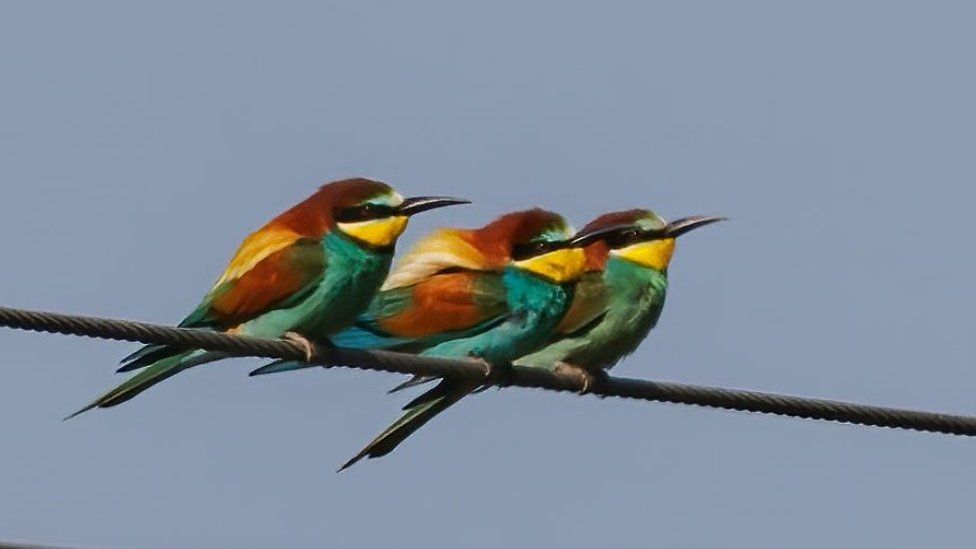
Well, what can I say here? They really are unmistakeable, with males and females having the same contrasting, multicoloured plumage. A red neck and crown, blending into yellow and red on its back. A yellow throat, and a blue and green breast extending down to its belly. They have fairly long tails, and fairly long, pointed beaks for a passerine. The juvenile is similar, but with a browner back and a paler shoulder. But if you do happen to see one, I can almost guarantee you will recognise it.
Diet
Bee-eaters are predominantly insect hunters, with some very refined methods of capturing their prey. As the name suggests, they often take bees, wasps and hornets, but any insects really, including mosquitoes, flies, and similar. Two hunting methods have been observed: one is rather reminiscent of flycatchers, making quick, darting flights from a perch. This is called hawking. While the other involves gliding slowly from a perch and hovering for seconds while catching prey. They are very careful with prey that could pose a threat to it, removing stingers from bees and wasps by repeatedly smashing the creature against a hard surface. A bee-eater can catch and eat around 250 insects a day.
Habitat
Bee-eaters in Europe generally nest in quarries, or areas with extensive sandbanks. A bit like Sand Martins in the UK, they nest colonially in these sandbanks, excavating burrows around a metre long (3.3ft), using their beak to dig and feet to get rid of the excess dirt. Quite the feat for a bird only about a foot long! They will also inhabit the riverbanks, woodlands and sometimes farmland.
Migration
Their migration is a long one, from Europe and across Asia to Sub-Saharan Africa. As I mentioned in the intro, the move up to the UK will extend their migration and add another sea-crossing. Not to mention the unpredictable weather along the route, and the Sahara crossing that must be completed.
Range
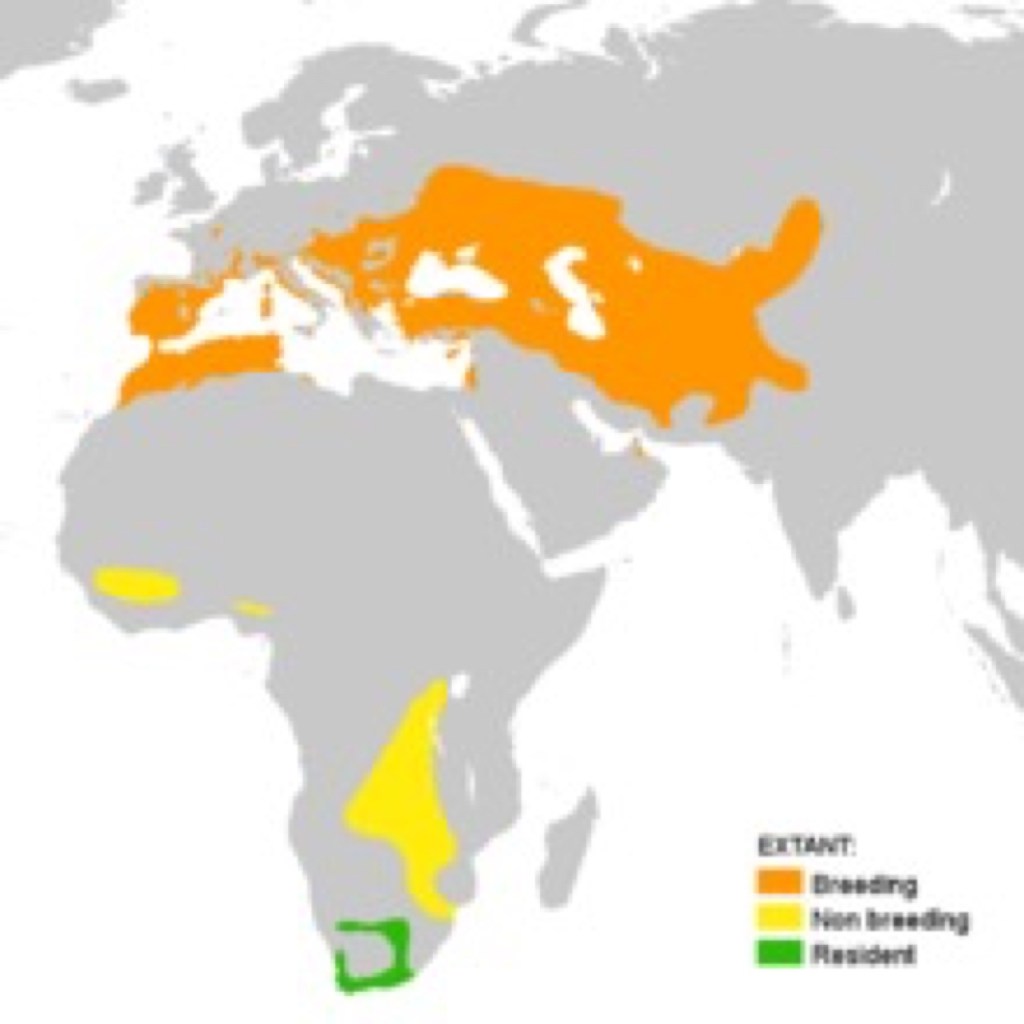
Their breeding range is rather expansive, covering most of Europe, a small part of North Africa and expanding as far east as west China. Their overwintering distribution covers the southern fringe of North Western Africa, stretching from Senegal and The Gambia down to Cameroon, and then further south to Angola, before expanding eastwards into countries such as the DRC, Tanzania and Zambia, before finally reaching eastern South Africa and all in between. There is also a resident, self sustaining population in the west of South Africa, Botswana and Namibia.
British Status
As mentioned above, breeding attempts are regular and have been successful in the past, and there have been seven in the last 20 years. Other than that, they are a regular spring overshoot to the South of England, with multiple birds every year. Spring overshoots are birds, often young and inexperienced, that have overshot their breeding grounds, heading too far north. To find one here is pretty cool, and a nice sight.
And there you have it, another Bird Spotlight, on none other than the incredible Bee-Eater. It really is an amazingly characteristic bird, but it could be a mixed blessing if it did establish a population here in the UK. It is a great sight to see, but Britain has grown used to finding it on the rare (but also regular) occasion, so much that its breeding has created a tidal wave of excitement across the country. But, according to the laws of nature, should it actually be in this country? Would it be able to adapt to our weather, for instance and does our climate supply a sufficient amount of food? Would it be able to find nesting sites, sandbanks and dunes, as development increases?
However, in its original range, the Mediterranean and Southern Europe, sand dunes and banks are commonplace, despite these habitats being in decline globally. But there is still a vast difference in the amount compared to the UK, and the little we do have are swarmed by tourists in the breeding season, and eroded by humanity’s constant draw to the beach and these sensitive and crucial environments. But yet it all comes down to one thing, and it is not difficult to guess. And this reason, is of course, the human race’s desire to put our own needs and wants above those of nature.

