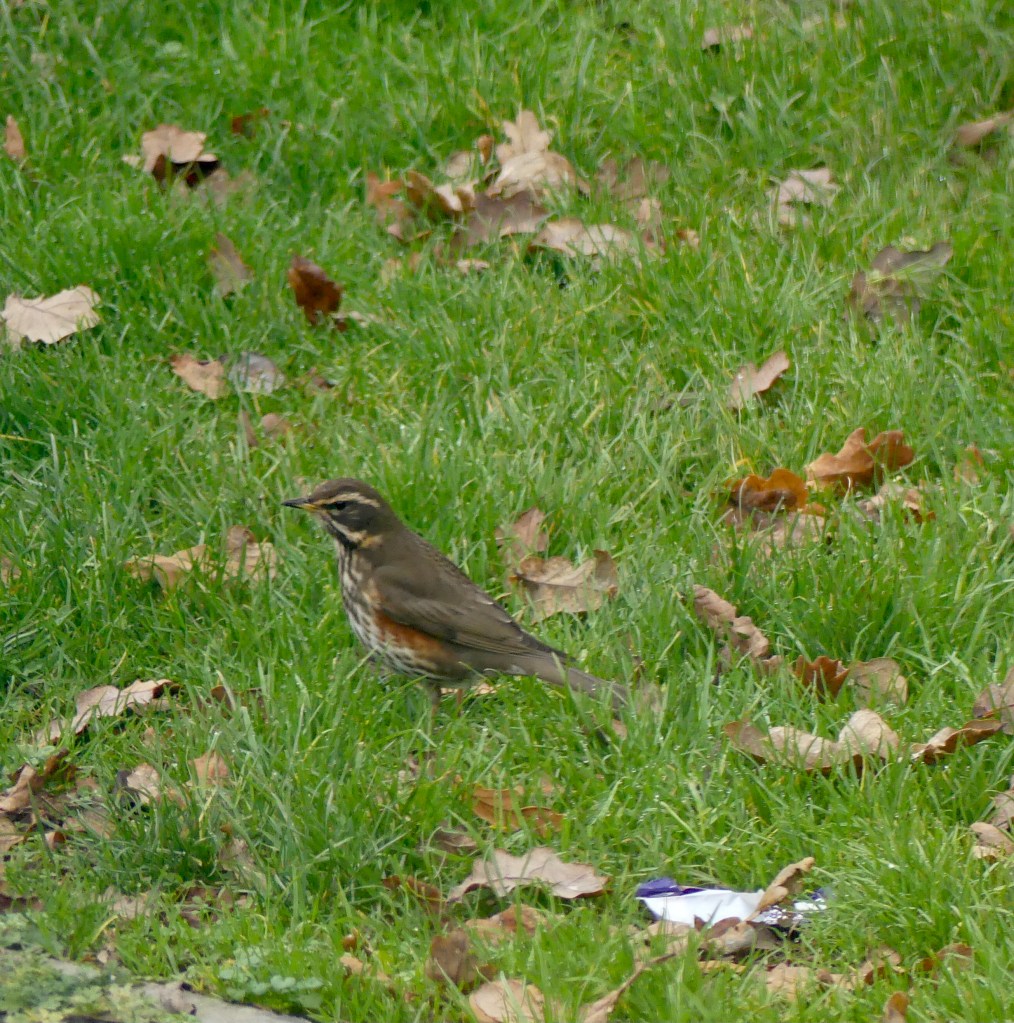
On returning home from an enjoyable day out, I head for the stairs and into my room. By default, I glance down through the window. A few birds were hopping about, occasionally turning over grass with their beaks. One was definitely a blackbird and the next caught my eye. Clutching my binoculars, I focus in but the bird had turned around so all I could see was it’s back and tail. However, it soon bounded around in an arc and began savaging the soil. It had a spotted breast. Except the speckles were not rounded, but in the form of arrows. It was a Song Thrush, one of the birds I don’t often see near my house.
The third one bore some resemblance to the Song Thrush, until it showed a rust-coloured segment of its wing. A tell-tale feature of none other than the Redwing. At first this came as a bit of a shock. I knew they were in the area, having found one dead some time ago. But I had never seen one alive! Arriving along with Fieldfares from the north, they stay in Britain for this part of the year due to our milder winters. There is a minute breeding population.the plumage difference between the Fieldfare and the Redwing is striking. The Redwing bears similarity to the Song Thrush, whereas the Fieldfare has proportions of its plumage coloured grey.
Simply marvellous.